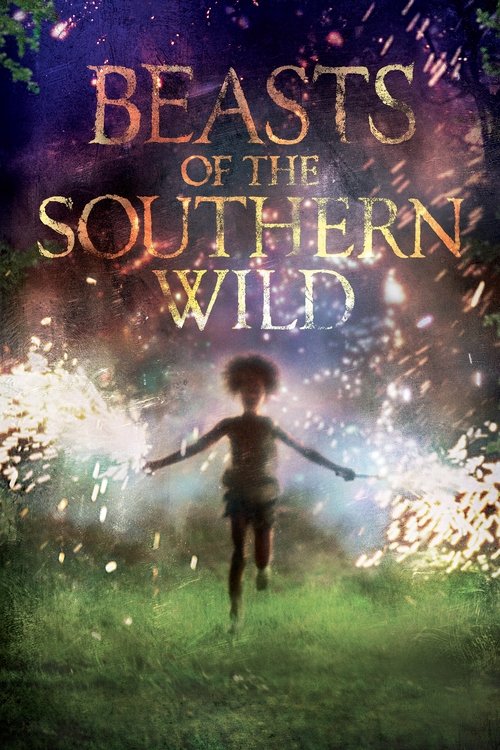
Beasts of the Southern Wild
2012 · Benh Zeitlin
For when you want to feel something big — a film that will probably make you cry and somehow leave you braver for it. Emotionally demanding, but the kind of challenge that pays you back.
What it's about
Six-year-old Hushpuppy lives with her fierce, ailing father in the Bathtub, a ramshackle bayou community on the wrong side of the levee, where life is poor, wild, and defiantly celebratory. When a storm floods their world and her father's health falters, she starts to see the whole universe coming unglued — melting ice caps, ancient beasts on the march — and decides she has to hold it together herself.
The experience
Raw and rapturous at once: handheld, muddy, loud with fireworks and crab boils, then suddenly tender enough to wreck you. It sweeps you along on a child's logic, where grief and myth are the same size.
Performances
Quvenzhané Wallis, cast at five and six years old, carries the entire film with a ferocity that earned her an Oscar nomination — one of the great child performances. Dwight Henry, a New Orleans baker with no acting experience, matches her as the father, all rough love and fear.
The craft
Shot on grainy 16mm in the real Louisiana wetlands by a scrappy New Orleans collective, it looks handmade in the best way — you can feel the humidity. The surging, homemade-sounding score (co-written by the director) does half the emotional lifting, and the fantasy creatures were built practically, which is why they feel dreamed rather than rendered.
Why it matters
The indie sensation of 2012 — Sundance's Grand Jury Prize, the Caméra d'Or at Cannes, four Oscar nominations including Best Picture — and proof that a micro-budget regional film could crash the biggest stage.
Snapshot
Beasts of the Southern Wild is the feature debut of Benh Zeitlin, a fantastical drama filtered entirely through the consciousness of Hushpuppy, a six-year-old girl raised by her ailing father in an isolated bayou community cut off from the mainland by a levee. Adapted from Lucy Alibar's one-act play Juicy and Delicious, the film fuses social realism — poverty, environmental catastrophe, a defiant fringe community — with mythic fantasy, as melting ice caps loose prehistoric aurochs that march toward Hushpuppy across the film's emotional landscape. Made on a modest budget by the New Orleans–based collective Court 13 and shot on 16mm in the Louisiana wetlands, it became one of the signal American independent successes of its decade: Grand Jury Prize at Sundance, the Caméra d'Or at Cannes, and four Academy Award nominations, including Best Picture, Best Director, and a historic Best Actress nomination for Quvenzhané Wallis, the youngest ever in that category. Its reputation rests on a rare combination — vernacular, near-documentary texture married to an unembarrassed cosmic imagination — and its reception was admiring but not unanimous, with a substantial counter-current questioning its politics of poverty and place.
Industry & production
The film originated outside the conventional development system. Zeitlin and his collaborators worked through Court 13, a filmmaking collective that had coalesced in New Orleans in the years after Hurricane Katrina and operated with a communal, craft-built ethos rather than a studio production-line model. The project grew from Lucy Alibar's stage play, which she and Zeitlin reworked into a screenplay relocating the material to the Louisiana Gulf. Financing came largely through independent channels — Cinereach, a nonprofit production company and foundation, was a central backer, with the film developed in part through labs and grant support associated with that independent ecosystem. Reported budgets place the production in the low single-digit millions; precise figures vary across sources, so the safest claim is simply that it was made cheaply by industry standards.
Production was concentrated in Terrebonne Parish in southern Louisiana, with the fictional "Bathtub" assembled from real bayou locations (Montegut is commonly cited as a principal site). The cast was built around non-professionals discovered through open calls: Quvenzhané Wallis was cast as Hushpuppy years before the legal minimum age the production had advertised, and Dwight Henry, who plays Wink, was a New Orleans baker with no prior acting career. Fox Searchlight acquired distribution rights following the film's Sundance premiere in January 2012, releasing it in the United States that summer. The acquisition-after-festival path — discovery, prize, distributor pickup, awards run — is the textbook independent trajectory, and Beasts is one of the cleaner exemplars of it from the early 2010s.
Technology
Beasts of the Southern Wild was shot photochemically on 16mm film, a choice central to both its look and its production logic. The grain, latitude limits, and tactile imperfection of 16mm gave the imagery a weathered, handmade quality consonant with the world being depicted, and the relatively compact, rugged nature of 16mm gear suited a production working in mud, water, and small boats. The film was largely handheld, prioritizing mobility and responsiveness over the stabilized precision that heavier digital or large-format rigs would have imposed. The production's effects are overwhelmingly practical and in-camera: the aurochs were realized through physical means — reports describe trained animals costumed and scaled through forced perspective rather than fully computer-generated creatures — keeping the fantastical elements grounded in the same photographed reality as the human drama. This practical, analog orientation is not incidental; it is the technological expression of the collective's build-it-by-hand method, in which sets, props, and the floating dwellings of the Bathtub were fabricated by the same community making the film.
Technique
Cinematography
Ben Richardson's camerawork is the film's defining formal signature and earned him significant attention as a debut feature cinematographer. The visual strategy is consistently child-scaled: the camera frequently sits low, near Hushpuppy's eye level, and the handheld framing privileges proximity, fragments, and felt detail — sparks, water, fur, firelight — over establishing geography. This produces a subjective, sensory immediacy that keeps the spectator inside the protagonist's perception rather than surveying her world from outside. Natural and available light dominate, and the 16mm grain lends warmth and texture to the bayou's greens, browns, and firelit oranges. The handheld restlessness can read as documentary urgency, but it is carefully shaped toward lyricism, especially in passages of celebration and reverie. The result is a cinematography of intimacy and texture rather than spectacle, even when the narrative reaches for the apocalyptic.
Editing
Cut by Crockett Doob and Affonso Gonçalves, the film moves associatively as much as causally. Hushpuppy's voiceover threads otherwise discontinuous images into an emotional logic, and the editing routinely favors mood, rhythm, and juxtaposition — the intercutting of the advancing aurochs with the human story being the clearest structural device. Montage compresses time and folds memory, premonition, and present action together so that the fantastical and the literal share a single continuous register. The pacing alternates between propulsive, percussive sequences and slower passages of contemplation, and the assembly's willingness to let images stand for feeling rather than information is a large part of why the film reads as poem as much as plot.
Mise-en-scène / staging
The Bathtub is a triumph of constructed-but-found production design: dwellings cobbled from salvage, a truck-bed boat, bonfire gatherings, livestock among the houses. The staging emphasizes communal life and improvised abundance against material poverty, so that the setting reads as chosen and defended rather than merely endured. Compositions tend to embed Hushpuppy within environment — surrounded by water, animals, debris, and other bodies — reinforcing her continuity with the natural world that the narrative makes explicit. The physical world feels lived-in because much of it genuinely was built and inhabited by the production, and that authenticity of texture is inseparable from the film's meaning.
Sound
Sound design works to dissolve the boundary between the human and natural worlds: water, insects, animals, weather, and fire form a dense, enveloping bed, and the recurring motif of listening — Hushpuppy pressing her ear to chests and shells to hear heartbeats — makes hearing a thematic act. The score, composed by Dan Romer and Zeitlin himself, is built on surging strings, folk and brass textures, and accumulating ostinatos that swell toward ecstatic release. The music is anything but background; its rising, anthemic momentum is one of the principal engines of the film's emotional effect, and it became among the most discussed and imitated aspects of the picture's sensibility.
Performance
The film's power is inseparable from two non-professional performances. Quvenzhané Wallis, around six during production, carries nearly every scene as Hushpuppy with a gravity and self-possession that critics found astonishing; her Best Actress nomination made her the youngest nominee in the category's history. Dwight Henry, as Wink, plays a father whose love is expressed through harshness — preparing his daughter for a world in which he will not survive to protect her — and his rawness and physical conviction anchor the fantasy in genuine grief and tenderness. The decision to cast from the community, and to draw performances through environment and circumstance rather than technique, is fundamental to the film's claim of authenticity.
Narrative & dramatic mode
The narrative is organized as a child's mythologized coming-of-age, told retrospectively and subjectively through Hushpuppy's voiceover. Its dramatic mode is magical realism: the literal facts of illness, flooding, and abandonment coexist, without hierarchy, with the cosmological — the universe coming "unstuck," ice caps melting, aurochs released from the ice to bear down on the Bathtub. These creatures function less as plot agents than as externalized figures of mortality and fear, converging on Hushpuppy in the climactic confrontation where she faces them down. The structure is episodic and associative rather than tightly plotted, moving through set pieces — the storm, the levee, the evacuation shelter, the floating bar, the search for the mother — that accrue emotional rather than mechanical causation. The film consistently privileges feeling and image over exposition, trusting the child's-eye logic to bind disparate registers into one.
Genre & cycle
Beasts sits at the intersection of several lineages: the lyrical American independent drama, the magical-realist fable, the child's-perspective film, and the eco-apocalyptic imagination. It belongs recognizably to a post-Katrina cycle of work reckoning with the Gulf Coast, disaster, and the precarity of marginal communities, even as it abstracts its setting into the fictional Bathtub. Within the early-2010s indie landscape it stands alongside other festival-launched, formally adventurous, non-professional-cast features, and it helped consolidate a strain of American filmmaking that paired Malick-inflected lyricism with vernacular, regional grounding. Its fantasy element keeps it from pure social realism, while its rootedness in real poverty and place keeps it from pure fable — the productive tension that defines the film.
Authorship & method
The film is best understood as both an auteur debut and a collective production. Benh Zeitlin directed, co-wrote, and co-composed, and his sensibility — earnest, mythic, rhapsodic — saturates the work; it announced a distinctive voice, even as his subsequent output remained sparse (his next feature, Wendy, did not arrive until 2020). Lucy Alibar, author of the source play Juicy and Delicious and co-writer of the screenplay, is the narrative's originating imagination and Zeitlin's essential creative partner. Cinematographer Ben Richardson translated the conception into its grainy, child-level visual language. Composer Dan Romer, co-writing the score with Zeitlin, supplied the surging music that is among the film's most identifiable elements and the start of a continuing Romer–Zeitlin collaboration. Editors Crockett Doob and Affonso Gonçalves shaped the associative structure. Underpinning all of it is Court 13, the collective whose communal, hand-built method — fabricating the world, casting from the community, working with practical effects — is itself a kind of authorship, and arguably the film's deepest signature.
Movement / national cinema
The film is firmly American independent cinema, but of a regionally specific and collectively produced variety rooted in post-Katrina New Orleans. It is less a product of the coastal independent establishment than of a localized, DIY filmmaking culture, and its national-cinema significance lies partly in how it foregrounds a marginal American place and people rarely centered on screen. At the same time, its aesthetic is cosmopolitan and cinephilic, drawing on European and global art-cinema traditions of lyricism and magical realism; its strong reception at Cannes underscored that it was legible within an international art-film frame as much as a domestic indie one.
Era / period
Arriving in 2012, the film is very much of its moment. It emerges from the post-2008 American independent surge in which festival discovery and specialty-label distribution (here Fox Searchlight) offered small films a path to wide visibility and awards recognition. It is steeped in post-Katrina consciousness — vulnerability, displacement, the abandonment of poor communities by larger systems — and in the period's intensifying anxiety about climate change, which it renders as melting ice and rising water. Technologically it sits at the tail end of widespread 16mm origination, its analog texture already a deliberate aesthetic statement as the industry completed its shift to digital capture. It captures a cultural instant when ecological dread, economic precarity, and a hunger for the handmade converged.
Themes
The film's central themes are mortality and inheritance: Wink's project is to teach Hushpuppy how to survive his death and the unraveling of her world, and her arc is the acquisition of fearlessness in the face of that loss. Tightly bound to this is the relationship between humanity and nature — Hushpuppy understands herself as a piece of a vast interconnected order, "a part of the big universe," and the film insists on continuity rather than separation between people, animals, weather, and cosmos. Other persistent strands include community and defiant self-determination (the Bathtub residents' refusal of evacuation and assimilation, their dignity in poverty); ecological catastrophe as both literal and mythic event; and the resilience and interiority of a child confronting forces far larger than herself. The recurring motif of the heartbeat — life as something one can hear, hold, and lose — gathers these concerns into a single image.
Reception, canon & influence
Critically, Beasts of the Southern Wild was among the most celebrated films of 2012. It won the Grand Jury Prize for U.S. Dramatic competition at Sundance and the Caméra d'Or for best first feature at Cannes, an unusually strong festival double, and went on to four Academy Award nominations — Best Picture, Best Director, Best Adapted Screenplay, and Best Actress — a remarkable haul for a micro-budget debut. Wallis's nomination, as the youngest in the category's history, became a defining part of the film's story. Yet acclaim was accompanied by serious critique: a notable strand of commentary questioned the film's representation of poverty and race, debating whether its romanticization of the Bathtub aestheticized deprivation or condescended to its subjects. That debate is part of the historical record and should be acknowledged alongside the praise.
The influences flowing into the film are several and frequently noted: the lyrical, voiceover-driven, nature-suffused cinema of Terrence Malick; the tradition of literary and cinematic magical realism; and the child's-perspective imagination of works like Maurice Sendak's Where the Wild Things Are, with its monstrous yet intimate creatures. Critics have also reached for Hayao Miyazaki's ecological fantasy and for the rough, ecstatic energy of certain world-cinema folk traditions as touchstones; these are interpretive comparisons rather than documented direct sources, and should be treated as such.
Looking forward, the film's legacy is real if diffuse. It helped validate a strain of American independent filmmaking marked by regional rootedness, non-professional casting, practical fantasy, and surging, anthemic scoring — and the Romer–Zeitlin musical sensibility in particular proved widely admired and echoed. It launched Quvenzhané Wallis as a significant young performer and established Zeitlin as a singular, if deliberately unprolific, voice. Beyond specific careers, it stands as a touchstone for the early-2010s independent moment: proof that a hand-built film from a collective on the Gulf Coast could reach the center of international film culture, while also serving as a continuing case study in the ethics of representing poverty and place on screen.
A Deleuzian reading
Hushpuppy holds a baby animal up to her ear and listens for its heartbeat.
The full Deleuzian reading of Beasts of the Southern Wild →
Reception
The 2012 indie fairy tale — Sundance Grand Jury Prize, Camera d'Or at Cannes, four Oscar nominations including Best Picture — that has since cooled into a time capsule; what was hailed as a miracle then now gets a more ambivalent 'peak Obama-era Sundance' shrug.
How Beasts of the Southern Wild was received, from release to now →
Influences: the films it descends from and the films it influenced
- Days of Heaven (1978) — Establishes the magic-hour natural-light cinematography and the child's-voiceover-over-lyrical-montage structure that the dossier names as Beasts' core Malick debt.
- The Tree of Life (2011) — The direct contemporary model for fragmentary associative editing shot from a low, child-eye-level camera that fuses domestic intimacy with cosmic/natural scale.
- The Spirit of the Beehive (1973) — Filters rural poverty through a small child's magical-realist perception, where an imagined monster becomes emotionally literal — the template for Hushpuppy's aurochs.
- The Night of the Hunter (1955) — Southern-gothic fairy tale staged as a child's frightened, expressionist vision of a hostile adult world, the American-myth register Beasts adopts.
- Pather Panchali (1955) — Lyrical, natural-light observation of childhood inside poverty using a non-professional cast immersed in landscape and weather rather than plot.
- The 400 Blows (1959) — Founds the child-coming-of-age built on an untrained young lead and a roving, intimate handheld camera that stays at the kid's level.
- George Washington (2000) — Transplants Malick's lyricism and associative child-voiceover directly onto the impoverished American South with a non-professional child cast — the immediate domestic precursor.
- Where the Wild Things Are (2009) — Renders hand-built, practical-effect monster creatures intimate by governing them through a child's emotional logic rather than spectacle.
- My Neighbor Totoro (1988) — The animist ecological fantasy the dossier cites, where a child's wonder conjures benign-monstrous nature spirits as ordinary fact.
- Time of the Gypsies (1988) — The ecstatic folk magical-realism — surging communal energy and brass-driven anthemic scoring — that critics reach for in Beasts' Bathtub revels.
- To Kill a Mockingbird (1962) — Cinematographer Ben Richardson maintains the child-height low-angle framing as an unwavering compositional principle, rendering the adult world as literally looming; Quvenzhané Wallis's debut physical stillness—somatic, unlearned restraint rather than trained technique—directly descends from the non-actor performance mode Mulligan elicited from Mary Badham.
- Aguirre, the Wrath of God (1972) — Ben Richardson's handheld natural-light cinematography with wide-angle distortion, an entirely non-professional cast including a six-year-old lead performing in the register of controlled emotional excess, and Dan Romer's ambient scoring deploy the Aguirre grammar of psychological location filmmaking, displaced from the Amazon to the Louisiana bayou.
- The Florida Project (2017) — A child's-eye view of romanticized American poverty using non-professional casting and found locations, inheriting both the method and the aestheticizing-deprivation debate.
- The Rider (2017) — Non-professionals playing versions of themselves inside a natural-light Western landscape with Malick-lyric handheld — the regional-rootedness strain Beasts helped validate.
- Beasts of No Nation (2015) — Carries the Dan Romer collaboration forward: a child's-eye war rendered as myth over Romer's surging, anthemic score.
- Wendy (2020) — Zeitlin and Romer reunite to rework child-fantasy myth on the Gulf with non-professional kids and practical wonder — the lineage's self-continuation.
- The Fault in Our Stars (2014) — Cinematographer Ben Richardson's naturalistic available-light, handheld, shallow-focus visual grammar is the same identity he transposes onto Fault.
- Where the Crawdads Sing (2022) — Shares screenwriter Lucy Alibar and her feral-wilderness-child grammar — a marsh-dwelling outsider observed at ground level, nature filmed as kin rather than backdrop — which Alibar transplanted almost wholesale into Kya's bayou.
- Winter's Bone (2010) — Same Sundance-era regional naturalism: a young girl navigating a harsh, specific American backwater shot with local non-professional supporting players.
- Ballast (2008) — Mississippi Delta drama built from non-professional locals, available light and handheld framing — the contemporaneous Gulf-South found-realism mode.
- Mud (2012) — Arkansas-river child's-eye coming-of-age that mythologizes a working-class Southern waterscape in the same year and register.
- My Father's Shadow (2025) — A non-professional child lead carried on handheld grain and voiceover that mythologizes memory, using contrast of scale to set one small figure against a vast threatening world.
- The Mysterious Gaze of the Flamingo (2025) — Anchors magical realism in a marginalized community seen through a child's mythologizing eyes, the child-POV-plus-fantastic synthesis the seed shares.
- Capernaum (2018) — Six-year-old non-professional girl as sole narrative focalizer in a community facing displacement, with handheld child-eyeline immersion and editing that constructs ethical argument through sustained close-up on a child's face; shares Capernaum's formal grammar even as its mythopoeic register differs from Labaki's social realism.
- Short Term 12 (2013) — Contemporary breakout of a nonprofessional child performance carried by handheld immersion inside a kid's emotional reality, a 2010s indie sibling in method and Sundance moment.
- Summer 1993 (2017) — Builds an entire film on a nonprofessional child's sensory, ground-level experience of loss and an elemental rural place, prioritizing observed physical immediacy over explanatory plot.
- System Crasher (2019) — A feral non-professional child lead whose fierce interiority is carried by flare-lit, saturated, handheld lyrical subjectivity and wonder rather than pity.
- Nickel Boys (2024) — Anchors its Southern world to a child's-eye handheld POV and mythic voice-over, sharing Nickel Boys' ground-level embodied perspective on a young Black protagonist.
- Room (2015) — Uses a young child's voiceover to reframe material hardship as personal cosmology, the same mid-2010s indie device by which Jack's narration mythologizes his confinement.
- My Sweet Orange Tree (2012) — A same-year sibling built on a poverty-bound child narrator whose imaginative, mythologizing voiceover transmutes deprivation and a parent's mortality into an elegiac survival cosmology.
Similar films
- The Tree of Life (2011) — influence & lineage
- Flow (2024) — shared sensibility
- Moonrise Kingdom (2012) — shared sensibility
- Little Amélie or the Character of Rain (2025) — shared sensibility
- The Shape of Water (2017) — shared sensibility
- Life of Pi (2012) — shared sensibility
- The Revenant (2015) — shared sensibility
- Boy & the World (2014) — shared sensibility
All the films related to Beasts of the Southern Wild →