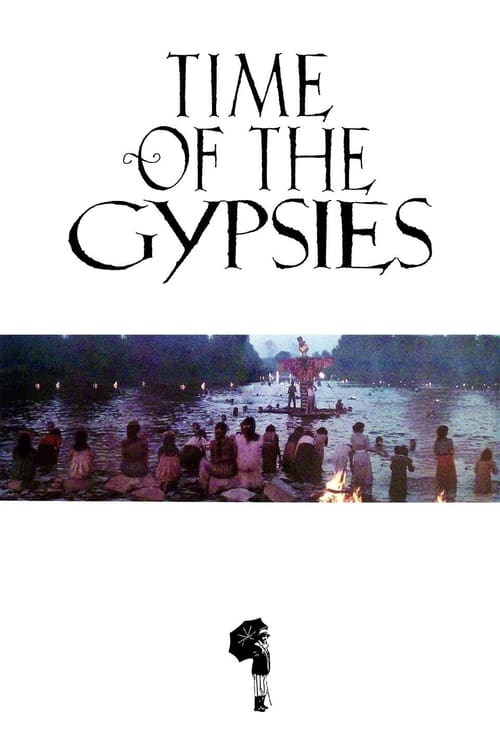
Time of the Gypsies
1988 · Emir Kusturica
For when you want to be swept into a teeming, unfamiliar world and don't mind laughing and grieving in the same scene — a maximalist epic for a patient night, closer to challenge than comfort.
What it's about
In a Roma village in Yugoslavia, Perhan is a gangly, trusting teenager raised by his grandmother, in love with a local girl, and gifted with a modest telekinetic power he barely understands. When the flashy racketeer Ahmed rolls through promising medical treatment for Perhan's ailing sister, Perhan follows him to Italy — and into a world of begging rings, theft, and exploitation where his innocence becomes currency. It's a coming-of-age story that keeps erupting into wedding feasts, levitations, and dreams.
The experience
Rowdy, sorrowful, and overflowing — brass-band chaos and mud one minute, floating veils and moonlit rituals the next. It's long and unruly by design, and it earns a real emotional wallop; you come out feeling like you've lived a whole life alongside Perhan.
The craft
Kusturica shoots with anarchic energy — crowded frames, animals wandering through scenes, celebrations staged like small hurricanes — while Goran Bregović's score threads a mournful Romani melody through the whole film that you'll be humming for weeks. The magical touches are done in-camera with a handmade, dreamlike quality. It's a film of textures: smoke, rain, feathers, firelight.
Why it matters
It won Kusturica the Best Director prize at Cannes and fixed his reputation as one of Europe's great maximalists, while bringing Roma life — cast largely with Roma non-actors speaking Romani — to world screens on an unprecedented scale.
Snapshot
Time of the Gypsies (original Serbo-Croatian title Dom za vešanje, literally "House for Hanging") is Emir Kusturica's third feature and the film that consolidated his reputation as one of the most distinctive stylists to emerge from late-socialist Yugoslavia. A sprawling coming-of-age tragedy set among Roma communities in Macedonia and among migrant labor and crime networks in Italy, it follows Perhan, a fatherless young man with a gift for telekinesis, as he is drawn out of his grandmother's household by the racketeer Ahmed and gradually corrupted, betrayed, and destroyed. The film is built on a paradox that defines Kusturica's mature work: a documentary-grounded subject — the real trafficking of Yugoslav Roma children into begging and theft rings abroad — rendered through exuberant magical realism, with levitating brides, a beloved pet turkey, and objects that drift through the air. Awarded Best Director at Cannes in 1989 and largely performed in the Romani language by non-professional actors, it is both a landmark of Balkan cinema and a foundational text for the "Gypsy film" as an international art-house category.
Industry & production
The film was produced within the Yugoslav studio system in its final years, before the wars of the 1990s dismantled that infrastructure. Kusturica came to it as a rising prestige director: his debut Do You Remember Dolly Bell? (1981) had won a prize at Venice, and When Father Was Away on Business (1985) had taken the Palme d'Or at Cannes, giving him unusual latitude and international financing access for a director from a mid-sized socialist film industry. Production was centered on the Roma settlement of Šuto Orizari ("Šutka") on the edge of Skopje, then in the Yugoslav republic of Macedonia, with subsequent sequences shot in Italy to stage the migrant-crime narrative.
The project's origins lay in journalism: reporting on the sale and trafficking of Roma children out of Yugoslavia into Western Europe supplied the film's spine, and Kusturica has consistently framed the film as motivated by that documented abuse rather than by folkloric interest alone. The decision to cast largely from within Roma communities and to shoot in Romani was itself a production gamble, requiring the direction of non-actors and complicating the usual controls of a scripted feature. A longer, multi-part television version was later assembled from the material, a common practice in the region that reflected the film's origins in an expansive shoot. Precise budget figures and box-office returns are not reliably documented in the accessible record, and I will not invent them; what is clear is that the film circulated primarily as a festival and art-house release rather than a commercial one.
Technology
The film was shot on 35mm color stock using conventional late-1980s camera technology, with no reliance on the optical or digital effects that would later become standard for "fantastic" imagery. Its most celebrated magical set-pieces — floating figures, hovering objects, the bride lifted into the air — were achieved through practical, in-camera and on-set means: wires, rigs, hidden supports, and careful staging, rather than post-production compositing. This artisanal approach is central to the film's texture; the levitations feel physically present within the profilmic space rather than added afterward, which is precisely why they read as dreamlike rather than as spectacle. The location-heavy production, working in a real settlement and in Italian exteriors, likewise depended on relatively mobile, robust equipment suited to unpredictable conditions and non-professional performers.
Technique
Cinematography
The images were made by Vilko Filač, Kusturica's regular cinematographer and a decisive contributor to the director's visual signature. Filač's work here favors mobile, roving camerawork, deep and often crowded compositions, and a palette that moves between the muddy, rain-soaked earth tones of Šutka and warmer, more saturated registers in the dream and celebration scenes. The camera behaves as a participant in the film's teeming environments, threading through animals, extended families, and clutter, so that the frame is almost never still or empty. This density — the sense of a world overspilling the edges of the image — is a hallmark of the Kusturica–Filač partnership and gives the film its characteristic feeling of a reality perpetually on the verge of tipping into the miraculous.
Editing
The cutting, by Andrija Zafranović, must hold together an unusually elastic structure: naturalistic domestic scenes, criminal intrigue across two countries, and lyrical fantasy interludes. The film's rhythm alternates between sustained, immersive sequences that let chaos accumulate and sharper transitions into reverie and ritual. The recurring St. George's Day celebration on the river, the wedding set-pieces, and the dream imagery are integrated so that the fantastic does not arrive as rupture but as an extension of the same continuous world. The existence of a substantially longer television cut indicates how much footage the edit had to shape, and how much of the film's meaning rests on selection and pacing.
Mise-en-scène / staging
Mise-en-scène is arguably Kusturica's primary expressive tool. The film stages life as a crowded, animal-filled, mud-and-water environment: the turkey, geese, and other creatures move freely through human scenes; the settlement is rendered as a churning collective rather than a set of discrete individuals. Water and rain recur as staging elements, and celebrations — weddings, the riverside feast — become elaborate choreographies of bodies, music, and motion. Against this the fantastic is inserted with deliberate matter-of-factness: a veil or a bride rising into the air is staged within the same continuous space as the mundane, refusing any visual quarantine between the real and the magical.
Sound
The score by Goran Bregović is inseparable from the film's identity and became one of the most influential film-music achievements to come out of the Balkans. Drawing on Romani and wider Balkan musical idioms, Bregović's music — above all the melody associated with the St. George's Day song "Ederlezi" — gave the film an emotional and cultural charge that carried far beyond it. (The authorship and crediting of that melody, rooted in traditional and pre-existing sources, later became a matter of dispute; I flag this rather than adjudicate it.) Beyond the score, the sound design leans into the ambient density of the settlement — animals, crowds, weather — and the film's use of the Romani language for most dialogue is itself a sonic and political choice, one of the earliest sustained uses of Romani in a feature film.
Performance
The film is carried by Davor Dujmović as Perhan, whose transformation from tender, gawky adolescent to hardened, then broken, young man supplies the tragic arc. Bora Todorović plays Ahmed, the seductive and menacing racketeer, with a mixture of paternal warmth and predation that makes the corruption legible. Much of the surrounding ensemble was drawn from non-professional Roma performers, and the film's realism depends heavily on their unforced presence. The direction of non-actors — coaxing sustained, credible behavior rather than trained performance — is a signature Kusturica achievement here, and the mixture of professional leads with a non-professional community lends the film its documentary undertow.
Narrative & dramatic mode
The narrative is a tragic Bildungsroman structured around loss of innocence and moral fall. Perhan begins embedded in a web of familial obligation — a healer grandmother, a sister needing medical treatment, a courtship thwarted by class and family suspicion — and is lured abroad by the promise of help, only to discover that Ahmed's enterprise is exploitation. His gradual complicity, his separation from those he loves, and the deaths that follow drive toward a violent, fatalistic conclusion in which vengeance and self-destruction converge. The dramatic mode fuses social realism with magical realism: telekinesis, levitation, and dream logic operate not as escapism but as the interior register of characters whose material circumstances are otherwise merciless. The film's tonal audacity lies in holding comedy, tenderness, brutality, and the miraculous within a single continuous world.
Genre & cycle
Nominally spanning drama, crime, fantasy, and romance, the film resists clean genre placement, which is part of its point. It borrows the shape of the crime-family saga — a patriarch, a young initiate, betrayals, a climactic wedding-and-reckoning — and grafts it onto a folkloric coming-of-age tale saturated with the fantastic. Within Kusturica's own output it belongs to a loosely continuous cycle of Balkan magical-realist films that would culminate in Underground (1995) and return to Roma milieu in Black Cat, White Cat (1998). More broadly, it helped define an international "Gypsy film" cycle, a category later associated with directors such as Tony Gatlif, in which Romani life becomes the subject of lyrical, music-driven art cinema — a framing that carries both celebratory and problematic implications discussed below.
Authorship & method
The film is a director's film in the fullest sense, but it rests on a stable creative team. Kusturica co-wrote the screenplay with Gordan Mihić, a screenwriter with deep engagement in Roma and marginal subject matter, and the collaboration grounds the film's fantastic flights in specific social observation. Vilko Filač (cinematography) supplied the roving, dense visual style that recurs across Kusturica's late-Yugoslav features. Goran Bregović (music) provided the score that became, for many audiences, the film's most memorable element and a defining sound of the Kusturica brand. Andrija Zafranović (editing) shaped the sprawling material into its final rhythm. Kusturica's method — location shooting in a real community, direction of non-professionals, use of the Romani language, and the staging of magic through practical means — is consistent with his formation at FAMU, the Prague film school, whose blend of humane realism and playful invention marks his sensibility.
Movement / national cinema
Kusturica is the central figure of the internationally visible generation of Yugoslav cinema that followed the earlier, more overtly dissident Black Wave. Trained at FAMU in Prague, he belongs to the so-called "Prague school" of Yugoslav directors whose work married Central European craft to Balkan subject matter. Time of the Gypsies is a Yugoslav (specifically Bosnian-Macedonian) production made near the end of the federal state's existence, and it now reads partly as an elegy for a multi-ethnic world about to be torn apart. It sits at the head of what would become internationally recognized as "Balkan cinema," a category that Kusturica himself did much to define and, for some critics, to burden with a set of exoticizing conventions.
Era / period
Made in 1988–89, the film arrives at the hinge of an era: the last moment of Yugoslav federal cinema before the wars, and the tail end of the Cold War division of Europe. Its very subject — the movement of poor, stateless-in-practice Roma from the socialist periphery into the Western European informal economy — anticipates the migration and exploitation narratives that would dominate the following decades. Aesthetically it belongs to a late-1980s art-cinema moment receptive to magical realism and to non-Western or marginal milieus, and its Cannes success reflected a festival culture eager for exactly this fusion of social gravity and stylistic exuberance.
Themes
The film's central themes are exploitation and corruption: the trafficking of children and the seduction of the vulnerable into criminal dependency, with Ahmed as the figure through whom innocence is monetized. Around this cluster themes of family and obligation, the loss of innocence, and betrayal — of kin, of love, and finally of self. Displacement and migration frame the tragedy, as home and abroad become poles of belonging and ruin. The supernatural motifs — Perhan's telekinesis, the grandmother's healing, the levitations — thematize the persistence of the miraculous within poverty, and perhaps the powerlessness of gifts that cannot alter material fate. Recurring images — water and rain, the pet turkey, coins placed on the eyes of the dead — knit these themes into a symbolic fabric about purity, sacrifice, and the theft of what is sacred, culminating in a final gesture in which even the dead are robbed.
Reception, canon & influence
Critically, the film was received as a major work and won Kusturica the Best Director prize at the 1989 Cannes Film Festival, cementing his standing after the earlier Palme d'Or for When Father Was Away on Business. It was widely praised for its visual imagination, its score, and the ambition of rendering a marginalized community with epic scope, and it has retained a place in discussions of the best European films of its decade. It also attracted a durable line of criticism — voiced by some Roma commentators and scholars — that its poetic-exoticizing lens risks aestheticizing poverty and reinforcing stereotypes even as it condemns the abuse it depicts; this debate is part of the film's canonical standing rather than a footnote to it.
Looking backward, the film's most cited influence is the magical realism of Latin American literature, Gabriel García Márquez in particular, whose fusion of the everyday and the miraculous critics repeatedly invoked; the crime-saga architecture, with its patriarch, initiate, and climactic wedding, invites comparison to the American gangster epic, and Kusturica's cinema more broadly bears the marks of Fellini's carnivalesque and of a Central European lyricism absorbed at FAMU. Looking forward, its legacy is substantial: it opened the international "Gypsy film" as a recognizable art-house mode, powerfully shaped Western perceptions of Balkan cinema, and set the template Kusturica himself would extend in Underground and revisit in Black Cat, White Cat. The Kusturica–Bregović sound, and "Ederlezi" above all, entered world-music circulation and has been widely reused and referenced since. Its use of Romani-language dialogue and a largely Roma cast also stands as a reference point in ongoing debates about who gets to represent marginalized communities on screen — a question the film both advanced and, for its critics, exemplified.
A Deleuzian reading
A bride goes up.
The full Deleuzian reading of Time of the Gypsies →
Reception
It won Kusturica Best Director at Cannes in 1989 and was acclaimed from the start — but its standing has only grown as Kusturica's own reputation has soured, with many fans now treating it as the film of his that holds up best, often ranked above his two Palme d'Or winners.
How Time of the Gypsies was received, from release to now →
How to watch Time of the Gypsies: what to notice on a first viewing
- Watch how plainly the film stages Perhan's telekinesis. Objects and bodies lift and drift within ordinary scenes, no dissolve, no reaction shot of wonder, staged in the same unbroken space as the mud and the geese. Perhan barely moves. When he wants something, the world moves instead, which is exactly the shape of a boy who can't change anything by acting.
- Notice how rarely the camera holds still or empty. Vilko Filač's camera threads constantly through people, animals, and clutter, so the frame stays crowded and moving rather than composed and posed. The density puts you inside a world that is always overflowing its own edges.
- Listen for the recurring St. George's Day melody. Goran Bregović's score, built on Romani and Balkan idioms, returns again and again around the riverside celebration, giving the film its most memorable identity. The music carries the film's warmth and grief in the same tune, long before you can explain why.
- Notice how often mud, rain, and animals share the frame with people. Geese and a pet turkey move freely through human rooms, and water and rain recur constantly across the settlement, blurring the line between household and terrain. The ordinary world and something wilder underneath it are never really kept apart.
- Watch how Perhan's face changes across the film. Davor Dujmović plays him tender and gawky at first, and the performance hardens steadily as Perhan is drawn deeper into Ahmed's world. You can track his corruption in his face before the plot ever states it.
The whole guide to watching Time of the Gypsies, with the keys for a rewatch →
Influences: the films it descends from and the films it influenced
- I Even Met Happy Gypsies (1967) — Founded the Yugoslav 'Gypsy film' by shooting a largely non-professional Roma cast speaking Romani on location, the exact ethnographic-poetic template Kusturica extends.
- Los Olvidados (1950) — Fuses documentary slum poverty with abrupt surrealist dream inserts (the floating, slow-motion oneiric sequence) among real street children — the model for magic erupting inside social misery.
- Accattone (1961) — Sacralizes sub-proletarian outcasts by casting non-professionals and framing them with iconic gravity against location squalor, scored to elevate the marginal.
- La Strada (1954) — Establishes the itinerant carnival-road milieu and casting-for-faces, with a plaintive recurring musical motif carrying the pathos the way Bregović's does here.
- Amarcord (1973) — Episodic small-community fresco built on dense, crowded grotesque-comic compositions and recurring images of practical wonder — the carnivalesque grammar Kusturica absorbs.
- The Godfather (1972) — Supplies the crime-saga architecture of patriarch, corrupted initiate, and climactic wedding set piece that organizes Perhan's descent.
- Closely Watched Trains (1966) — Exemplifies the FAMU/Czech-New-Wave blend of humane realism and deadpan lyrical invention that formed Kusturica's Prague-school sensibility.
- Eréndira (1983) — A direct García Márquez screen adaptation dramatizing an elder pimping a child across a magical-realist landscape — the literary source-mode Kusturica cites made cinematic.
- Mirror (1975) — Achieves levitation and drifting-object imagery through practical in-camera means, the physical-magic technique behind Perhan's floating.
- When Father Was Away on Business (1985) — Immediate precursor pairing Vilko Filač's roving camera with a child's-eye view of a fracturing household — the same craft team and optic.
- Shadows of Forgotten Ancestors (1965) — Inherits the fusion of specific-culture ethnography with visionary folk-magical imagery and a wall-to-wall folk soundscape, rooting cinematic poetry in a bounded traditional community exactly as Parajanov modeled.
- Underground (1995) — Extends the Bregović brass score and unbroken roving-camera bacchanals to national allegory, scaling up the same delirious ensemble staging.
- Black Cat, White Cat (1998) — Returns to the Roma milieu with animal-filled mise-en-scène and wedding-farce choreography, reprising the practical-magic and crowded compositions in a comic key.
- Gadjo Dilo (1997) — Immerses in Romani-language dialogue with a Roma cast and community music-making, carrying forward the art-house Gypsy film Kusturica internationalized.
- Latcho Drom (1993) — Structures the film around Roma music itself, taking the score-as-protagonist idea of the Kusturica–Bregović sound to its logical extreme.
- Slumdog Millionaire (2008) — Builds a magical-realist rags saga on a child-begging and mutilation racket, inheriting both the kinetic aestheticization of poverty and the ethical critique it draws.
- Beasts of the Southern Wild (2012) — The ecstatic folk magical-realism — surging communal energy and brass-driven anthemic scoring — that critics reach for in Beasts' Bathtub revels.
- Queen Margot (1994) — Source of Goran Bregović's ritualistic Balkan-folk scoring method — the very composer and idiom Chéreau imports as the film's anachronistic score.
- Do You Remember Dolly Bell? (1981) — Kusturica's debut coming-of-age already deploys the tender-grotesque family ensemble and adolescent longing that Perhan's bildungsroman darkens.
- Aferim! (2015) — Renders Balkan Roma subjugation through a mobile ensemble camera on location, engaging the same representation-of-the-marginalized debates the film provoked.
- The Lost Letter (1972) — Extends the same song-saturated folk-carnival grotesque and magical-realist picaresque — music woven into the fabric, episodes strung like beads, the devil's-bargain motif — in a Balkan register.
Similar films
- Black Cat, White Cat (1998) — influence & lineage
- When Father Was Away on Business (1985) — influence & lineage
- Underground (1995) — influence & lineage
- La Strada (1954) — influence & lineage
- Satantango (1994) — shared sensibility
- Once Upon a Time in Anatolia (2011) — shared sensibility
- Yeelen (1987) — shared sensibility
- The Best of Youth (2003) — shared sensibility