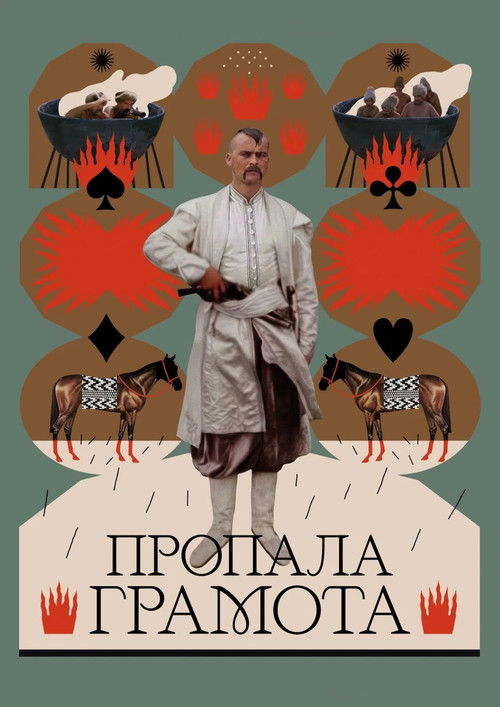
The Lost Letter
1972 · Borys Ivchenko
For when you want something genuinely unlike anything in your usual rotation — a playful, fantastical romp with real folk soul. Easy to enjoy, endlessly odd, great for a curious night when you'd rather be surprised than soothed.
What it's about
Two Zaporozhian cossacks are entrusted with a letter from their hetman to the empress in St. Petersburg, and the road there runs straight through a folk-tale universe: card-playing devils, witches, drinking bouts, and enchantments at every crossroads. It's a rowdy Ukrainian musical comedy spun loosely from Gogol's early stories, where delivering one piece of paper becomes an odyssey through a whole carnival of peasant legend.
The experience
Boisterous, colorful, and gleefully strange — part tall tale told at full volume, part fever dream with songs. It moves with the loose, tumbling energy of folklore, where anything can happen at the next tavern.
Performances
Ivan Mykolaichuk, the defining face of Ukrainian poetic cinema, anchors the mayhem with an earthy charisma that keeps the fantasy human.
The craft
Made at the Dovzhenko studios in Kyiv from a screenplay by the poet Ivan Drach, it pours folk music, painterly imagery, and carnival staging into one exuberant package. The pleasure is in its texture — costumes, songs, and devilry rendered with the handmade vividness of a storybook come alive.
Why it matters
Soviet censors judged it ideologically incorrect and shelved it for roughly a decade, which turned it into a cult treasure and a landmark of Ukrainian poetic cinema — a national classic that had to outlive its own suppression.
Snapshot
The Lost Letter (Ukrainian: Пропала грамота, Propala hramota) is a folk-fantastical musical comedy produced at the Oleksandr Dovzhenko Film Studios in Kyiv in 1972, directed by Borys Ivchenko from a screenplay by the poet Ivan Drach, and built as a vehicle for Ivan Mykolaichuk, the defining screen presence of Ukrainian poetic cinema. Loosely adapting Nikolai Gogol's early story from Evenings on a Farm Near Dikanka, it follows two Zaporozhian cossacks who set out to carry a letter from their hetman to the empress in St. Petersburg, and who along the way tumble through a peasant carnival world of card-playing devils, witches, and enchantment. Its most consequential fact is not on screen but around it: Soviet censors judged the film "ideologically incorrect" and shelved it for roughly eleven years, so that a film shot in 1972 reached audiences only in 1983. That suppression, and the cult status the film accumulated afterward, make it a landmark both of Gogolian adaptation and of the collision between Ukrainian national imagination and late-Soviet cultural policy. It is today counted among the touchstone titles preserved and restored by the Dovzhenko Centre.
Industry & production
The film was made inside the fully state-controlled apparatus of Soviet cinema, at the Dovzhenko Studio, the principal feature-film plant of the Ukrainian SSR and the institutional heir to Oleksandr Dovzhenko's legacy. Production passed through an unusual handover at the outset: the project had first been assigned to Viktor Hres, and Borys Ivchenko took over the direction, reportedly assuming the assignment on the condition that Mykolaichuk play the lead — an arrangement that tells us how central the star was to the film's very conception. Location work drew on the Poltava region, Gogol's own home country, and on Peterhof outside Leningrad, whose imperial palace grounds supplied the register of St. Petersburg splendor that the cossacks' journey delivers them into.
The decisive industrial story here is censorship. By 1972 the Ukrainian cultural sphere was passing through a sharp contraction — the purge of the shistdesiatnyky (the "Sixtiers" generation of the intelligentsia), the reining-in of national expression, and the effective dismantling of the poetic-cinema tendency at Dovzhenko. A film that reimagined cossack antiquity as a self-sufficient Ukrainian world, garlanded with folk song and vernacular wit, was legible to the authorities as national assertion. It was withheld from release; accounts note promotional gestures around 1973 that came to nothing, and the picture stayed on the shelf until 1983. Precise archival documentation of the censorship deliberations is thinner in accessible sources than the outcome itself, and claims about the reasoning should be read as reconstruction rather than quoted verdict.
Technology
The Lost Letter is a conventional 35mm color studio production of its period, made with the film stocks and equipment standard to a major Soviet studio in the early 1970s. Color is not incidental to it: the film belongs to the strand of Ukrainian cinema that used saturated, folk-derived color as an expressive rather than merely reproductive tool, in the lineage opened by Sergei Parajanov's Shadows of Forgotten Ancestors (1965). No claim of technical novelty at the level of camera or process should be made — the film's ambition is aesthetic and cultural rather than technological. Its most significant "technological" afterlife is recent: the film has been digitally restored in 4K, part of the broader campaign to preserve and recirculate the Dovzhenko-era canon, which is how most contemporary viewers now encounter it.
Technique
Cinematography
The cinematography is credited to Vitalii Zymovets. The visual approach answers to the film's double nature as both earthy folk comedy and fantasy: a palette and staging drawn from Ukrainian folk art and Baroque church imagery, alternating the sunlit, open textures of the Poltava countryside with the theatrical, hellish, and imperial interiors the plot demands. In keeping with the poetic-cinema sensibility the film inherits, images tend toward the tableau and the emblematic — composition organized around ornament, ritual, and frontal folk display — rather than toward invisible continuity. Detailed shot-by-shot technical analysis of Zymovets's work is not well represented in Western-language scholarship, and specifics beyond this general characterization should be treated as thinly documented.
Editing
The editing serves an episodic, picaresque structure: a journey narrative punctuated by set-piece encounters (the tavern, the card game with devils, the descent into an underworld), interleaved with musical numbers. The rhythm is therefore that of the folk-tale digression rather than the tightly geared plot. The specific editor's credit is not reliably surfaced in the accessible record, and I will not attribute it; what can be said is that the film's cutting is subordinated to song, dance, and comic incident, giving it the additive, beads-on-a-string shape characteristic of orally derived material.
Mise-en-scène / staging
Staging is where the film most clearly declares itself. Drach and Ivchenko assemble a dense, deliberately Ukrainian mise-en-scène — cossack dress, ritual objects, tavern and village life, carnival grotesquerie — that reads the past as a living folk cosmos rather than a museum. The devils, witches, and the empress's court are pitched at the level of folk theater and lubok caricature: broad, frontal, festive. This is the film's chief argument, made visually before it is made verbally: that the cossack world is complete unto itself, with its own comedy, cosmology, and dignity, requiring no validation from the imperial center the heroes are traveling toward.
Sound
Sound is arguably the film's beating heart. The music is built from Ukrainian folklore, in arrangements credited to Mykolaichuk himself — a striking fact that makes the star not merely the lead but a co-author of the film's sonic identity. Song is not decoration but structure and meaning: the folk repertoire carries the national content that the plot dresses in comedy. This heavy reliance on folk song is exactly the kind of assertion of a distinct cultural voice that made the film suspect to the authorities, and it is what earns the frequent description of the picture as a "musical" tragicomedy.
Performance
Performance is dominated by Mykolaichuk, cast as the cossack Vasyl. Coming off his iconic turn in Shadows of Forgotten Ancestors, he brings a rooted, charismatic folk lyricism that the film is engineered around; the role, and this film's eventual release, are routinely said to have consolidated his standing as an emblem of Ukrainian cinema. He is partnered by Fedir Stryhun as the second cossack, Andriy, with a supporting ensemble drawn from the Ukrainian theatrical and film worlds — including Lidiia Vakula in a role associated with the empress/wife strand of the story and the veteran Maria Kapnist in a witch role. The acting register is broad and presentational, tuned to folk comedy and the fantastical rather than to psychological realism.
Narrative & dramatic mode
The narrative mode is the picaresque folk tale: a quest — deliver the letter — that functions mainly as a thread on which to string marvels and comic trials. Gogol's original is a tall tale told at one remove, a sexton's yarn of a grandfather who gambles with witches to recover a stolen letter and a stolen horse; the film keeps that spirit of relayed, unreliable, half-supernatural anecdote. Dramatically it operates in the register of tragicomedy and carnival: danger and the diabolical are real but are met with wit, song, and folk resilience, and the supernatural is treated as continuous with everyday village life rather than as horror. The journey structure lets the film move between comic naturalism (the tavern, the road) and outright fantasy (devils, the underworld), with the imperial destination held up, finally, as the strangest and most alien territory of all.
Genre & cycle
On its face the film sits at the crossing of comedy, fantasy, and adventure, and is often more precisely labeled a folk musical tragicomedy. It belongs to two overlapping cycles. The first is the long tradition of screen Gogol, and specifically of adaptations mining the Dikanka cycle's blend of Ukrainian folklore, humor, and the demonic — the vein that also produced the many screen versions of The Night Before Christmas, May Night, and Viy. The second, and more historically loaded, is the cycle of Ukrainian poetic cinema of the 1960s–early 1970s. The Lost Letter arrives at the tail end of that movement and can be read as its comic, popular inflection — folklore and national memory delivered not through the austere lyricism of Parajanov or Yuri Ilyenko but through carnival entertainment. That it was shelved is itself a marker of the cycle's terminus.
Authorship & method
Authorship here is genuinely plural, and unusually so. Borys Ivchenko (son of the Dovzhenko-studio director Viktor Ivchenko) directs, but the film's identity is co-determined by two others. Ivan Drach, one of the leading poets of the Sixtiers generation and an experienced screenwriter of the poetic-cinema wave, wrote the script, and by all accounts substantially transformed Gogol: reports describe him weaving in references to other Ukrainian writers — Hryhorii Kvitka-Osnovianenko, Mark Kropyvnytskyi, Oleksa Storozhenko — so that the film becomes a deliberate anthology of Ukrainian literary and folk tradition rather than a straight Gogol transcription. Ivan Mykolaichuk, beyond starring, is credited with the folk-music arrangements and is often described as contributing to the screenplay and shaping the production creatively. The cinematographer Vitalii Zymovets completes the core group. The method, then, is collaborative folk-synthesis: taking a canonical Gogol tale as a license to assemble a broad, song-saturated portrait of Ukrainian cultural memory — precisely the collective authorial gesture that the period's cultural policing was designed to suppress.
Movement / national cinema
The film is inseparable from Ukrainian poetic cinema, the Dovzhenko-studio movement that, following Parajanov's Shadows of Forgotten Ancestors, pursued a national art cinema grounded in folklore, ethnographic texture, and expressive color and composition (Ilyenko's A Well for the Thirsty and The White Bird Marked with Black, Leonid Osyka's The Stone Cross). The Lost Letter is a late, populist entry in that lineage, and its fate dramatizes the movement's end: by 1972–73 the political climate in Soviet Ukraine had turned decisively against overt national expression, the Sixtiers were being suppressed, and poetic cinema was effectively curtailed. The film is thus both a product of the movement and one of its casualties — which is a large part of why it later became a rallying point for the memory of that cinema.
Era / period
It is a work of the late-Brezhnev "stagnation" era, made at the exact hinge in Soviet Ukrainian cultural life when the relative openings of the 1960s were being closed. The eleven-year gap between production (1972) and release (1983) maps almost perfectly onto the most repressive stretch of that period, and the film's history is legible as a case study in how the shelf — the polka, the withheld film — functioned as an instrument of control short of destruction. Its eventual 1983 release, followed by wider rediscovery, tracks the slow loosening that preceded and accompanied perestroika.
Themes
The film's governing theme is the self-sufficiency and dignity of Ukrainian folk culture. The literal journey — carrying a letter to the imperial center — becomes a structure through which the film asserts that the cossack world, with its songs, humor, faith, and cosmology, is complete on its own terms; the empire is the exotic, faintly absurd Other, not the source of meaning. Related themes run through it: the pact with the devil and the contest of wits against supernatural evil, drawn from Gogol and folk tale; carnival inversion, in which the low, comic, and demonic carry serious cultural weight; and cultural memory itself, given that Drach's script consciously gathers the wider Ukrainian literary inheritance. It is precisely because these themes read as national self-affirmation that the film was treated as politically charged.
Reception, canon & influence
Contemporary reception was, by design, almost nil: the film was suppressed on completion and its belated 1983 release is generally described as passing with minimal press. Its real reception is retrospective. Freed into circulation in the 1980s, it acquired durable cult status in Ukraine and is now widely regarded as a classic of Ukrainian cinema, routinely folded into the canon of the poetic-cinema era and preserved and 4K-restored by the Dovzhenko Centre. It is frequently credited with helping to cement Mykolaichuk's status as a national screen icon. One festival honor is reported in the record — a prize (described as a "Golden Pagoda") at a Bangkok festival following the 1983 release — but this detail rests on limited sourcing and should be treated with corresponding caution rather than as firmly documented fact.
Its backward influences are clear and multiple: Gogol's Dikanka tales as source; the broader tradition of Ukrainian folk theater, song, and literature (Kvitka-Osnovianenko, Kropyvnytskyi, Storozhenko) that Drach folded in; and the visual-aesthetic model of Parajanov's Shadows of Forgotten Ancestors, which had redefined what a folkloric Ukrainian film could look like. Its forward legacy is harder to trace as a chain of direct imitation and easier to state as significance: as one of the last poetic-cinema films and a suppressed one, it became a symbol of the movement's aborted potential, a rediscovered classic that later generations of Ukrainian filmmakers and archivists have reclaimed as heritage — and, in the twenty-first century, a natural candidate for restoration and re-canonization as Ukrainian cinema reasserts its distinct history. Detailed accounts of specific later films made in its image are not well established in the accessible record, and I flag that as a genuine gap rather than filling it with invention.
Principal sources consulted for grounding: Wikipedia); Dovzhenko Centre.
Reception
Soviet censors watched it once, branded it 'ideologically incorrect', and shelved it at the Dovzhenko studio for eleven years — it only officially surfaced in 1983. Now it's flipped completely: a beloved fixture of the Ukrainian canon and a Dovzhenko Centre Top 100 staple.
How The Lost Letter was received, from release to now →
Influences: the films it descends from and the films it influenced
- Shadows of Forgotten Ancestors (1965) — Established the folk-baroque model the film inherits directly — whirling subjective camera, ethnographic ritual staged as spectacle, and saturated Hutsul color blocks — and cast the same Mykolaichuk as its folk-lyric lead.
- The Color of Pomegranates (1969) — Supplies the frontal, lubok-flat tableau grammar — figures arranged like painted icons against emblematic props — that Ivchenko adapts into the film's carnival-grotesque set pieces.
- Earth (1930) — Founds the Ukrainian poetic-cinema tableau at the very studio (Dovzhenko) whose house style Ivchenko was raised in, treating folk faces and rural rhythm as lyric composition rather than plot vehicle.
- Viy (1967) — The prior Soviet Gogol-Dikanka adaptation whose folk-demonic grotesque — devil's pact, church-night phantasmagoria, hand-crafted apparitions — the film reworks as tragicomic rather than horror.
- The Night Before Christmas (1961) — Rou's Dikanka fairy-tale template — a Cossack bargaining with a comic devil amid carnival village revelry — furnishes the pact-with-devil picaresque and holiday-carnival staging.
- The Eve of Ivan Kupala (1968) — Another poetic-cinema Gogol-Dikanka adaptation that turns the folk tale into free-associative, color-drenched montage, modeling the license to expand Gogol into a folkloric visual anthology.
- The Stone Cross (1968) — Sharpens the poetic-cinema ethnographic tableau — patient documentary attention to peasant ritual and object — that underlies the film's folk-authenticity texture.
- Sadko (1953) — The Soviet folk-fantasy spectacle tradition of saturated storybook color and epic bylina picaresque quest that the film channels into its wandering-Cossack structure.
- Babylon XX (1979) — The film's co-author-star steps behind the camera to continue its exact craft: folk-song scoring, village-carnival grotesque, and lyric tableau sustaining the poetic-cinema mode into the late Brezhnev years.
- The Legend of Suram Fortress (1985) — Parajanov's return film reaffirms the frontal-tableau, sacrifice-and-pact folk legend as cinema of static painted image — the aesthetic The Lost Letter had kept alive during his silencing.
- Pamfir (2022) — Reclaims the folk-carnival grotesque and Faustian bargain for contemporary Ukrainian cinema, staging Malanka masking ritual as saturated, baroque spectacle in the same folk-self-sufficiency key.
- The White Bird Marked with Black (1971) — A near-contemporary poetic-cinema film built around Mykolaichuk's same soft-eyed folk-lyric performance idiom, allegorizing Ukrainian history through song and ballad-like episodic structure.
- A Spring for the Thirsty (1965) — Shares the movement's parable-in-images method — dialogue-thin, symbol-heavy folk imagery carrying meaning — that shaped the film's non-naturalistic visual storytelling.
- Marketa Lazarová (1967) — A parallel Eastern-bloc folk-baroque experiment: elliptical episodic structure and grotesque medieval-carnival tableaux pursued as sensory ethnography rather than linear narrative.
- Time of the Gypsies (1988) — Extends the same song-saturated folk-carnival grotesque and magical-realist picaresque — music woven into the fabric, episodes strung like beads, the devil's-bargain motif — in a Balkan register.
Similar films
- Shadows of Forgotten Ancestors (1965) — influence & lineage
- Earth (1930) — influence & lineage
- Marketa Lazarová (1967) — influence & lineage
- Dry Leaf (2026) — shared sensibility
- On the Silver Globe (1989) — shared sensibility
- Courier (1986) — shared sensibility
- The Eccentrics (1974) — shared sensibility
- Repentance (1987) — shared sensibility