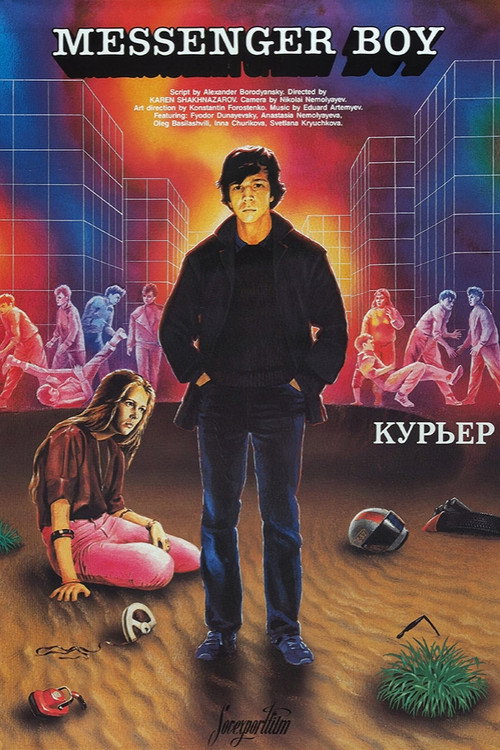
Courier
1986 · Karen Shakhnazarov
For when you want a hangout film with an edge — something wry and youthful that still gives you something to think about after. Comfort viewing for fans of deadpan, with a bittersweet aftertaste.
What it's about
Ivan, a smart-mouthed Moscow school-leaver in the early Gorbachev years, has no college place, no plans, and the army looming; he lives with his divorced mother and delivers packages for a magazine. The job brings him into the orbit of a self-satisfied professor and his rebellious daughter Katya, and his deadpan provocations — including a fake romance staged mostly to annoy her father — become a running duel between a drifting younger generation and the establishment that can't read it.
The experience
Light and funny on the surface — deadpan comebacks, awkward dinner parties, breakdancing — with a genuinely melancholy undertow about aimlessness that sneaks up on you. It's the rare comedy that leaves you a little haunted.
The craft
Karen Shakhnazarov adapts his own novella with a sitcom-light touch that keeps flipping into something sadder, letting silences and non-answers carry the weight the jokes deflect. It's a time capsule of mid-'80s Moscow — apartments, courtyards, street dancing — shot with unforced documentary flavor.
Why it matters
Released just as glasnost loosened Soviet culture, it landed as a generational statement and became one of the most seen and argued-over Soviet films of its moment — the screen portrait of perestroika-era youth.
Snapshot
Kuryer (Courier) is Karen Shakhnazarov's adaptation of his own novella, a wry, melancholy portrait of Soviet youth adrift on the cusp of perestroika. Its hero, Ivan Miroshnikov, is a school-leaver with no plans, no ambition he will admit to, and a talent for deadpan provocation; his running joust with a self-satisfied academic and that academic's daughter becomes a vehicle for a larger unease about what the younger Soviet generation believed in, if anything. Released as Mikhail Gorbachev's reforms were beginning to loosen the culture, the film landed as a generational statement and became one of the most widely seen and discussed Soviet pictures of its moment. It pairs a light, almost sitcom-like surface — misunderstandings, a fake romance, comic set-pieces — with a genuinely bleak undertow about drift, aimlessness, and the gulf between fathers who "believed" and sons who cannot pretend to. The result is a comedy that keeps curdling into something sadder, and a period document of unusual candor.
Industry & production
Courier was produced by Mosfilm, the flagship state studio, and emerged from the specific institutional loosening of the mid-1980s. The Fifth Congress of the Soviet Filmmakers' Union in May 1986 is the customary marker for the perestroika thaw in cinema — the reorganization of the Union, the challenge to the old guard, and the beginnings of a shelf-clearing that released long-banned films. Courier is best understood as a film made with, rather than against, that new latitude: it was not a suppressed work but a sanctioned production that could speak more frankly about youthful disaffection than would have been comfortable a few years earlier.
Shakhnazarov was still a relatively young director building his reputation inside Mosfilm; Courier consolidated it. The source was his own prose — a novella published earlier in the decade in the youth-oriented literary press — which gave the adaptation the authority of a first-person generational account. The screenplay was written by Shakhnazarov with Alexander Borodyansky, a frequent and important collaborator whose work with the director spans much of Shakhnazarov's career; their partnership is one of the durable facts of late-Soviet and post-Soviet cinema. Exact budget and internal production figures are not part of the well-documented public record, and I will not invent them; what is secure is the studio (Mosfilm), the authorship (Shakhnazarov and Borodyansky from Shakhnazarov's own novella), and the film's reception as a commercial and critical event.
Technology
Courier is a conventionally shot 35mm studio picture of its period, and its technological interest lies less in image capture than in sound. Its most forward-looking element is the score by Eduard Artemyev, the Soviet Union's pre-eminent electronic composer — the man behind the synthesizer-and-ANS textures of Tarkovsky's Solaris, Mirror, and Stalker. Artemyev's synthesizer palette gives Courier a contemporary, slightly cool sheen that aligns it with the international pop-electronic idiom of the mid-1980s rather than with the orchestral tradition of official Soviet scoring. That choice is itself a statement: the film's sound belongs to the world of the young, of imported music and new machines, not to the concert hall of the fathers.
Technique
Cinematography
The photography, by Nikolai Nemolyaev, favors a clean, legible, largely unshowy realism appropriate to a comedy of contemporary manners. The camera observes Moscow apartments, editorial offices, and streets with an eye for the specific textures of late-Soviet daily life — the furnishings, clothes, and interiors that make the film valuable as a period record. Where the film reaches for lyricism it does so sparingly, most memorably in its handling of the young faces that are its real subject; the visual style holds back so that the performances and the settings carry the meaning.
Editing
The cutting serves a hybrid tonal design: brisk enough to keep the comic misunderstandings buoyant, but willing to slow and hold on faces at the moments when the comedy gives way to something unresolved. The film's rhythm is that of a character study wearing the clothes of a light social comedy, and the editing manages the repeated tonal switchbacks — from farce to disquiet and back — that are central to its effect.
Mise-en-scène / staging
Staging is organized around a set of charged interiors: the mother's apartment, the professor's book-lined bourgeois home, the newspaper office where Ivan runs his errands. The professor's flat is a space of settled cultural capital — the accoutrements of the intelligentsia — against which Ivan's studied indifference reads as both insolence and a kind of honesty. The film repeatedly frames the encounter between generations as an encounter between social spaces and their furnishings, using the contrast of homes and dress to carry the argument about values without stating it.
Sound
Beyond Artemyev's electronic score, the film's soundscape leans into contemporary youth culture — the imported pop and dance music that marks Ivan's world as distinct from his elders'. The famous breakdancing episode, in which Ivan's friend performs, is the clearest instance of sound and movement announcing a generational identity built from Western-inflected styles then filtering into Soviet cities. Sound, in Courier, is one of the ways the film keeps insisting that the young inhabit a different sensory world from their parents.
Performance
The film is carried by a first-time-ish lead performance of striking flatness-as-strategy. Fyodor Dunayevsky plays Ivan with a masklike cool — a refusal to perform sincerity that is exactly the character's defense and the film's subject. Opposite him, Anastasiya Nemolyaeva plays Katya, the professor's daughter, whose decision to play along with Ivan's invented affair gives the plot its motor; she matches his guardedness with her own. Oleg Basilashvili, a major stage and screen actor, lends the professor Kuznetsov the weight and self-regard of the established intelligentsia, so that the generational duel is genuinely mismatched in cultural authority. Inna Churikova, one of the great Soviet actresses, plays Ivan's divorced mother, grounding the domestic scenes in real weariness and tenderness. The casting strategy — an unknown, affectless young lead against seasoned heavyweights — is itself expressive of the film's theme.
Narrative & dramatic mode
The dramatic mode is comedy of manners shading into character study and generational elegy. The engine is a lie: to needle the condescending professor, Ivan claims an affair with Katya, and Katya, unexpectedly, corroborates it. From that small provocation the film spins a series of social embarrassments and near-romances, but it consistently declines to resolve into either the romantic-comedy payoff or the moral correction its structure seems to promise. Ivan does not "grow up" on cue; the fake romance does not simply become real; the professor is not straightforwardly humbled. The film's mode is ironic and open-ended, using the machinery of light comedy to stage an argument it refuses to settle — an argument about whether the young owe their elders belief, and about what, if anything, they are being asked to believe in.
Genre & cycle
Nominally a drama-romance-comedy, Courier belongs to a recognizable late-Soviet cycle of "youth films" that took the disaffection and drift of the 1980s generation as their subject. It sits alongside the era's other landmark generational statements — most famously Vasili Pichul's Little Vera (1988), the perestroika youth film par excellence — as part of a wave that used the loosening of censorship to depict boredom, cynicism, sexuality, and social malaise with new frankness. Within that cycle Courier is the comparatively gentler, wittier entry: less scandalous than Little Vera, more concerned with irony than with shock, but animated by the same conviction that the official narrative of purposeful Soviet youth had come apart.
Authorship & method
The controlling authorship is Shakhnazarov's, and Courier is a key film in understanding him. He adapts his own novella, co-writes with his long-standing partner Alexander Borodyansky, and directs in a register — ironic, socially observant, tonally slippery — that recurs across his filmography. Shakhnazarov's later career gives the film a particular institutional resonance: he went on to become the head of Mosfilm, running the studio from the late 1990s onward, which makes Courier the early signature work of a filmmaker who would become one of the central figures of the Russian film industry.
His key collaborators here are exactly the ones a serious account must name: Borodyansky as co-writer; Eduard Artemyev, whose electronic score situates the film in the contemporary and links it, through Artemyev's biography, to the highest Soviet art cinema of the preceding decade; and cinematographer Nikolai Nemolyaev. The performances of Basilashvili and Churikova bring the authority of the Soviet theatrical and cinematic establishment to bear on a film about the establishment's failure to reach the young — a productive tension between the film's casting and its content.
Movement / national cinema
Courier is a Soviet, specifically Russian-language Mosfilm production, and it is inseparable from the perestroika moment in Soviet cinema. It is not an avant-garde or a dissident film; it is a mainstream studio picture that used the new openness to speak plainly about generational disillusion. In the broader map of national cinema it functions as a bridge: it carries the craft and institutional weight of the mature Soviet studio system while pointing toward the harsher, more disenchanted Russian cinema of the late 1980s and the collapse to come. As such it is regularly cited as one of the representative films of the perestroika thaw.
Era / period
The film is saturated with its exact historical moment — the early Gorbachev years, before the full reforms and long before 1991. Its texture is a catalog of that instant: the looming two-year conscription that hangs over every young man; the breakdancing and imported fashion; the newspaper office as a fading institution of official culture; the divorced household as ordinary rather than scandalous. The mandatory military service is more than plot furniture: in 1986 it inevitably evokes the war in Afghanistan, and the film's anxiety about what awaits its aimless young men has that unspoken shadow behind it. Courier is one of the most vivid cinematic time-capsules of the pre-collapse Soviet 1980s, precisely because it treats the period's malaise as ordinary weather rather than as crisis.
Themes
The governing theme is generational rupture — the failure of transmission between the generation that "believed" (in the war, in the project, in culture) and a generation that cannot or will not perform belief. Ivan's affectless irony is the film's central symptom: not stupidity or malice but a refusal to counterfeit the sincerity his elders demand. Around this cluster several linked concerns: aimlessness and the fear of the future (the void after school, the dread of conscription); the gap between the intelligentsia's cultural capital and the young's indifference to it; class and comfort, staged through homes, coats, and gifts; and the question of what a young person can honestly want in a society whose grand promises have gone hollow. The film's most quoted gesture is its challenge to dream — the demand that the young name a grand aspiration — and its unease lies in the suspicion that the honest answer is that they cannot. The ending's turn toward the faces of youth reframes the whole comedy as a serious question addressed outward: what will become of these people?
Reception, canon & influence
Courier was a major popular and critical success and remains one of Shakhnazarov's best-known works. It was among the most-attended Soviet films of its release period and won recognition on the festival circuit, including a jury prize at the Moscow International Film Festival — a sign that it was embraced both as a crowd-pleaser and as a serious statement. (I will not attach a specific attendance figure, since I cannot verify one precisely; the secure claim is that it drew a very large domestic audience and was widely discussed.) Its critical standing has only grown: it is routinely cited as one of the defining films of perestroika-era cinema and as an unusually clear-eyed portrait of the late-Soviet generation.
Looking backward, the film draws on the Soviet tradition of the social-realist comedy of manners and on the generational-portrait strain of Soviet cinema, while its electronic score connects it, through Eduard Artemyev, to the art cinema of Tarkovsky. Its frankness is enabled by the specific institutional opening of the mid-1980s rather than borrowed from a foreign model, though its youth-culture texture — breakdancing, pop, imported style — registers the pull of Western influence on Soviet young people.
Looking forward, Courier stands near the head of the perestroika youth-film cycle that culminated in works like Little Vera, and it helped legitimize a cinema willing to show Soviet young people as bored, cynical, and unmoored. For Shakhnazarov himself it was a career-defining film, the early signature of a director who would go on to lead Mosfilm and shape Russian cinema for decades. Today it is watched and taught less as a comedy than as a document — the moment when Soviet cinema looked at its own children and admitted it did not know what they believed, or what would become of them.
Reception
A genuine phenomenon in the perestroika-era USSR — a huge hit with young audiences and a prize-winner at the 1987 Moscow International Film Festival — it later slipped off Western radars entirely, only to be rediscovered by cinephiles as one of the defining time capsules of the late Soviet moment.
How Courier was received, from release to now →
Influences: the films it descends from and the films it influenced
- Walking the Streets of Moscow (1964) — Establishes the lyrical Soviet youth comedy-of-manners built around an affectless, gently wandering young protagonist whose drift through the city carries the film — the observational register Courier inherits for Ivan.
- I Am Twenty (Ilyich's Gate) (1965) — The foundational generational-portrait film of unmoored Moscow youth, using loose observational long takes and overheard-conversation naturalism rather than plot to render aimlessness — the documentary-of-a-generation approach Courier revives.
- July Rain (1967) — Ambient intelligentsia malaise scored to transistor-radio pop bleeding through street scenes, fusing pop-culture texture with drift — the sound-design strategy of youth music as generational marker that Courier extends with breakdancing and synth-pop.
- Beware of the Car (1966) — The template for the ironic Soviet comedy of manners that satirizes social types through deadpan situation, the tonal register — social observation delivered as light comedy — that Shakhnazarov and Borodyansky operate in.
- Autumn Marathon (1979) — Perfects the tonal switchback of intelligentsia comedy — mortification and melancholy sliding into farce within a scene — the register the charged apartment-visit interiors of Courier reproduce between Ivan and Basilashvili's professor.
- Solaris (1972) — Eduard Artemyev's synthesizer score here defines the Soviet electronic-art-film sound; Courier draws that same composer's contemporary electronic idiom, linking a youth comedy to the highest Soviet art cinema through the scoring credit itself.
- Stalker (1979) — Artemyev's ambient electronic textures as psychological atmosphere rather than melody — the specific tonal palette Courier repurposes to give a comedy of manners an undertow of unease and generational dread.
- The Theme (1979) — Panfilov's showcasing of Inna Churikova's establishment theatrical authority is the exact weight Courier casts against its unknown lead — the deliberate tension of heavyweight Soviet performers embodying the older order that cannot reach the young.
- We Are from Jazz (1983) — The earlier Shakhnazarov–Borodyansky collaboration built on youth, music subculture, and generational cheek against authority — the same authorial method and writing partnership Courier refines into a sharper social document.
- Little Vera (1988) — Extends Courier's frankness into full glasnost candor — bored, cynical working-class youth shown against exhausted parents in charged domestic interiors, the perestroika youth-film cycle that Courier stands at the head of.
- Zerograd (1988) — The next Shakhnazarov–Borodyansky film, carrying forward the tonally slippery, ironic-observational authorial voice into absurdism — the same collaboration and register, now turned on the whole Soviet order rather than its children.
- Taxi Blues (1990) — Sustains the generational-rupture drama as a charged two-hander across a class and worldview gulf, scored to contemporary music — inheriting Courier's structure of an unmoored young man colliding with an older figure who cannot comprehend him.
- Plumbum, or The Dangerous Game (1986) — A near-simultaneous portrait of an affectless, morally opaque teenager whose blank composure unsettles the adults around him — the same performance mode of the illegible youth that Courier's deadpan lead embodies.
- Is It Easy to Be Young? (1987) — The perestroika documentary that formalized the era's central gesture — the older generation directly interrogating disaffected youth and getting no reassuring answer — which is Courier's exact dramatic engine in fiction form.
- Assa (1987) — Builds its youth portrait around authentic rock/pop subculture (Tsoi, actual musicians) as the generation's real texture, sharing Courier's method of importing living youth-culture surfaces — style, music, slang — straight into the frame.
- The Burglar (1987) — Roots its disaffected-teen narrative in the documented Leningrad rock scene, using subcultural milieu as characterization — the same substitution of authentic youth-culture ethnography for conventional psychology that Courier practices.
Similar films
- Brother (1997) — shared sensibility
- Ballad of a Soldier (1959) — shared sensibility
- The Cranes Are Flying (1957) — shared sensibility
- Ivan Vasilyevich Changes His Profession (1973) — shared sensibility
- Ivan's Childhood (1962) — shared sensibility
- Kolya (1996) — shared sensibility
- Mirror (1975) — shared sensibility
- Like Someone in Love (2012) — shared sensibility