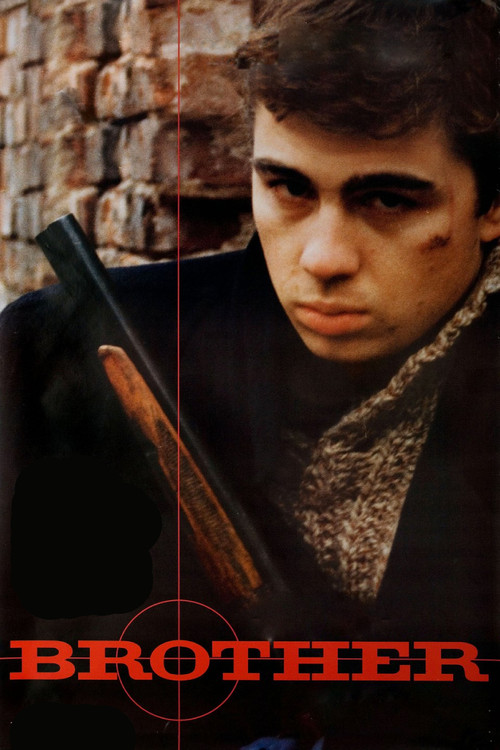
Brother
1997 · Aleksei Balabanov
For when you want something raw and morally unresolved — a crime film to argue about afterward, not to unwind with. Choose it when you're up for bleakness with a hypnotic pull.
What it's about
Danila, a quiet young soldier back from the Chechen war, drifts to St. Petersburg to start over near his successful older brother — who turns out to be a contract killer in trouble, and who quietly maneuvers Danila into taking a job aimed at a mob boss. In a city of crumbling courtyards, street markets, and casual violence, Danila proves unnervingly good at the work, all while collecting cassette tapes and treating murder with the same mildness as everything else.
The experience
Lean, gray, and deadpan — a thriller that refuses to thrill in the usual way, letting violence land flat and matter-of-fact while a rock soundtrack hums underneath. It leaves you uneasy precisely because Danila is so likable, and the film never tells you how to feel about that.
Performances
Sergei Bodrov Jr.'s Danila is one of the iconic performances of post-Soviet cinema — boyish, soft-spoken, almost gentle, which makes his capacity for killing genuinely disturbing and made him a folk hero to a generation.
The craft
Aleksei Balabanov shot it fast and cheap, and the roughness is the aesthetic: drab interiors, wintry streets, violence staged without glamour or spectacle. The Nautilus Pompilius songs on Danila's ever-present cassettes function almost as the film's inner voice, fusing the character to the sound of the Russian '90s.
Why it matters
The defining film of post-Soviet Russia's chaotic 1990s — a national phenomenon that gave the decade its anti-hero, launched a landmark of Russian genre cinema, and remains fiercely argued over for its casual prejudices and ambivalent morality.
Snapshot
Brother (Russian: Брат) is the film that, more than any other, gave post-Soviet Russian cinema a face — the boyish, soft-spoken killer Danila Bagrov, played by Sergei Bodrov Jr. A demobilized soldier drifting home from the First Chechen War, Danila arrives in a gray, predatory St. Petersburg, is drawn by his older brother Viktor into contract murder, and turns out to be preternaturally good at it. Directed by Aleksei Balabanov and produced by Sergei Selyanov's CTB (STV) Film Company, the picture was made cheaply and quickly in the mid-1990s and became a genuine national phenomenon, its hero adopted as a folk icon of the decade. It is at once a lean genre thriller, a portrait of a country in economic and moral free-fall, and — in its casual ethnic hostilities — one of the most argued-over Russian films of its era. Its blend of naturalistic Petersburg atmosphere and a soundtrack built from the rock band Nautilus Pompilius fixed a specific 1990s structure of feeling that Russian audiences still recognize instantly.
Industry & production
Brother is a product of the collapse-and-improvisation economy of Russian filmmaking after the Soviet studio system disintegrated. State financing had evaporated; the old Goskino apparatus no longer guaranteed production or distribution, and cinema attendance had cratered as audiences turned to television and pirated video. Into that vacuum stepped a handful of independent producers, chief among them Sergei Selyanov, whose St. Petersburg-based CTB (in Latin transliteration STV) Film Company became the crucial engine of the era's commercial-auteur cinema and Balabanov's home studio for the rest of his career.
The film was shot on a modest budget with a small crew, largely on real St. Petersburg locations — apartments, tram lines, markets, cemeteries, the streets themselves — rather than on built sets, a necessity that became an aesthetic. Precise budget and box-office figures for Brother are not reliably documented in the English-language record and I will not invent them; what is clear is that the picture was economical to make and that its outsized cultural reach came less through theatrical release, in a period when theaters were half-dead, than through television broadcast and the vast informal video market. That distribution reality is inseparable from the film's meaning: Brother circulated the way its hero moves — cheaply, quickly, on cassette, hand to hand.
Technology
Brother was made on 35mm film in the last fully analog moment of Russian cinema, before digital acquisition and cutting arrived. Its technological texture is deliberately of-the-moment and low-tech: the visual grain of modest film stock and available light, the improvised camera rigs its cinematographer was known for, and a production design saturated with the disposable hardware of the 1990s.
Two technologies function almost as characters. The first is the portable personal music player — Danila is rarely without headphones, and his handheld cassette/CD player is the membrane between him and a hostile city, the device through which the Nautilus Pompilius songs enter both his world and ours. The second is the improvised weapon. Danila, self-taught, fabricates guns and silencers from scavenged parts — the famous suppressor cobbled from a plastic bottle. This do-it-yourself gunsmithing is a precise emblem of the shortage economy: violence, like everything else, is jury-rigged from what's lying around. The film's technological imagination is thus resolutely handmade and provisional, matching a society reassembling itself out of scrap.
Technique
Cinematography
The photography, by Balabanov's longtime collaborator Sergei Astakhov, is the film's signature. Astakhov renders St. Petersburg in a cold, desaturated, overcast palette — grays, muddy greens, wet stone — that strips the imperial city of romance and presents it as a labyrinth of courtyards, stairwells, trams, and markets. The camera favors a loose, quasi-documentary handheld observation, staying close to Danila and moving with him through crowds, so that the audience experiences the city's menace at his shoulder. Astakhov, celebrated in the Russian industry for inventive, low-cost rigging solutions, gets mobility and immediacy out of limited means. The result is a naturalism that never tips into showiness: violence is filmed plainly, often in a single unemphatic setup, which makes it colder and more matter-of-fact than the choreographed spectacle of Western action cinema.
Editing
The cutting is unhurried and observational, letting scenes breathe — Danila wandering, riding trams, listening to music — before snapping into brisk, deglamorized efficiency in the killings. The film's most distinctive editorial device is the music montage: extended passages set to Nautilus Pompilius in which image and song fuse into a mood-portrait of the city and the hero, functioning almost as internal monologue for a protagonist who says very little. (English-language sources on the specific editor and cutting-room process are thin, and I won't attribute particulars I can't verify.) The rhythm alternates drift and dispatch, mirroring Danila's own unnerving calm.
Mise-en-scène / staging
Balabanov stages Brother in the actual fabric of mid-1990s Petersburg: cramped communal apartments, an open-air market, a Lutheran cemetery where the vagrant German lives, tram interiors, nightclub crowds. Props and costume do heavy characterizing work — Danila's oversized, shapeless sweater, at odds with his lethality; the ubiquitous headphones; the scavenged weaponry. The staging is anti-heroic and anti-glamorous: contract murders happen in banal spaces, and the city's social ecology (gangsters, addicts, the homeless, exhausted workers like the tram driver Sveta) is presented at eye level rather than stylized.
Sound
Sound is arguably the film's beating heart. Rather than commission an original score, Balabanov built the soundtrack around the Russian rock band Nautilus Pompilius and its frontman Vyacheslav Butusov, whose songs Danila is forever seeking — his quest for the band's new album is a running thread, and Butusov even appears in the film's orbit. This use of pre-existing, culturally loaded rock music does what a conventional score cannot: it grounds Danila in a specific generational sensibility and lends his blankness a lyrical, melancholic interiority. Against the music, the diegetic sound design keeps violence dry and unsentimental — gunfire is small and flat, not operatic. The tension between the tender songs and the brutal action is the film's central expressive engine.
Performance
Sergei Bodrov Jr.'s Danila is a landmark of underplaying. Bodrov — not a trained screen-action star but a recognizable young television personality and the son of director Sergei Bodrov Sr. — gives Danila a gentle, almost childlike affect: quiet voice, shy smile, courteous manner, punctuated by sudden, frictionless violence and by ugly, offhand bigotry. The refusal to editorialize the character through performance is precisely what makes him magnetic and disturbing. Viktor Sukhorukov, as the treacherous brother Viktor, supplies a jittery, self-serving contrast, and the supporting figures — the beaten-down tram driver Sveta, the drug-using club girl Kat, the philosophical German in the cemetery — are played in a bruised naturalist register that keeps the film anchored to lived 1990s reality.
Narrative & dramatic mode
The narrative is a lean picaresque built on a fraternal betrayal: Danila comes to the city for his brother, is used by him as a disposable trigger-man, survives, and quietly settles accounts before moving on. Structurally it is episodic — Danila drifts through encounters (the market, the tram, the party, the cemetery, a string of hits) that accrete into a portrait rather than a tightly plotted thriller. The dramatic mode is deadpan and ironic: extreme violence is treated with flat understatement, and the hero's moral code — protect the weak, punish the strong, stay loyal — coexists with casual cruelty in a way the film pointedly declines to resolve. Danila is legible as a folk-tale simpleton-hero (the naïf who turns out to be the most capable man in the room) transplanted into gangster realism, which is much of why he proved so adoptable as myth.
Genre & cycle
Brother belongs to, and helped define, the post-Soviet "bandit" crime film — the wave of 1990s Russian pictures about contract killers, mafiya, and the lawless market economy. It emerges from the shadow of chernukha, the bleak, taboo-breaking social realism of late-perestroika cinema that wallowed in squalor and despair; Brother inherits that grim texture but reroutes it toward genre pleasure and, crucially, toward a hero. Where chernukha offered only victims, Brother offers an agent — a just avenger who imposes order on chaos. In doing so it hybridizes the American gangster/vigilante film with a distinctly Russian moral-folkloric sensibility, and it stands as a founding entry in a national action-crime cycle that Balabanov's own Brother 2 (2000) would extend and inflame.
Authorship & method
Brother is an auteur film built on a tight repertory of collaborators. Aleksei Balabanov (1959–2013), who also wrote the screenplay, is its controlling intelligence — a director whose body of work runs from the austere literary adaptations of his early period (Happy Days, The Castle) through the perverse Of Freaks and Men to the corrosive late films Cargo 200 and Morphine. His method fused genre accessibility with an unsentimental, often provocative moral vision and a refusal to flatter the audience; Brother is the moment that method met the mass public.
His key collaborators recur across his filmography. Cinematographer Sergei Astakhov shaped the film's cold Petersburg naturalism and its resourceful, mobile camerawork. Producer Sergei Selyanov and CTB provided the independent infrastructure that made an artisanal, uncompromised film commercially viable. Rather than a scoring composer, the musical author is effectively Vyacheslav Butusov / Nautilus Pompilius, whose existing songs supply the film's emotional register — an unusual authorship choice in which a rock band's catalog does the work of a score. Above all there is Sergei Bodrov Jr., whose Danila became so identified with Balabanov's vision that actor and director are inseparable in the film's legacy; Bodrov's death in 2002 in the Kolka/Karmadon glacier disaster in North Ossetia, during production of another project, sealed Danila as a fixed cultural memory.
Movement / national cinema
The film is a defining artifact of 1990s Russian national cinema — the traumatized, improvisatory cinema of the post-Soviet transition. It captures a specific historical Russia: the aftermath of the First Chechen War (1994–96), the gangster capitalism of the Yeltsin years, mass impoverishment, and a pervasive sense of civilizational disorientation. St. Petersburg is not merely a setting but a subject; the German vagrant's remark that the city is a terrible, devouring force reads as a thesis about the whole society. Institutionally, Brother embodies the shift from a collapsed state-studio model to producer-driven independent cinema centered on figures like Selyanov, and it demonstrated that Russian genre film could speak to a mass domestic audience about its own present.
Era / period
Made and set in the mid-1990s, Brother is thoroughly of its moment: the interregnum between the USSR's dissolution and the Putin-era consolidation. Its hero is a product of the Chechen war; its economy is the shuttle-trade, extortion, and cash-in-envelopes world of early Russian capitalism; its media landscape is cassettes, kiosks, and television. This period specificity is exactly what gave the film its documentary charge at release and its nostalgic weight later. It has since become a primary text through which Russians remember the "wild nineties," and much of the debate about the film is really a debate about how to remember that decade.
Themes
The film's central theme is the search for a moral order in a world that has lost one. Danila improvises a personal code — loyalty to kin, protection of the vulnerable, contempt for the powerful — precisely because the state, the law, and traditional authority have all failed. Fraternal loyalty and its betrayal drive the plot: Viktor sells out the very brother whose devotion the film's title invokes. Rootlessness and the returning-soldier's dislocation run underneath, as does the city-as-predator motif. And then there is the film's most contested strand: Danila's casual xenophobia — his slurs against Caucasians and other ethnic and national others. The film neither underlines nor apologizes for these, and critics remain genuinely divided over whether Brother diagnoses the bigotry of its moment or indulges it. That refusal to resolve — to tell us whether Danila is hero, symptom, or indictment — is itself the film's most durable and uncomfortable theme.
Reception, canon & influence
Brother premiered on the international festival circuit — it was selected for Cannes' Un Certain Regard in 1997 — but its decisive reception was domestic and popular. It struck a nerve as few Russian films of the decade did, and Danila Bagrov became a folk hero, his lines quoted and his image circulated far beyond the film itself; the picture is routinely cited as one of the defining Russian works of the 1990s. Critically it was both celebrated as a vital, authentic portrait of the era and attacked for its ethnic hostility and for the seductive glamour some saw in its violence — a controversy that has never fully settled and that the sequel would deliberately intensify.
Looking backward, the film draws on the traditions that fed it: the chernukha realism of late-Soviet cinema, the moral-folkloric archetype of the naïf-hero, and the American gangster and vigilante genres it localizes. Looking forward, its influence is large and specific. It launched a domestic crime-cycle and confirmed a producer-auteur model (Selyanov/CTB, Balabanov) that shaped subsequent Russian genre filmmaking. Its direct sequel, Brother 2 (2000), pushed Danila's mythology toward overt anti-American, nationalist bravado and became a phenomenon in its own right, cementing the character in the culture. Bodrov's early death only deepened the film's canonization, turning Danila into a permanent figure of national memory. Today Brother is treated as a keystone of post-Soviet cinema — the film through which a generation of Russians recognized themselves, argued about themselves, and mythologized a decade — and its uneasy mixture of tenderness, violence, and prejudice keeps it a live text rather than a museum piece.
Reception
An instant word-of-mouth phenomenon with Russian youth in 1997 — it took the Kinotavr Grand Prix while much of the intelligentsia recoiled at its amoral hero — and has since hardened into THE defining film of post-Soviet Russia, its stature only growing (and getting thornier) with each decade.
How Brother was received, from release to now →
Influences: the films it descends from and the films it influenced
- Kalina Krasnaya (The Red Snowball Tree) (1974) — Supplies the moral-folkloric archetype Danila localizes — the plain-spoken ex-con/naïf returning to a fallen world, whose unforced decency silently indicts a corrupt order.
- My Friend Ivan Lapshin (1984) — German's grainy, deep-staged crowd realism and lived-in location texture is the native Russian model for Astakhov's mobile, documentary-grade naturalism rather than a studio look.
- Little Vera (1988) — The chernukha template Brother inherits: desaturated housing-block squalor, blunt on-screen sex and violence, and drab real-location shooting standing in for a decaying society.
- Taxi Driver (1976) — The alienated ex-serviceman drifting a corrupt city as self-appointed cleanser, complete with the DIY-armament ritual — Danila's homemade sleeve rig echoes Travis's sliding arm-gun.
- Le Samouraï (1967) — Melville's near-mute contract killer models Danila's underplaying — professionalism conveyed through affectless economy and coded gesture instead of dialogue or reaction.
- Mean Streets (1973) — Establishes the method of letting a character's own pop-record taste replace an orchestral score, threading rock tracks through episodic street vignettes — Danila's Nautilus fandom is the same device.
- Breathless (À bout de souffle) (1960) — Handheld run-and-gun street shooting and the charming, deadpan young criminal improvising through a real modern city — the New Wave grammar Balabanov re-grounds in Petersburg.
- Death Wish (1974) — The American vigilante-genre chassis Brother localizes: an ordinary man methodically dispensing lethal order across a metropolis the law has abandoned.
- Happy Days (1991) — Balabanov's own austere, deadpan Petersburg absurdism (shot by Astakhov) that first fixes his flat affect and the cold city-as-character later weaponized for genre.
- Brother 2 (2000) — Direct sequel that scales the music-montage into a full Russian-rock jukebox and pushes the picaresque and Danila's laconic mythos into overt nationalist bravado.
- Sisters (Syostry) (2001) — Bodrov's directing debut under Selyanov/CTB, porting the laconic-protector-in-lawless-Russia template and location realism to a children's road-flight thriller.
- War (Voyna) (2002) — Extends the moral-order-in-chaos and unresolved xenophobia into the Chechen war using the same handheld documentary camera and deadpan, near-affectless narration.
- Boomer (Bumer) (2003) — Flagship of the bandit-crime road-picaresque cycle Brother launched, with Sergei Shnurov's rock score deployed as authorial needle-drop rather than composed underscore.
- Cargo 200 (2007) — The corrosive endpoint of the Astakhov location-naturalism and period needle-drops, turning the same wild-era decay and unflattering moral gaze into outright horror.
- Trainspotting (1996) — A contemporaneous case of needle-drop pop scoring and episodic picaresque built around a marginal youth subculture, using curated songs as the emotional through-line.
- Pulp Fiction (1994) — The mid-90s pairing of deadpan-ironic violence with a hand-picked jukebox soundtrack doing the work of a score — the same tonal register Balabanov reaches independently.
Similar films
- Eastern Promises (2007) — shared sensibility
- Courier (1986) — shared sensibility
- No Country for Old Men (2007) — shared sensibility
- Little Odessa (1994) — shared sensibility
- Pusher (1996) — shared sensibility
- Brothers (2004) — shared sensibility
- Tae Guk Gi: The Brotherhood of War (2004) — shared sensibility
- Lilya 4-ever (2002) — shared sensibility