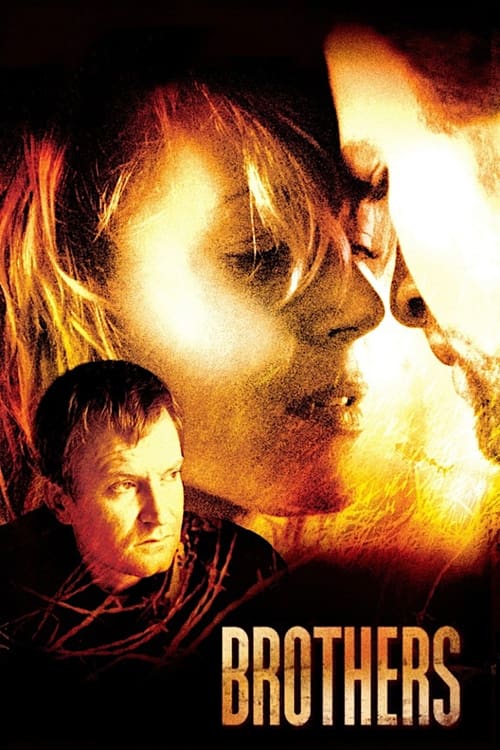
Brothers
2004 · Susanne Bier
For when you want serious, grown-up drama that puts you through the wringer and gives you something to argue about afterward — moral dilemmas with no clean answers. Not a comfort watch; a rewarding one.
What it's about
Michael, a steady Danish army officer with a wife and two daughters, deploys to Afghanistan; his helicopter is shot down and the family is told he's dead. His younger brother Jannik — fresh out of prison, the family screw-up — steps unexpectedly into the gap, helping Michael's widow and children rebuild. But Michael is alive, held prisoner, and what happens to him in captivity means the man who eventually comes home is not the man who left.
The experience
Raw and unbearably tense in the way only family drama can be — long dinner-table scenes where you brace for something to shatter. It's an emotional gut-punch that trusts silence and faces as much as dialogue.
Performances
Ulrich Thomsen charts Michael's transformation with frightening control, Connie Nielsen grounds the film as the wife caught between brothers, and Nikolaj Lie Kaas makes Jannik's redemption genuinely moving rather than sentimental.
The craft
Susanne Bier shoots in the intimate, handheld style that came out of Denmark's Dogme movement — natural light, tight close-ups on eyes and hands — so the war scenes and the kitchen scenes carry the same nerve-shredding immediacy. Anders Thomas Jensen's script builds its moral trap with merciless economy.
Why it matters
A high point of the Danish drama wave of the 2000s that made Bier an international name, and a story compelling enough that Hollywood remade it five years later.
Snapshot
Brødre (released internationally as Brothers) is a Danish drama of war, guilt, and domestic fracture, directed by Susanne Bier from a screenplay by Anders Thomas Jensen. It belongs to the wave of emotionally intense, handheld Danish cinema that emerged in the immediate wake of the Dogme 95 movement, and it stands as the central panel of the informal "trilogy" of moral-dilemma melodramas Bier and Jensen made together in the 2000s, bracketed by Open Hearts (2002) and After the Wedding (2006). The premise is a deliberate inversion of fairy-tale archetype: Michael (Ulrich Thomsen), the upstanding career officer and family man, deploys to Afghanistan with the International Security Assistance Force; his helicopter is downed, he is taken prisoner and reported dead, and back in Denmark his volatile ex-convict brother Jannik (Nikolaj Lie Kaas) steps quietly into the vacancy, growing close to Michael's wife Sarah (Connie Nielsen) and daughters. When Michael returns—having committed an unspeakable act to survive captivity—the film becomes a study of a man hollowed out by trauma and corroded by suspicion. Beyond its domestic chamber drama, Brothers is notable as one of the earliest European feature films to confront the psychological aftermath of the post-2001 Afghanistan deployment, and it would gain a second life through Jim Sheridan's 2009 Hollywood remake.
Industry & production
Brothers was produced by Zentropa, the production house founded by Lars von Trier and Peter Aalbæk Jensen that had been the engine of the Dogme 95 phenomenon and the dominant force in Danish art-house export through the late 1990s and 2000s. Working within Zentropa placed Bier inside an ecosystem geared toward lean, director-driven production, international co-financing, and a recognizable house aesthetic of intimacy and improvisatory realism. The film was part of a productive run for Danish cinema in which a small national industry, buoyed by the Danish Film Institute's support model and the global brand recognition Dogme had created, was punching far above its weight on the festival circuit.
The film's international breakthrough came at the Sundance Film Festival in early 2005, where it won the World Cinema Audience Award, a result that helped secure art-house distribution in the United States and elsewhere and cemented Bier's standing as a director who could marry festival prestige with broad emotional accessibility. (Precise box-office figures for a film of this scale and distribution pattern are not something I can responsibly quote.) Within Denmark the film was a critical success and figured in the national awards season; I will not invent a specific tally of statuettes, but its prominence at the Bodil and Robert awards of its year is part of the record of its domestic reception. The most consequential industrial afterlife of Brothers was its sale to Hollywood: it was remade by Irish director Jim Sheridan in 2009 with Tobey Maguire, Jake Gyllenhaal, and Natalie Portman, a transaction emblematic of the era's traffic in remake rights for successful European dramas.
Technology
Brothers was shot on film stock with a deliberately stripped, naturalistic approach to image-making rather than as a technological showcase, and its "technology" is best understood as an aesthetic discipline inherited from Dogme: available light wherever possible, handheld cameras, long takes that let performers work without the interruptions of elaborate marks and rigging. The Afghanistan sequences were not shot on location in a war zone; like most European productions of the period depicting that conflict, the film used substitute landscapes and controlled settings, with the emphasis placed on faces and confined interiors rather than on spectacle or large-scale battle staging. The decisive technical instrument of the film is the close-up lens trained on the human face—Bier's recurring fascination with eyes, mouths, and the micro-shifts of expression—rather than any apparatus of action cinema.
Technique
Cinematography
The cinematography, by Morten Søborg, is the film's signature. Søborg works in a restless, handheld idiom that keeps the frame breathing and slightly unstable, a technique that reads less as documentary roughness than as a barometer of emotional pressure. Bier and Søborg are devoted to the extreme close-up, frequently isolating eyes and fragments of faces in tight inserts that cut across conventional coverage. These fragmentary close-ups do double duty: they register interior states the dialogue withholds, and they create a vocabulary of glances—between brothers, between husband and wife, between parent and child—that carries much of the film's meaning. The palette favors cool, desaturated Scandinavian interiors against the harsher light of the captivity scenes, and the camera's intimacy with the actors gives even quiet domestic moments a charged, almost invasive proximity.
Editing
The editing builds the film's dramatic architecture out of cross-cutting between two collapsing worlds—Michael's ordeal abroad and the slow reconstitution of the family at home—so that the audience holds knowledge the characters do not. The cutting tightens markedly as Michael's post-return paranoia escalates, fragmenting domestic space into nervous shards that mirror his disintegrating perception. The handheld coverage and the close-up grammar give the editors abundant reaction material, and the film's most harrowing beats are constructed through accumulation of faces rather than through graphic depiction.
Mise-en-scène / staging
Bier stages the drama in the registers of bourgeois Danish domesticity—kitchens, dining tables, children's bedrooms, the renovated home that Jannik helps complete in Michael's absence—and lets the ordinariness of these spaces become the stage for extraordinary rupture. The film repeatedly uses the family meal and the home-improvement project as sites where tenderness and menace coexist. The captivity sequences are staged with claustrophobic minimalism, stripped to a few figures and bare surroundings, so that the moral catastrophe at their center lands as an intimate human transaction rather than a set piece.
Sound
The score is by Johan Söderqvist, one of Bier's most important and recurring collaborators, whose music threads restrained, melancholic motifs through the drama without tipping into bombast. The sound design favors the textures of domestic life and the abrupt, disorienting registers of the war scenes, and Bier is unafraid of silence and of letting raw vocal performance—weeping, shouting, the catch of a withheld confession—carry sequences unscored. The contrast between the warmth of home sound and the deadened acoustic of captivity reinforces the film's two-world structure.
Performance
Performance is the film's true medium. Ulrich Thomsen, a veteran of Thomas Vinterberg's Festen (Dogme #1), gives Michael a brittle, clenched authority that curdles into terror and rage; his return-home arc is a sustained study of a man who cannot speak the thing that has unmade him. Connie Nielsen—a Danish actress with a substantial international career—plays Sarah with a grounded, watchful realism, navigating grief, tentative new attachment, and then fear of the husband restored to her. Nikolaj Lie Kaas, another Dogme alumnus (The Idiots), gives Jannik a wounded, redemptive charge, transforming the screw-up brother into the film's unexpected moral center. Bier's improvisation-friendly, close-up-driven method extracts unusually exposed work from all three, and from the child actors playing the daughters, whose frightened intuition of their father's transformation supplies some of the film's most painful moments.
Narrative & dramatic mode
The dramatic mode is melodrama in the serious, classical sense—a theater of moral extremity and intense feeling—disciplined by a realist surface. The screenplay's engine is dramatic irony: the spectator knows Michael is alive while the family mourns, and later knows the true nature of his trauma while the family gropes at his silence. The "two brothers" structure works as an ethical thought experiment, deliberately overturning the cultural shorthand of the good son and the prodigal: the responsible brother is driven to commit an atrocity, while the disreputable one quietly becomes dependable. The film withholds and then partially discloses its central secret—the act of survival in captivity—using it as a buried charge under the domestic scenes. The resolution refuses easy catharsis, locating whatever redemption is available not in absolution but in the bare possibility of confession.
Genre & cycle
Brothers sits at the intersection of the war film and the domestic drama, but it largely evacuates the conventions of combat cinema in favor of the war film's psychological aftermath—the returning-soldier story, with its lineage running back through The Best Years of Our Lives and the post-Vietnam dramas of damaged homecoming. Within Bier's own filmography it belongs to a recognizable cycle: the run of contemporary moral-dilemma dramas she made with Anders Thomas Jensen—Open Hearts, Brothers, After the Wedding—each built around a sudden catastrophe that detonates a comfortable life and forces characters into impossible ethical choices. The film also participates in the broader 2000s cycle of European cinema reckoning with the wars in Afghanistan and Iraq, and specifically with the home-front cost of those deployments.
Authorship & method
The film is the product of a tight authorial partnership. Susanne Bier, trained at the National Film School of Denmark and a signatory of the Dogme movement with Open Hearts (Dogme #28), brings a method built on emotional maximalism channeled through realist technique: handheld camera, extreme close-ups, an obsessive attention to faces and eyes, and a willingness to push actors into raw exposure. Anders Thomas Jensen, her screenwriter here and across the trilogy, is one of Danish cinema's defining writers—an Oscar-winning short filmmaker and the author of darkly moral, sharply constructed scripts—and his architecture of irony and ethical entrapment is fundamental to the film. The cinematographer Morten Søborg translates Bier's intimacy into the film's restless visual grammar; the composer Johan Söderqvist supplies its restrained emotional underscoring; and the editing shapes the cross-cut structure on which the drama depends. The collaboration is genuinely co-authorial: the Bier–Jensen–Söborg combination constitutes a recognizable house style that carries across multiple films.
Movement / national cinema
Brothers is a quintessential product of post-Dogme Danish cinema. The Dogme 95 manifesto, launched by von Trier and Vinterberg, had by the early 2000s exhausted its formal program as a strict rulebook but bequeathed a durable aesthetic and a confident, export-oriented national industry. Bier is one of the central figures of this second phase, retaining Dogme's handheld intimacy and actor-centered realism while abandoning its ascetic prohibitions—using non-diegetic score, constructed sets, and conventional production resources freely. The film exemplifies how a small national cinema, organized around Zentropa and supported by the Danish Film Institute, leveraged the Dogme brand into sustained international visibility, and how its leading directors—Bier, Vinterberg, von Trier—moved fluidly between national subjects and global circulation.
Era / period
Made in 2004 and breaking out in 2005, Brothers is firmly a film of the early post-9/11 decade. Its Afghanistan strand engages directly with the ISAF deployment then underway, and Denmark's own participation in the coalition gives the film a specifically national charge: it asks what that distant war does to ordinary Danish families. The film captures an early moment in cinema's attempt to metabolize these conflicts, predating the larger wave of American Iraq- and Afghanistan-themed films that arrived in the latter half of the decade, and it does so by displacing the war almost entirely onto the home front and the returning veteran's psyche.
Themes
The film's governing themes are guilt and the unbearable weight of survival; the moral relativity of the "good" and "bad" brother; the secrets that families keep and the silences that destroy them; and trauma as a contaminant that travels home from war and poisons intimacy. Michael's atrocity in captivity is the film's moral black hole—an act committed under coercion that nonetheless cannot be lived with—and the drama turns on whether speaking it can release him. Around this sits a meditation on family as both refuge and fragile construction, on jealousy and suspicion as the shadow side of love, and on redemption figured not as forgiveness granted but as truth finally uttered. The inversion of brotherly archetypes carries an implicit critique of the social judgments that sort people into the worthy and the worthless.
Reception, canon & influence
Critically, Brothers was received as a powerful, emotionally lacerating drama and as confirmation of Bier's arrival as a major European director; its Sundance World Cinema Audience Award was the key marker of its international reception and the springboard for its art-house distribution. Critics singled out the performances of Thomsen, Nielsen, and Lie Kaas and Bier's intimate, close-up-driven technique, while some noted the risks of her melodramatic intensity—the same quality that made the film so affecting could read, to skeptical viewers, as emotional pressure applied without restraint.
Looking backward, the film draws on the post-Dogme Danish realist tradition and its actor-led ethos, on the long lineage of the damaged-veteran homecoming drama in war cinema, and on the moral-dilemma dramaturgy that Bier and Jensen had begun developing in Open Hearts. Looking forward, its most direct legacy is Jim Sheridan's 2009 American remake, which transposed the story to a U.S. military family and gave the material a Hollywood cast and scale—an unusually faithful instance of the European-to-Hollywood remake traffic of the period. Within Bier's own career, Brothers consolidated the method and concerns that she carried into After the Wedding (an Academy Award nominee for Best Foreign Language Film) and ultimately into In a Better World (2010), with which she won that Oscar—making Brothers a crucial step in the trajectory of one of the most internationally successful European directors of her generation, and in the broader story of how Danish cinema's post-Dogme moment translated into lasting global influence.
A Deleuzian reading
Start with an eye.
The full Deleuzian reading of Brothers →
Reception
A festival hit on release — it took the Audience Award at Sundance 2005 and cemented Susanne Bier's international breakout — but today it mostly circulates as 'the Danish original,' rediscovered by viewers working backwards from the 2009 Hollywood remake.
How Brothers was received, from release to now →
Influences: the films it descends from and the films it influenced
- Open Hearts (2002) — The first Bier–Jensen collaboration that established the moral-dilemma blueprint, the extreme-close-up inserts on eyes and trembling mouths, and the Söderqvist underscoring that Brothers systematizes into a house style.
- The Celebration (Festen) (1998) — Dogme #1 handheld, available-light realism and the dramaturgy of a buried family secret detonating at the dinner table — the post-Dogme actor-led ethos Brothers inherits wholesale.
- Breaking the Waves (1996) — Jittery handheld close-up camera and emotional maximalism trained on a woman's devotion during her man's absence, the visual grammar of raw-nerve intimacy Bier adapts.
- The Best Years of Our Lives (1946) — Founding template of the returning-veteran reintegration drama — the awkward homecoming, the marriage and household realigned around a man presumed changed or lost.
- The Deer Hunter (1978) — The captivity sequence in which a POW is coerced into killing, the trauma that hollows out the returning soldier — Brothers' Afghanistan captivity beat descends directly from this device.
- Coming Home (1978) — The marital triangle formed in a soldier's absence, the wife drawn toward another man while her husband is at war, then the violent reckoning on his return.
- Scenes from a Marriage (1973) — Establishes the face-filling close-up as the primary unit of domestic-crisis drama, reading a marriage's collapse off eyes and skin rather than action — Bier's core technique.
- The Idiots (1998) — Dogme provocation pushing actors into improvisational, near-documentary exposure, modeling the performance-first, rules-stripped method Bier carries out of the movement.
- Brothers (2009) — An unusually faithful American remake transposing the captivity-and-homecoming structure and the brother-substitution triangle onto a U.S. Marine family.
- After the Wedding (2006) — Extends the Bier–Jensen–Søborg house style — melodramatic moral entrapment built on a withheld secret, sprung through extreme close-up inserts on eyes and irises.
- In a Better World (2010) — Carries the same handheld desaturated grammar and Jensen's ethical-entrapment architecture into parallel adult and child moral plots, the method Brothers consolidated.
- Things We Lost in the Fire (2007) — Bier's Hollywood transposition of the grief-and-close-up method, the faces-and-eyes intimacy and diegetic-silence underscoring applied to widowhood and addiction.
- The Last Viking (2025) — Jensen's screenwriting mode at its most severe: two brothers, one returned from confinement fundamentally altered, and an entire household reorganized around a single withheld fact — proof that the damaged-brothers structure predates his directing and that his own features are the shaggy, comic reworking of scripts he first built as melodrama for Mikkelsen.
- The Hunt (Jagten) (2012) — Post-Dogme dramatic irony in which the audience holds a truth a community refuses to see, the withheld/false-secret engine driving Mads Mikkelsen through claustrophobic realism.
- Incendies (2010) — Cross-cut structure that withholds a war secret until a devastating reveal, manufacturing melodramatic shock through editing architecture the way Brothers braces homefront against captivity.
- The Messenger (2009) — Returning-soldier drama centered on the home-front fracture and a quasi-romantic bond formed in grief and casualty notification, shot in restless handheld intimacy.
- Submarino (2010) — A Danish two-brothers study of damaged masculinity and inherited trauma rendered in desaturated handheld realism, the same post-Dogge sibling-fracture terrain.
Similar films
- Tae Guk Gi: The Brotherhood of War (2004) — shared sensibility
- Saving Private Ryan (1998) — shared sensibility
- The Hurt Locker (2008) — shared sensibility
- Funny Games (2008) — shared sensibility
- Black Hawk Down (2001) — shared sensibility
- The Baader Meinhof Complex (2008) — shared sensibility
- Brother (1997) — shared sensibility
- Riders of Justice (2020) — shared sensibility