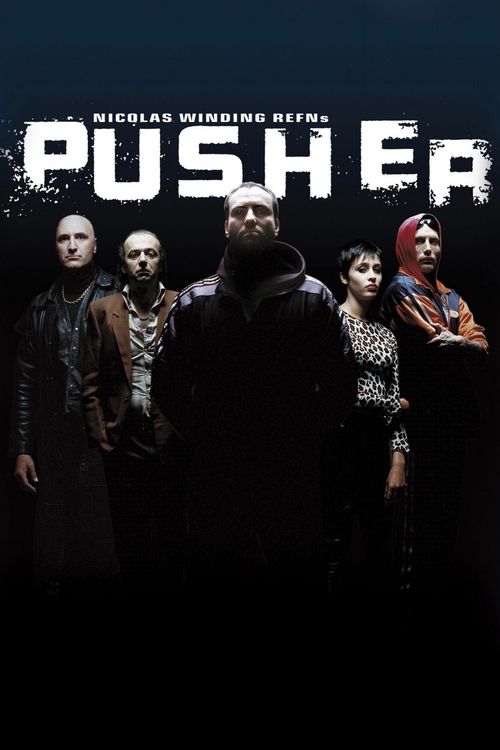
Pusher
1996 · Nicolas Winding Refn
When you want your crime cinema rough and real — no gloss, no cool, just a countdown you can't look away from. A challenge, not a comfort; save it for when you're in the mood to descend.
What it's about
Frank is a small-time drug pusher in Copenhagen, coasting through a week of deals, bad jokes, and late nights with his lowlife best friend. Then a transaction goes wrong, and suddenly he owes serious money to a Serbian crime boss who is friendly right up until he isn't. The film follows Frank day by day as the debt tightens around him and his options shrink.
The experience
Raw, jittery, and increasingly airless — it feels less like watching a crime movie than being trapped in one man's worsening week. The handheld grit gives it a documentary charge, and the dread builds through repetition until you can feel the walls closing in.
Performances
Kim Bodnia is magnetic as Frank, all bravado slowly curdling into panic, and a young Mads Mikkelsen — in one of his earliest roles — is unforgettable as his motor-mouthed sidekick.
The craft
Shot on 16mm with handheld cameras in real Copenhagen locations, it trades polish for texture: grainy, cramped, and alive. Refn was twenty-five and directing like he had nothing to lose, building pressure through structure — a day, another day, another — rather than plot twists.
Why it matters
It launched Nicolas Winding Refn's career, introduced Mads Mikkelsen to the world, and became a founding text for a grittier, street-level strand of Scandinavian crime cinema.
Snapshot
A week in the life of Frank (Kim Bodnia), a small-time Copenhagen drug pusher whose botched transaction with a Serbian crime lord named Milo (Slavko Labovic) spirals him into an ever-tightening vise of debt, desperation, and betrayal. Shot on 16mm with a handheld, almost documentary intimacy, Pusher announced Nicolas Winding Refn — then twenty-five years old — as a filmmaker of uncommon nerve. It is a survival film organized around attrition rather than plot, accumulating pressure through repetition and spatial claustrophobia until its protagonist is hollowed out entirely. The film launched a career, introduced Mads Mikkelsen to international audiences in an early film role, and established a template for a particular strand of Nordic crime cinema rooted not in genre mechanics but in the texture of physical and economic despair.
Industry & production
Pusher was produced under conditions of genuine scarcity. Refn had failed to gain admission to the Danish Film School and instead financed the project through a small production company, Balboa Entertainment, which he co-founded. The budget was minimal by any measure — drawn from a patchwork of Danish Film Institute support and private funding — and the production functioned essentially as guerrilla filmmaking, shooting largely without permits in the streets, apartments, and underground venues of Copenhagen. The compressed schedule forced improvisational decisions that became aesthetic commitments: locations were used as found, ambient noise was embraced rather than controlled, and the cast was encouraged to inhabit rather than perform.
The casting of Kim Bodnia, already an established Danish television and film actor, lent the production a commercial hook it might otherwise have lacked. Mads Mikkelsen, then working primarily in Danish theater and television, appears as Tonny, Frank's crude and loyal associate; by his own subsequent accounts this was among his earliest substantial film work, and the role's physical shamelessness — Tonny is vain, thick-witted, tattooed across the neck — established a willingness to occupy uncomfortable registers that would define his later career. Slavko Labovic as Milo brings a contained menace calibrated precisely to what the production's resources could accommodate: his authority derives from stillness and implication rather than overt violence.
The film opened in Denmark in September 1996 to strong domestic returns for its scale and profile, initiating a relationship between Refn and Danish audiences that would sustain two sequels. Its international circulation came more gradually, through festival exposure and a growing cult following in the United Kingdom and continental Europe across the late 1990s and early 2000s.
Technology
Pusher was shot on 16mm film, a choice driven partly by budget and partly by aesthetic intention. The grain structure of 16mm at the exposure levels Refn and cinematographer Morten Søborg chose produces a texture that reinforces the film's surface vocabulary: nothing is smooth, nothing resolves cleanly. The film was subsequently blown up to 35mm for theatrical projection, a process that further accentuates grain and enhances the sense that the image has been wrested from difficult conditions rather than composed in comfort.
The camera is almost exclusively handheld. Steadicam and dolly work are essentially absent, which means that even scenes of relative calm carry a residual tremor — the image breathes with the operator's body. This was not unprecedented in crime cinema (the tradition runs through Cassavetes and the British kitchen-sink films), but in the mid-1990s Danish context it read as a deliberate declaration of method: realism as formal commitment, not incidental quality.
Lighting design is minimal and practical-source-dominant: interiors are lit by what the location provides, with supplemental fill kept barely perceptible. The result is a pronounced chiaroscuro that owes less to expressionist stylization than to the actual luminance conditions of Copenhagen's nighttime economy.
Technique
Cinematography
Morten Søborg's work on Pusher is its visual nervous system. The camera is close to its subjects in a way that reads as slightly invasive — medium shots are cropped at the neck or chest, close-ups press uncomfortably near — which produces a persistent sense that personal space is being violated. This is not random: the film's entire dramatic architecture concerns Frank's inability to find safe ground, and Søborg's framing literalizes that condition spatially. The camera follows rather than leads; it arrives at positions reactively, as if tracking an event it cannot fully anticipate.
Exterior shots of Copenhagen are stripped of the city's picturesque qualities. The Copenhagen of Pusher is back streets, car parks, suburban interchange points, the featureless periphery of an urban economy. Color temperature is often cool-to-neutral, with skin tones rendered slightly sallow. These are not deficiencies of production design but considered choices about what to show and how to frame belonging.
Editing
The editing rhythm moves between two tempos: scenes of frenetic accumulation — negotiations gone wrong, cash changing hands across multiple locations — cut quickly and disruptively; and scenes of waiting, which are allowed to breathe past the point of comfort. The effect is a kind of temporal cruelty. Frank's subjective experience of time is reproduced in the viewer: some moments won't end, others escape before they've settled.
The film resists the suture-editing conventions of mainstream crime cinema. Eyeline matches are occasionally disregarded; reaction shots arrive late or not at all. These are less visible as stylistic devices than as cumulative erosions of the viewer's secure orientation in the scene.
Mise-en-scène / staging
Pusher is staged for proximity. Most scenes involve characters in cars, cramped apartments, or narrow hallways — the built environment functions as a pressure apparatus. There is almost nowhere in the film where characters can stand at a comfortable social distance from each other, and this spatial constraint is dramaturgically intentional: Frank's world shrinks over the course of the week, and the staging embodies that contraction.
Objects matter: drugs wrapped in cling film, cash in envelopes, the paraphernalia of low-level narcotics distribution. Refn's mise-en-scène keeps these materials in frame, tactile and unglamorous. There is none of the fetishized elegance that American crime cinema often brings to its criminal economies; the stuff of Frank's trade looks cheap and provisional because it is.
Sound
The sound design sits at the intersection of verisimilitude and expressionism. Ambient urban noise is preserved and not cleaned out in post — traffic, ambient music bleeding from buildings, overlapping voices — creating a sonic density that reinforces the visual aesthetic. When Frank is under extreme pressure, the sound mix tightens rather than swells; silence and near-silence are used more aggressively than underscoring as markers of dread.
The film's music — electronic in register, often sparse — functions as an atmospheric underlayer rather than an emotional instruction. The specific composer credit is one area where the detailed production record is not uniformly available in the published scholarship; what can be said is that the sonic design overall avoids the ironizing distance of post-Tarantino crime cinema and instead commits to immersion.
Performance
Bodnia's performance as Frank is the film's spine. He plays desperation as a physiological condition: the shoulders tighten, the jaw works, the eyes shift not craftily but anxiously. There is nothing cool or charismatic about Frank, which is itself a position: the film refuses the seductive criminal protagonist that American genre convention makes available. Bodnia had the range to play this without self-pity, which is a more difficult register than it appears.
Mikkelsen as Tonny is operating in a different key — broader, more physically expressive, almost farcical at points — and the contrast between the two actors creates a productive tonal friction. Tonny is not a foil in any schematic sense; he is a separate kind of failure, defined by different blindnesses than Frank's, and Mikkelsen's performance makes this legible without underlining it.
Slavko Labovic's Milo is the film's fulcrum of menace, realized through economy rather than intensity. The performance is about what Milo withholds — affect, explanation, acknowledgment — and this restraint communicates a power that explicit violence would dilute.
Narrative & dramatic mode
Pusher is a compression narrative: it traces seven days, each marked by a title card, during which the protagonist's options contract toward zero. The structure owes less to the crime film's conventional arc of rise-and-fall than to something closer to tragedy in the Greek sense — a character defined by a particular kind of limitation meeting circumstances that expose and enlarge that limitation until it becomes fatal.
The drama operates through accumulation and repetition rather than escalation and reversal. Frank makes calls. Frank drives. Frank waits. Frank gets told no. The formal patterning of these activities makes the film feel like a system — a mechanism clicking through its stages — rather than a narrative in the conventional sense. What shifts is not the nature of Frank's actions but the shrinking horizon against which they register.
Refn's script is notably spare in exposition and backstory. We do not learn how Frank became a pusher, what his family history is, or what an alternative life might look like. This is not an oversight but a formal decision: the film is interested in Frank's present and immediate future, not in the explanatory architecture that mainstream drama typically provides.
Genre & cycle
Pusher belongs to a recognizable cycle of European crime films from the 1990s — films that stripped American genre conventions of their glamour and installed them in more socially grounded, economically specific European settings. La Haine (Kassovitz, 1995) and Trainspotting (Boyle, 1996) are obvious contemporaries. These films shared a distrust of the crime film's mythology of cool even as they worked within its visual and dramatic vocabulary.
More specifically, Pusher belongs to a tradition of low-budget, location-shot crime films organized around the perspective of the small-time criminal rather than the charismatic kingpin or the investigating detective — a tradition that includes Alan Clarke's British television work, Abel Ferrara's Bad Lieutenant (1992), and portions of the French beur cinema of the 1980s and early 1990s. Within Danish cinema, it has no direct predecessor; the Danish crime film had not developed a comparable tradition, which made Pusher a generic founding gesture as much as a contribution to an existing form.
Authorship & method
Nicolas Winding Refn wrote and directed Pusher from a screenplay he developed independently. His method in this period was emphatically practical and improvisational: the shortage of resources forced a working style that privileged immediacy over planning, which suited the material. Refn has discussed at some length — though detailed primary accounts require verification against interview records — that his interest was in film as visceral experience rather than literary adaptation or theatrical performance.
Cinematographer Morten Søborg was essential to translating these instincts into a consistent visual grammar. Søborg's background in Danish television and his willingness to work within severe constraints produced a style that was coherent without being finessed.
The film represents a specific authorial posture: European arthouse intention expressed through American genre, but without the ironic distance that posture sometimes assumes. Refn wanted to make something that worked on a gut level, and the formal choices — the proximity, the grain, the refusal of narrative comfort — serve that aim.
Movement / national cinema
Pusher arrived at a decisive moment for Danish cinema. The Dogme 95 movement, launched by Lars von Trier and Thomas Vinterberg in 1995, had placed Danish cinema conspicuously on the international map and introduced a set of formal constraints — location shooting, natural light, handheld camera, synchronous sound — that bore an obvious surface resemblance to Pusher's aesthetic, though Refn's film was not a Dogme work and its intentions differed from Dogme's anti-illusionist manifesto. What Dogme and Pusher shared was an orientation against the smoothed-out aesthetics of commercial European filmmaking, a preference for abrasion over polish.
Pusher can be placed within a broader Nordic crime revival that, across the subsequent two decades, would produce the Scandinavian crime fiction phenomenon (Stieg Larsson, Jo Nesbø) in literature and, on screen, series like The Bridge and The Killing. While the direct influence is difficult to trace in any linear way, Refn's film established that Copenhagen could be an antagonist in its own right — not the picturesque Copenhagen of tourist circulation, but a gray, pressurized city of interlocking dependencies and economic precarity.
Era / period
Mid-1990s European cinema operated in the wake of several reorientations: the collapse of the Soviet bloc and the redrawing of European cultural geography; the influence of American independent cinema (Tarantino's impact on genre expectations was widely felt after 1994); and the emergence of digital and low-budget production technologies that made certain kinds of filmmaking newly accessible. Pusher is a film of this specific moment — it is legible only against a background of relative democratization in production access and a corresponding appetite for rawness as an aesthetic value.
Themes
The film's central thematic concern is entrapment — economic, social, and existential. Frank is not a villain, not a hero, not a rebel; he is a person shaped by a particular set of limited options who has made choices that have narrowed his options further, and who now exists in a space where choices are almost entirely illusory. The film is interested in how systems — criminal economies, social hierarchies, debt structures — determine individual action, not by preventing it but by making certain outcomes structural rather than incidental.
Loyalty and its failure run through the film as a secondary theme. Frank's relationships are all transactional, but they carry the residue of feeling — of obligation, of something that might have been friendship. When these relationships collapse, they do so not through dramatic betrayal but through the ordinary workings of self-interest, which is more dispiriting.
Masculinity is a constant, largely unremarked pressure. The world of the film is almost entirely male, and its codes — silence, toughness, the management of fear through aggression — govern every interaction. Frank's failure is not simply economic; it is a failure of the masculine performance that his world demands, and this shapes the particular quality of his desperation.
Reception, canon & influence
Pusher was a commercial and critical success in Denmark, substantially overperforming expectations for a debut feature made outside the established production apparatus. International reception developed more slowly but eventually positioned the film as a significant work of 1990s European crime cinema.
Backward influences: Refn's acknowledged touchstones span American genre cinema and European auteur tradition. Martin Scorsese's early crime films — particularly Mean Streets (1973) and GoodFellas (1990) — are legible presences: the milieu of small-time criminal economies, the episodic structure, the refusal to sentimentalize. Abel Ferrara's work, especially Bad Lieutenant, seems a proximate model for the film's commitment to protagonists without redemptive arcs. From European cinema, the kitchen-sink realism of Alan Clarke and the urban verité of Mathieu Kassovitz's La Haine (a year earlier) are relevant frames. Refn has also cited William Friedkin among his influences, suggesting an interest in the procedural crime film that knows where it is going but not how it will get there.
Forward legacy: Pusher generated two sequels — Pusher II: With Blood on My Hands (2004) and Pusher III: I'm the Angel of Death (2005) — that expanded the world of the first film while shifting perspective to Tonny and Milo respectively. These sequels are in many respects more formally ambitious than the original and together constitute one of the more coherent crime trilogies in European cinema. A British remake, directed by Luis Prieto, appeared in 2012, updated to London's drug trade; it received a limited theatrical release.
The film is most consequential, however, in what it initiated for Refn's career and, through him, for a particular strand of international arthouse crime cinema. Bronson (2008), Drive (2011), and Only God Forgives (2013) trace a progression from the gritty naturalism of Pusher toward something more overtly stylized and formally experimental, but the core preoccupations — masculinity under pressure, the aesthetics of violence, the refusal of moral comfort — are already present in 1996. For Mikkelsen, the role of Tonny was an early foundation for a screen identity that would extend to Casino Royale, Hannibal, and eventually Academy Award recognition with Druk (2020).
Within the scholarship of Nordic cinema, Pusher occupies an interesting liminal position: it is both part of the Danish new wave that Dogme helped catalyze and resistant to that movement's ideological framework. It is a founding document of a specifically Danish urban crime aesthetic, one whose influence on subsequent Scandinavian screen culture — the procedural crime dramas, the dark-city aesthetic of Nordic noir — is real even if the lines of transmission are diffuse and indirect.
A Deleuzian reading
A title card says DAY ONE.
The full Deleuzian reading of Pusher →
Reception
A raw shock to polite Danish cinema in 1996 and a domestic hit, it traveled slowly abroad as a video-store cult item — now it's canonized as one of the great crime debuts and the founding text of the Refn cult.
How Pusher was received, from release to now →
Influences: the films it descends from and the films it influenced
- Shadows (1959) — Cassavetes established 16mm guerrilla production as formal commitment rather than compromise, treating handheld tremor and ambient sound preservation as the constitutive texture of lived experience — the foundational method Refn directly inherits for Pusher's documentary intimacy.
- The Killing of a Chinese Bookie (1976) — Cassavetes' compression narrative of a small-time operator driven into an impossibly tightening debt trap — structured around accumulation of humiliation rather than dramatic escalation — is the direct structural predecessor to Frank's week-long descent.
- Pickpocket (1959) — Bresson's anti-suture editing conventions — withheld reaction shots, violated eyeline matches, cuts on action rather than on dialogue rhythm — and his insistence on performance as physical economy rather than expression feed directly into Pusher's formal register.
- Mean Streets (1973) — Scorsese's use of handheld 16mm-influenced framing to track small-time criminals through the physical texture of their transactions — debts called in, cash changing hands across locations, streets as economic space — establishes the genre's visual vocabulary Refn reworks for Copenhagen.
- Pixote (1980) — Babenco's 16mm guerrilla production among Brazil's criminal underclass — documentary-intimate close framings of semi-professional performers in found locations, ambient sound preserved, economic desperation rendered as physical fact — establishes the method Refn applies in a Nordic context.
- Henry: Portrait of a Serial Killer (1990) — McNaughton's 16mm-to-35mm blowup workflow and practical-source lighting design — treating grain and deep shadow as evidence of material production conditions rather than stylistic choice — directly precede Refn's identical technical approach to rendering the texture of criminal environments.
- Bad Lieutenant (1992) — Ferrara's architecture of a single week's debt-driven collapse — using Harvey Keitel's fully physiological performance and practical-source New York location lighting to render desperation as bodily event rather than psychological state — is the direct template for Refn's direction of Bodnia.
- Naked (1993) — Leigh's staging of physiological desperation — performance grounded in bodily states and economic precarity rather than dramatic psychology, actors inhabiting rather than demonstrating — and his accumulation-over-escalation narrative structure feed directly into Refn's direction of Bodnia as Frank.
- Rosetta (1999) — The Dardennes' refinement of the handheld physiological tracking shot — camera locked to the body through desperate economic survival, no establishing shots, no spatial relief — extends the method Pusher helped establish toward even greater physical specificity and the removal of all remaining narrative comfort.
- Gomorrah (2008) — Garrone applies Pusher's anti-glamour formal program — 16mm-textured digital photography, small-time criminal perspective, non-professional performers in found industrial locations, ambient sound, practical lighting — to the Neapolitan Camorra, extending the compression narrative across multiple interlocking protagonists.
- A Prophet (2009) — Audiard inherits Pusher's architecture of accumulation — a nobody entering a criminal economy and surviving through attrition rather than agency — and its staging for claustrophobic environments, extending the compression narrative into a fully institutional space with practical-source lighting throughout.
- Fish Tank (2009) — Arnold's 16mm handheld photography with invasive close framings of a working-class body in peripheral urban space, ambient sound preserved, practical-source lighting, and accumulation-over-escalation narrative structure directly extend Pusher's formal method into British social realism.
- R (2010) — The most direct Danish descendant: Lindholm and Noer apply Pusher's full formal program — 16mm-influenced texture, claustrophobic environment staging, physiological performance, dual-tempo editing, accumulation of threat without resolution — to a prison setting, producing the most explicit extension of Refn's Copenhagen method.
- Riders of Justice (2020) — Founded the modern Nordic crime idiom — cold, procedural underworld mechanics and Mikkelsen as menace — supplying the genre machinery (biker gang, contract killing) that Riders borrows and then subverts.
- Pusher II (2004) — The direct parent film: same Vesterbro underworld, Super-16 handheld and real-time drug-deal dread, out of which Tonny's bit part is expanded into a full portrait for the sequel.
- Kids (1995) — Clark's simultaneously developed 16mm guerrilla method — invasive close framings of non-professional bodies through a compressed urban day, ambient sound preserved, no-permit location shooting, practical lighting — is an essentially contemporaneous discovery of the same formal approach for rendering youth on the economic margin.
- La Promesse (1996) — The Dardennes simultaneously developed the camera-follows-body handheld method — framing at neck and shoulder, reacting rather than anticipating action — for tracking protagonists through economic entrapment, an essentially contemporaneous discovery of the same formal solution as Pusher's.
Similar films
- La Promesse (1996) — influence & lineage
- Pusher II (2004) — same viewing thread
- Pusher 3 (2005) — same viewing thread
- Drive (2011) — same viewing thread
- Eastern Promises (2007) — same viewing thread
- The Rip (2026) — same viewing thread
- Nikita (1990) — shared sensibility
- Taxi Driver (1976) — shared sensibility
All the films related to Pusher →
Watch it with: curated runs of related films
- Undercover and Underworld — A run of cops, criminals, and the moles planted between them — watch these back-to-back for how loyalty curdles into betrayal across one corrupt city after another, from the Boston docks to Hong Kong to Marseille-by-way-of-New-York.