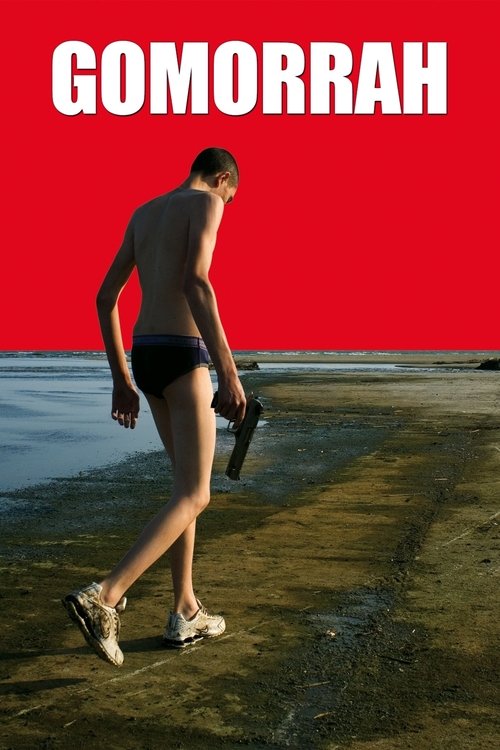
Gomorrah
2008 · Matteo Garrone
Io Capitano put the migrant crossing at the center of Oscar season and of the recurring "who gets to tell migration stories" argument.
When you want the hard truth instead of the myth — a challenging, unsparing watch for a night when you're ready to sit with something bleak and real. Not comfort viewing, and all the more powerful for it.
What it's about
Five loosely connected stories trace how the Camorra — the crime network of Naples and the surrounding region — seeps into every corner of ordinary life: a timid money-runner in the housing projects, teenage boys itching to matter, a tailor in the garment trade, men in the toxic-waste business. There's no godfather here and no rise-and-fall arc, just people trying to survive inside a system that owns everything around them.
The experience
It's cold water thrown on every gangster fantasy you've absorbed — flat, immersive, almost documentary in feel, with violence that arrives suddenly and without ceremony. It doesn't thrill you; it hollows you out, and it stays with you for days.
The craft
Matteo Garrone shoots on real locations with a roving, ground-level camera and largely unknown faces, refusing the genre's usual glamour at every turn — no swagger, no anthems, no charismatic kingpins. The bleached concrete of the Naples housing projects becomes a character in itself. Adapted from Roberto Saviano's explosive nonfiction exposé.
Why it matters
A sensation at Cannes and a landmark of modern European cinema, it redefined how organized crime could be shown on screen — as an economy and an ecosystem rather than a family saga — and cast a long shadow over the crime films and series that followed.
Snapshot
Gomorrah (Gomorra) is the film that broke the spell of the mob movie. For three decades the dominant cinematic image of organized crime had been operatic, elegiac, and seductive — the dynastic grandeur of Coppola, the kinetic glamour of Scorsese, the rise-and-fall myth of De Palma's Scarface. Matteo Garrone's adaptation of Roberto Saviano's 2006 nonfiction exposé refuses all of that. It strips the genre of charisma, narrative arc, and moral clarity, and replaces them with a flat, ground-level, almost anthropological account of how the Camorra — the crime network of Naples and the surrounding Campania region — saturates ordinary life: the housing projects, the garment trade, the toxic-waste economy, the corner grocery, the bedrooms of teenage boys. Structured as five loosely braided stories that almost never intersect, the film argues through its very form that the Camorra is not a story with protagonists but a system without an outside. It won the Grand Prix at the 2008 Cannes Film Festival and became, almost immediately, the reference point for a new register of European crime cinema: the genre stripped of myth and returned to sociology.
Industry & production
The film's origin is inseparable from the phenomenon of its source. Roberto Saviano's book Gomorra (2006) was an unusual hybrid of investigative journalism, memoir, and literary reportage that named names, mapped clan economies, and detailed the Camorra's penetration of legitimate industry. It became a national and then international bestseller, and it made Saviano a marked man: following published threats he was placed under permanent police protection and has lived under guard ever since. The film therefore arrived freighted with civic urgency and real danger, and that context shaped both its reception and its refusal to glamorize.
Garrone, who had built a reputation through small, idiosyncratic features such as L'imbalsamatore (The Embalmer, 2002) and Primo amore (2004), was an unexpected steward for so charged a property, and his outsider-to-the-material sensibility — observational, unsentimental, drawn to grotesque or marginal milieus — proved decisive. The adaptation was built by an unusually large writing team: Garrone worked with Maurizio Braucci, Ugo Chiti, Gianni Di Gregorio, and Massimo Gaudioso, with Saviano himself among the credited screenwriters. The decision to fracture the book's sprawling material into five discrete narrative strands, rather than forge a single protagonist's throughline, was the central dramaturgical choice and the source of the film's distinctive shape.
Casting mixed a few professionals — most notably Toni Servillo, then emerging as one of Italy's finest screen actors, and Gianfelice Imparato — with a large body of non-professionals drawn from the Neapolitan region and from the very neighborhoods depicted. Production centered on Scampia, the deprived northern periphery of Naples, and above all on the Vele di Scampia, the notorious "Sails," vast wedge-shaped public-housing megastructures whose decaying walkways and courtyards become the film's defining landscape. Shooting in such locations carried genuine risk and required local accommodation; the film's grounding in actual Camorra territory is part of its authority. (I won't cite specific budget or box-office figures I cannot verify, but the relevant industry fact is that the film became a major international art-house success and Italy's most prominent cultural export of its year.)
Technology
Gomorrah is technologically self-effacing by design. It was shot largely handheld with available or naturalistic light, in a documentary idiom that subordinates every technical choice to the impression of unmediated observation. I won't assert a precise capture format I can't confirm, but the texture on screen — grainy, desaturated, often underlit, attentive to the concrete and sodium-light palette of the projects — is the antithesis of glossy genre filmmaking. The camera frequently behaves as if it has wandered into a real situation rather than staged one: framings are imperfect, focus is functional rather than beautified, and the apparatus never announces itself. Where the contemporaneous mob film leaned on crane moves, designed lighting, and polished coverage, Garrone's production used the rougher tools of reportage to manufacture a sense of having stolen footage from life. The technology, in other words, is in service of an aesthetic of withdrawal.
Technique
Cinematography
The cinematography is by Marco Onorato, Garrone's longtime collaborator, and it is the film's most discussed formal achievement. Onorato works in a register of restrained, often handheld observation, favoring long lenses and a roving, watchful camera that keeps its distance even in moments of violence. The palette is muted and concrete-gray, the light frequently flat and ambient. Crucially, the camera declines to dramatize: killings happen abruptly, at the edges of frames, without the build-up, slow motion, or musical underscoring that conventional cinema uses to confer meaning on death. This refusal to aestheticize brutality is the visual ethic of the whole film — violence as banal interruption rather than spectacle. The architecture of the Sails is shot to emphasize entrapment: deep, vertiginous compositions of stacked walkways and enclosed courtyards turn the housing project into a visual metaphor for a closed system.
Editing
The editing, by Marco Spoletini (another regular Garrone collaborator), governs the film's boldest decision: the interweaving of five stories that share a world but almost never a scene. The cross-cutting is deliberately undramatic. Rather than accelerating toward convergence — the payoff a conventional multi-strand structure would promise — the assembly lets the strands run parallel and mostly unresolved, so that the cumulative effect is breadth rather than climax. Within scenes, the cutting is sparing and observational, holding on actions longer than comfort allows and declining the rhythmic montage that genre violence usually invites. The structure asks the viewer to do the synthesizing work; the film withholds the connective tissue that would turn a system into a plot.
Mise-en-scène / staging
Garrone's staging is rooted in real, found environments and in the choreography of ordinary activity within them. The Sails are not a set but a location, and the blocking exploits their geography — the way money, drugs, and bodies move through stairwells, balconies, and sightlines under constant surveillance. Across the five strands the staging builds a cross-section of an economy: the clandestine tailoring workshop where haute-couture garments are sewn for a pittance; the quarries and farmland where toxic waste is illegally dumped; the apartment-block drug market run with bureaucratic routine; the arms cache where two boys play at being gangsters. Garrone composes these milieus with an ethnographer's attention to procedure — how a payment is made, how waste is buried, how a dress is measured — so that the texture of work and transaction carries the film's argument. The grotesque and the mundane sit side by side, a tonal signature carried over from his earlier films.
Sound
Gomorrah is notable for what it largely withholds: a conventional orchestral score that would cue emotion and confer tragic weight. Instead it leans on ambient sound, the acoustic reality of its locations, and source music — including the neomelodica Neapolitan pop that forms the genuine cultural soundtrack of these neighborhoods. The relative absence of non-diegetic scoring is itself a meaning-making choice: without music to instruct the audience how to feel, violence registers as flat fact rather than catharsis. (Accounts of the film's music credits vary and I won't attribute a specific composer I can't confirm; the salient, well-established point is the film's deliberate suppression of traditional underscoring.) The sound world is Neapolitan dialect — the film is performed and was released in heavy napoletano, frequently subtitled even for Italian audiences — and that linguistic density is part of its claim to authenticity.
Performance
The performances blend professional precision with non-professional rawness. Toni Servillo, as Franco, the smoothly rationalizing broker of the toxic-waste strand, supplies a study in white-collar criminality — articulate, businesslike, morally insulated. Gianfelice Imparato plays Don Ciro, the timid bagman who distributes the clan's subsistence payments to dependent families, a portrait of fearful complicity. The non-professionals — among them Salvatore Abruzzese as the thirteen-year-old Totò, whose initiation into the clan is the film's most quietly devastating arc, and Marco Macor and Ciro Petrone as Marco and Ciro ("Pisellino"), the two Scarface-besotted teenagers who steal an arms cache and overreach — carry an unguardedness that no trained actor could counterfeit. Salvatore Cantalupo plays Pasquale, the gifted tailor whose attempt to moonlight for Chinese competitors becomes the film's most poignant strand. The casting strategy is itself an argument: these faces belong to the world being depicted.
Narrative & dramatic mode
The dramatic mode is observational realism pushed toward the systemic. Gomorrah is structurally anti-dramatic: it offers no single protagonist, no rising action toward a unifying climax, and no redemptive arc. Its five stories — the bagman, the boy, the two would-be gangsters, the waste broker and his apprentice, the tailor — are chosen to map the Camorra's vertical reach, from street-level drug economy to globalized industry, from childhood to white-collar middle age. They share characters only glancingly and rarely affect one another's outcomes, a deliberate frustration of the multi-plot convergence the audience has been trained to expect. The governing question is not "what happens to this person?" but "how does this system reproduce itself across every level of a society?" The result is closer to a literary cross-section or a sociological map than to a thriller; meaning accrues through accumulation and rhyme rather than through plot mechanics. The mode owes a clear debt to Italian neorealism, but it is neorealism without the humanist consolation — a realism of foreclosed possibility.
Genre & cycle
Gomorrah belongs to the crime film but defines itself against the genre's dominant tradition. The most explicit gesture is the two teenagers who quote and imitate Brian De Palma's Scarface (1983), wading into the surf and firing stolen weapons in their underwear in conscious mimicry of Tony Montana. Garrone stages their fantasy precisely to puncture it: the boys have absorbed the Hollywood myth of the gangster as self-made sovereign, and the film methodically demonstrates how that myth gets them killed. The picture thus operates as a critical counter-statement to the American mob movie — to Coppola's tragic grandeur and Scorsese's seductive energy — insisting that real organized crime offers no ascent, no romance, and no autonomy, only absorption. Within Italian cinema it stands in a lineage of anti-mafia and crime-and-society films, but it renovated that tradition for the twenty-first century and helped inaugurate a new cycle of unromantic European crime realism.
Authorship & method
The film is a strong statement of Garrone's authorial method even as it adapts another man's reportage. His recurring preoccupations — marginal and grotesque milieus, the texture of ordinary work and transaction, an observational refusal to sentimentalize — are all present, executed through a stable company of collaborators: cinematographer Marco Onorato and editor Marco Spoletini, both central to the look and rhythm of his cinema, and a writing team led with Maurizio Braucci, Ugo Chiti, Gianni Di Gregorio, and Massimo Gaudioso, alongside Roberto Saviano. The authorship is genuinely shared between Garrone's directorial sensibility and Saviano's journalistic authority; the film's power derives from the friction between a reporter's evidentiary commitment and a filmmaker's instinct for the concrete, near-documentary image. Garrone's method here — real locations, mixed professional/non-professional casts, dialect performance, suppressed scoring, fractured structure — constitutes a coherent aesthetic program rather than a set of incidental choices.
Movement / national cinema
Gomorrah is a landmark of Italian national cinema and was widely read as evidence of a vital reawakening of socially engaged Italian filmmaking after years in which the country's cinema had lost international prominence. It descends most directly from neorealism — the De Sica/Rossellini tradition of non-professional actors, real locations, and attention to the materially dispossessed — while updating that inheritance for a globalized criminal economy and draining it of neorealism's residual humanism. It is also legible within a broader regional formation of Neapolitan cinema and, alongside Paolo Sorrentino's Il Divo (which shared the 2008 Cannes competition and won the Jury Prize), it marked a moment when Italian cinema reasserted itself on the world stage through politically charged, formally ambitious work.
Era / period
The film is a document of the mid-2000s, the years of Saviano's reporting, when the Camorra's diversification into legitimate industry — textiles, construction, and above all the illegal disposal of hazardous and toxic waste across Campania — had become an acute public scandal. The waste-dumping strand connects the film to one of the region's defining environmental and public-health crises, the contamination of agricultural land later associated with the so-called "Land of Fires." Made and released in the context of the book's sensation and Saviano's enforced concealment, the film carries the charge of a live political emergency rather than a historical reconstruction; it speaks to a moment when the relationship between organized crime, globalized capitalism, and environmental devastation had become impossible to ignore.
Themes
The dominant theme is systemic entrapment — the foreclosure of the "outside." Across all five strands the Camorra functions less as a gang than as the total environment in which life is conducted; there is no clean economy, no uncorrupted institution, no exit. Around this cluster several others: the corruption of childhood, embodied in Totò's almost unremarked passage from grocery delivery to clan loyalty, dramatizing how the system reproduces itself by consuming the young; the lethal seduction of the gangster myth, exposed through the two Scarface-quoting boys; the interpenetration of crime and legitimate global capitalism, from counterfeit haute couture to international waste trafficking, which collapses the comfortable distinction between the criminal underworld and the lawful economy; complicity and the impossibility of neutrality, as figures like Don Ciro and the tailor Pasquale discover that even passive participation implicates and endangers them; and the banality of violence, rendered abrupt, unscored, and meaning-resistant. The film's deepest argument is structural: evil here is not a charismatic individual but a distributed condition.
Reception, canon & influence
Gomorrah was received as a major critical event. It won the Grand Prix at Cannes in 2008 and went on to dominate the European Film Awards, where it was named Best Film, and to sweep major Italian prizes; it became a widely cited international success and one of the most acclaimed European films of its decade. It also became the focus of a notable awards controversy when, selected as Italy's official submission for the Academy Award for Best Foreign Language Film, it failed to secure a nomination — an omission frequently cited as evidence of the Academy's blind spots regarding formally adventurous world cinema. Critical reservations, where they appeared, tended to concern the demands of its fractured structure and the deliberate emotional flatness that some viewers found alienating — though that flatness is precisely the point.
Looking backward, the film's influences are clear: Saviano's reportage as its evidentiary spine; Italian neorealism as its formal and ethical ancestor; the anti-mafia film tradition; and, as a negative model held up for critique, the American gangster canon, Scarface above all. Looking forward, its influence has been substantial and durable. It established a template of unromantic, systemic crime realism that reverberated through European film and, especially, prestige television. It generated a major franchise: the Sky Italia series Gomorra (2014–2021), developed from the same source world, became an international phenomenon and a touchstone of the global wave of morally unsentimental crime serials. For Garrone, it was the breakthrough that secured his international standing and enabled the run of distinctive films that followed — Reality (2012), Tale of Tales (2015), and Dogman (2018). More broadly, Gomorrah helped shift the prestige crime drama away from myth and toward sociology, demonstrating that the genre could indict the very romance it had so long traded in.
A Deleuzian reading
A man is shot in a stairwell and the camera is already drifting somewhere else.
The full Deleuzian reading of Gomorrah →
Reception
It stormed Cannes in 2008, taking the Grand Prix and getting hailed as the anti-Godfather that stripped every ounce of glamour from the mafia movie; nearly two decades on it's settled in as the landmark of the 2000s Italian cinema revival and the film that made 'Gomorrah' a global brand.
How Gomorrah was received, from release to now →
Influences: the films it descends from and the films it influenced
- Rome, Open City (1945) — Founding neorealist method Garrone inherits wholesale: shooting in real war-scarred locations with mixed professional/non-professional casts and a documentary indifference to dramatic shaping.
- Paisan (1946) — Episodic braided structure of discrete, non-converging strands surveying a society — the direct formal ancestor of Gomorrah's five-strand mosaic that refuses a single protagonist.
- Bicycle Thieves (1948) — Neorealism's ethic of using the street and the ordinary worker as evidence, suppressing melodrama so economic systems, not heroes, drive events.
- Salvatore Giuliano (1962) — The investigative 'cine-inchiesta' template: anti-dramatic, fractured chronology built from documentary reportage to anatomize organized crime as a systemic, political structure rather than a personal saga.
- Le Mani sulla Città (1963) — Rosi's analysis of corruption-as-economy — building speculation, contracts, waste — anticipates Gomorrah's tracing of the camorra through haute couture, toxic-waste dumping, and concrete.
- Scarface (1983) — The negative model held up for critique: Gomorrah literally quotes Tony Montana as the aspirational fantasy that seduces and destroys the wannabe gangsters Marco and Ciro.
- La Battaglia di Algeri (1966) — Newsreel-grain handheld immediacy and crowd ethnography that makes staged events read as captured documentary — the observational register Marco Onorato adopts.
- Pixote (1980) — Casting actual slum children and letting their unperformed presence carry the indictment — the nonprofessional youth-on-the-margins ethnography behind Totò's strand.
- City of God (2002) — Favela ethnography with nonprofessional locals and braided crime strands across generations — the same sociological-not-mythic approach, though Gomorrah strips out its kinetic stylization.
- Pusher (1996) — Garrone applies Pusher's anti-glamour formal program — 16mm-textured digital photography, small-time criminal perspective, non-professional performers in found industrial locations, ambient sound, practical lighting — to the Neapolitan Camorra, extending the compression narrative across multiple interlocking protagonists.
- Mamma Roma (1962) — Inherits the Accattone/Mamma Roma iconography of the Italian urban periphery, casting locals and shooting the concrete borgate as a fallen sacred geography of the sottoproletariato.
- Pusher 3 (2005) — Immersive handheld, available-light multi-strand realism that plants the camera inside a migrant-inflected criminal economy without genre uplift or moralizing.
- Gomorra (TV series) (2014) — Extends the same source world into long-form, keeping the dialect performance, suppressed romance, and unsentimental systemic crime while reintroducing serial dramatic propulsion.
- Suburra (2015) — Italian crime built on Gomorrah's template of crime-as-real-estate-and-politics nexus, dialect realism, and morally flattened ensemble.
- A Ciambra (2017) — Pushes the mixed-cast ethnography further by casting a real Romani family as themselves in real locations, inheriting Gomorrah's documentary-fiction friction.
- Mediterranea (2015) — Handheld observational immersion in a southern-Italian underclass economy (migrant labor), using nonprofessionals and suppressed scoring in Gomorrah's evidentiary mode.
- Capharnaüm (2018) — Casts real slum children living the depicted conditions and lets ethnographic observation, not plot mechanics, build the systemic indictment.
- Sicario (2015) — Carries forward the post-Gomorrah shift of the crime film toward sociology of an organized-crime system — supply chains, institutions, expendable foot soldiers — over individual mob mythology.
- Sicario: Day of the Soldado (2018) — Sollima's formative milieu: the procedural, deglamorized depiction of organized crime as a system of labor and recruitment, including youths drawn into violence.
- Dheepan (2015) — Films a single housing complex (the Vele di Scampia) as operational terrain — a map of sightlines, deliveries, lookouts and dead ends — using residents and non-professionals, which is precisely how Dheepan surveys its estate before the line is ever drawn.
- Dhurandhar (2025) — Stages killings at observational distance with no musical preparation and no coverage of the reaction, treating the criminal enterprise as logistics — the anti-operatic counterweight to Dhurandhar's crane work.
- Reality (2012) — Garrone, Onorato, and Spoletini reapply the Neapolitan found-location method and grotesque-milieu observation to the fantasy of celebrity rather than crime.
- Dogman (2018) — Continues the desaturated-concrete palette and entrapment architecture of a degraded peripheral landscape, with a nonprofessional-flavored cast in a marginal trade.
- Fish Tank (2009) — Contemporaneous European social realism using a nonprofessional lead, boxed-in estate architecture, and handheld proximity to render entrapment by environment.
- Mesrine: Killer Instinct (2008) — Garrone and Richet converge in the same release year on the European counter-movement to Hollywood crime glamour: 35mm grain, wide-angle proximity to non-theatrical violence, the criminal milieu rendered as unglamourized social ecology rather than individual pathology.
- A Prophet (2009) — Garrone and Audiard simultaneously develop the crime film as a non-professional-cast procedural built on ambient sound, photochemical handheld observation, and institutional space as spatial argument — Gomorrah's Neapolitan housing projects functioning as an exterior prison with identical spatial-power logic, the camorra hierarchy a visible analog of the penitentiary's.
- Outrage (2010) — Garrone treats the Camorra as a bureaucratic system depicted through institutional spaces, ensemble suppressed menace, and non-escalating confrontation staging—the same organizational-not-psychological proceduralism Kitano employs, though in a neorealist Italian register rather than a stylized Japanese one.
- Athena (2022) — Uses the brutalist housing estate (Le Vele) as choreographed architecture of menace, staging crime within a single concrete complex whose walkways and voids structure the action.
- Salaam Bombay! (1988) — Updates the neorealist tradition with non-professional casting and an observational, anti-glamorizing camera embedded in real criminal geography, refusing catharsis exactly as Salaam Bombay! does.
- Gangs of Wasseypur - Part 2 (2012) — A parallel de-glamorized regional-crime realism — dialect-heavy, place-specific, embedding violence in the mundane economics of an illicit resource trade, as GoW does with coal.
- Elite Squad (2007) — Dissolves crime drama into observational documentary texture through embedded handheld and ambient diegetic sound, the parallel European branch of the same favela/periphery realism.
- Gangs of Wasseypur - Part 1 (2012) — Parallel practice of regional-dialect crime realism shot in documentary-style available light with non-professional locals, refusing gangster glamour for ethnographic texture.
- Eastern Promises (2007) — Sibling extending the anti-glamour ethic to European organized crime — de-heroized, quasi-documentary staging where criminal economies grind on impersonally, the tonal cousin to Eastern Promises' unromantic vory bureaucracy.
Similar films
- Bicycle Thieves (1948) — influence & lineage
- City of God (2002) — influence & lineage
- The Battle of Algiers (1966) — influence & lineage
- Scarface (1983) — influence & lineage
- Rome, Open City (1945) — influence & lineage
- Salvatore Giuliano (1962) — influence & lineage
- The Godfather (1972) — shared sensibility
- GoodFellas (1990) — shared sensibility
All the films related to Gomorrah →