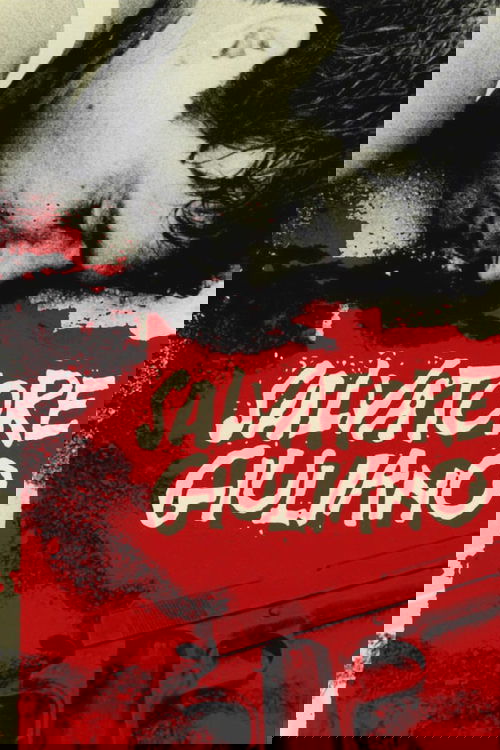
Salvatore Giuliano
1962 · Francesco Rosi
For when you want to play detective with history — a film to argue about afterward, not to unwind to. Choose it on a night you're up for a challenge and want to come out sharper than you went in.
What it's about
A bandit's bullet-riddled body turns up in a Sicilian courtyard, and the press swarms in wanting the real story: how did a twenty-seven-year-old outlaw become both Italy's most wanted criminal and a folk hero? Instead of a straight biography, the film circles his life like an investigation — the separatist uprising he fought for, the massacre pinned to his men, the politicians, police, and mafia who used him and then let him fall. The man himself stays at the edges of the frame; what you're really watching is the machinery around him.
The experience
Cool-headed and gripping in the way a great piece of investigative journalism is gripping — it withholds easy answers and makes you assemble the truth yourself. The fractured timeline demands attention, and the reward is a slow-building anger at how neatly power covers its tracks.
The craft
Shot in stark black and white on the actual Sicilian locations, often with locals rather than professional actors, so the towns and hillsides carry the weight of testimony. The bold structure — starting from the corpse and reconstructing outward — turns editing itself into an act of inquiry. The sun-bleached widescreen landscapes are worth a big screen.
Why it matters
It effectively invented the Italian cinema of inquiry — the political film as public investigation — and made Francesco Rosi the model for a generation of filmmakers who treated the camera as a tool for interrogating state power.
Snapshot
Salvatore Giuliano is the film that crystallized a new mode of Italian cinema: the cinema d'inchiesta, or cinema of inquiry. Ostensibly the biography of Sicily's most famous postwar bandit, it is in fact a forensic anatomy of the political machinery surrounding his life and death — and, pointedly, a film in which its title character is almost never alive on screen. Rosi opens with Giuliano's bullet-riddled corpse in a Castelvetrano courtyard, and from that fixed point the film circles outward and backward, reconstructing the separatist insurgency of the late 1940s, the massacre at Portella della Ginestra, the bandit's collusion with and abandonment by the Sicilian and national authorities, and the courtroom and prison aftermath. The result is less a portrait than an autopsy of a cover-up, structured to make the viewer feel the unknowability at the center. Shot on the actual locations in and around Montelepre with the local population as cast, in a high-contrast documentary register, it announced Rosi as the major political filmmaker of his generation and supplied a template that would run through Costa-Gavras, Gillo Pontecorvo, and the entire international tradition of the political reconstruction film.
Industry & production
The film was made within the orbit of producer Franco Cristaldi's Vides company, in association with Lux Film, a configuration typical of the ambitious, socially engaged Italian productions of the period that sought to marry artistic seriousness with the resources of the established industry. Rosi had served his apprenticeship as an assistant to Luchino Visconti — notably on La terra trema (1948), itself a Sicilian location film using non-professionals — and to Michelangelo Antonioni, and he had directed two prior features (La sfida, 1958, and I magliari, 1959) before undertaking Salvatore Giuliano as his decisive statement.
The production's defining decision was to shoot in Sicily itself, in Montelepre and the surrounding territory where the events had unfolded barely a decade earlier, and in Castelvetrano where Giuliano died. The townspeople — many of whom had lived through the bandit years — appear as themselves or in roles drawn from their own experience, including the black-clad women whose collective mourning gives several sequences their weight. This was a delicate undertaking: the events were recent, the wounds open, and the official account of Giuliano's death contested. Rosi and his collaborators researched the case extensively, treating trial records, press coverage, and local testimony as raw material. The film's mode of address — its refusal to invent a tidy explanatory drama — flows directly from this investigative posture.
The picture premiered in 1962 and earned Rosi the Silver Bear for Best Director at the Berlin International Film Festival, an early confirmation of its international standing.
Technology
Salvatore Giuliano was made with the standard professional apparatus of early-1960s Italian production — 35mm black-and-white photography, post-synchronized sound in the prevailing Italian practice of dubbing rather than location recording, and conventional studio finishing. There is no technological novelty in the equipment; the film's innovation is one of method and aesthetic rather than apparatus. What it does is press existing tools toward a documentary illusion: deep-focus black-and-white stock exploited for its newsreel associations, real locations standing in for any reconstructed set, and natural Sicilian light and landscape used as expressive resources. The post-synchronized soundtrack, far from a limitation, allowed Rosi to control the dense layering of dialect voices, official pronouncements, and ambient sound that the film deploys. In short, the technology is unremarkable; the discipline with which it is bent toward an austere realism is the point.
Technique
Cinematography
The photography is by Gianni Di Venanzo, one of the supreme black-and-white cinematographers of the Italian postwar era, whose work for Antonioni and later Fellini placed him at the center of the period's visual achievement. In Salvatore Giuliano Di Venanzo forges a style of stark, chalky contrast — sun-bleached whitewashed walls, the parched stone of the Sicilian hills, black-garbed figures cut sharply against bright ground. The register deliberately evokes the photojournalism and newsreel imagery through which most Italians would have known the Giuliano affair, lending the reconstruction an air of recovered document. Compositions favor the wide view in which human figures are subordinated to landscape and architecture — the bandit's men as small shapes on rocky hillsides, crowds dispersed across the open ground at Portella della Ginestra. The famous overhead and elevated angles render events with an almost cartographic detachment, refusing the close identification of conventional biography.
Editing
The editing — by Mario Serandrei, the great Italian editor associated with Visconti — is the film's structural engine and its most influential single feature. Rather than a linear chronology, the film advances through a mosaic of time frames: the discovery of the corpse, the separatist campaign, the massacre, the disintegration of the band, the Viterbo trial, and the prison death of Giuliano's lieutenant Gaspare Pisciotta are interleaved so that cause and consequence are continually held in tension. Transitions are frequently abrupt and unexplained, forcing the viewer to assemble the case as an investigator would, from fragments that do not announce their relations. The cutting withholds the connective tissue of ordinary narrative — establishing dialogue, expository bridges — and in doing so reproduces the experience of confronting an event whose truth has been deliberately obscured. This editorial logic, in which structure itself argues a thesis about hidden power, is Rosi's lasting formal contribution.
Mise-en-scène / staging
Rosi stages mass action with a documentarian's eye and a tragedian's sense of scale. The Portella della Ginestra sequence — the May Day 1947 massacre in which gunfire was opened on a gathering of peasants — is choreographed across real open ground, the panic and scattering rendered in long shots that emphasize collective experience over individual heroics. The recurring motif of the mourning women, advancing as a black chorus, gives several passages the gravity of ritual. Interiors — the courtroom at Viterbo, the carabinieri offices, the prison — are staged with a procedural flatness that contrasts with the elemental Sicilian exteriors. Throughout, Giuliano himself is kept at a distance: glimpsed, reported, mythologized, but rarely brought into intimate view, a staging decision that makes absence the film's central presence.
Sound
In keeping with Italian practice the film is post-synchronized, and Rosi uses the soundtrack to thicken the documentary texture. Sicilian dialect, official Italian, the formal language of the court, and the cries of the bereaved coexist, marking the gulf between local reality and state administration. The score is by Piero Piccioni, deployed with restraint; the film leans more on the expressive use of silence, ambient sound, and the human voice — keening, testimony, command — than on continuous musical underscoring. Sound, like image, is bent toward the evidentiary rather than the emotive.
Performance
The cast is largely non-professional, drawn from the Sicilian communities where the film was shot, in the neorealist lineage Rosi inherited from Visconti's La terra trema. This casting yields faces and bodies that carry the weight of lived history rather than performed character. Frank Wolff, a more recognizable presence, plays Pisciotta, the lieutenant whose betrayal and subsequent poisoning in prison form one of the film's tragic spines. The performances are kept deliberately undemonstrative; Rosi suppresses the star mechanics of biography so that no single figure — least of all Giuliano, who is barely individuated — can absorb the film into conventional identification. The effect is a collective protagonist: a community, and beyond it a political order, rather than a hero.
Narrative & dramatic mode
The film's mode is investigative and analytic rather than dramatic in the classical sense. It begins at the end — the corpse — and proceeds by reconstruction, assembling its account from multiple, non-chronological vantage points without ever delivering the reassurance of a definitive explanation. Crucially, Rosi declines to dramatize the contested facts he cannot verify: the precise circumstances of Giuliano's death, the identity of those who ordered the Portella massacre, the full architecture of complicity between the bandit and the authorities are left as open questions, marked as unknown rather than filled in with invention. This is a drama of evidence and inference, modeled on the inquest and the trial, and it asks the spectator to occupy the position of a juror confronting incomplete testimony. The withholding is itself the argument: that the truth was buried by interested parties, and that an honest film can only trace the shape of the absence.
Genre & cycle
Salvatore Giuliano sits at the intersection of the crime film, the historical reconstruction, and the political exposé, but its true significance is as the founding work of the Italian cinema politico / cinema d'inchiesta — the cinema of investigation — that Rosi himself would extend across the 1960s and 1970s with films such as Le mani sulla città (1963), Il caso Mattei (1972), Lucky Luciano (1973), and Cadaveri eccellenti (1976). Where the conventional gangster biography romanticizes its outlaw, Rosi's film systematically de-romanticizes Giuliano, dissolving the bandit-hero myth into an analysis of the structures that produced and then disposed of him. It thereby inaugurates a cycle in which the investigation of a real crime becomes the means of indicting a political and economic order.
Authorship & method
The film is the foundational statement of Francesco Rosi's authorship, defined by a method that fuses neorealist location practice with a rigorous, almost juridical structure of inquiry. From Visconti, his mentor, Rosi took the commitment to real places and non-professional faces and the southern-Italian social subject; he transformed these into an instrument of political analysis. His method rested on extensive documentary research — court records, journalism, local testimony — and on a structural daring that made the editing table the site of the film's thesis.
Rosi's authorship here is inseparable from his collaborators. The screenplay was developed by Rosi with frequent collaborators including the formidable Suso Cecchi d'Amico, Enzo Provenzale, and Franco Solinas — the last of whom would carry the investigative-political screenplay into The Battle of Algiers (1966) and beyond, making Salvatore Giuliano a key node in the writing of postwar political cinema. Gianni Di Venanzo's photography supplied the documentary-modernist image; Mario Serandrei's editing supplied the fragmented architecture; Piero Piccioni's music supplied the restrained scoring. The film is thus an auteur work in the fullest sense — unmistakably Rosi's in vision and politics — while drawing on the finest craft talent of the Italian industry.
Movement / national cinema
Salvatore Giuliano belongs to Italian national cinema at a pivotal moment of transition. It descends directly from neorealism — its locations, non-actors, and social conscience are the legacy of Rossellini, De Sica, and above all Visconti — but it pushes that inheritance into a new, more analytic and overtly political phase. Made in the same early-1960s ferment that produced the Italian art-cinema modernism of Antonioni and Fellini and the emergence of figures like Pasolini and Bertolucci, it represents the specifically committed and investigative current of that renaissance. It is also, emphatically, a film of the Italian South — part of the long cinematic reckoning with the Mezzogiorno, with Sicily, and with the unresolved relationship between the Italian state and its peripheries.
Era / period
The film addresses a precise and traumatic period of Italian history: the immediate postwar years from roughly 1945 to the early 1950s, when Sicilian separatism, banditry, and the consolidation of the postwar Christian Democratic order intersected violently. The Portella della Ginestra massacre of 1 May 1947, in which a Labor Day gathering of peasants and leftists was fired upon, stands at the film's moral center, emblematic of the Cold War suppression of the Italian left and the murky alliances among bandits, landowners, organized crime, and the state. Made in 1962, fifteen years after the events, the film reckons with a past still politically live — the trials and their unanswered questions had unfolded within recent memory — and it implicitly addresses its own moment's continuities with that buried history.
Themes
The film's governing theme is the opacity of power: the way responsibility for political violence is diffused, concealed, and finally rendered unaccountable. Giuliano functions as an instrument — useful to separatists, to anti-communist interests, to the authorities — and then as an inconvenience to be eliminated; the film studies how such figures are made and unmade by forces above them. Allied themes include the tragedy of the Sicilian South, caught between archaic banditry and a modern state that exploits it; the unreliability of official truth and the labor of reconstructing what has been suppressed; the collective grief of communities subjected to violence, embodied in the mourning women; and the betrayal of the postwar promise of justice, figured in the massacre and in Pisciotta's poisoning before he can testify fully. Above all, the film dramatizes absence — the missing center where a clear account should be — as the characteristic condition of political crime.
Reception, canon & influence
Critically, Salvatore Giuliano was recognized at once as a major achievement, its standing confirmed by the Silver Bear for Best Director at Berlin in 1962 and by its enduring place in the canon of Italian political cinema and of Rosi's body of work; it is widely regarded as one of the foundational films of the genre and one of Rosi's masterpieces. (Detailed contemporary box-office figures and the full spread of first-run reviews are beyond what can be reliably summarized here, and I won't invent them.)
Looking backward, the film draws on the neorealist tradition of location shooting and non-professional casting — Visconti's La terra trema is the proximate model — and on the documentary and photojournalistic culture through which the Giuliano affair had entered public consciousness. Looking forward, its influence is profound and well-documented in the lineage of the political reconstruction film. Through screenwriter Franco Solinas it connects directly to Gillo Pontecorvo's The Battle of Algiers (1966), which shares its newsreel aesthetic and its anatomy of insurgency and state power. Its investigative structure and its fusion of real events with rigorous formal analysis anticipate Costa-Gavras's Z (1969) and the broader European political-thriller cycle. Within Italy, it launched Rosi's own sustained project of the film-inchiesta and shaped a generation of politically engaged filmmakers. Its reputation has only grown with time, sustained by its restoration and circulation through art-house and home-video channels, and it remains a touchstone for any cinema that seeks to investigate, rather than merely dramatize, the hidden workings of power.
A Deleuzian reading
Start where Rosi starts: a body face-down in a courtyard in Castelvetrano, a rifle and a handgun arranged beside it.
The full Deleuzian reading of Salvatore Giuliano →
Reception
It arrived as a sensation — Silver Bear for Best Director at Berlin in 1962 and a founding text of Italian political cinema — then drifted into 'respected but unseen' territory abroad, until Criterion and Martin Scorsese's vocal championing restored it as essential viewing.
How Salvatore Giuliano was received, from release to now →
Influences: the films it descends from and the films it influenced
- La terra trema (1948) — Rosi (Visconti's assistant) took the on-location Sicilian shooting, non-professional villagers cast as themselves, and post-synchronized dialect speech directly from this film and repurposed them as instruments of forensic analysis rather than lyrical realism.
- Rome, Open City (1945) — Established the neorealist newsreel-grain location aesthetic and the collective civilian protagonist that Salvatore Giuliano inherits, including the chorus of grieving women and the documentary treatment of state violence in real streets.
- Paisà (1946) — Its episodic, geographically-scattered mosaic structure — discrete fragments that together anatomize a national trauma rather than follow one hero — prefigures Rosi's non-linear assembly of the Giuliano affair from dispersed testimonies.
- Citizen Kane (1941) — The investigative architecture built on a withheld central figure reconstructed through fragmented, conflicting testimony and a corpse-first/begins-at-the-end framing is the structural template Rosi adapts to a real political assassination.
- The Wages of Fear (1953) — Demonstrated a tense, semi-documentary treatment of exploited Southern men and harsh sun-baked landscapes that fed Di Venanzo's hard high-contrast image and Rosi's unsentimental view of poverty as political condition.
- The Battle of Algiers (1966) — Written by Salvatore Giuliano co-writer Franco Solinas, it carries forward the newsreel grain, non-professional collective casting, and the anatomy-of-insurgency-versus-state-power structure into the anti-colonial reconstruction film.
- Hands Over the City (1963) — Rosi's immediate next film extends his cinema-di-inchiesta method — documentary research, juridical structure, the editing table as thesis — from rural banditry to urban real-estate corruption, with Di Venanzo again supplying the modernist documentary image.
- The Mattei Affair (1972) — Directly reprises the Salvatore Giuliano template — a powerful dead man reconstructed through fragmented investigation, withheld and opaque at the center — applied to the unexplained death of the ENI oil chief.
- Illustrious Corpses (1976) — Pushes the film-inchiesta into the conspiracy thriller, retaining the opacity-of-power theme, elevated architectural framings, and the investigation that dissolves rather than resolves into the machinery of the state.
- Z (1969) — Builds the European political thriller on Rosi's fusion of a real assassination with rigorous reconstructive editing, accelerating the fragmented-testimony method into propulsive procedural montage.
- Investigation of a Citizen Above Suspicion (1970) — Part of the same Italian politically-engaged cycle Rosi launched, it interrogates the opacity and impunity of state power through a destabilized, non-linear structure withholding moral resolution.
- JFK (1991) — Inherits the begins-with-the-killing, mosaic-of-contradictory-testimony reconstruction of a political assassination, mixing pseudo-documentary monochrome footage with investigation to dramatize the unknowable workings of hidden power.
- Zodiac (2007) — Carries the forensic-procedural ethos forward — an obsessive accretion of documentary detail around a withheld, never-resolved central figure, privileging the act of investigation over catharsis or solution.
- La Grazia (2025) — Founds the Italian investigative political-cinema tradition of dissecting the machinery of office and clemency, the documentary-procedural backbone Sorrentino inherits and turns inward.
- The Godfather Part II (1974) — Rosi's semi-documentary treatment of Sicilian organized crime as a social institution — actual locations, non-professional faces, a sociological rather than romantic gaze — provides the visual and tonal grammar for Part II's Sicilian prologue and its refusal to aestheticize poverty or violence.
- La Haine (1995) — Rosi's overhead shots that locate an individual body within a systemic geography — the drone-like distance that reveals the political logic of a space — are the compositional logic behind La Haine's crane surveys of Chanteloup-les-Vignes, which position the protagonists within an architecture of exclusion before descending to street level.
- Serpico (1973) — Rosi's method of reconstructing a real political death through a splintered, evidence-based chronology that refuses emotional resolution—treating institutional crime as archaeology rather than drama—establishes the Italian political-cinema template that Salt and Lumet translate directly into Serpico's episodic structure, where years of career are compressed into implicating fragments rather than dramatized confrontations.
- The Confession (1970) — Also scripted by Franco Solinas, it shares the investigative-political screenplay DNA — dossier-derived structure and the dramatization of state coercion through documented procedure rather than melodrama.
- The Conformist (1970) — Extends the politically-charged Italian art film with non-chronological reconstruction of a compromised man, sharing the period anatomy of fascism-and-power assembled from temporally fragmented blocks.
- The Battle of Chile (1975) — Applies the cinema-di-inchiesta logic to actual documentary footage, using elevated mass-action long shots and a collective protagonist to anatomize a coup as an analysis of class and state power.
- Rocco and His Brothers (1960) — Rosi, a Visconti assistant, pushes the same neorealism-into-art-cinema moment forward — post-synced ensemble realism on real Sicilian locations, the southern-migration question, now organized by a modernist non-linear inquiry.
- Mafioso (1962) — Released the same year, it likewise treats the Sicilian mafia as an impersonal social structure and web of silence rather than a crime spectacle, the sociological approach Mafioso pursues through comedy instead of inquiry.
Similar films
- Investigation of a Citizen Above Suspicion (1970) — influence & lineage
- Paisan (1946) — influence & lineage
- The Battle of Algiers (1966) — influence & lineage
- Rome, Open City (1945) — influence & lineage
- Il Sorpasso (1962) — often watched together
- 1900 (1976) — often watched together
- Raging Bull (1980) — often watched together
- Rashomon (1950) — shared sensibility