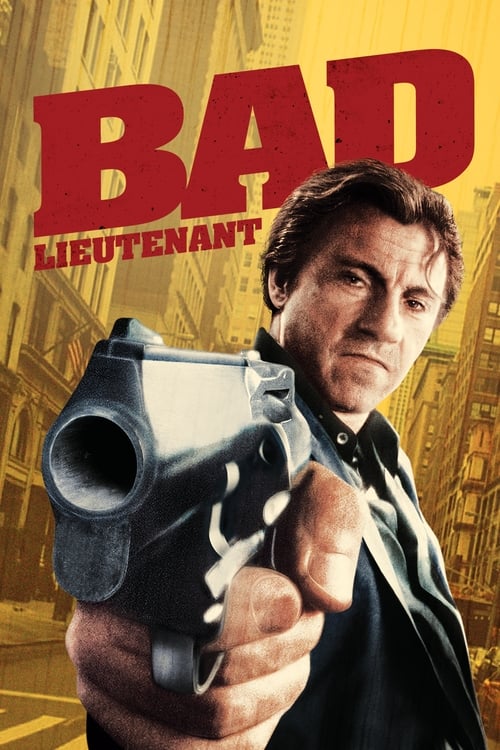
Bad Lieutenant
1992 · Abel Ferrara
For when you want to be shaken, not entertained — a dark night-of-the-soul film to sit with when you're ready for something extreme and sincere about guilt and grace. Firmly on the challenge end of the spectrum.
What it's about
An unnamed New York narcotics detective is coming apart — drugs, spiraling gambling debts on the baseball playoffs, and casual abuses of his badge at every turn. When he's assigned to the rape of a young nun, her response to the crime confronts him with a question of forgiveness he can't answer, and the case becomes a mirror he can't look away from.
The experience
Harrowing and raw, closer to a confession than a cop movie — long, unflinching scenes of a man hitting bottom, shot with a grimy intimacy that offers no relief. It's genuinely hard to watch in places, and that difficulty is exactly its power.
Performances
Harvey Keitel gives one of the most exposed performances in American film — howling, weeping, stripped literally and figuratively bare. It's fearless work that few actors would attempt, let alone survive.
The craft
Abel Ferrara shoots early-90s New York with a grubby, handheld immediacy that makes every scene feel caught rather than staged, and the script — co-written with Zoë Lund — structures the sleaze like a religious ordeal. Its NC-17 reputation is earned, but the shock serves the film's obsession with sin and the possibility of mercy.
Why it matters
A touchstone of the early-90s New York independent scene and the purest distillation of Ferrara's lapsed-Catholic cinema, its influence visible in every crime film that treats degradation as a spiritual question.
Snapshot
Bad Lieutenant is the most concentrated expression of Abel Ferrara's career-long obsession with sin and grace: a punishing, near-liturgical portrait of an unnamed New York narcotics detective (Harvey Keitel) sliding through drugs, gambling debt, sex, and abuses of his badge until the rape of a young nun confronts him with a question of forgiveness he cannot answer for himself. Co-written by Ferrara with Zoë Lund — herself a former Ferrara star and a presence in the film — it stands at the intersection of the New York independent scene of the early 1990s, the lapsed-Catholic strain of American cinema, and the deliberately abject end of the crime film. Its notoriety derives partly from content (it carried an NC-17 in the United States and includes Keitel's full-frontal nudity and unsimulated-seeming drug use) but its durability derives from Keitel's extraordinarily exposed performance and from Ferrara's willingness to treat damnation and redemption as literal subjects rather than metaphors. It is a small, cheap film with the ambitions of a Passion play.
Industry & production
The film was an independent production made well outside the studio system, produced by Edward R. Pressman — a long-standing backer of difficult American auteurs — together with Ferrara's regular collaborators, and released theatrically in 1992 (Aries Films is the distributor most often cited). It was made on a low budget; figures circulated in the press have hovered around the low single-digit millions, but precise, fully verified budget and gross numbers are not reliably documented and I will not invent them. What is clear from the production's character is that money was scarce and shooting was fast: the film was made on New York streets and in real-feeling interiors, with a small crew, in a manner closer to guerrilla filmmaking than to a conventional studio crime picture.
The defining industrial fact of Bad Lieutenant is its rating. The Motion Picture Association assigned it an NC-17, then still a young and commercially toxic category, and the film became one of the early test cases for whether a serious adult drama could circulate under that rating rather than being quietly buried or cut to an R. Ferrara released it uncut; in some markets an edited version circulated to reach venues that would not book an NC-17. The episode is part of the film's history as a flashpoint in the long American argument about the ratings board and the commercial viability of explicit adult content made for grown-ups rather than for exploitation. Keitel, then in the midst of a career resurgence (1992 also brought Reservoir Dogs), lent the project the credibility of a major actor willing to go to genuinely uncomfortable places.
Technology
Technically the film is unshowy by design. It was shot on 35mm film in the early-1990s independent mode — available light and practical sources wherever possible, fast stocks pushed to hold images in dark interiors and on night streets, and a mobile, often handheld camera. There is no recourse to optical spectacle; the "technology" of the film is essentially the technology of cheap, fast, location-based 35mm production. The grain, the blown-out highlights of New York sodium-vapor streetlight, and the muddy blacks of unlit apartments are not flaws to be corrected but the native texture of the image, and Ferrara and his cinematographer lean into them. The result reads less as stylization than as a refusal of polish — a documentary-adjacent surface appropriate to a film about a man living in squalor.
Technique
Cinematography
Ken Kelsch, Ferrara's frequent director of photography, shoots in a register of degraded naturalism. The camera is restless without being frantic; it favors the loose, observational handheld take and the long hold over coverage that would tidy a scene into clean shot/reverse-shot. Crucially, Kelsch and Ferrara are willing to let the camera simply sit and watch in the film's hardest passages — most famously the extended take in which the Lieutenant, having pulled over two young women in a car, coerces them in real time while masturbating, the scene playing out in an unbroken duration that denies the audience any cut to relief. The same patience governs the late scene of the Lieutenant howling and weeping before the altar. The lighting is sourcey and grim: fluorescent greens, the orange wash of the street, the dim amber of bars and apartments. Compositionally the film frames Keitel small inside the city or isolated against blank walls, the visual grammar of a man with no interior life left to furnish.
Editing
Anthony Redman's cutting is built around duration and accretion rather than momentum. The film's structure is episodic — a series of degradations and small mercies strung along the spine of the nun investigation and the escalating baseball bet — and the editing honors the rhythm of bad days bleeding into worse ones. Where conventional crime cinema accelerates toward set pieces, Bad Lieutenant often decelerates, holding on humiliation past the point of comfort. The recurring motif of the radio play-by-play threads the gambling subplot through otherwise unrelated scenes, an aural cut that binds the film's loose episodes into a single tightening noose.
Mise-en-scène / staging
The film's worlds are interiors of decay — strip-lit station houses, cluttered apartments, bars, the desecrated church — and the staging consistently places the Lieutenant in spaces that double as moral environments. The church is the load-bearing set: the rape of the nun occurs at the altar, the chalice and ciborium are stolen, and the climactic confrontation stages the Lieutenant's collapse in the nave, where a vision of Christ (the record is thin on exactly how literal Ferrara intends this; the film deliberately blurs hallucination and apparition) draws him to his knees. Catholic iconography is not decoration but the film's central scenery. Domestic scenes — the Lieutenant's wife and children at home, glimpsed almost as another man's life — are staged with a flat, ordinary normalcy that throws his nocturnal dissolution into relief.
Sound
Joe Delia's score is sparing and elegiac, more lament than crime-film propulsion, and it reaches its peak in the church climax where music carries the weight of a religious catharsis the dialogue refuses to articulate. Against this, the film's sound design is dominated by the radio: the baseball broadcast that tracks the Lieutenant's deepening debt is a near-constant aural presence, a profane liturgy answering the sacred one. The needle-drop and source-music textures of early-'90s New York fill the bars and cars. Schooly D's hard rap, used elsewhere in Ferrara's work, contributes to the urban sonic field. The overall mix is unglamorous and close, keeping us inside the Lieutenant's clammy, overstimulated headspace.
Performance
The film is, finally, a vehicle for one of the great exposed performances in American cinema. Harvey Keitel plays the Lieutenant without vanity and very nearly without dialogue in the conventional sense — much of the role is physical and vocal abandon: the slack-jawed high, the naked howl, the literal weeping and wailing in the church. Keitel is widely understood to have improvised and committed heavily, and his Catholic background is part of the role's legend (the precise division between scripted and improvised material is not fully documented, and I won't overstate it). Zoë Lund, who co-wrote the film and who had starred as the mute avenger of Ferrara's Ms. 45, appears as a drug-addicted woman who shares a long, intimate scene of shooting up with Keitel and delivers the film's quasi-philosophical articulation of its themes. The supporting cast is largely non-marquee and naturalistic, which keeps Keitel's grand, almost operatic disintegration tethered to a recognizably grubby real world.
Narrative & dramatic mode
The film's dramatic mode is closer to the morality play or the saint's-life than to the procedural it superficially resembles. There is a crime — the rape of the nun — and there is an investigation, but Ferrara is uninterested in detection as plot. The investigation functions instead as a spiritual provocation: the nun forgives her rapists and refuses to name them, and her grace becomes unbearable to a man who cannot forgive himself or imagine being forgiven. Around this runs a parallel clock — the Lieutenant's compounding bets on a Mets–Dodgers playoff series that keep going against him until the debt becomes a death sentence — which supplies the film's only conventional suspense and its bleak structural irony. The narrative is deliberately episodic and accretive, a downward spiral rather than a rising action, building not to a solved case but to a final gesture of mercy that the Lieutenant extends and pays for. It is a redemption narrative that refuses to confirm whether redemption has occurred.
Genre & cycle
Generically the film sits inside the dirty-cop tradition but works to dismantle it. It descends from the corrupt-policeman pictures of the 1970s — the moral exhaustion of Serpico, the brutalism of The French Connection's margins — and from the wider New Hollywood vision of New York as inferno. But where those films retain a procedural or thriller engine, Bad Lieutenant strips the genre down to abjection and metaphysics, closer in spirit to a religious tract than to a cop thriller. It belongs equally to the early-1990s cycle of transgressive American independent cinema and to Ferrara's own run of crime-inflected morality films (King of New York, The Funeral, The Addiction), where genre is consistently a delivery system for theology.
Authorship & method
Bad Lieutenant is a near-pure expression of Ferrara as a Catholic filmmaker — guilt, sin, the possibility and cost of grace — working in his characteristic mode of controlled chaos: low budget, fast shooting, heavy reliance on actor commitment and improvisation, and an aesthetic of deliberate ugliness. The authorship is genuinely shared with Zoë Lund, his co-writer and on-screen presence, whose voice shapes the film's drug-mystic philosophizing and whose own history with Ferrara (from Ms. 45) is woven into the project. The key collaborators form Ferrara's repertory: cinematographer Ken Kelsch, editor Anthony Redman, and composer Joe Delia, all of whom helped define the grimy, mournful house style across his early-'90s work. Producer Edward R. Pressman provided the independent infrastructure. And Harvey Keitel functions almost as a co-author of the central role, his improvisatory abandon inseparable from the film's meaning. The method is the message: roughness, exposure, and risk are the point.
Movement / national cinema
The film is a document of American independent cinema at a specific moment — the early-1990s New York scene, post-Cassavetes in its faith in the actor and the location, contemporaneous with the indie surge that would crest mid-decade. It is unmistakably a New York film, rooted in the city's outer-borough grime and its Catholic working-class texture, and Ferrara belongs to a lineage of New York Catholic filmmakers (Scorsese above all) for whom the city is a moral landscape. It is not part of a formal movement with a manifesto; rather it represents the transgressive, auteur-driven wing of American independent film, distinct from the more polished Sundance strain that was rising at the same time.
Era / period
Made and set in the early 1990s, the film is saturated with the New York of the late crack era — a city of visible decay, addiction, and danger that would be substantially transformed within the decade. Its production circumstances belong to the brief window when the NC-17 was new and serious filmmakers tested whether adult drama could survive it. The baseball subplot anchors the film to a specific late-'80s/early-'90s New York sports culture (the Mets), and the film's whole sensibility — the AIDS-era anxiety, the pre-gentrification cityscape, the persistence of an ethnic Catholic working class — fixes it firmly in its moment, just before the city it depicts began to disappear.
Themes
The film's governing theme is the relationship between sin and grace in a Catholic frame: the question of whether a man who has done the unforgivable can be forgiven, and whether he can accept it. The nun's radical forgiveness of her rapists is the film's moral pivot — grace offered freely and received as an affront by a man who believes only in debt and punishment. Addiction runs as both literal subject and metaphor: drugs, gambling, and sex are interchangeable forms of a craving that is finally spiritual. Guilt, self-destruction as a perverse form of penance, and the longing for absolution organize the Lieutenant's arc. The recurring images of Christ and the Eucharist, the desecration and the prayer, insist that the film be read theologically. Its final act — a mercy the Lieutenant extends at the cost of his own life — leaves deliberately open whether he has been saved or merely destroyed, refusing the consolation of a clear redemption.
Reception, canon & influence
On release the film was divisive, as designed: its explicitness and NC-17 made it a cause célèbre, and critical opinion split between those who found it gratuitous and those who recognized in Keitel's performance and Ferrara's religious seriousness one of the rawest American films of its era. Over time the consensus has shifted decisively toward the latter; the film is now widely regarded as Ferrara's masterpiece and as one of the defining American independent films of the 1990s, with Keitel's turn routinely cited among the great screen performances of the decade. (Specific contemporary review quotations and award outcomes I won't fabricate; the broad arc from controversy to canonization is well established, the granular reception record less so.)
Looking backward, the film draws on the corrupt-cop cinema of the 1970s, on Scorsese's Catholic guilt (Mean Streets above all, with which it shares Keitel and a theology of the streets), on the Cassavetes tradition of actor-driven realism, and on Ferrara's own earlier collaboration with Zoë Lund. Looking forward, it became a touchstone for transgressive, faith-haunted crime cinema and a benchmark for the "actor's abyss" performance. Its most visible offspring is Werner Herzog's 2009 Bad Lieutenant: Port of Call New Orleans with Nicolas Cage — produced under a shared title and producer rather than as a straight remake, and a film Ferrara himself publicly disowned; Herzog notably claimed never to have seen the original. That strange afterlife only underscores the original's status as a singular object: a cheap, brutal, devout film that has outlasted its scandal to stand as a permanent fixture of the American independent canon.
A Deleuzian reading
Start with the howl.
The full Deleuzian reading of Bad Lieutenant →
Reception
In 1992 it was an NC-17 scandal object — praised for Harvey Keitel's ferocity but treated by many as an endurance test — and it now sits comfortably as Abel Ferrara's signature film and a cornerstone of grimy 90s New York cinema.
How Bad Lieutenant was received, from release to now →
Influences: the films it descends from and the films it influenced
- Mean Streets (1973) — Hands Ferrara both Harvey Keitel and the template of a guilt-ridden Catholic protagonist absolved or damned in the streets, shot handheld with red-lit church-and-bar iconography that Bad Lieutenant inherits wholesale.
- Ms. 45 (1981) — Ferrara's own prior collaboration with Zoë Lund, establishing the lo-fi grindhouse-morality-play method — actor-as-body, grimy location shooting, sin and retribution — that the pair refine here.
- The Driller Killer (1979) — Ferrara's deliberately ugly, available-light, downtown-New-York aesthetic of degradation, where cheapness and exposure are treated as expressive virtues rather than limitations.
- Taxi Driver (1976) — Supplies the abyss-stare structure of a lone man cruising a corrupted city toward a violent reckoning, plus the subjective immersion in nocturnal New York squalor as moral landscape.
- Shadows (1959) — Originates the actor-driven improvisational realism — performance discovered on camera rather than scripted — that licenses Keitel's improvisatory abandon as co-authorship of the role.
- The Killing of a Chinese Bookie (1976) — Models the long-take, available-light study of a self-destructing man, letting performance run past the point of comfort and shaping scenes around an actor's behavior rather than plot beats.
- The French Connection (1971) — Codifies the handheld, documentary-grain dirty-cop film shot on real New York streets, where procedural grime and a morally compromised detective replace heroic policing.
- Serpico (1973) — Establishes the 1970s corrupt-NYPD milieu and location-driven realism — the institutional rot and on-the-take cop — that Ferrara strips of any reformist hope.
- Pickpocket (1959) — Provides the transcendental grammar of grace arriving through transgression — a criminal's degradation as the paradoxical road to salvation — underwriting Ferrara's theology of sin and redemption.
- Leaving Las Vegas (1995) — Extends the 'actor's abyss' performance Keitel pioneered here — an unsparing, near-improvised portrait of a man drinking himself to death, prioritizing exposure and risk over redemption arc.
- Requiem for a Dream (2000) — Inherits the unflinching, physiologically explicit treatment of addiction as bodily abjection, refusing the moralizing distance of earlier drug films in favor of immersive degradation.
- Narc (2002) — Carries forward the handheld, available-light dirty-cop film built on a self-destructing detective, foregrounding moral compromise and raw performance over genre mechanics.
- Training Day (2001) — Descends from the corrupt-cop-as-actor's-showcase model, structuring a single dissolute day around a virtuoso performance of police criminality and spiritual reckoning.
- Bad Lieutenant: Port of Call New Orleans (2009) — Shares the title, producer, and the central conceit of a drug-addled, gambling, abusive cop as vehicle for unhinged star performance (Cage's improvisatory excess answering Keitel's), reworked as Herzogian 'ecstatic truth.'
- Marty Supreme (2025) — The Ferrara strain of New York realism — a protagonist's escalating compulsion and self-destruction rendered in abrasive, immersive, near-vérité texture.
- Insomnia (2002) — Ferrara's against-type deployment of Harvey Keitel — a recognizable star of moral authority playing physical deterioration and spiritual corruption — is the performance template for Pacino's Dormer; specifically, Ferrara's technique of making guilt visible in the body (sweat, trembling, collapse) rather than through dialogue or confession.
- Pusher (1996) — Ferrara's architecture of a single week's debt-driven collapse — using Harvey Keitel's fully physiological performance and practical-source New York location lighting to render desperation as bodily event rather than psychological state — is the direct template for Refn's direction of Bodnia.
- Big Night (1996) — Direct collaborator debt: Ken Kelsch's fast, low-budget New York method — shooting to practical tungsten sources with minimal fill and handheld tolerance — is carried intact into Big Night's available-light amber interiors.
- King of New York (1990) — Immediate predecessor from the same repertory (cinematographer Ken Kelsch, composer Joe Delia, editor Anthony Redman), sharing the mournful crack-era-New-York house style and elegiac scoring.
- The Addiction (1995) — Reunites Ferrara with Zoë Lund's drug-mystic philosophizing, extending the same fusion of addiction, Catholic damnation, and grace into vampiric allegory with the same grainy black-and-white squalor.
- The Funeral (1996) — Continues the Ferrara/Delia/Redman repertory's morality-play structure — Catholic guilt, fated violence, theology of the streets — built around committed ensemble performance.
- Deep Cover (1992) — Sibling study, released the same year, of a policeman's total moral damnation — the corrupt-cop-as-tragic-descent that Deep Cover stages through undercover assimilation.
Similar films
- The Funeral (1996) — influence & lineage
- King of New York (1990) — influence & lineage
- Serpico (1973) — influence & lineage
- The French Connection (1971) — influence & lineage
- Training Day (2001) — influence & lineage
- Mean Streets (1973) — influence & lineage
- Taxi Driver (1976) — influence & lineage
- The Last Temptation of Christ (1988) — shared sensibility