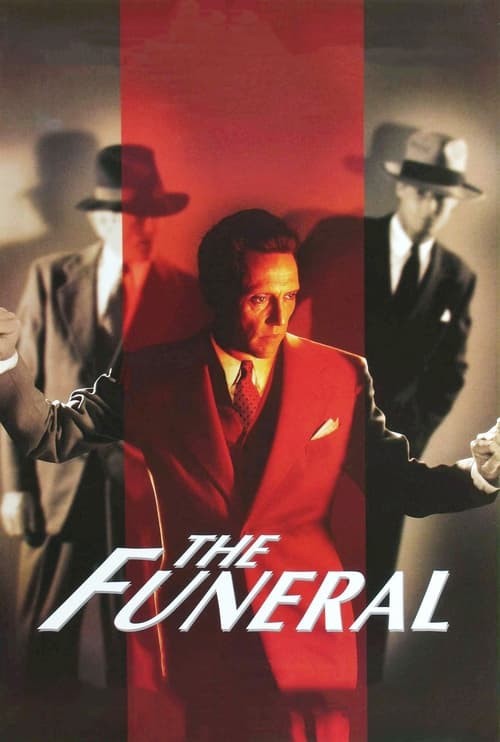
The Funeral
1996 · Abel Ferrara
For when you want the dark stuff — a gangster film that trades cool for damnation and gives you something to sit with afterward. Strictly a challenge pick, not a comfort watch.
What it's about
Depression-era New York, among Italian-American racketeers: the film opens at the wake of Johnny, the youngest of three criminal brothers, shot dead in the street. As his surviving brothers Ray and Chez prepare to bury him, the family circles the question of revenge — and through memory and recrimination, the film asks whether men raised into violence ever really had a choice. It's a gangster picture built like a family tragedy.
The experience
Heavy, brooding, and genuinely unsettling — less a crime thriller than a slow-burning moral inquest, thick with grief, Catholic guilt, and the dread that violence has its own momentum. It leaves a bruise.
Performances
Christopher Walken is coiled and chillingly rational as the eldest brother, while Chris Penn is the standout — volcanic, tormented, frightening and pitiable in the same breath. Vincent Gallo haunts the film in flashback as the dead brother.
The craft
Ferrara shoots the 1930s in candlelit rooms and deep shadow, and Nicholas St. John's script turns genre business — the wake, the score-settling, the union strike — into a running argument about sin and free will. The period atmosphere is dense and funereal, all wood, smoke, and murmured prayers.
Why it matters
One of the most admired films of Ferrara's 1990s run, it cemented his reputation as American crime cinema's great moralist — the director who takes damnation literally.
Snapshot
The Funeral is Abel Ferrara's bleakest and most theologically severe gangster picture: a Depression-era family tragedy disguised as a crime film, in which a Catholic catechism on sin, free will, and damnation is enacted through the bodies of three criminal brothers. Set among Italian-American racketeers in 1930s New York, the film opens at its own endpoint — the wake of the youngest brother, Johnny (Vincent Gallo), shot dead in the street — and works backward and outward through memory and recrimination to ask whether any of these men could ever have chosen differently. Written by Ferrara's lifelong collaborator Nicholas St. John, it is less a revenge thriller than a meditation on the metaphysics of revenge: the conviction, voiced by the surviving brothers Ray (Christopher Walken) and Chez (Chris Penn), that violence is both freely chosen and fatally inherited. The result is a chamber piece of grief, guilt, and predestination that strips the gangster genre of its operatic consolations and leaves only the doctrine underneath.
Industry & production
The Funeral belongs to the mid-1990s American independent sector, the same milieu of festival-driven specialty distribution that carried Ferrara's other films of the period. It was produced as a low-budget independent feature — Ferrara worked throughout his career well outside studio financing — and assembled a remarkable cast for its scale: Christopher Walken, Chris Penn, Vincent Gallo, Annabella Sciorra, Isabella Rossellini, and a young Benicio del Toro. That ensemble reflects Ferrara's standing among actors as a director who offered serious, risk-taking material rather than money, and the period-piece ambition (1930s costuming, vintage automobiles, tenement and warehouse interiors) was achieved through the kind of resourceful, location-driven production design that characterizes his New York work.
The film premiered in competition at the Venice Film Festival in 1996, where Chris Penn won the Volpi Cup for Best Actor — the production's most concrete and best-documented honor, and a recognition of the film's strongest performance. It received a limited art-house theatrical release in the United States and circulated primarily through festivals, critics' attention, and home video. I won't assert specific budget or box-office figures, as Ferrara's independent productions of this era have a thin and unreliable public financial record; the safe characterization is that The Funeral, like most of his work, was a small commercial proposition that earned its reputation critically rather than at the box office.
Technology
Technologically the film is conventional for a mid-1990s independent feature: it was shot on 35mm film and finished photochemically, with no notable reliance on the digital tools that were only beginning to enter the independent world. What is significant is not novel apparatus but the disciplined use of established craft toward a period look — film stock, lighting, and lab timing pushed toward the dense, shadowed register the story demands. Ferrara's filmmaking has always been analog and tactile in this sense; the "technology" of The Funeral is the camera, the lamp, and the cutting bench used with conviction rather than any innovation in capture or effects.
Technique
Cinematography
The photography is by Ken Kelsch, Ferrara's regular cinematographer across this stretch of his career (King of New York, Bad Lieutenant, The Addiction), and it is central to the film's meaning. Kelsch works in a deep, low-key chiaroscuro: faces emerge from darkness, interiors are lit as if by a few practical sources, and the palette runs to browns, blacks, and the cold blue of night. The look consciously evokes both 1930s period and the moral atmosphere of classic film noir, but it refuses noir's glamour — the shadows here are not stylish so much as enveloping, a visual theology of a world without grace. The camera tends toward stillness and proximity, holding on the brothers' faces during long exchanges so that the drama is read in expression rather than movement. Where Ferrara's Bad Lieutenant was raw and handheld, The Funeral is more composed and painterly, its framings often arranged around the wake and the body, with the dead Johnny a recurring still center.
Editing
The film's architecture is built on flashback: the present-tense wake is continually interrupted by memory, so that the narrative is assembled associatively rather than chronologically. The editing's task is to braid these временные layers — the gathered, grieving present and the retraced past that explains the killing — without dissolving the tension of the revenge plot unfolding in the now. (The editing is credited to Bill Pankow; I flag that Ferrara's editorial collaborations of this period are sometimes inconsistently documented, so I'll describe the cutting's function rather than overstate authorship.) The rhythm is deliberate and weighted, favoring held shots and hard transitions between time frames that mirror the characters' compulsive returning to grievance and guilt. The structure makes the film feel less like a story moving forward than like a mind circling a wound.
Mise-en-scène / staging
The Funeral is staged as a series of enclosed rooms — the parlor with the coffin, the marital bedrooms, the warehouse, the bar — and the confinement is the point. This is a family sealed inside its own house and its own determinism. Production design renders the 1930s through worn, lived-in interiors rather than showpiece period spectacle, and the recurring tableau of the open casket organizes much of the staging: characters are repeatedly blocked in relation to the dead body, so that conversation, accusation, and mourning all take place in the literal presence of death. The wives' domestic spaces are set against the men's spaces of business and violence, a spatial division that carries the film's gendered moral argument.
Sound
The score is by Joe Delia, Ferrara's longtime composer, and it works in a restrained, melancholy register rather than the propulsive scoring of a conventional crime film. Music is used sparingly, underscoring grief and dread, leaving much of the film to the sound of voices in rooms. Period source music and the ambient texture of the era thread through without ostentation. The overall sound design is intimate and interior, matching the photography's enclosure — this is a film of murmured conversations, sudden eruptions, and long silences around the coffin.
Performance
Performance is the film's engine, and Ferrara directs his ensemble toward a naturalistic intensity. Christopher Walken plays Ray, the eldest brother, with chilling control — a man who articulates the family's fatalism as if reciting doctrine, his stillness a mask over absolute conviction. Chris Penn's Chez is the volcanic counterweight, a tormented, mentally unstable figure (the film gestures toward what we would now call bipolar disorder) whose anguish and rage earned him the Venice Best Actor prize; it is the performance that gives the film its raw nerve. Vincent Gallo's Johnny, seen mostly in flashback, is the idealistic youngest, drawn toward leftist labor politics, his vitality making his death the more grievous. Annabella Sciorra and Isabella Rossellini, as Ray's and Chez's wives, supply the film's conscience — they name the brothers' fatalism as the self-justifying lie it is, and their scenes carry the critique the men cannot make of themselves. Benicio del Toro appears in a supporting role as a rival, early in his career.
Narrative & dramatic mode
The film's dramatic mode is the tragedy of inevitability. Its very structure — beginning at the funeral, then excavating the past — forecloses suspense about whether Johnny dies and redirects attention to why, and to whether the cycle can be broken. This is closer to Greek or Catholic tragedy than to the suspense architecture of the gangster thriller: the audience watches characters move toward an end already established, and the drama lies in their failure, or refusal, to choose otherwise. The flashback construction makes memory itself the dramatic medium; the present action (the hunt for Johnny's killer) advances grimly while the past supplies the moral weight. Dialogue is discursive and argumentative — the brothers and wives debate sin, justice, and damnation explicitly — so that the film often plays as a dramatized theological disputation embedded in a crime story. The ending consummates the logic of the whole: rather than catharsis or restored order, the revenge plot collapses into a near-total self-destruction of the family, a bloodletting that confirms the doctrine of inescapable damnation the film has been arguing.
Genre & cycle
The Funeral is a gangster film built to negate the gangster film. It arrives a generation after The Godfather (1972) and amid the 1990s revival of the form, and it knowingly refuses the operatic grandeur, the rise-and-fall arc, and the romanticized family loyalty that the genre traffics in. There is no ascent here, no empire, no seductive criminal glamour — only a small family of racketeers consumed by grief and metaphysics. Ferrara strips the genre to its moral skeleton: crime as sin, the family as a closed economy of violence, loyalty as a trap. In this it belongs less to the lineage of celebratory mob epics than to a darker tradition of crime films interested in damnation, and it stands as a self-conscious anti-genre statement, using the audience's genre expectations precisely in order to deny them consolation.
Authorship & method
The Funeral is a product of one of American independent cinema's most distinctive and durable creative partnerships: director Abel Ferrara and screenwriter Nicholas St. John, friends since childhood, who collaborated across Ferrara's defining films (Ms. 45, King of New York, Bad Lieutenant, The Addiction, Dangerous Game). St. John, a devout Catholic, repeatedly wrote scripts preoccupied with sin, free will, guilt, and the possibility — or impossibility — of redemption, and The Funeral is among the most uncompromising expressions of that sensibility, leaning toward damnation where some earlier films held open a door to grace. The film is widely regarded as one of their last major collaborations, which lends it a summative weight within Ferrara's body of work.
Ferrara's method is actor-centered and atmosphere-driven: he builds films around intense ensemble performance, dense low-key visual texture, and a willingness to let theological and moral argument surface directly in dialogue. His key collaborators here are the same craftspeople who shaped his signature style — cinematographer Ken Kelsch and composer Joe Delia foremost among them — so that The Funeral feels of a piece with Bad Lieutenant and The Addiction in look, sound, and obsession, even as it transposes those concerns into period costume. The authorship is genuinely shared: Ferrara's direction and St. John's writing are inseparable in accounting for what the film means.
Movement / national cinema
The film belongs to American independent cinema and, more specifically, to the gritty New York filmmaking tradition with which Ferrara is identified — a lineage of urban, morally serious, low-budget work that runs through figures like Martin Scorsese and the city's exploitation-to-art-house pipeline out of which Ferrara himself emerged. Though The Funeral is a period piece rather than a contemporary street film, its sensibility is continuous with that New York independent mode: location-rooted, performance-driven, indifferent to Hollywood polish, and unembarrassed by metaphysical and Catholic content. Ferrara's reputation has always been double — a cult figure in the United States, but more fully canonized as an auteur in Europe, particularly France — and The Funeral's Venice competition slot reflects that European art-cinema embrace as much as its American indie origins.
Era / period
The film is set in the 1930s, and its Depression-era setting is not merely decorative. The economic desperation of the period underwrites the family's criminal enterprise and frames Johnny's sympathy for labor radicalism and leftist politics — a subplot that ties his idealism, and ultimately his death, to the class tensions of the decade. The period also lets Ferrara and St. John invoke an older, more total Catholic culture, in which the doctrines of sin and damnation the film dramatizes would have been lived as unquestioned reality. Produced in 1996, the film sits within the 1990s American independent boom and the era's gangster-film revival, and it reads in part as a commentary from that moment back onto both the genre's golden-age period setting and the myths the genre had accumulated.
Themes
The film's governing theme is the collision between free will and predestination. Its characters insist that their violence is freely chosen and morally answerable, even as the film's fatal structure suggests they are bound by nature, family, and sin to repeat it — a paradox drawn straight from Catholic theology, where damnation is both deserved (chosen) and, for these men, seemingly inescapable. Revenge is anatomized as a closed moral system: each act of vengeance is justified and each justification produces the next death. Guilt, sin, and the absence of grace saturate the film; where some Ferrara–St. John films allow a flicker of redemption, The Funeral mostly forecloses it. Family functions as both refuge and prison, loyalty as the mechanism of mutual destruction. The wives articulate a counter-theme — a clear-eyed critique of the men's self-mythologizing fatalism — making gender and moral witness part of the design. And the Depression backdrop folds in class and political idealism (Johnny's leftism) as a road not taken, a vision of solidarity that the family's blood-logic cannot accommodate.
Reception, canon & influence
On the influences flowing into the film: The Funeral draws on the long history of the Hollywood gangster film and on film noir's visual and moral vocabulary, even as it works to subvert them, and it is shaped most deeply by the Catholic theological tradition that runs through all of Nicholas St. John's screenplays. It stands in dialogue with the post-Godfather family-crime epic, defining itself against that template. Within Ferrara's own filmography it is continuous with the sin-and-damnation cycle of Bad Lieutenant and The Addiction, transposed to period.
Critically, the film was received as a serious, severe, and divisive work — admired by Ferrara's partisans for its theological ambition and ensemble acting, found punishingly bleak by others. Its most concrete laurel is Chris Penn's Volpi Cup for Best Actor at Venice in 1996, and Penn's performance, along with Walken's, anchors most accounts of the film's value. Beyond that single, well-documented award, I'd treat sweeping claims about its reception as uncertain: the durable critical consensus is that The Funeral is a respected, demanding entry in Ferrara's catalog rather than a popular success.
On its legacy forward: the film's influence is best understood as part of Ferrara's broader standing as a cult auteur whose uncompromising, morally serious crime films helped sustain an alternative to the gangster genre's romanticism — an example for filmmakers interested in crime as a vehicle for metaphysical and religious inquiry rather than spectacle. As one of the last major Ferrara–St. John collaborations, it also holds a particular place in the historiography of that partnership, a kind of dark culmination of their decades-long argument about sin and freedom. Its afterlife has been one of reappraisal and cult devotion — kept alive by Ferrara's admirers and by the performances at its core — rather than mainstream canonization. Where the historical record on its precise impact is thin, the honest summary is that The Funeral endures as a respected, fiercely individual work whose reputation rests on its theological seriousness and its acting more than on any measurable wave of imitation.
A Deleuzian reading
A coffin sits in the front room, lid open, candles burning down.
The full Deleuzian reading of The Funeral →
Reception
Barely a ripple in 1996 — it slipped out between bigger gangster pictures and got respectful-but-quiet reviews. Now it's routinely named the hidden peak of Ferrara's staggering 90s run, the one Ferrara-heads bring up to prove the streak went deeper than Bad Lieutenant.
How The Funeral was received, from release to now →
Influences: the films it descends from and the films it influenced
- Force of Evil (1948) — Establishes the template The Funeral inherits: two brothers fatally bound in crime, with noir chiaroscuro and a stylized, near-liturgical dialogue that voices damnation and moral predestination aloud rather than dramatizing it obliquely.
- Angels with Dirty Faces (1938) — The 1930s Catholic gangster picture that stages free-will-versus-salvation as explicit theological argument inside the crime milieu — the period-Catholic moral framework St. John's script reconstructs.
- The Public Enemy (1931) — Source of the Depression-era gangster iconography and curt brutal naturalism — the working-class 1930s street-and-tenement texture the film deliberately period-reconstructs.
- White Heat (1949) — Pathological family-bond gangster psychology where grief and loyalty curdle into self-destruction — the affective engine behind Walken's and Penn's fraternal mourning and rage.
- The Godfather (1972) — The operatic Catholic-ritual family-crime epic against which the film defines itself, borrowing the ceremonial set-piece (here the wake/open casket) as the structuring frame while stripping out the romance and grandeur.
- The Godfather Part II (1974) — Model for interleaving present grief with period-flashback origins, using cross-cut chronology to make the crime dynasty's doom feel retroactively sealed.
- Once Upon a Time in America (1984) — Elegiac memory-flashback architecture and the tragedy-of-inevitability mode — gangster lives narrated as already-foreclosed, recalled from a vantage of loss.
- Mean Streets (1973) — Embeds Catholic guilt and the sacramental fear of damnation inside low-level street crime, carried by ensemble naturalism and improvisatory low-key texture — Ferrara's closest American kin.
- King of New York (1990) — Same Ferrara/St. John/Ken Kelsch/Joe Delia unit: dense low-key chiaroscuro crime morality where the criminal is a damned figure pursuing an impossible redemption.
- Bad Lieutenant (1992) — Ferrara/St. John's most direct dramatization of Catholic sin-and-grace, with Joe Delia's score and Kelsch's shadowed interiors — The Funeral transposes the same damnation cycle into period costume.
- The Addiction (1995) — Immediate sibling in the St. John theology cycle, letting metaphysical argument about evil and free will surface explicitly in dialogue rather than subtext.
- Dangerous Game (1993) — Same partnership's actor-centered method — building the film around volatile, exposed ensemble performance and emotional unraveling, the technique that wins Penn his Volpi Cup turn.
Similar films
- King of New York (1990) — influence & lineage
- Bad Lieutenant (1992) — influence & lineage
- The Godfather (1972) — influence & lineage
- The Irishman (2019) — influence & lineage
- Once Upon a Time in America (1984) — influence & lineage
- The Godfather Part II (1974) — influence & lineage
- Mean Streets (1973) — influence & lineage
- GoodFellas (1990) — shared sensibility