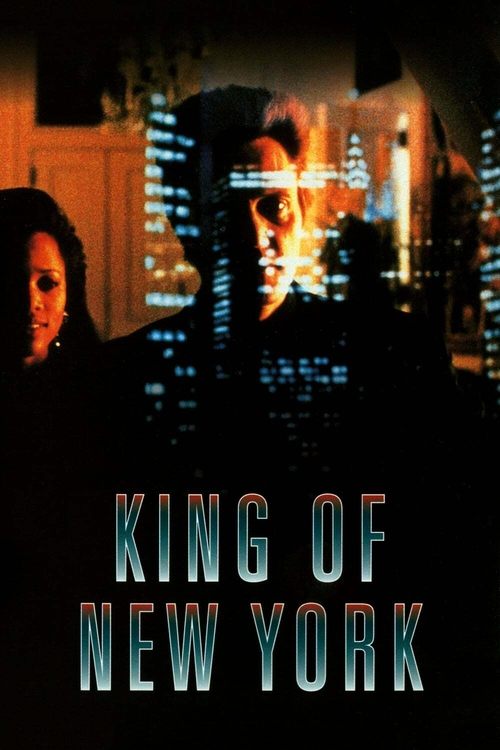
King of New York
1990 · Abel Ferrara
For a late night when you want your crime movie stylish, mean, and a little bit haunted — this is a challenge, not a comfort watch. Reach for it when you're in the mood to be seduced by something you know is bad for you.
What it's about
Frank White, a New York drug lord, walks out of prison with a plan that makes no sense to anyone around him: wipe out every rival in the city's narcotics trade, take it all, and pour the money into a hospital for the poor. He moves through nightclubs, penthouses, and subway cars with a crew that would die for him, while a squad of increasingly unhinged cops decides the law isn't going to be enough to stop him. It's a gangster picture wearing a Robin Hood story, and neither half is joking.
The experience
Nocturnal, sleek, and genuinely dangerous — long stretches of neon-lit cool ruptured by sudden, brutal violence. It plays like a fever dream of late-80s New York, seductive and rotten at the same time, and it leaves a bruise rather than a moral.
Performances
Christopher Walken gives one of his defining performances as Frank White — soft-spoken, almost gentle, with a reptilian charisma that makes the menace land harder. A young Laurence Fishburne matches him with live-wire, unpredictable energy.
The craft
Abel Ferrara shoots New York at night like a city underwater — neon, wet streets, silhouettes in penthouse glass — and the mix of glossy surfaces with grimy violence is the whole point. The soundtrack folds early hip-hop into the crime picture years before that became standard. It rewards a dark room and loud speakers.
Why it matters
The disreputable downtown cousin of the era's prestige gangster films, it became a cult touchstone — especially in hip-hop, where Frank White was adopted as an alias by rappers who took the film as gospel. It cemented Walken's iconography and Ferrara's reputation as American crime cinema's dark conscience.
Snapshot
King of New York is Abel Ferrara's nocturnal gangster fable, a neon-lit chronicle of Frank White (Christopher Walken), a drug kingpin newly released from prison who sets out to liquidate his rivals, consolidate the New York narcotics trade, and funnel the proceeds toward a hospital for the city's poor. Built on a script by Ferrara's lifelong collaborator Nicholas St. John, the film fuses the iconography of the crime picture with a sardonic Robin Hood premise and a streak of Catholic moral inquiry that runs through the pair's work. It is at once a glossy, almost operatic genre exercise and a bleak meditation on power, charity, and damnation — anchored by one of Walken's defining performances, all soft-spoken menace and reptilian charisma. Released the same year as Goodfellas, it represents the disreputable, downtown counterweight to mainstream Hollywood's gangster prestige: smaller, stranger, more morally vertiginous, and ultimately more interested in the metaphysics of sin than in the sociology of the mob.
Industry & production
King of New York was made outside the Hollywood studio system, financed largely through Italian sources — a reflection of Ferrara's standing as a director more bankable abroad, particularly in Europe, than at home. The production was assembled with European money (the producer Augusto Caminito and associated Italian entities were central to financing), with Mary Kane among the producers on the American side. This European-funded, New York–shot model was characteristic of a certain stratum of American independent filmmaking in the period, in which continental investors backed auteurist genre cinema that domestic studios considered too violent or too uncommercial.
The film was shot on location in New York City, and its sense of place is fundamental rather than decorative: the Plaza Hotel, the subway system, Times Square, the bridges and outer-borough streets are not backdrop but argument. Ferrara, a native New Yorker who had already mined the city's underside in The Driller Killer (1979) and Ms. 45 (1981), treats the metropolis as a moral and physical battleground stratified by class and race. The shoot reportedly traded on guerrilla-inflected location work typical of Ferrara's methods, though precise budget and production figures are not something I can state with confidence; the record on the exact financing structure and cost is thinner in general circulation than for studio productions of the era, and I will not invent numbers.
Commercially the film was a modest performer in U.S. theatrical release, never a wide hit, and its real life began on home video and in repertory, where it accrued its lasting cult reputation.
Technology
Technologically, King of New York is conventional for its moment: a 35mm film production using the standard photochemical apparatus of 1990. Its distinction lies not in any technical novelty but in how aggressively it exploits available tools — fast film stocks and careful exposure control to shoot in near-darkness, and a saturated, sodium-and-neon palette achieved through lighting and color rather than any post-photographic process. There is no significant use of optical or early digital effects; the film's "futurism" is entirely atmospheric. In an account grounded strictly in the historical record, it would be misleading to claim any technological innovation here — the achievement is one of craft and sensibility applied to ordinary period equipment.
Technique
Cinematography
The cinematography by Bojan Bazelli is the film's most celebrated formal element and a touchstone of early-1990s neo-noir style. Bazelli renders New York as a city of perpetual night, lit by cold blues, smeary neons, and pools of shadow that swallow faces and bodies. The images are at once sleek and grimy — high-gloss surfaces and reflective wet streets crossed with the murk of subway tunnels and unlit interiors. The visual scheme draws an implicit class map: the antiseptic chill of the Plaza suite Frank White inhabits against the harsher, dirtier light of the neighborhoods his rivals control. Bazelli's work here, with its expressive color and willingness to let darkness dominate the frame, helped define a glossy neo-noir look that would be widely imitated; he went on to a substantial Hollywood career, and King of New York remains among his signature accomplishments.
Editing
Anthony Redman's editing alternates between languor and sudden violence. Long, atmospheric passages — Walken brooding, the camera drifting through nightscapes — are punctured by abrupt, brutal eruptions: the shootouts are sharp and disorienting rather than balletic, emphasizing chaos and lethality over choreography. The rhythm mirrors the film's moral structure, lulling the viewer into Frank's seductive calm before puncturing it. The cutting also serves the film's tonal instability, holding genre pleasure and dread in uneasy suspension.
Mise-en-scène / staging
Ferrara's staging is built around contrasts of register: opulence and squalor, stillness and slaughter. Frank White's command of space — the way he occupies the Plaza, a nightclub, the back of a car — communicates power through composure. Set-pieces are organized around New York's geography as social text, from a Chinatown massacre to the climactic gun battles. The Robin Hood conceit is staged with deliberate irony: scenes of Frank dispensing largesse and championing the hospital are framed alongside the murderous means that fund them, so that the mise-en-scène itself refuses to resolve the contradiction.
Sound
The soundtrack is a defining feature, drawing on hip-hop to ground the film in its contemporary urban moment — Schoolly D's music figures prominently, an early and influential marriage of rap to a major crime film's sonic identity. Joe Delia's score supplies a brooding, atmospheric counterpoint. The interplay of rap, score, and the ambient roar of the city gives the film a texture distinct from the operatic or jazz-inflected scoring of more traditional gangster pictures, and it is one of the clearest channels through which the film later spoke to a hip-hop audience.
Performance
Performance is where the film's reputation most durably rests. Walken's Frank White is a study in lethal understatement — courtly, melancholy, capable of sudden ferocity — a man who seems to believe his own redemptive mythology. Around him Ferrara assembled a remarkable young ensemble: Laurence Fishburne (billed as Larry Fishburne) as the manic, devoted lieutenant Jimmy Jump; David Caruso and Wesley Snipes as the obsessive cops hunting Frank; Victor Argo as the weary senior detective; with Steve Buscemi, Giancarlo Esposito, and Paul Calderon among the crew and supporting players. Many of these actors were on the cusp of stardom, and the film now reads as a snapshot of a generation of New York performers in formation. The acting style ranges from Walken's icy minimalism to Fishburne's volatile theatricality, a deliberate spread that energizes the film.
Narrative & dramatic mode
The narrative mode is tragic and ironic rather than realist. The Robin Hood frame — a criminal who would redeem himself by robbing the rich underworld to give to the poor — is offered not as a literal program to be admired but as a self-justifying fantasy the film both indulges and indicts. Frank White is a romantic figure who is also a mass murderer; the script by Nicholas St. John keeps the audience suspended between seduction and judgment. The dramatic engine is the collision between Frank's ambitions and the police, but the deeper structure is moral and quasi-religious: a question of whether grace is available to a man who does great evil in the name of a stated good. The film moves toward inexorable doom, its plot machinery secondary to its atmosphere of damnation.
Genre & cycle
King of New York sits at the intersection of the gangster film and neo-noir. It belongs to the early-1990s resurgence of the American crime film — arriving in the same year as Scorsese's Goodfellas and amid renewed interest in mob and street-crime narratives — but it stands apart from the mainstream of that cycle. Where the prestige gangster picture offered sociological sweep and naturalistic detail, Ferrara delivered something more stylized, abstract, and morally extreme. It also anticipates and feeds the wave of urban crime cinema that would follow across the decade. As neo-noir, it extends the genre's fatalism and nocturnal style into a contemporary, multiracial New York, and its fusion of crime iconography with hip-hop sound marks it as a transitional work between the noir tradition and the street-crime films to come.
Authorship & method
The film is best understood as the product of the long Ferrara–St. John partnership. Screenwriter Nicholas St. John, Ferrara's collaborator across much of his career, brought the Catholic preoccupations — sin, guilt, the possibility and cost of redemption — that recur throughout their joint filmography and that elevate King of New York above genre exercise. Ferrara's directorial method favored atmosphere, performance, and moral provocation over tidy storytelling, and he drew charged, idiosyncratic work from his actors.
The key collaborators form a recognizable Ferrara stock company and an exceptional set of craftspeople: cinematographer Bojan Bazelli, whose neo-noir imagery is inseparable from the film's identity; composer Joe Delia, a frequent Ferrara musical partner; and editor Anthony Redman, who shaped the film's distinctive tonal rhythm. Together with St. John's script and Walken's performance, these constitute the authorial signature of the film — collaborative auteurism in which Ferrara's vision is realized through a consistent team.
Movement / national cinema
The film belongs to American independent cinema and, more specifically, to a New York tradition of gritty, location-driven, morally confrontational filmmaking that descends from the city's underground and exploitation roots toward the art house. Ferrara is one of the central figures of this lineage — a director who worked the seam between grindhouse and auteur cinema. At the same time, the film's European financing situates it within a transatlantic mode of production in which American genre auteurs found backing abroad. Its critical embrace was often warmer in Europe than in the United States, reinforcing Ferrara's status as an American filmmaker partly sustained by a continental cinephile audience.
Era / period
King of New York is profoundly a film of its moment: New York at the turn of the 1990s, in the grip of the crack epidemic, soaring violent crime, and acute anxieties about urban decay, race, and class. The narcotics economy at the film's center, the racial composition of its rival crews and its police, and the visible inequality of its geography all register the social texture of the late-Reagan / early-Bush city. It captures the metropolis just before the transformations of the following decade, and its hip-hop soundtrack ties it precisely to the cultural moment of rap's ascent. The film functions, in retrospect, as a vivid document of a particular New York that has since largely vanished.
Themes
The film's governing theme is the entanglement of evil and benevolence — the idea that a man might do monstrous things in pursuit of a self-defined virtue, and the question of whether such a justification means anything before God or the world. Power, and its loneliness, runs through Frank White's every scene. Class and charity are central: the Robin Hood promise of redistributing wealth to the poor is examined as both genuine impulse and narcissistic alibi. Race threads through the alliances and antagonisms of the underworld and the police. And beneath all of it lies the St. John–Ferrara concern with sin and redemption — the spiritual accounting of a life, the hope of grace, and the suspicion that it may be unattainable. Death pervades the film as both plot mechanism and theological horizon.
Reception, canon & influence
Critical reception on release was divided. The film's extreme violence and morally slippery treatment of its antihero alienated some reviewers, while others recognized the power of Walken's performance and Bazelli's images; it was, characteristically for Ferrara, more readily celebrated in Europe than in the American mainstream. Over time the critical verdict shifted decisively, and the film is now widely regarded as one of Ferrara's finest works and a key American crime film of its era, a fixture of cult and repertory canons.
Looking backward, the film draws on the gangster tradition and on noir fatalism, refracted through the legend of Robin Hood and through the Catholic moral framework that St. John and Ferrara brought to all their collaborations; it also reflects Ferrara's own grounding in New York exploitation and underground filmmaking.
Looking forward, its influence has been substantial and runs along two channels. Within cinema, its glossy neo-noir style, its hip-hop-scored urban milieu, and its morally complex antihero anticipated and shaped the urban crime films of the 1990s. Even more striking is its impact on hip-hop culture: Frank White became an enduring icon, most famously adopted by The Notorious B.I.G., who took "Frank White" as an alias and identified with the character — a measure of how deeply the film penetrated the music it had itself drawn upon. That reciprocal relationship between film and rap is one of King of New York's most distinctive legacies. Within Ferrara's own career, it stands as a crucial work bridging his early genre films and the more nakedly spiritual Bad Lieutenant (1992), consolidating the themes of sin, power, and the longing for redemption that define his body of work.
A Deleuzian reading
Picture Walken's face floating in the blue dark of a Plaza suite, the city burning faintly below the window, and nothing on it moving but the eyes.
The full Deleuzian reading of King of New York →
Reception
Divisive on arrival — its 1990 New York Film Festival screening famously split the audience, and many critics dismissed it as empty, nihilistic style — but it's since been embraced as a cult classic and one of Christopher Walken's defining performances.
How King of New York was received, from release to now →
Influences: the films it descends from and the films it influenced
- Le Samouraï (1967) — The blueprint for Walken's hushed, ascetic gangster — Alain Delon's near-silent, ritualized minimalism establishes the underplayed antihero whose stillness reads as menace, the register Ferrara draws from Walken.
- The Conformist (1970) — Vittorio Storaro's expressionist color-as-emotion and pools of saturated, theatrical light are the direct precursor to Bazelli's neon-soaked, low-key palette that floods King of New York's interiors with blue and amber.
- Mean Streets (1973) — Establishes the New York Catholic-crime grammar — sin, guilt and longed-for grace scored to pop/street music over neighborhood naturalism — the exact moral-aesthetic frame St. John and Ferrara inherit.
- Force of Evil (1948) — Polonsky's fatalist gangster-as-tragic-moralist, the racketeer doomed by his own corrupted idealism, supplies the tragic-ironic mode and the 'criminal who imagines himself benefactor' template behind Frank White.
- Get Carter (1971) — The cold, procedural gangster who moves through the city dispensing violence with affectless calm — its clinical detachment and editing that snaps from quiet to brutality prefigures Ferrara's languor-to-violence rhythm.
- Point Blank (1967) — Pioneers the stylized neo-noir of the lone avenger gliding through modernist, color-coded spaces, fusing arthouse formal abstraction with pulp crime — the high-style register King of New York extends.
- Scarface (1983) — The operatic immigrant-outsider crime epic with synth-driven scoring and excess as moral statement, plus the antihero's delusion of building an empire on his own terms, a direct gangster-film forebear.
- Ms. 45 (1981) — Ferrara's own NYC exploitation grounding — gritty street-shot vigilantism, the city as moral wilderness, and a protagonist enacting righteous violence — the underground craft King of New York gentrifies into glossy neo-noir.
- New Jack City (1991) — Directly extends the crack-epidemic NYC milieu and hip-hop-scored urban crime film with a charismatic drug-empire kingpin, the commercial sibling that picks up King of New York's rap-inflected gangster template a year later.
- Menace II Society (1993) — Inherits the morally slippery antihero in a hip-hop-scored urban underworld and the editing that lulls before erupting into shocking violence, channeling Ferrara's languor-to-violence rhythm into 90s street cinema.
- Carlito's Way (1993) — The tragic-ironic gangster who dreams of going straight and dispensing benevolence yet is dragged to a fated death, scored and shot in lush neon-noir New York — the same doomed-king arc as Frank White.
- Belly (1998) — The fullest visual heir — its hyper-saturated, low-light neon photography and hip-hop-driven crime milieu directly extend Bazelli's palette into the rap-video-era gangster film, completing the film-rap reciprocity Frank White began.
- True Romance (1993) — Deploys Walken's quiet-menace register in its own key while extending the glossy, music-saturated 90s crime stylization, carrying forward the Walken-understatement performance idiom King of New York crystallized.
- Bad Lieutenant (1992) — Made with the same Ferrara–St. John authorship two years later, it nakedly extends the sin/power/redemption theology, pushing the Catholic moral provocation King of New York consolidated to its spiritual extreme.
- The Funeral (1996) — Same Ferrara–St. John–Delia stock company applying the tragic-ironic crime mode and damnation theology to a period gangster milieu, with the identical languid-then-sudden tonal rhythm.
- Heat (1995) — Shares the neon-and-sodium night palette and the cult of the cool, understated professional criminal, building crime as glossy nocturnal city-symphony in the same neo-noir lineage.
- Deep Cover (1992) — Shot by Bojan Bazelli — the direct DP lineage: the same neon-bathed, saturated-color urban expressionism (deep magentas, sodium-vapor pools) transfers straight into Deep Cover.
Similar films
- The Funeral (1996) — influence & lineage
- Bad Lieutenant (1992) — influence & lineage
- Carlito's Way (1993) — influence & lineage
- Scarface (1983) — influence & lineage
- Menace II Society (1993) — influence & lineage
- Heat (1995) — influence & lineage
- GoodFellas (1990) — shared sensibility
- Paid in Full (2002) — shared sensibility