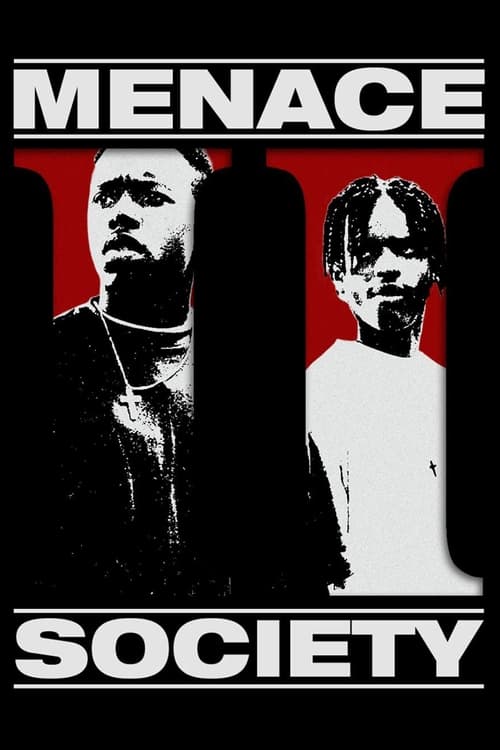
Menace II Society
1993 · Allen Hughes
For when you want to be shaken, not soothed — a hard, unflinching film to reckon with, not a comfort watch. Reach for it when you're ready to sit with anger and hopelessness and think about where they come from.
What it's about
Caine is a teenager in Watts, Los Angeles, raised by the drug trade and the streets, who spends one long summer after high school trying to imagine a way out. He narrates his own drift through hustles, loyalties, and sudden violence, pulled between people who want better for him and friends — like the grinning, trigger-happy O-Dog — who make leaving feel impossible. It's a portrait of a neighborhood where every choice is booby-trapped, told from the inside.
The experience
Bleak, electric, and genuinely shocking — the violence lands with sickening consequence rather than adrenaline, and the fatalism creeps up on you. It moves with real momentum, but you watch a lot of it with your stomach clenched.
Performances
Larenz Tate's O-Dog is the terrifying standout — a grinning teenage id whose charm and volatility make him impossible to look away from, and the film's most chilling argument.
The craft
The Hughes brothers were twenty-one, fresh from music videos, and it shows in the best way: prowling Steadicam, expressionist night colors, and a virtuoso robbery sequence replayed on a grainy interrogation-room monitor. The style is flashy but never romanticizing — every eruption is filmed for its aftermath. It rewards a dark room and your full attention.
Why it matters
It landed like a rebuke to the redemptive arcs of the early-'90s hood cycle, choosing witness over moral lesson, and announced the Hughes brothers as major talents straight out of the gate.
Albert and Allen Hughes were twenty-one when they made their debut, and it landed like a rebuke to the redemptive arcs of the early-'90s hood cycle. Where Boyz n the Hood moralized, Menace II Society bears witness: Watts after the Reagan years, seen through Caine, a teenager narrating his own drift with a fatalism that the film neither endorses nor softens. The Hughes brothers came from music videos and it shows in the best sense — prowling Steadicam, expressionist night colors, a virtuoso robbery sequence replayed on a police interrogation-room monitor — but the style never romanticizes; every eruption of violence lands with sickening consequence, filmed for aftermath rather than adrenaline. Tyger Williams's script gives the ensemble a terrifying standout in Larenz Tate's O-Dog, a grinning teenage id the film calls 'America's nightmare' — young, Black, and taught by America to not care. The voiceover owes a debt to GoodFellas, openly acknowledged, but the despair is unborrowed. Three decades on, it stands as the bleakest and arguably the most formally accomplished film of its wave, the one that refused to promise a way out.
A Deleuzian reading
A detective presses play.
The full Deleuzian reading of Menace II Society →
Reception
Acclaimed but treated as a controversy on release — critics praised it while the press fretted over its violence amid the early-90s 'hood film' wave — it's since been canonized as the bleak, uncompromising peak of that cycle.
How Menace II Society was received, from release to now →
Influences: the films it descends from and the films it influenced
- GoodFellas (1990) — The whole architecture of Caine's retrospective first-person voiceover narrating a doomed life, plus freeze-frames punctuated by narration and roving Steadicam through a criminal milieu, is lifted directly — the Hugheses treat Watts the way Scorsese treats the Lucchese crew.
- Mean Streets (1973) — Establishes the handheld, jukebox-scored portrait of small-time hoods trapped in a few blocks, where violence erupts without warning and lingers on its aftermath rather than its choreography.
- A Clockwork Orange (1971) — Model for the unrepentant, seductive voiceover of a protagonist the film refuses to redeem — the anti-redemption narration that lets O-Dog and Caine remain morally unreconciled to the end.
- Do the Right Thing (1989) — Supplies the expressionist, heat-saturated color palette and stylized inner-city block-as-stage, proving New Black Cinema could use aggressive art-direction rather than gritty naturalism.
- Boyz n the Hood (1991) — The immediate template Menace answers and inverts: same South Central geography, voiceover framing, and systemic-neglect thesis, but Menace strips out Singleton's redemptive father-figure uplift.
- Killer of Sheep (1978) — The LA Rebellion foundation — Watts rendered as textured daily-life realism with non-actors and neighborhood specificity, the observational Black-Los-Angeles grammar Menace stylizes.
- Sweet Sweetback's Baadasssss Song (1971) — Originates the independently-financed, defiantly Black-authored crime narrative whose protagonist evades white authority without apology, the lineage of self-authored fatalism Menace inherits.
- Superfly (1972) — Blaxploitation street iconography and the drug-economy-as-only-exit plot that the hood film reworks into tragedy rather than cool.
- King of New York (1990) — Inherits the morally slippery antihero in a hip-hop-scored urban underworld and the editing that lulls before erupting into shocking violence, channeling Ferrara's languor-to-violence rhythm into 90s street cinema.
- Colors (1988) — Extends the real-location, early-career-ensemble hood film with hip-hop source scoring, replacing Colors' outsider cop gaze with first-person fatalism.
- Dead Presidents (1995) — The Hugheses' own follow-up extends the same Steadicam bravura and violence-aftermath staging into a period heist tragedy, confirming their signature grammar.
- Clockers (1995) — Lee answers the hood cycle with the same fixation on the aftermath of violence — lingering crime-scene forensics and the interrogation-room as recurring set — that Menace foregrounds via its convenience-store monitor replay.
- Belly (1998) — Pushes Menace's music-video-derived expressionist color to its extreme, with cinematographer Malik Sayeed's high-contrast neon and gel lighting turning the hood film into pure visual maximalism.
- Set It Off (1996) — Another music-video director carrying the kinetic, glossily-lit LA crime aesthetic into a heist frame, with the same doomed-crew fatalism where the outcome is preordained from the first frame.
- City of God (2002) — Globalizes Menace's toolkit — retrospective voiceover, freeze-frame chapter markers, kinetic music-video cutting, and matter-of-fact child violence — transposing the Watts fatalism to a Rio favela.
- Training Day (2001) — Fuqua brings the music-video craft and roving Steadicam back to a single hard day in South Central, extending Menace's expressionist-realist LA street cinematography into the police-corruption register.
- American History X (1998) — Supplies the retrospective confessional voiceover narrating one's own doom inside a violent subculture, plus the commercials-trained high-gloss surface applied to ghetto realism — the tragedy-of-cycles narration Danny's essay structure echoes.
- Paid in Full (2002) — Modeled the hood-realist understatement and matter-of-fact, non-choreographed violence from which Wood Harris's restrained, interior performance as Ace directly descends.
- Straight Outta Compton (2015) — Its handheld, in-close naturalism and abrupt eruptions of street violence model the you-are-there camera and unsentimental block texture Gray and Libatique reconstruct for late-80s Compton.
- Blindspotting (2018) — The Hughes brothers cut a killing back in as an intrusive recurring flashback structuring the protagonist's guilt, the trauma-image editing grammar Blindspotting uses for the shooting Collin can't stop replaying.
- Juice (1992) — Directed by Spike Lee's cinematographer, it shares Menace's cinematographer-eye compositional polish and the escalating-loyalty-into-murder arc among young friends, released a year prior as a near-twin.
- La Haine (1995) — The French banlieue transposition — Steadicam gliding through housing projects, day-in-the-life-to-fatal-ending structure, and the same conviction that systemic neglect makes the ending inevitable.
- Deep Cover (1992) — Extends the retrospective-voiceover narration of a Black protagonist chronicling his own inescapable slide, inheriting Deep Cover's confessional first-person framing of the drug economy.
Similar films
- Boyz n the Hood (1991) — influence & lineage · same viewing thread
- Dead Presidents (1995) — influence & lineage
- La Haine (1995) — influence & lineage
- Clockers (1995) — influence & lineage
- A Clockwork Orange (1971) — influence & lineage
- Training Day (2001) — influence & lineage
- Do the Right Thing (1989) — influence & lineage · same viewing thread
- American History X (1998) — same viewing thread
All the films related to Menace II Society →
Watch it with: curated runs of related films
- Reckoning with the Color Line — A run through a century of American film on race — from the movie that industrialized screen racism to the ones that talk back to it — best watched in rough chronological conversation.