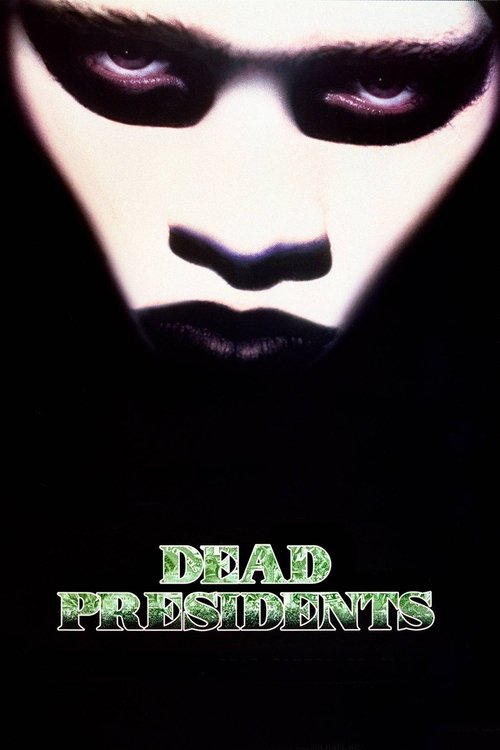
Dead Presidents
1995 · Albert Hughes
For when you want an ambitious, angry American epic with real weight — a crime film that's actually about something. This is a challenge pick, not a comfort watch: it earns its violence and its bitterness.
What it's about
A young Black man comes of age in the Bronx of 1968, ships out as a Marine to Vietnam, and returns to an early-1970s neighborhood that has no place for him — no work, no honor for his service, old friends scattered into hustles and pulpits. Broke and cornered, he and his fellow veterans plan a desperate robbery of an armored car full of unmarked cash. It's a heist movie wrapped around nearly a decade of American history.
The experience
Sprawling and intense — part warm neighborhood memoir, part harrowing war film, part nerve-shredding crime picture, with the tone darkening as the years pass. It plays like a tragedy you can see coming and can't look away from.
Performances
Larenz Tate anchors the film's decade-spanning arc, carrying the lead from wide-eyed teenager to hollowed-out veteran with striking range for so young an actor.
The craft
The Hughes Brothers, two years off their incendiary debut, swing for a period epic on their second film — recreating the late-'60s Bronx and the Vietnam jungle with grim confidence, and staging the robbery itself with unforgettable, ghost-faced imagery. The 1970s soul soundtrack does real storytelling work, marking time as the era curdles.
Why it matters
A landmark of the 1990s wave of Black American filmmaking, it widened the scope of what a 'hood film' could be — connecting street crime to Vietnam and to the abandonment of Black veterans — and its heist imagery has been referenced and homaged ever since.
Snapshot
Dead Presidents is the second feature from the Hughes Brothers, the identical-twin directing team of Albert and Allen Hughes. (Studio and DVD credits bill the film to both brothers as co-directors; the single-name attribution in this dossier's header is a cataloging convention and does not reflect how the film was actually made.) Arriving in October 1995, two years after their incendiary debut Menace II Society, it is an unusually ambitious sophomore effort: a period tragedy that follows a young Black man from a Bronx adolescence in 1968, through a tour as a Marine in Vietnam, into a disillusioned early-1970s homecoming, and finally into a botched armored-car robbery. Where the debut compressed its violence into a tight contemporary present, Dead Presidents reaches across nearly a decade of American history, using one protagonist's arc to bind together the war abroad and the economic war at home. The title is period slang for paper currency—the presidents printed on U.S. banknotes—and the film literalizes the pun in its central heist, when the crew paints their faces in ghostly whiteface to rob a truck of unmarked cash. It is a crime picture, a war film, and a social chronicle at once, and its reach both distinguishes it and, for some critics, overextends it.
Industry & production
The film was produced and released under the Hollywood Pictures banner, one of Disney's adult-oriented labels of the period, positioning a Black-directed crime-drama within a major-studio distribution apparatus at the crest of the mid-1990s "hood film" cycle. The Hughes Brothers, then in their early twenties, were among the youngest filmmakers working at that scale, having graduated from music videos and Menace II Society into a larger, period-set production requiring Vietnam battle staging, extensive 1960s–70s New York recreation, and a substantial ensemble. The screenplay is credited to Michael Henry Brown, working from a story developed with the Hughes brothers; its seed was a real account drawn from Wallace Terry's oral history Bloods: An Oral History of the Vietnam War by Black Veterans, a book the directors have cited as source material for the returning-veteran narrative and the money-heist premise. I have not been able to confirm exact production-budget or box-office figures with certainty, so I will not assert them; contemporary accounts generally frame the film as a mid-budget studio release that performed modestly rather than as a breakout hit, and its reputation has rested more on ambition and craft than on commercial performance.
Technology
As a mid-1990s studio production, Dead Presidents was originated and finished photochemically on 35mm film, well before digital intermediates or digital capture were options at this budget level. Its technical demands were therefore practical rather than computational: period art direction and costuming to move convincingly across roughly 1968 to 1973; on-set makeup and prosthetic effects for the war sequences, which include graphic battlefield wounding; and the striking cosmetic effect of the robbery masks, achieved with white and black face paint rather than any optical trickery. The Vietnam combat was staged practically with pyrotechnics and squibs in the era's tradition. In short, the film's "technology" is the mature apparatus of analog studio filmmaking deployed for period reconstruction; there is little here that is technologically novel, and the interest lies in how conventionally available tools are marshaled for atmosphere and shock.
Technique
Cinematography
The film was photographed by Lisa Rinzler, who had also shot Menace II Society and was among the more distinctive cinematographers of the period. Her work here shifts register across the film's three movements: a warmer, more nostalgic palette for the Bronx adolescence; a desaturated, chaotic handheld idiom for Vietnam; and a colder, harder look for the disillusioned homecoming and the heist. The film is attentive to the textures of period urban space, and the robbery sequence in particular is staged for high-contrast graphic impact, the whitened faces emerging from darkness. Rinzler's camera balances the Hughes brothers' appetite for visceral immediacy with a more composed, classical sense of the period tableau than their debut allowed.
Editing
The editing carries an unusually heavy structural burden, because the screenplay is essentially a compressed epic that must traverse years, tones, and continents. The cutting has to modulate between the leisurely coming-of-age opening, the fragmentary violence of the war, and the tightening mechanism of the crime plot's final act. Where the film is most admired, the editing achieves genuine propulsion in the heist and its collapse; where it is most criticized, the very breadth of material makes the transitions feel like the joins of several films stitched together. This tension between epic scope and feature-length running time is, more than any single technical choice, the film's central formal problem.
Mise-en-scène / staging
The Hughes brothers' staging is at its most confident in bounded, charged spaces: the numbers-running economy of the neighborhood, the claustrophobia of the jungle, the choreography of the robbery. The face-paint imagery is the film's signature act of staging—a self-consciously theatrical, almost carnivalesque disguise that inverts racial visibility at the moment the men seize the "dead presidents." The period mise-en-scène, from clothing to storefronts to the iconography of Black urban life at the turn of the 1970s, is rendered with evident care, and the directors show a music-video-trained eye for the emblematic image.
Sound
The soundtrack is one of the film's most celebrated dimensions, drawing on a deep well of period soul, funk, and R&B to anchor the audience in the era's Black popular culture. This licensed music does much of the film's atmospheric and emotional work, situating scenes historically and lending the homecoming its bittersweet charge. Against this bedrock of period songs sits the score (discussed below), and the combination—vintage soul for the world, orchestral composition for the interior drama—defines the film's sonic identity.
Performance
Larenz Tate anchors the film as Anthony Curtis, remaking himself entirely from the manic sociopath he had played in Menace II Society into a quieter, more sympathetic figure whose gradual corrosion is the film's through-line. The ensemble is deep: Keith David brings gravity as the neighborhood elder Kirby; Chris Tucker supplies volatile comic energy as the doomed Skip; Bokeem Woodbine, Freddy Rodríguez, and others fill out the crew of veterans; N'Bushe Wright plays Anthony's partner Juanita. Martin Sheen appears in a small but pointed role as the sentencing judge in the film's closing movement. The performances are generally praised as the film's most consistent strength, holding emotional coherence across a narrative that is otherwise pulled in several directions.
Narrative & dramatic mode
The dramatic mode is tragedy in a realist, socially grounded key. The film is structured as a rise-and-fall biography compressed into a triptych: innocence and community in the Bronx; trauma and brutalization in Vietnam; and economic desperation, crime, and downfall on return. The heist functions as the classic tragic mechanism—the desperate gamble that promises deliverance and instead seals ruin—and the ending, with Anthony sentenced to a long prison term, forecloses any redemptive uplift. The film's ambition is to make the personal catastrophe legible as a historical and systemic one: the veteran is failed by the country he served, and crime is presented less as moral choice than as the terminus of foreclosed options. This is melodrama in the serious sense—a mode that stakes large social meaning on the fate of an individual—rather than genre thriller for its own sake.
Genre & cycle
Dead Presidents sits at the intersection of several genres: the crime/heist film, the war film, and the social-realist coming-of-age drama. It belongs squarely to the early-1990s cycle of Black-directed American films—following Boyz n the Hood, Menace II Society, Juice, and others—that brought Black urban experience into the commercial mainstream. But it distinguishes itself within that cycle by its period setting and historical reach: rather than a contemporary present-tense chronicle, it is a work of historical fiction that folds the Vietnam veteran's story into the "hood" template, connecting the genre's usual concerns—economic marginalization, violence, community—to an earlier moment and to the specific unhealed wound of the war. In doing so it also joins the long tradition of American Vietnam cinema, but from a vantage—the Black enlisted veteran returning to a hostile home economy—that mainstream Vietnam films had largely neglected.
Authorship & method
The governing authorial signature is that of the Hughes Brothers, whose method fused a music-video sensibility for the emblematic image with an appetite for uncompromised violence and a sociological seriousness about Black American life. Coming off the acclaim of Menace II Society, they used their new leverage to attempt something larger and riskier in scope. Their key collaborators recur meaningfully: cinematographer Lisa Rinzler, carried over from the debut, provided visual continuity and period texture; screenwriter Michael Henry Brown shaped the Bloods-derived material into its triptych structure. Most distinctively, the score was composed by Danny Elfman—a notable and somewhat unexpected pairing, given Elfman's association with Tim Burton's fantastical worlds—whose orchestral writing supplies the film's interior, tragic register beneath its surface of period soul. The editing (credited to Dan Lebental) had the difficult task of reconciling the film's competing scales. The overall method is collaborative in the studio sense but stamped throughout by the twins' shared vision; the very qualities that made Menace so forceful—directness, violence, moral seriousness—are here stretched across a broader canvas.
Movement / national cinema
The film is a product of American independent-minded filmmaking absorbed into the studio system—specifically the New Black Cinema wave of the early-to-mid 1990s, when a generation of young Black directors gained unprecedented access to mainstream production and distribution. It is not a movement film in the formal-avant-garde sense; rather, it participates in a moment of demographic and thematic expansion within Hollywood, in which stories of Black American life could be told at scale and by Black authors. Its particular contribution to that movement is historical depth: it insists that the contemporary conditions the cycle depicted have roots in an earlier generation's experience of war and economic exclusion.
Era / period
Two eras are in play. The film's diegetic period runs from the late 1960s through the early 1970s—the Vietnam War, the return home, and the economic and social dislocation of that turn-of-the-decade moment for Black urban communities. The film's production era is the mid-1990s, a high-water mark for Black-directed commercial cinema and for the crime-drama cycle. The distance between these two periods is itself part of the film's meaning: made in 1995, it looks back a quarter-century to argue for continuity between the disillusionment of the Vietnam-era veteran and the conditions its own cinematic moment was chronicling in the present tense.
Themes
The film's central theme is the betrayal of the returning veteran—specifically the Black veteran who serves a nation that offers him no economic foothold on return. Money is the film's obsessive motif: the "dead presidents" of the title, the numbers economy of the neighborhood, and the heist that promises transformation through cash and instead delivers destruction. Around this cluster the film gathers themes of masculinity and its dead ends; of trauma, both the acute violence of combat and its slow domestic aftermath; of community and its erosion; and of systemic entrapment, in which crime is figured as the endpoint of structural foreclosure rather than individual vice. The face-paint disguise crystallizes a further theme of racial visibility and inversion. Underlying all of it is a tragic determinism: the sense that the protagonist's fall is written into the historical conditions he inherits.
Reception, canon & influence
Critical reception on release was mixed-to-favorable, and its dominant note was the tension between ambition and control. Reviewers widely praised the performances, the period atmosphere, the soundtrack, and the sheer scope of the undertaking, while a recurring reservation held that the film attempted too much—that its three-part structure strained against its running time and that the tonal shifts between coming-of-age, war film, and heist thriller did not always cohere. It was frequently measured against Menace II Society, sometimes to its disadvantage as a looser, more diffuse work, though others credited the Hughes brothers precisely for refusing to repeat themselves.
Influences on the film (backward): The most direct is Wallace Terry's oral history Bloods, the documented source for the veteran-heist premise. More broadly the film draws on the American Vietnam cinema of the 1970s and 1980s and on the crime/heist tradition, refracting both through the perspective of the Black enlisted veteran. It also stands on the shoulders of the immediate New Black Cinema wave—Boyz n the Hood and the directors' own Menace II Society—whose commercial success made a period-set variation possible.
Legacy (forward): Dead Presidents has endured less as a canonical landmark than as an admired, ambitious, and somewhat under-recognized work whose reputation has grown among cinephiles over time. Its most concrete cultural afterlife lies in its imagery and title, which entered hip-hop iconography—the whiteface robbery mask and the "dead presidents" phrase for money became durable references in rap culture—and in its soundtrack's continued reputation. Within the Hughes brothers' filmography it marks the pivot toward larger-canvas, genre-inflected work that would continue in their subsequent films. Its lasting significance is as one of the period's most formally ambitious attempts to fuse the Black urban drama with historical epic, and to write the Black Vietnam veteran into a national story that had largely left him out. Where the historical record on its precise commercial and production details is thin, that ambition—and the craft of Rinzler's images, Elfman's score, and Tate's central performance—remains the clearest basis for its continued reputation.
Reception
Met with mixed reviews and modest box office in 1995 — critics called it ambitious but overstuffed after the Hughes Brothers' Menace II Society breakthrough — it's since been reclaimed as one of the great underrated 90s crime films, and one of the few American movies to center Black Vietnam veterans.
How Dead Presidents was received, from release to now →
How to watch Dead Presidents: what to notice on a first viewing
- Watch the color shift between the Bronx and Vietnam scenes. Rinzler shoots the Bronx adolescence in a warm, nostalgic palette, then switches to a desaturated, chaotic handheld look once the story moves to Vietnam. The look changes with the world Anthony is in, before you're told anything has changed.
- Listen for period soul and funk anchoring each scene. The soundtrack leans on a deep well of licensed soul, funk, and R&B to place you historically, doing as much work as the costumes or the sets. The music tells you exactly what year and what world you're standing in.
- Watch Anthony grow quieter across the film's opening stretches. Larenz Tate plays Anthony's gradual corrosion through stillness and withdrawal rather than outbursts, a slow erosion you register in what he stops saying. You can track how much has been taken from him just by how little he says.
- Notice the period detail in clothing and storefronts. The film renders the turn-of-the-1970s Bronx, its clothes, its storefronts, its iconography of Black urban life, with evident, unhurried care. This much specific detail is what makes the neighborhood feel like a real place being lost.
- Notice the film's rhythm change moving from block to jungle. The editing shifts from a leisurely coming-of-age pace in the Bronx to fragmentary, disorienting cutting once combat begins, matching rhythm to each part of Anthony's life. The cut itself tells you how much has broken, before a single line of dialogue does.
The whole guide to watching Dead Presidents, with the keys for a rewatch →
Influences: the films it descends from and the films it influenced
- Menace II Society (1993) — The directors' own debut established the template carried directly into this film — Lisa Rinzler's high-contrast, saturated handheld cinematography and the cold-open eruption of point-blank convenience-store violence.
- Boyz n the Hood (1991) — Its sociological coming-of-age realism and commercial breakthrough defined the New Black Cinema grammar — episodic neighborhood milieu, mentor/father figures, violence as social inevitability — that the Hughes brothers inherited and then stretched into period epic.
- The Deer Hunter (1978) — The three-movement structure — home community, the war's dislocating trauma, and a hollowed-out return that can no longer fit the old life — is the direct architectural model for the film's coming-of-age/Vietnam/heist triptych.
- Coming Home (1978) — Establishes the disillusioned, betrayed returning veteran whose government has abandoned him, scored to a wall-to-wall period-pop soundtrack used as emotional index rather than underscore.
- Taxi Driver (1976) — The Vietnam vet reabsorbed into a decaying, neon-lit urban America and metabolizing his alienation into violence — the psychic template for Anthony Curtis's homecoming into a Bronx that has no place for him.
- Across 110th Street (1972) — A Harlem robbery-gone-wrong built on a Bobby Womack soul soundtrack that comments on the action — the precise fusion of period-soul scoring with Black-crime tragedy that this film extends.
- Super Fly (1972) — Curtis Mayfield's soul score functions as the film's moral conscience and narrative engine, modeling the period-soul-soundtrack-as-authorial-voice device.
- The Killing (1956) — The clown-masked robbery and fastidious heist mechanics are the noir precursor to the whiteface armored-car robbery, where the mask itself becomes the film's most durable emblematic image.
- Dog Day Afternoon (1975) — The sweaty, botched, procedurally realistic heist that curdles from competence into panic and tragedy — the anti-glamour heist realism the armored-car sequence adopts.
- GoodFellas (1990) — The needle-drop period-pop scoring synced to escalating criminal fortune and the voiceover-driven tragic rise-and-fall arc are the immediate crime-epic model for the film's scope and structure.
- Platoon (1986) — Its grunt's-eye immersive infantry combat — chaos, atrocity, unit disintegration seen from the enlisted man's ground level — is the staging model for the film's Vietnam midsection.
- Killer of Sheep (1978) — The L.A. Rebellion's Black neorealism — quotidian working-class texture scored to Black American music — is the aesthetic root beneath the New Black Cinema wave the Hughes brothers refract.
- Belly (1998) — A music-video-trained director extending the Hughes brothers' emblematic-image sensibility — extreme high-contrast, saturated, painterly frames applied to Black crime narrative as pure visual iconography.
- American Gangster (2007) — A large-canvas period Black-crime historical epic anchored to the Vietnam-era heroin pipeline, pursuing the same ambition to write Black criminal enterprise into a national historical narrative.
- Da 5 Bloods (2020) — Returns explicitly to the Wallace Terry 'Bloods' oral-history material and the betrayed-Black-veteran thesis, staging a buried-treasure heist by aging Vietnam vets owed a debt their country never paid.
- Set It Off (1996) — A near-contemporaneous Black-crew heist driven by economic desperation and racial abandonment, sharing the tragic register in which the robbery is framed as the only available exit.
Similar films
- Menace II Society (1993) — influence & lineage
- American Gangster (2007) — influence & lineage
- Dog Day Afternoon (1975) — influence & lineage
- GoodFellas (1990) — influence & lineage
- Platoon (1986) — influence & lineage
- Boyz n the Hood (1991) — influence & lineage
- Paid in Full (2002) — shared sensibility
- Bound by Honor (1993) — shared sensibility