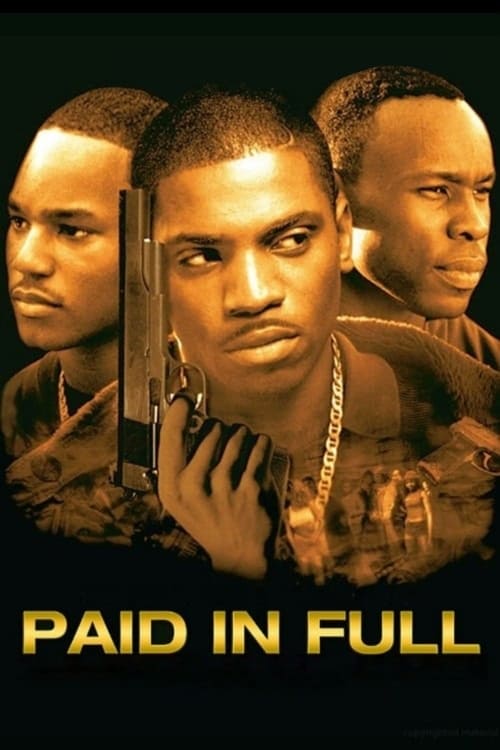
Paid in Full
2002 · Charles Stone III
When you want a crime saga with real style and real stakes — a Friday-night rise-and-fall you'll be quoting afterward. Entertaining first, sobering second.
What it's about
Harlem, the 1980s, the dawn of the crack era: a dry-cleaner's delivery boy drifts into dealing after his best friend goes to prison, and rises to the top of the drug world on courtesy, caution, and people skills rather than menace. It's drawn from the real lives of Azie Faison, Rich Porter, and Alpo Martinez — names that still carry weight in hip-hop — and it counts the cost of the climb as carefully as the climb itself.
The experience
Propulsive and quotable, with the swagger of a great rap record, but there's a moralist's ledger underneath — the fun keeps curdling into dread, and the ending mood is closer to elegy than victory lap.
Performances
Wood Harris, a year before The Wire, gives Ace a watchful stillness the genre almost never allows its kingpins; Mekhi Phifer and Cam'ron bring the charisma and the chaos swirling around him.
The craft
Charles Stone III directs with an insider's ear — the clothes, the slang, the block-level economics of the trade all ring true, and the period detail is loving without being a costume party. The storytelling is classical rise-and-fall, executed with unusual moral clarity.
Why it matters
Dimension Films barely released it in 2002 and it looked destined to be a footnote — then hip-hop adopted it, quoting it in a thousand verses and studying it like scripture, until it became one of the culture's canonical street films.
Roc-A-Fella Records' venture into cinema produced one enduring classic, and this is it: a chronicle of the 1980s Harlem crack trade drawn from the real lives of Azie Faison, Rich Porter and Alpo Martinez, names spoken with weight in hip-hop ever since. Charles Stone III — fresh from the 'Whassup?' Budweiser ads, soon to make Drumline — directs with an insider's ear and a moralist's ledger, following a dry-cleaner's delivery boy who drifts into dealing and rises on courtesy and caution rather than menace. Wood Harris, a year before The Wire, gives Ace a watchful stillness the genre rarely allows its kingpins; Mekhi Phifer and Cam'ron supply the charisma and the chaos around him. Dimension Films barely released it in 2002, and it looked destined to be a footnote. Then the culture took over: quoted in a thousand rap verses, studied like scripture, its dialogue passing into the vernacular. Few American crime films owe their classic status so completely to the audience the studio ignored.
Reception
Barely made a ripple in theaters in 2002 — Miramax gave it a quiet release and it grossed a fraction of its budget — but two decades of word-of-mouth, rap lyrics, and streaming turned it into a stone-cold classic of the crime genre.
How Paid in Full was received, from release to now →
Influences: the films it descends from and the films it influenced
- Super Fly (1972) — Established the Harlem-cocaine-dealer-plotting-one-last-score-to-exit-the-game template, with a soundtrack (Curtis Mayfield) functioning as the protagonist's moral narrator — the exact 'get in, cash out, get clean' arc Ace pursues.
- Scarface (1983) — The canonical 1980s rise-and-fall drug epic structured as a moral ledger of appetite and collapse, whose operatic accumulation-then-ruin arc Paid in Full compresses and de-glamorizes.
- Goodfellas (1990) — Supplied the observational rise-and-fall chronicle built from granular period texture and naturalistic ensemble behavior rather than plot mechanics — the docu-realist crime-milieu grammar Stone applies to 1980s Harlem.
- New Jack City (1991) — Codified the crack-era Harlem drug-kingpin iconography — the fortified stash-house economy, the rapid-empire montage — that Paid in Full deliberately renders in a quieter, less theatrical register.
- Juice (1992) — A cinematographer-director's film that pioneered casting rappers as dramatic leads (Tupac), the rap-star-as-actor practice Paid in Full extends by casting Cam'ron opposite trained actors.
- Menace II Society (1993) — Modeled the hood-realist understatement and matter-of-fact, non-choreographed violence from which Wood Harris's restrained, interior performance as Ace directly descends.
- Belly (1998) — Most direct craft parent: a music-video auteur importing saturated, high-gloss, slow-motion visual design and rap-star casting into the drug-dealer drama — the exact pedigree Stone (also a video director) carries into this film.
- Deep Cover (1992) — A noir-inflected drug-trade morality tale narrated by a conscience-in-voiceover, supplying the introspective 'weighing the cost' interiority that underlies Paid in Full's moral-ledger theme.
- ATL (2006) — A music-video director's feature debut applying the identical glossy hip-hop-cinema visual grammar to a character-driven coming-of-age tale on the edge of the drug economy.
- American Gangster (2007) — Extends the based-on-true-events Harlem drug-baron portrait with the same period fidelity and performance restraint, treating the empire as a ledger of controlled, businesslike calculation.
- Notorious (2009) — Carries the Roc-adjacent hip-hop-canon rise-and-fall biopic forward, dramatizing real street figures with the same reverence-plus-realism and rap-star-as-lead casting.
- Snow on tha Bluff (2011) — Pushes the based-on-true-street-lives drug drama into found-footage authenticity, inheriting Paid in Full's anti-glamour, ledger-of-consequences ethos stripped of gloss.
- SuperFly (2018) — A music-video auteur remaking the dealer-wants-out narrative with heightened visual sheen — the same video-director-to-crime-feature pipeline, closing the loop back to Paid in Full's own Super Fly ancestry.
- Sugar Hill (1993) — A near-contemporary Harlem-dealer-wants-out story pitched in a melancholic, operatic-restraint key, sharing the fraternal-bond-versus-the-game tension that structures Ace, Mitch, and Rico.
- The Wire (2002) — The same-year, institutionally realist anatomy of the drug trade as a moral-ledger economy — prioritizing procedural texture and character economics over gangster spectacle.
- City of God (2002) — A same-year, based-on-true-events, hip-hop-inflected rise-and-fall of neighborhood drug youth told through kinetic, music-video-derived editing and ensemble character-vignette structure.
Similar films
- Scarface (1983) — influence & lineage
- American Gangster (2007) — influence & lineage
- Menace II Society (1993) — influence & lineage
- Deep Cover (1992) — influence & lineage
- GoodFellas (1990) — influence & lineage
- City of God (2002) — influence & lineage
- Dead Presidents (1995) — shared sensibility
- King of New York (1990) — shared sensibility