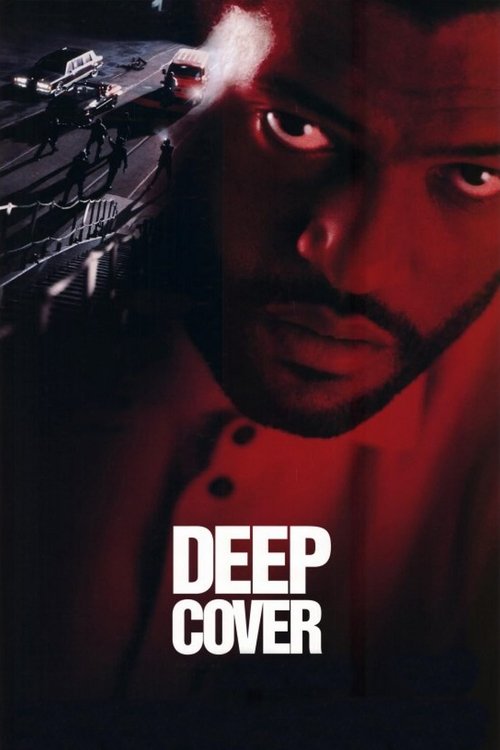
Deep Cover
1992 · Bill Duke
For a late-night crime fix with real teeth — when you want noir atmosphere and a film that's actually furious about something. Entertaining first, bruising second.
What it's about
A Black police officer is recruited for a special anti-drug operation: go undercover in the LA cocaine trade and work his way up from street level toward the men at the top, where the trail runs uncomfortably close to political power. The deeper he sinks, the blurrier the line between the cop and the criminal he's pretending to be.
The experience
Slick, moody, and morally queasy in the best way — a hard-boiled voiceover that starts confident and slowly corrodes, pulling you down with it. It's tense and stylish, but what stays with you is its anger.
Performances
Laurence Fishburne, in his first true lead, is magnetic as a man losing track of which self is the disguise; Jeff Goldblum, cast brilliantly against type as a yuppie lawyer sliding into the trade, is unnervingly funny and frightening at once.
The craft
Bill Duke and cinematographer Bojan Bazelli drench the film in saturated blues and reds — a nocturne of neon and shadow that looks gorgeous on a good screen. The writing treats the drug war not as backdrop but as subject, tracing the money past street level toward power, while the voiceover does real narrative work instead of decoration.
Why it matters
Dismissed as a genre picture in 1992, it took decades for the canon to admit it as one of the great American neo-noirs — and a rare crime film of its era that interrogates the drug war rather than moralizing about it.
Bill Duke — the imposing character actor who turned director — made one of the great American neo-noirs, and it took decades for the canon to admit it. Laurence Fishburne, in his first true lead, plays an undercover cop descending through the LA cocaine trade, his hard-boiled voiceover corroding from procedural confidence into moral vertigo; Jeff Goldblum, cast brilliantly against type, is the yuppie lawyer sliding down alongside him with unnerving relish. Duke and cinematographer Bojan Bazelli drench the film in saturated blues and reds, a nocturne of neon and shadow that treats the drug war not as backdrop but as subject: the film is openly furious about who profits from the trade and who gets consumed by it, tracing the money past street level toward power itself. Where much early-'90s crime cinema moralized, Deep Cover interrogates — the badge, the state, the very idea of a 'good' cop in a rigged game. Its title track introduced the world to a rapper named Snoop Doggy Dogg, giving the film a second cultural afterlife. The Criterion Collection's 2021 edition sealed its rehabilitation from genre programmer to essential Black American noir.
Reception
A modest performer in 1992, quietly respected but overshadowed by the era's bigger 'hood films' — three decades on it's been fully reappraised as one of the great 90s neo-noirs, a status sealed when Criterion added it to the Collection in 2021.
How Deep Cover was received, from release to now →
Influences: the films it descends from and the films it influenced
- Paid in Full (2002) — A noir-inflected drug-trade morality tale narrated by a conscience-in-voiceover, supplying the introspective 'weighing the cost' interiority that underlies Paid in Full's moral-ledger theme.
- Touch of Evil (1958) — Establishes the expressionist chiaroscuro portrait of a narcotics investigator dissolving into the corruption of the border-world he polices — the shadow-drenched moral-descent template Deep Cover inherits.
- Superfly (1972) — Codifies the Black-cinema cocaine-economy iconography (dealer glamour, the deal as ritual) that Deep Cover both quotes and critiques — the lineage Snoop's soundtrack debut explicitly closes the loop on.
- Across 110th Street (1972) — Grounds the Black-American crime-noir mode in institutional rot — cops as compromised as the criminals — the theme/institutional-critique Duke sharpens two decades later.
- Taxi Driver (1976) — Supplies the first-person confessional voiceover of a lone man narrating his own moral descent through a neon-slicked city — the narrative/voiceover + undercover-descent scaffolding Fishburne's Russell Stevens runs on.
- Prince of the City (1981) — Builds the slow-dissolution undercover structure in which a cop's assumed identity corrodes his real one — the descent-into-corruption arc Deep Cover compresses into pulp form.
- To Live and Die in L.A. (1985) — Pioneers the saturated neon crime-noir palette and the cop-who-crosses-every-line premise, pushing procedural realism into stylized color the way Bazelli later does.
- King of New York (1990) — Shot by Bojan Bazelli — the direct DP lineage: the same neon-bathed, saturated-color urban expressionism (deep magentas, sodium-vapor pools) transfers straight into Deep Cover.
- A Rage in Harlem (1991) — Duke's own immediately prior period Black-noir, establishing his authorship command of genre pastiche, heightened color, and Black crime milieu that Deep Cover modernizes.
- New Jack City (1991) — Contemporaneous sibling of the crack-era Black crime film built on an undercover cop inside a drug empire — the same drug-war-critique premise from the enforcement side.
- One False Move (1992) — Sibling neo-noir of the exact same moment reviving Black-American noir through moral rot and racial reckoning, sharing the era/early-1990s Criterion-rehabilitated arthouse-crime pedigree.
- Bad Lieutenant (1992) — Sibling study, released the same year, of a policeman's total moral damnation — the corrupt-cop-as-tragic-descent that Deep Cover stages through undercover assimilation.
- Menace II Society (1993) — Extends the retrospective-voiceover narration of a Black protagonist chronicling his own inescapable slide, inheriting Deep Cover's confessional first-person framing of the drug economy.
Similar films
- Training Day (2001) — influence & lineage
- King of New York (1990) — influence & lineage
- Clockers (1995) — influence & lineage
- Drive (2011) — influence & lineage
- To Live and Die in L.A. (1985) — influence & lineage
- Donnie Brasco (1997) — shared sensibility
- Paid in Full (2002) — shared sensibility
- L.A. Confidential (1997) — shared sensibility