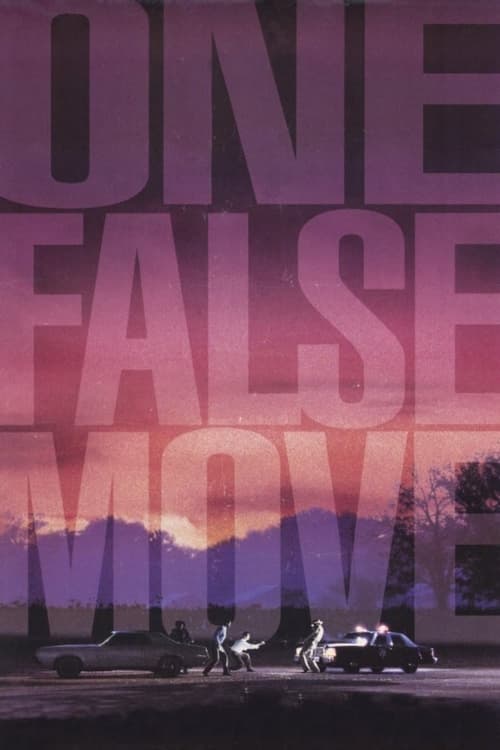
One False Move
1992 · Carl Franklin
For when you want a crime story with real weight — gripping enough for a Friday night, serious enough to sit with you afterward. Fair warning: it earns its intensity.
What it's about
Three killers — a volatile ex-con, a quietly terrifying planner, and a young woman named Fantasia caught between them — flee Los Angeles after a drug robbery leaves a house full of bodies, heading for a small Arkansas town. Waiting there is Dale Dixon, the local sheriff, a talkative small-town lawman thrilled to be included in a real LAPD manhunt. The film is two vectors converging on one dirt road, and the closer they get, the more personal the collision becomes.
The experience
Tense and unsparing, with sudden violence that actually shocks because the film cares about its people. What starts as a lean crime thriller keeps deepening — by the end it plays less like pulp and more like tragedy, and it leaves a bruise.
Performances
Bill Paxton is extraordinary as Dale Dixon, a man whose eager, aw-shucks surface slowly reveals something much more complicated. Billy Bob Thornton, who co-wrote the script, is chillingly convincing as one of the killers, and Cynda Williams gives Fantasia a wounded gravity that becomes the film's center.
The craft
Carl Franklin directs with patience rare in the genre, letting character and place — sun-blasted highways, cramped rooms, a small Southern town — carry the dread. The Thornton–Epperson script smuggles a story about race, family, and buried history inside a fugitive thriller without ever announcing it.
Why it matters
Made cheaply and nearly dumped straight to video, it was rescued by critics who championed it into one of the most admired American crime films of the nineties — launching Franklin's directing career and announcing Thornton as a writer.
Snapshot
A crime picture that arrives dressed as exploitation and ends as tragedy. Three killers flee Los Angeles after a drug robbery and a house full of murders, driving east toward a small Arkansas town where the sheriff — a garrulous, star-struck local named Dale Dixon — is thrilled to be included in a real LAPD manhunt. The film's engine is convergence: two vectors closing on a single dirt road. Its subject, revealed slowly and without announcement, is the buried kinship between a white Southern lawman and the Black woman driving toward him, and the child that kinship produced. Carl Franklin's second non-Corman feature, written by the Arkansas-born team of Billy Bob Thornton and Tom Epperson (Thornton also plays one of the killers), it was made cheaply for a video-oriented producer and nearly went straight to the shelf; critical advocacy pushed it into theaters, where it became one of the defining American independent films of the early 1990s and the launch point for Franklin's studio career. It is short, plain, brutally efficient, and it turns on a recognition scene rather than a shootout — though it delivers that too, with a flatness that refuses catharsis.
Industry & production
One False Move was produced by IRS Media, the film arm of IRS Records, one of several music-adjacent companies that moved into low-budget production during the video boom of the late 1980s. Jesse Beaton and Ben Myron produced. The budget was small — figures in the low single-digit millions are commonly cited, though the precise number is not firmly documented in the scholarly record and should be treated as approximate. Everything about the film's shape follows from that economics: a compact cast, three or four principal locations, a road structure that lets the production move rather than build, and a running time under 105 minutes.
The pivotal industrial fact is the film's near-disappearance. IRS's business model was oriented toward the home-video market, where a hard-edged crime title with recognizable character actors could recoup without a theatrical print-and-advertising spend. One False Move was headed in that direction when critical enthusiasm intervened. Gene Siskel and Roger Ebert both championed it prominently, and it landed high on year-end critics' lists; the resulting attention produced a platform theatrical release in 1992 rather than a direct-to-video dump. The episode became a case study, repeated for years afterward, in what film criticism could still do for a movie with no marketing budget — and, less flatteringly, in how close the distribution system came to burying it. The exact chronology of screenings, festival dates, and the ranking each critic gave it is the sort of detail that varies between accounts; the broad narrative of critical rescue is well established.
Carl Franklin came to the film through Roger Corman. After a substantial acting career — years of television work through the 1970s and 1980s — he entered the American Film Institute's directing program and then made features for Corman's Concorde, including Nowhere to Run (1989) and Full Fathom Five (1990). The Corman apprenticeship is legible in every reel of One False Move: coverage that is sufficient and no more, scenes that begin late and end early, violence staged for maximum effect at minimum cost. What Franklin added was a seriousness of moral attention that the Corman school neither required nor rewarded.
Technology
The film is a 35mm production of the pre-digital era, made when a low-budget American feature meant photochemical origination, optical opticals, and a magnetic or early digital mix finished on a modest schedule. Its technical interest lies less in equipment than in the media ecology it both depicts and inhabits. Consumer video is present inside the film — the Los Angeles crimes are entangled with a camcorder, and the grain and glare of amateur video sit inside a 35mm frame as evidence, as commodity, as a record that outlives the recorded. That was a genuinely contemporary texture in 1992: the camcorder had become a household object, and the Rodney King tape had made the amateur video image a national argument about what cameras prove.
The same technology shaped the film's fate. The videocassette market was the reason IRS Media existed, the reason One False Move was financed, and nearly the reason it was never projected. Its subsequent life has been a home-video life: rediscovery through rental and cable, then DVD, then a restored high-definition edition (a Criterion release drawn from a 4K restoration has brought it to a new audience). A film that the video market almost consumed was preserved by it.
Technique
Cinematography
James L. Carter's photography works by contrast of climate. The Los Angeles material is nocturnal, close, lit in sodium and lamplight, the camera near enough to bodies that the opening sequence becomes physically intolerable. The Arkansas material is the opposite: flat, overexposed daylight, wide fields, two-lane blacktop running to the horizon, a light that offers no shadow to hide in. The road sections use long lenses and held shots that let the highway do the work — heat shimmer, distance, the sense of a country being crossed rather than a montage of travel. Interiors are unfussy and often practical-lit, with the sheriff's office and the motel rooms rendered in an unglamorous ambient realism that reads as documentary rather than noir stylization. The film's most famous stretch, the final confrontation outside a house at the end of a dirt road, is staged in open, unhelpful light with the camera at a slight remove: no heroic angles, no slow motion, no cutting into the impacts. The refusal is the point.
Editing
Carole Kravetz's cutting establishes the film's dual-track structure and then exploits it. The pattern is straightforward parallel montage — fugitives moving, town waiting — but the tempo is asymmetrical: the road scenes accumulate dead time and small friction, while the Star City scenes are comic, digressive, almost sitcom-loose, so that the audience relaxes into a register the film intends to destroy. Within scenes the film is economical to the point of bluntness; entrances and exits are trimmed hard. The crucial editorial decision is the withholding of the connective information about Lila's past until the film can drop it as a single reframing beat, after which every earlier scene of Dale's clowning reads differently. The opening massacre is the one place where the cutting becomes deliberately unbearable — sustained rather than fragmented, so that the violence has duration instead of impact.
Mise-en-scène / staging
The film's world is built from American negative space: gas stations, motel rooms with two beds and a television, a diner, a highway shoulder, a small-town office with a coffee maker and a wall of nothing much. Franklin stages conversations in cars and doorways, using confinement to keep the three criminals in permanent, unresolvable proximity — Ray's volatility, Pluto's cold competence, and Fantasia's watchfulness pressed into a sedan's front and back seats. In Star City, staging emphasizes Dale's constant performance: he is always positioning himself relative to the visiting detectives, always angling for an audience. The final act moves to a house and its yard, domestic space, which is where the film has been heading thematically all along.
Sound
The score — associated with Peter Haycock and Derek Holt of the British blues-rock band Climax Blues Band, working with Terry Plumeri — leans on slide guitar and sparse blues figures, a Southern signature used with restraint rather than atmosphere-by-the-yard. Long passages carry no music at all. The sound design privileges environment: cicadas, air conditioners, tires on gravel, the specific hush of a rural night. Against that quiet, gunfire is loud, ugly, and short. The opening sequence's soundtrack of pleading and struggle is the film's most aggressive use of audio, and it is deployed once, early, to establish stakes the rest of the film need never restate.
Performance
Bill Paxton's Dale Dixon is the film's structural gamble: a character introduced as comic relief — vain, provincial, nicknamed "Hurricane," desperate to be taken seriously by big-city cops — who must survive the audience's condescension and then earn something else entirely. Paxton, to that point a character actor known for high-pitch supporting work, plays the bluster fully and lets the film hollow it out; the performance made him a lead. Billy Bob Thornton's Ray is a study in unstable amiability, four years before Sling Blade would make his regional specificity famous. Michael Beach gives Pluto an unsettling, articulate self-possession — the intelligence in the car, and the coldest thing in the film. Cynda Williams, coming off Mo' Better Blues (1990), plays Fantasia/Lila with a guardedness that reads first as complicity and later as strategy; the performance has to conceal the film's secret without seeming to, and it does.
Narrative & dramatic mode
The structure is a convergence plot with a buried recognition at its center — closer in mechanism to tragedy than to thriller. The audience is granted partial superiority over Dale (we have watched the killers work), which produces suspense; but the film reserves a second, deeper piece of information that inverts the hierarchy, so that the character we were laughing at turns out to be the one carrying the story's moral weight. Dramatic irony becomes the delivery system for shame. The film also refuses the genre's usual satisfactions: the manhunt does not resolve through procedure, the shootout produces no triumph, and the ending withholds redemption while granting acknowledgment. It is a plot about consequences arriving on schedule from a great distance — geographic, temporal, and historical.
Genre & cycle
One False Move is neo-noir relocated from the city to the rural South — the strain critics have since called country noir or rural noir. It sits at the head of an early-1990s American independent crime cycle that includes Red Rock West (1993), Lone Star (1996), Fargo (1996), and A Simple Plan (1998), all of which share its interest in provincial competence, landscape as fate, and crime as the surfacing of local history. The lineage runs back through Blood Simple (1984) to the Jim Thompson–Charles Willeford pulp tradition and to the fugitive-couple road picture (Bonnie and Clyde, The Getaway, Badlands). Its other, less discussed generic parent is the Southern racial procedural of In the Heat of the Night (1967) — the small-town sheriff, the outside investigation, the town's buried arrangements — which One False Move inverts by making the sheriff himself the site of the buried arrangement.
Crucially, it belongs to the pre-Pulp Fiction moment. Its violence is neither ironic nor stylish; the film's opening is designed to make you unable to enjoy what follows. Two years later the cycle's dominant tone would shift decisively toward the arch and referential, which is part of why One False Move has aged so well.
Authorship & method
Franklin's authorship is defined by restraint applied to genre material and by an unusual patience with actors — a legacy of his own long career in front of the camera. His method here is to let scenes run at their natural social tempo, to trust flat compositions, and to place moral revelation in performance rather than in camera rhetoric. The Corman training supplies the discipline; the AFI period supplies the ambition.
The screenplay by Billy Bob Thornton and Tom Epperson is the other authorial center. Both are from Arkansas, and the film's regional detail — speech rhythms, the social geometry of a small town, the exact shading of what everyone knows and never says — comes from that. The pair returned to the same nerve in A Family Thing (1996), another story of a white Southern man confronting Black kinship, and Thornton's Sling Blade (1996) extended the regional voice into his own directorial work. Jesse Beaton went on to produce Franklin's Devil in a Blue Dress (1995). Cinematographer James L. Carter, editor Carole Kravetz, and the Haycock/Holt/Plumeri music team each contribute to a house style of plainness that is far harder to achieve than it looks.
Movement / national cinema
The film emerges from American independent cinema in the years after sex, lies, and videotape (1989), when a specialty distribution apparatus existed but was still thin enough that a picture like this could fall through it. It is also adjacent to — without quite belonging to — the breakthrough of Black American filmmaking around 1991–1992, the moment of Boyz n the Hood, Straight Out of Brooklyn, Juice, Daughters of the Dust, and Bill Duke's Deep Cover (1992). Franklin's film complicates the grouping: it is a rural crime picture with a white protagonist, written by two white Arkansans, that nonetheless makes American racial inheritance its actual subject. Franklin himself has been consistently read as a director who works inside genre and studio structures rather than against them, and whose politics are carried by dramatic architecture rather than by declaration.
Era / period
1992. The film reached theaters in the same year as the Rodney King verdict and the Los Angeles uprising — a coincidence of timing, not of production, since the picture was shot before those events, but one that gave its opening Los Angeles sequence and its journey into Southern racial history an accidental charge. It arrives at the close of the video-store era's peak, at the beginning of the indie boom that Miramax and Sundance would define for the rest of the decade, and just before the Tarantino inflection reset the tone of American crime film. Its politics of race are handled without the period's more common uplift structures: no reconciliation speech, no institutional villain, only a private accounting.
Themes
The governing theme is inheritance — what a place produces and then declines to acknowledge. Dale's affability is the sound of a man who has never had to reckon with anything; the film's action is the arrival of the reckoning by car, from two thousand miles away. Race is treated as material history rather than as issue: the film's central fact, a white lawman's Black child, is stated so quietly that the audience feels the silence around it as the town's actual moral condition. Other threads: masculinity as performance, and its cost when the performance is called; the small town as a place people escape from and are dragged back to; violence as something that leaves a body behind rather than a set piece; and the doubling of Dale and Lila, two people who made the same bargain in opposite directions.
Reception, canon & influence
Critical reception was strong and, more importantly, active — critics advocated for the film as much as they reviewed it, and the Siskel-and-Ebert campaign became part of its identity. Reviewers singled out the discipline of Franklin's direction, the shock of the opening, and Paxton's transformation from character man to lead. The film has never had a large popular audience; its canonization has been a slow accumulation through home video, repertory programming, and eventually restoration and a prestige disc release, and it now appears routinely on lists of the best American crime films of the 1990s.
Backward. Its inheritances are clear even where they are not documented as stated influences: classical noir's doomed-return structure; the fugitive road picture from Bonnie and Clyde through The Getaway and Badlands; the Southern racial procedural of In the Heat of the Night; the paperback fatalism of Thompson and his descendants; and the Corman production model, which taught Franklin how to make a whole film out of very few shots. Where Franklin has spoken about influences, accounts vary in the record, and it would be irresponsible to attribute specific citations to him here.
Forward. One False Move immediately produced Franklin's own career — Devil in a Blue Dress (1995), One True Thing (1998), Out of Time (2003), and a long, distinguished run in prestige television — and it produced Billy Bob Thornton's, both as an actor whose regional menace became a signature and as the writer-director of Sling Blade. Bill Paxton's post-1992 leading roles, up to and including A Simple Plan, follow directly from what this film revealed. More broadly, it stands at the front of the country-noir cycle that ran through Fargo, A Simple Plan, and Lone Star, and forward into Winter's Bone (2010), Blue Ruin (2013), Hell or High Water (2016), and the first season of True Detective — all of them working the same seam of landscape, provincial competence, and violence as the return of local history. The specific structural move it perfected — the comic small-town lawman who turns out to be the film's moral center — has been reused often enough to become a convention. Whether later filmmakers took it directly from Franklin or arrived at it independently is not documented; what is certain is that One False Move got there first, and did it with a recognition scene rather than a gunfight.
A Deleuzian reading
Watch where Dale Dixon puts himself in a room.
The full Deleuzian reading of One False Move →
Reception
Its distributor planned to dump it straight to video until critics — Siskel and Ebert loudest among them — championed it into theaters, with Gene Siskel naming it his #1 film of 1992. Thirty years later the reappraisal was complete: a Criterion edition in 2022 and a standing spot in the '90s neo-noir canon.
How One False Move was received, from release to now →
How to watch One False Move: what to notice on a first viewing
- Watch where Sheriff Dale positions himself near the visiting detectives. Dale keeps angling into the frame with the LAPD detectives, leaning in, offering information nobody asked for, always trying to read as their equal. The way a person places their body in a room can tell you more than what they say.
- Notice the difference in light between the Los Angeles and Arkansas scenes. James Carter shoots Los Angeles close and dark in sodium light, then Arkansas in flat, overexposed daylight with no shadow to hide in. Two climates stand in for two kinds of danger, one hidden in darkness and one exposed in plain sight.
- Follow how the film cuts between the fugitives and the waiting town. Carole Kravetz intercuts the killers' drive east with Star City's slower, almost comic rhythm, so the audience relaxes into the small town scenes. The film lets you get comfortable in one register before it plans to take that comfort away.
- Listen for the slide guitar and how rarely it plays. The blues score by Haycock, Holt, and Plumeri appears sparingly, and long stretches carry no music at all, just cicadas and gravel underfoot. Silence does most of the work, so when gunfire finally comes it lands loud and ugly.
- Notice how much time the three killers spend crammed in one car. Franklin stages most of the road scenes inside the sedan, pressing Ray's volatility, Pluto's coldness, and Fantasia's watchfulness into the front and back seats. Confinement keeps three incompatible people permanently near each other with nowhere to look away.
The whole guide to watching One False Move, with the keys for a rewatch →
Influences: the films it descends from and the films it influenced
- Out of the Past (1947) — Supplies the doomed-return architecture — a man living under a borrowed name in a small town where everyone knows him casually and no one knows him truly, until a car carrying the past pulls in and the recognition, not the gunfight, is the catastrophe.
- In the Heat of the Night (1967) — The Southern racial procedural template: metropolitan detectives working a killing inside a white small-town lawman's jurisdiction, with the racial etiquette of each interrogation — who sits, who stands, who gets addressed by first name — carried entirely in blocking rather than dialogue.
- In Cold Blood (1967) — The cross-cut convergence engine — killers driving toward a destination while lawmen assemble at the far end — plus Conrad Hall's flat available-light plainness that refuses to make the murders photographically beautiful.
- Bonnie and Clyde (1967) — The fugitive road picture's tonal whiplash: comic bickering inside a moving car cut hard into unglamorous, badly aimed violence that runs a beat longer than the audience's appetite for it.
- The Getaway (1972) — Jim Thompson's paperback fatalism married to the car interior as pressure chamber — an entire criminal partnership staged in windshield two-shots with the highway ticking past behind the actors.
- Boxcar Bertha (1972) — The Corman production model Franklin was trained inside — a genre quota picture delivered on a fixed schedule by covering whole scenes in very few setups, the exact economy that lets One False Move hold flat compositions for their full social duration and still finish on budget.
- Badlands (1973) — The long-lens flatland highway image, figures compressed against an indifferent horizon, paired with the affectless calm of killers who discuss supper and homicide in the same vocal register.
- Blood Simple (1984) — Regional American noir in which killing is protracted, incompetent and physically laborious — the violence takes visible effort and the camera declines to cut away from any of it.
- Devil in a Blue Dress (1995) — Franklin and producer Jesse Beaton carry the identical method into period noir — scenes played at natural social tempo, moral revelation placed in performance, and the racial reading of every room built into staging instead of camera rhetoric.
- Fargo (1996) — Perfects the structural move One False Move got to first: a small-town lawman introduced as provincial comedy who turns out to be the film's moral center and its only genuinely competent professional.
- Sling Blade (1996) — Thornton extends the Arkansas speech rhythms of the One False Move screenplay into his own direction: long unhurried takes in which regional idiom delivers the exposition, and violence arrives without any preparatory camera move.
- A Family Thing (1996) — Thornton and Epperson return to the same nerve with the same withholding technique — a white Southern man forced to acknowledge Black kinship he has always half-known, the disclosure held back until it can only be absorbed, not argued with.
- A Simple Plan (1998) — Paxton's post-1992 leading persona in full — ordinary provincial decency corroding under moral pressure — staged in cold-climate flatness where landscape supplies the dread Raimi would normally extract from camera movement.
- Winter's Bone (2010) — Country-noir procedural built on provincial competence, its protagonist navigating kinship networks and unwritten local law, with environmental sound and regional string music doing the work a conventional suspense score would.
- Blue Ruin (2013) — Violence as clumsy sustained labor performed by amateurs, staged in car interiors and roadside rooms in unbroken takes that deny the audience the release of a clean, well-placed shot.
- Hell or High Water (2016) — Long-lens highway convergence across the Southwest — two criminal brothers and a drawling lawman closing on the same intersection — with the lawman's comic surface concealing the film's moral verdict, and a slide-guitar-inflected score standing in for the landscape's history.
- Deep Cover (1992) — The parallel 1992 case of a Black director taking hardboiled genre architecture at face value and making racial inheritance the actual load-bearing mechanism of the plot rather than its decor.
- Lone Star (1996) — Runs the same buried-recognition device — a border sheriff excavating a local history that resolves into his own bloodline — with the town's racial geometry of who married whom and who never says it functioning as the actual evidence chain.
Similar films
- Devil in a Blue Dress (1995) — influence & lineage
- Sling Blade (1996) — influence & lineage
- In Cold Blood (1967) — influence & lineage
- Lone Star (1996) — influence & lineage
- The Getaway (1972) — influence & lineage
- Reservoir Dogs (1992) — shared sensibility
- Emily the Criminal (2022) — shared sensibility
- The Fugitive (1993) — shared sensibility