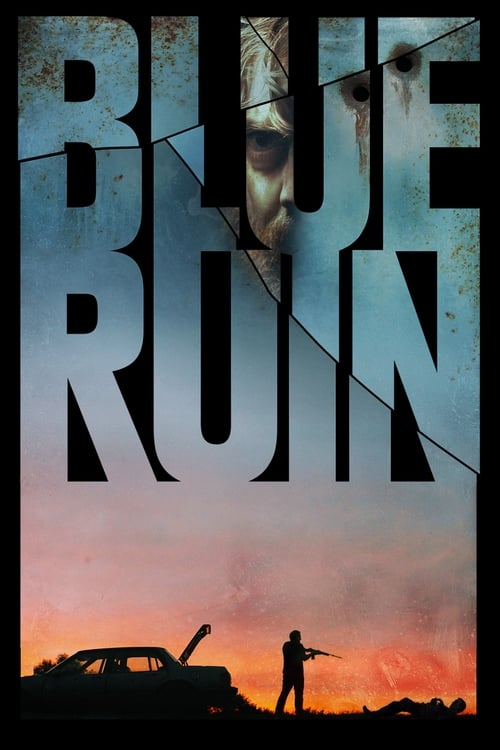
Blue Ruin
2014 · Jeremy Saulnier
For when you want a thriller stripped to the bone — no speeches, no catharsis, just consequence. A gripping one-sitting watch for a night when you'd rather be riveted than comforted.
What it's about
Dwight is a gentle, wordless drifter living out of a rusted blue Pontiac on the Delaware shore. When he learns the man imprisoned for killing his parents is about to be paroled, he drives home to Virginia to take revenge — and succeeds just well enough to start a war he is completely unequipped to fight, one that pulls his estranged sister's family into the crossfire with an armed and vengeful clan.
The experience
Lean, quiet, and almost unbearably tense — long stretches pass without dialogue, and the violence, when it comes, is sudden, messy, and real. It's also darkly funny in a mournful way, because its hero is an amateur and the film never lets you forget it.
Performances
Macon Blair is the film's revelation: soft-eyed, terrified, and heartbreaking, he plays an avenger who looks like he'd rather be anywhere else, and he makes incompetence more gripping than cool ever is.
The craft
Jeremy Saulnier wrote, directed, and shot it himself, and his cinematography gives rural Virginia a hushed, overcast beauty that makes the bloodshed land harder. The storytelling is ruthlessly economical — whole backstories delivered in a glance or a prop — and the quiet makes every sound count on good speakers.
Why it matters
A Kickstarter-funded breakout that won the critics' prize in Cannes' Directors' Fortnight, it launched Saulnier as a major genre voice and became a touchstone for stripped-down American indie thrillers.
Snapshot
Blue Ruin is a revenge thriller that takes the revenge film apart. Dwight Evans (Macon Blair) is a bearded drifter who lives in a rusting blue Pontiac on the Delaware shore. A local police officer tells him that Wade Cleland, the man jailed for killing Dwight's parents, is about to be paroled. Dwight drives back to rural Virginia, stabs Wade in a roadhouse bathroom, and botches nearly everything after that. He leaves his car behind, puts his sister's family in danger, and starts a war with the armed Cleland clan that he has no idea how to fight. The film is lean, mostly wordless, and clinical about its violence. It became the breakout second feature of Jeremy Saulnier, who wrote, directed and shot it. It premiered in the Directors' Fortnight at Cannes in 2013, where it won the FIPRESCI critics' prize, and it was released in the US in spring 2014. It is now regarded as one of the defining American independent genre films of the 2010s, and it set out the method Saulnier would extend in Green Room (2015) and Rebel Ridge (2024): people who don't know what they're doing, caught in violence that is precisely and physically realised.
Industry & production
Blue Ruin came from a small group of collaborators who had been making films together since childhood in Alexandria, Virginia. Saulnier and Macon Blair had made amateur movies as kids. Their first feature, the horror-comedy Murder Party (2007), got only modest attention. Saulnier then worked mostly as a cinematographer for hire on other people's independent films, Matthew Porterfield's Putty Hill (2010) among them. Blue Ruin was conceived partly as a last attempt at a directing career. In interviews Saulnier has said he and his wife put personal savings into the film. A Kickstarter campaign raised further money, a small share of the total but useful as both funding and publicity. The overall budget is generally described as well under a million dollars. Exact figures vary between accounts and are not reliably documented, so they are left out here.
The film was shot mainly on location in Virginia, with the opening section on the Delaware coast. The crew was small, many of them friends and regular collaborators. After Cannes, it was acquired for US distribution by RADiUS-TWC, the Weinstein Company's label for day-and-date theatrical and video-on-demand releases. It opened in a limited run in April 2014 alongside VOD availability. That release pattern was typical of American indie genre distribution at the time. It meant the film found most of its audience at home and through word of mouth rather than in theatres. Reliable box-office totals for the theatrical run are not well documented and are not given here.
Technology
Saulnier shot Blue Ruin digitally, in a 2.39:1 widescreen frame. Production accounts commonly name the Canon C300, a compact large-sensor camera popular on low-budget productions of the period, but the specific camera and lens package is not consistently documented. What the film shows is how cheap digital capture and a director-cinematographer could together produce a polished, scope-format genre picture on a micro-budget. The night scenes rely on available and practical light: headlights, motel fixtures, porch bulbs. The digital sensor's sensitivity in low light makes that possible. The film's look is a calculated use of limited means, not a fight against them.
Distribution technology matters here too. RADiUS-TWC's simultaneous VOD release is part of the film's history, because Blue Ruin was one of the films that showed a festival-launched indie thriller could build a reputation largely through home viewing.
Technique
Cinematography
Since Saulnier shot the film himself, the visual design is unusually unified. The palette is dominated by the faded blue of Dwight's Pontiac, the car the title refers to, and by washed-out blues and greens in exteriors and interiors alike. The blue works as a motif of decay and of a past that has never been resolved. Compositions use the wide frame to isolate Dwight: he is often placed off-centre, small against empty roads, parking lots and woods. The camera is mostly steady and observational, without handheld frenzy. That restraint makes the eruptions of violence more shocking. Saulnier often frames action in ways that hold back information, using closed doors, the darkness beyond headlights, or a figure partly hidden by the frame edge. Suspense comes from what can't be seen.
Editing
Julia Bloch's editing is patient and economical. The first act runs largely without dialogue and establishes Dwight's routines (scavenging food, bathing in strangers' houses, sleeping in the car) through accumulated detail rather than exposition. Information about the backstory is withheld and handed out in fragments, so the audience pieces together the murder of Dwight's parents roughly as slowly as Dwight reveals himself. Violent scenes are cut so the consequences are legible: we see the aftermath, the wound, the clumsy cleanup. The film runs about ninety minutes and is notably compact for its genre.
Mise-en-scène / staging
The film is staged in unglamorous American places: a beach-town boardwalk, a highway rest stop, a roadside bar, the suburban house where Dwight grew up, the Cleland family home, and the rural property of Dwight's old school friend Ben. Production design places the story in a recognisable, specific Mid-Atlantic and Southern setting rather than a mythic genre landscape. Guns are staged as awkward, heavy, frightening objects. Dwight can't handle them, and an early scene where he fails to get a handgun shows that clearly. Physical self-care runs through the staging as well, most memorably when Dwight tries to remove a crossbow bolt from his own thigh. Those scenes turn the action-film convention of the stoic, invulnerable hero into something painful and absurd. One of the film's most noted shifts is in Dwight's appearance. Once he shaves and cuts his hair, the wild drifter becomes a soft-faced, nondescript man. That makes him look ordinary and anonymous, and it also shows how unsuited he is to the role he has taken on.
Sound
The score is by Brooke and Will Blair, Macon Blair's brothers and long-time Saulnier collaborators. It is spare, ambient and low in the mix. It doesn't drive the action. It builds unease under long passages of near-silence. Much of the soundtrack is environmental: surf, insects, car engines, wind in trees. Gunshots are loud, abrupt and percussive against that quiet. The film's sparing dialogue adds to the sonic austerity.
Performance
Macon Blair's performance is the centre of the film and was the most widely praised element on release. His Dwight is passive, frightened, polite and doggedly determined, a man whose motive is grief and not competence. Blair plays him with wide, wounded eyes and a hesitant physicality that undercuts every gesture of action-hero resolve. Amy Hargreaves, as Dwight's sister Sam, carries the film's moral reproach in one quietly devastating confrontation. Devin Ratray, as Ben, adds wry, laconic humour and a sense of armed rural self-sufficiency that Dwight lacks. Eve Plumb, best known from television's The Brady Bunch, is cast against type as the Cleland matriarch. Kevin Kolack and Brent Werzner play the Cleland siblings as menacing but recognisably human.
Narrative & dramatic mode
The narrative follows the classic revenge structure, but Saulnier systematically drains it of catharsis. The killing that would normally be a climax comes early, and the rest of the film deals with what follows. The film is built on escalation and reciprocity: each act of violence draws retaliation, which draws more violence, in a closed feud logic that neither side can escape. The dramatic mode is a tense, darkly comic realism. The comedy comes from incompetence and bad luck, not jokes. A late revelation complicates the moral basis of the vendetta. It turns out that the guilt for the original killing, and the family ties between the Evanses and the Clelands, are not what Dwight believed. His revenge was aimed at a story he had only half understood. The ending is fatalistic. It offers no restoration, only an end to the cycle at great cost.
Genre & cycle
Blue Ruin belongs to the revenge thriller and to American neo-noir, specifically its rural and regional strand. It sits with the backwoods-noir and "Southern Gothic thriller" cycle of the 2000s and 2010s, which includes Winter's Bone (2010), Cold in July (2014), Joe (2013) and later Hell or High Water (2016). It has particular kinship with the films of the Coen brothers. Blood Simple (1984) and No Country for Old Men (2007) also depend on fumbled crimes, long silences and the physical cost of violence.
It also belongs to the wave of American independent filmmakers in the early 2010s who moved from low-budget naturalist drama, or low-budget horror, into tightly made genre filmmaking. This loose group includes Jim Mickle, Adam Wingard and Ti West. Within the revenge genre specifically, Blue Ruin is often read as a deliberate inversion of the vigilante film tradition, from Death Wish (1974) onward, which presents vengeance as competent, justified and satisfying.
Authorship & method
Jeremy Saulnier is a director who trained as a cinematographer. His authorship is visual and procedural. He is interested in the mechanics of violence (how wounds happen, how weapons behave, how bodies give out), in protagonists out of their depth, and in suspense built from geography and logistics. Blue Ruin is the first full statement of these concerns, which he developed further in Green Room and Rebel Ridge and in the bleaker Alaskan thriller Hold the Dark (2018). He shot that last one but did not write it.
His collaborations are long-standing and personal. Macon Blair, his childhood friend, is the film's star and creative partner. Blair later had supporting roles in Saulnier's work and became a director himself with I Don't Feel at Home in This World Anymore (2017), which won the Grand Jury Prize at Sundance. The Blair brothers' scores are part of Saulnier's sound across several films. Editor Julia Bloch cut Blue Ruin and went on to edit Green Room. The production grew out of this small circle, and the film reflects that self-sufficient way of working. Its craft is controlled and deliberate rather than slick.
Movement / national cinema
Blue Ruin is an American independent film. It came out of a moment when the boundary between "art-house" independence and genre filmmaking was thinning. It is not part of a declared movement. It does, though, mark the turn of a generation of US indies away from mumblecore's improvised, dialogue-heavy naturalism and toward genre storytelling with formal discipline and regional specificity. Its premiere at Cannes and its prize from an international critics' body made it an American genre film that was validated first through the European festival system. That route became increasingly common for American indie thrillers and horror films in the 2010s.
Era / period
The film was made and released in the early 2010s, when crowdfunding, inexpensive digital cinema cameras and day-and-date VOD distribution were changing the economics of American independent film. In that context Blue Ruin is something of a model case. Self-funding and Kickstarter money got it made, festival success gave it visibility, and a hybrid distributor carried it to audiences mainly through home video.
It also arrived during recurring American debate about gun culture and vigilantism. The film's portrait of a family arsenal, of guns passed between friends, and of armed self-defence in rural America gave it topical weight, though Saulnier has generally framed it as a genre exercise and not a polemic.
Themes
- The futility of revenge. The film's central argument is that vengeance doesn't restore anything. It spreads harm to the innocent, Dwight's sister and her children above all, and it can't undo the original loss.
- Incompetence and the ordinary man. Dwight isn't a trained killer. His clumsiness exposes how genre fantasy depends on implausible mastery.
- Inheritance and family. Both families carry a past they don't fully understand. The vendetta is passed down through generations and through blood, and the late revelations about the original crime turn the question of who belongs to whom into a central irony.
- Guns and the body. Firearms are shown as dangerous, unwieldy and morally heavy, and bodies are shown as fragile and slow to heal.
- Grief and arrested life. Dwight's homelessness is presented as a life that stopped on the night his parents died. The revenge plot is the only story he can imagine for himself.
- Place. The decaying coastal resort, the suburbs and the rural houses of the Mid-Atlantic and Virginia ground the story in a specific, unromantic America.
Reception, canon & influence
Critical reception. Blue Ruin won the FIPRESCI prize in the Directors' Fortnight at Cannes in 2013 and was very well received when released in the US in 2014. Critics singled out Macon Blair's performance, Saulnier's control of tension, and the film's clever reworking of revenge conventions. It appeared on a number of critics' year-end lists. Its standing in independent film circles was confirmed by recognition at the Independent Spirit Awards, though the details of specific nominations are best checked against the official record and are not elaborated here. Its commercial reach in cinemas was limited. Its reputation grew mainly through home viewing and critical advocacy.
Influences on the film (backward). Critics have consistently linked Blue Ruin to the Coen brothers, especially Blood Simple and No Country for Old Men, for their botched crimes, laconic tone and attention to the material traces of violence. It also connects to 1970s American films about violence in rural settings, notably Deliverance (1972) and Straw Dogs (1971), and to the vigilante genre it argues against. Saulnier's own background in independent naturalist cinema, through his cinematography work, shapes its observational patience. Interview remarks by Saulnier about specific models are reported in varying forms, so no particular quotation is attributed to him here.
Legacy (forward). Blue Ruin made Saulnier's career. It directly enabled Green Room (2015), a larger-scale siege thriller that refined the same approach of incompetent protagonists and precisely rendered violence, and it ultimately led to Rebel Ridge (2024), a widely seen Netflix thriller that again treats violence and authority in small-town America with procedural clarity. It also launched Macon Blair as an actor and filmmaker. More broadly, it became a reference point for the "elevated" or art-house-adjacent American genre film of the 2010s. It showed that a micro-budget, regionally specific thriller with an unheroic protagonist could earn international critical standing. Its blend of slow-burn suspense, dark comedy and a moral reckoning with violence can be traced in later American indie and streaming-era thrillers. It is regularly cited as one of the essential revenge films of its decade, and as a turning point for the micro-budget crime film in America.
Influences: the films it descends from and the films it influenced
- Blood Simple (1984) — The model for Blue Ruin's botched killing: murder shown as slow, clumsy physical work, where a body that won't die, blood that won't wipe up and evidence left behind drive the suspense instead of plot twists.
- No Country for Old Men (2007) — Dwight's self-surgery and wound-tending follow its procedural detail about field-dressing wounds and handling weapons, and both films use near-silent stretches where a man's improvised logistics are the drama.
- Straw Dogs (1971) — Blue Ruin's climax in the family house takes its structure from Peckinpah's domestic siege: a mild, unmasculine man defends a farmhouse by improvising, and the violence is shown as panicked and degrading rather than cathartic.
- Deliverance (1972) — Gives the template for rural Southern spaces as ungovernable terrain, where outsiders and kin settle accounts away from the law, and where killing leaves the survivors with corpses to deal with and lasting guilt.
- Death Wish (1974) — The vigilante formula Blue Ruin systematically undoes: Winner builds escalating, satisfying payback kills, and Saulnier swaps in a protagonist who can't shoot, can't plan and only spreads the damage.
- Shotgun Stories (2007) — A micro-budget Arkansas feud between half-brothers that opens with a grievance and escalates one retaliation at a time, setting up Blue Ruin's structure of an intra-family revenge chain that no one can stop.
- Dead Man's Shoes (2004) — A low-budget regional revenge film that holds back the backstory behind the avenger's grievance and lets the violence feel shabby and close-up, a key precedent for Blue Ruin's mix of withheld motive and plain, unglamorous realism.
- A Simple Plan (1998) — Ordinary, incompetent rural men commit one crime and are then pulled into a series of cover-up killings, the same aftermath-driven escalation Blue Ruin builds out of Dwight's single act.
- Murder Party (2007) — Saulnier's no-budget debut, also starring Macon Blair as a passive everyman stuck among violent people, where the director first tried out his mix of dark comedy and physically clumsy, prosaic gore.
- I Saw the Devil (2010) — Saulnier applies I Saw the Devil's violence-as-labor formal grammar to American indie genre filmmaking — staging confrontations as exhausting, materially consequential, physically deteriorating work, and tracking the progressive hollowing of the vigilante avenger through unglamorized bodily consequence rather than psychological interiority.
- Revanche (2008) — An international sibling in revenge-thriller subversion: it strips the vengeance premise of competence and payoff, rendering violence clumsy, consequential, and anti-cathartic rather than triumphant.
- One False Move (1992) — Violence as clumsy sustained labor performed by amateurs, staged in car interiors and roadside rooms in unbroken takes that deny the audience the release of a clean, well-placed shot.
- Green Room (2015) — Scales Blue Ruin's method up into a siege. Precise, anatomically specific wounds (a slashed arm, dog attacks) and protagonists with no combat skills work out survival through spatial logistics, with Blair, editor Julia Bloch and the Blair brothers' score all returning.
- I Don't Feel at Home in This World Anymore (2017) — Blair's directing debut carries Blue Ruin's amateur-avenger premise into comedy: a fed-up nobody's small act of justice becomes clumsy, bloody violence that the film treats with the same matter-of-fact physical detail.
- Hold the Dark (2018) — Carries over Blue Ruin's long silences, wide landscape framing that isolates its figures, and withholding of motive into a bleaker register. The midfilm shootout plays as a slow, procedurally exact massacre with no heroic payoff.
- Brawl in Cell Block 99 (2017) — Belongs to the post–Blue Ruin wave of American genre films that use a slow, patient lead-in to set up abrupt, anatomically blunt violence, treating injury as concrete physical fact rather than spectacle.
- Hell or High Water (2016) — Extends the 2010s rural neo-noir that Blue Ruin helped define, with economically worn small-town landscapes, sparse dialogue, and an aftermath-heavy final act where a standoff between the two sides replaces the climactic shootout.
- Rebel Ridge (2024) — Turns Blue Ruin's attention to how weapons, wounds and logistics actually work into a procedural study of small-town authority. Saulnier stages confrontations as legible, step-by-step escalations where restraint and positioning matter more than firepower.
- Winter's Bone (2010) — A regional indie crime film shot on location in natural light that makes a closed rural clan's code of silence and family loyalty the real antagonist, as the Cleland family is in Blue Ruin.
- Cold in July (2014) — A contemporary indie thriller where a timid family man kills a home intruder, with the clumsy shooting itself as the inciting incident, and is pulled into a widening cycle of retribution, the same inexperienced-killer setup in a genre-pastiche register.
- Riders of Justice (2020) — Deglamorizes revenge by making the avenger incompetent and the killing ugly and consequential — the ironic-revenge-subversion Riders shares, exposing vengeance as a grief-management fantasy rather than catharsis.
Similar films
- Rebel Ridge (2024) — influence & lineage
- No Country for Old Men (2007) — influence & lineage
- Revanche (2008) — shared sensibility
- Blood Simple (1985) — shared sensibility
- Blue Heron (2026) — shared sensibility
- Ghostlight (2024) — shared sensibility
- Shooter (2007) — shared sensibility
- Sirāt (2025) — shared sensibility