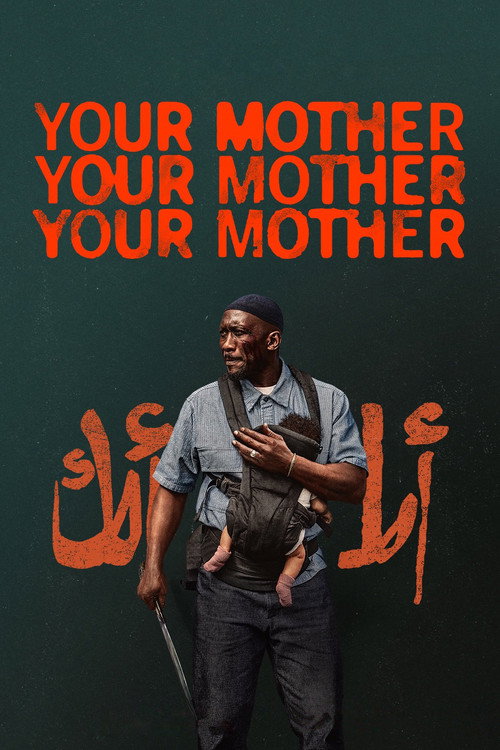
Your Mother Your Mother Your Mother
2026 · Bassam Tariq
For when you want an action movie with a soul — real fights and real feeling, not just one or the other. Reach for it when you're up for something that hits hard emotionally and physically; it's a challenge with a warm heart, not a comfort watch.
What it's about
Latif is a devout Muslim in Houston, a father of three, and a contract killer — a contradiction he has managed to live with until his wife dies suddenly. Left alone with two kids and a newborn daughter who needs breast milk, he sets out across the city on the most basic errand imaginable while his old employers, and a dangerous religious leader, close in. It's a hitman thriller wrapped around a grief drama, set inside an observant Muslim family in the American South.
The experience
It moves between two speeds — the slow, heavy quiet of mourning and sudden bursts of brutal close-quarters violence — and asks you to take both equally seriously. Tender and bruising at once, it leaves you sitting with the question of how care and killing can live in the same man.
Performances
Mahershala Ali, in his first major solo lead after two Oscar-winning supporting turns, carries the film: lethal physical authority in the fights, quiet wounded tenderness as a widowed father, with neither mode undercutting the other. John Cho plays sharply against type as an eccentric, Texan-coded antagonist, and Giancarlo Esposito — so often cast as menace — appears instead as a figure of moral weight.
The craft
Writer-director Bassam Tariq shoots the domestic scenes with the same seriousness as the fights, and the action is practical and choreographed — bladework, improvised weapons, bodies in real space — cut for emotional effect rather than clean geography. Katelin Arizmendi's camera keeps the images in service of character, and an atmospheric score by Son Lux favors contemplation over propulsion. It rewards a big screen and good speakers, especially in the close-quarters set pieces.
Why it matters
A rare studio-backed American action film with a Muslim protagonist whose faith is the source of his moral struggle rather than a sign of danger — a real shift after two decades of post-9/11 typecasting. It also marks Ali's arrival as a leading man and confirms Tariq, after the collapse of his Marvel Blade project, as a distinctive voice working genre on his own terms.
Snapshot
Your Mother Your Mother Your Mother is Bassam Tariq's second fiction feature, which he wrote and directed. Mahershala Ali plays Latif, a devout Muslim, a father of three, and a contract killer in Texas who takes only targets he believes the world is better off without. When his wife dies suddenly, the structure his life was built on goes with her: he must raise three young children alone, and because his infant daughter cannot take formula, he has to hunt across the city for breast milk, even as his employer demands one last job. The title comes from a well-known hadith. Asked who most deserves a person's good treatment, the Prophet Muhammad answers "your mother" three times before finally naming the father. The film is built on that hierarchy of care, and on a man forced to take on the role the saying ranks above his own.
The film premiered at the Toronto International Film Festival on September 12, 2026, as a Special Presentation. Amazon MGM Studios opened it in limited release in the United States on September 25 and expanded it through October, reaching 824 theaters by its fourth weekend. The critical response was strongly positive: 96% on Rotten Tomatoes across 115 reviews, with a 93% audience score, and 84 on Metacritic, in the aggregator's universal-acclaim range. Its theatrical gross was modest. The film is a hybrid: a hitman thriller with real, choreographed violence, wrapped around a grief drama and a portrait of observant Muslim family life in the American South. It is rated R.
Industry & production
The project has an unusual origin in a failed blockbuster. In 2021 Marvel Studios hired Tariq to direct its Blade reboot, with Mahershala Ali in the title role. Tariq left that production in September 2022 over its delays, and it stalled for years afterward. Coverage of Your Mother framed it as the collaboration Tariq and Ali had been denied: Ali came to the project after a year of edged-weapons training for the abandoned Marvel film. Andrew Dignan of In Review Online called it very likely the strangest film ever to begin its life as a Marvel movie. Natalia Keogan of The A.V. Club treated it as a consolation prize; Dignan and Vulture read the detour as a gain, with Vulture arguing the film's energy makes its origin story feel serendipitous rather than sad.
Principal photography ran from March to late May 2025, based in Atlanta, with some filming in Houston itself — a mostly Georgia shoot standing in for a Texas story, in the long pattern created by that state's production incentives, but anchored by location work in the city the film depicts.
The production companies were Orion Pictures and Two & Two Pictures, the latter run by Lucan Toh and Babak Anvari, the Iranian-British director of Under the Shadow (2016). Orion was by then operating as a specialty label inside Amazon MGM, which distributed. The release followed a familiar pattern for prestige genre films: a fall festival premiere, a platform opening, then a wide expansion timed to awards season. The Houston Cinema Arts Festival opened with the film on October 1, a homecoming for a story set in the director's own city. Commercially, the acclaim did not translate into a large gross: the film opened to $204,000 in six theaters, took $1.2 million in its fourth weekend after a 270% jump upon expanding to 824 theaters, and stood at $2.55 million domestic at that point, 113th for 2026, with its per-theater average dropping sharply on the wide expansion. How it performs on Amazon's streaming platform, which the studio's model treats as the real point of release, is where its commercial life will mostly happen.
Technology
The film's technical investment went into practical, stunt-driven action rather than visual effects, in the tradition revived by the John Wick series: close-quarters fighting staged for the camera rather than built digitally. Ali's sword work, honed in that year of training for Blade, drew specific praise from Jared Mobarak at The Film Stage, and Keogan singled out the execution of a fight built around improvised objects — petroleum jelly, shards of glass, latex gloves. The craft on display is choreography, blade handling and in-camera staging.
Technique
Cinematography
The film was shot by Katelin Arizmendi, best known for Carlo Mirabella-Davis's Swallow (2019), a film remembered for precise, controlled compositions that turn a domestic interior into a pressure chamber. Here her approach is more open: Robert Daniels of Screen Daily described open compositions and fluid editing that carry the fights and the spiritual passages alike, so that both kinds of scene are treated with the same seriousness. Dignan characterized the first half as gritty social-realist imagery, with the film's exploitation elements set against the domestic struggle rather than replacing it. Tariq has described one deliberate visual device: inverted shots that signal a spiritual descent into darkness. The film's main formal claim is that the house with its absent mother and the kill site matter equally to the camera.
Editing
The editor was Cam McLauchlin, whose previous work includes Guillermo del Toro's Nightmare Alley (2021). Daniels credited the fluidity of the cutting as part of what binds the action to the film's devotional material. The bigger editing challenge is structural: the film moves between the slow pace of mourning and the forward drive of a thriller, and reviewers disagreed about how well it manages the shift. Keogan argued it oscillates between domestic drama and action thriller without committing to either. Dignan found the final confrontation marred by disorienting spatial geography and judged the combat scenes less effective than the quiet character work; Justin Chang at NPR likewise called the action the film's most generic aspect, against the distinction of everything around it.
Mise-en-scène / staging
The production designer was Akin McKenzie and the costume designer Deirdra E. Govan. The film's design centers on contrasts: mosque and back room, family kitchen and kill site, prayer and violence. Its chief villain is given a strong visual signature — John Cho plays an evangelical preacher antagonist who wears grillz and a cowboy hat, a deliberately strange, Texas-coded look. IGN described the film's modern setting as borderline satirical even as its emotions stay grounded. Giancarlo Esposito plays Abdul Malik, a figure within the film's Muslim community. The religious spaces of Muslim Houston, and of Muslim America more broadly, are shown as ordinary and lived-in rather than exotic — Tariq has worked this way since his earliest projects, and the film's sense of place comes from his own Houston upbringing even where Georgia stood in for the city.
Sound
The score is by Son Lux — Ryan Lott, Rafiq Bhatia and Ian Chang — whose music for Everything Everywhere All at Once (2022) earned an Academy Award nomination. Tariq has said he worked with the band and with McLauchlin to build a score with a religious, parable-like feeling, favoring the film's contemplative side over the propulsive scoring usual in the action genre. Prayer and recitation are woven through the film; one prayer sequence was singled out by Sidra Jafri at Now Toronto as pivotal.
Performance
Critics framed the film as Mahershala Ali's first major solo lead after two Oscar-winning supporting roles (Moonlight, 2016; Green Book, 2018) and the Blade setback, and the performance was the most consistently praised element. Dignan described its quiet intensity and innate moral authority; Daniels wrote that Ali radiates charm whenever he is with the children while his physical weariness conveys a fragile spirituality to the camera; Chang praised the pairing of quiet depth with a lethal display of action prowess. Ali is himself a practicing Muslim, having converted in 1999, and commentary generally treated that personal fit as part of the role's credibility.
The supporting cast was singled out too. Adia plays the eldest daughter, Fatiha; Mobarak called her the film's true standout, and Jafri likewise praised the believability of her performance. Cho plays well against his usual type as the eccentric antagonist. Esposito, whose long run of genre villains (Breaking Bad, The Mandalorian) makes him an obvious choice for menace, is cast here as Abdul Malik instead. The ensemble also includes Abubakr Ali as Hatty, Laith Nakli as Mike Mahmoudi, Tramell Tillman as Talib and Tiffany Boone as Fugazi.
Narrative & dramatic mode
The story is set off by a death and driven by a need. The wife's sudden death removes the parent the hadith ranks first, and the newborn's refusal of formula turns the search for breast milk into the concrete goal behind Latif's journey across the city, with his employer's demand for one last job pulling against it. That premise is unusual: an errand-quest sits inside a crime plot, turning the familiar one-last-job structure into something closer to a trial of devotion. Tariq has said the breast milk is the search in more than one sense — that in looking for it, Latif is in some ways also looking for his wife.
The tone is deliberately mixed, and the mixing is the point. Chang wrote that the film delights in outrageous juxtapositions; Mobarak found the humor — familial, religious, violent — the thing that hooked him, arising from situational absurdity, a hitman seeking breast milk with infants in tow. Faith drama, family melodrama, character study and pulp thriller run side by side. Mobarak summarized the arc as a quest in which this father comes to realize he had been worried about the wrong fight — the film weighing presence and care against the genre's usual business.
Genre & cycle
The film fits within the twenty-first-century revival of the professional-killer film, most visibly the John Wick series (2014–2023), which made an aesthetic out of ritualized, practically staged violence and private codes of honor. But its truer lineage is the samurai film, and Tariq has been explicit about it: he has named Lone Wolf and Cub and John Woo's Hard Boiled as foundational references, cited Hayao Miyazaki's Princess Mononoke for its moral ambiguity, and said he wanted to create within that canon while adding his own image to it. Robert Kojder at Flickering Myth read the film as a samurai movie with influences reaching back to Akira Kurosawa. The Lone Wolf and Cub parallel is almost literal — a masterless killer traveling with an infant — and it places the film in the quieter line of introspective assassin cinema that runs through Jim Jarmusch's Ghost Dog: The Way of the Samurai (1999), with its solitary killer guided by a religious-philosophical text, here rewritten through Islamic ethics.
The widowed-father plot and the child-protection motive also link it to the broad family of protector thrillers. The religious dimension is rarer: an American action film in which Islam is the moral framework rather than a source of villainy, with the corrupted religious authority supplied instead by an evangelical preacher.
Authorship & method
Bassam Tariq is a Pakistani-American filmmaker born in Karachi and raised in Houston, and a graduate of the University of Texas at Austin. His career has moved between nonfiction, digital storytelling and fiction, with a consistent focus on Muslim lives depicted from the inside:
- 30 Mosques in 30 Days (from 2009, with Aman Ali), a Ramadan travel blog and later a project covering mosques across the United States. It established Tariq's interest in the variety of American Muslim communities.
- These Birds Walk (2013, co-directed with Omar Mullick), a documentary about runaway children and the Edhi Foundation in Karachi.
- Ghosts of Sugar Land (2019), a short documentary about young Muslim men in suburban Houston grappling with a friend who joined ISIS. It won a jury award at Sundance and is the clearest precursor to this film's Houston Muslim setting.
- Mogul Mowgli (2020), his first fiction feature, co-written with and starring Riz Ahmed as a British-Pakistani rapper struck by illness. It premiered at the Berlinale and established Tariq's approach to cultural identity: expressive, personal and often surreal.
Your Mother continues his practice of filling genre material with communal and religious detail drawn from his own experience — most directly in the breast-milk plot, which came from his own life, when his wife developed an infection after childbirth and their newborn refused formula. His key collaborators here were Arizmendi (cinematography), McLauchlin (editing), McKenzie (production design), Son Lux (music) and the producers Lucan Toh and Babak Anvari — notable because Anvari, as a director, has also used genre to explore diasporic and religious experience. Tariq has credited Ali with pushing him daily on set to be a better filmmaker.
Movement / national cinema
The film belongs to American independent-to-studio crossover cinema. More specifically, it is part of a growing body of work by Muslim and South Asian diasporic filmmakers in the U.S. and U.K. moving from niche festival films into genre filmmaking at studio scale. Relevant points of comparison include Riz Ahmed's projects (Sound of Metal, Mogul Mowgli), Nida Manzoor's Polite Society (2023), which pushed British-Pakistani family drama into martial-arts comedy, and television such as Ramy (2019–2022), in which Ali also appeared, which made observant Muslim American life a subject of mainstream drama.
Its regional identity is Texan, and specifically Houston: an extremely diverse city with a large Muslim population that American cinema has rarely depicted. The largely Georgia-based shoot complicates that claim on location but not the film's cultural one, and the city claimed the film back, opening its own festival with it.
Era / period
The film arrived in the mid-2020s, when several pressures were reshaping American filmmaking. Studios were shrinking production after the strikes and the streaming boom; franchise projects were stalling, Blade being the immediate cause of this film's existence; Amazon MGM was absorbing legacy labels like Orion into a streaming-first business. In that context a mid-budget, adult-oriented genre film with an Oscar-winning lead was rare and closely watched. Its small theatrical gross — under $3 million domestic even after a wide expansion — is typical of the period's difficulty in drawing audiences to original adult material in theaters, with streaming as the intended second life.
Culturally, it comes after two decades of post-9/11 American films that cast Muslims mostly as threats or victims. A Muslim protagonist whose faith is the source of his moral struggle, rather than a sign of danger, is a meaningful change in that representational history.
Themes
- Fatherhood as inherited duty. The title's hadith ranks the mother's claim above the father's, three times over. The film puts a father in the mother's place, and his need to nurture — literally to find milk — becomes the test of his devotion. Tariq frames the milk quest as also a search for the wife who is gone.
- Faith, dogma and grace. Latif is both devout and a killer, and the film stages that contradiction rather than explaining it away. Daniels argued Tariq has redefined the hitman genre into something more introspective and compassionate; Dignan read the film as a study of how certainty can weaponize devotion, and found power in shared uncertainty.
- Grief. Mourning is the film's emotional base, under its thriller surface; several critics found the family material its real strength.
- Masculinity and care. The arc points toward presence rather than retaliation — the realization, in Mobarak's reading, that the protagonist was worried about the wrong fight.
- Humor as theology. The comedy of outrageous juxtaposition — devotion, infants and ultraviolence in one frame — is treated by the film's admirers as integral, not relief.
- Unexamined taboos. Keogan's dissent at The A.V. Club argued that the film raises questions of sex and gender that matter to both the plot and the filmmaker's background, but merely winks at them instead of confronting them, and she found the lack of curiosity frustrating. It is a pointed objection worth recording.
Reception, canon & influence
Critical reception. The film was received very warmly from its TIFF premiere onward. It holds 96% positive on Rotten Tomatoes across 115 reviews, with a 93% audience score, and 84 on Metacritic from 30 reviews, with none negative. The Rotten Tomatoes consensus praises it as an inventive, tonally distinctive action film whose pulpy thrills never diminish its heart, with Ali's soulful performance cutting deepest. Daniels at Screen Daily called it a bold, artfully executed original action movie whose tender center is what feels special. Flickering Myth gave four stars, Now Toronto four and a half, and The Wrap and Vulture were rapturous. The dissents were specific: Keogan at The A.V. Club graded it C+, admiring the fight craft but judging the genre riff unevenly realized and its themes wasted; Dignan was mixed, finding the resolution compromised and the violence less impressive than the quiet passages; Chang, otherwise admiring, called the action its most generic element. Audiences were cooler than critics on Metacritic, where the user score sits at 6.1, with some viewers wanting the religious elements explored more deeply.
Influences on the film (backward). Tariq's stated references are Lone Wolf and Cub, Hard Boiled, the Kurosawa-rooted samurai canon and Princess Mononoke's moral ambiguity. His own Ghosts of Sugar Land is the source of its Houston Muslim milieu, and Mogul Mowgli of its blend of personal identity and heightened style. The abandoned Blade is a direct material influence: it brought Tariq and Ali together and gave Ali his bladework.
Legacy (forward). The film is a test case for several live questions: whether a Muslim protagonist can anchor a studio-backed action drama on his own terms; whether a director pushed out of the franchise system can do more distinctive work outside it; and whether streaming-era studios like Amazon MGM will keep backing mid-budget, auteur-driven genre films whose acclaim outruns their theatrical grosses. It marks Mahershala Ali's arrival as a leading man, and it confirms Bassam Tariq — after a documentary feature, a Sundance-winning short and two fiction features — as a leading filmmaker of the Muslim diaspora in American cinema.
Reception
Premiered as a TIFF 2026 Special Presentation, then opened limited on September 25 to near-unanimous acclaim: 96% on Rotten Tomatoes across 115 reviews, a Metascore of 84, and a 93% audience Popcornmeter. Amazon MGM's October expansion brought a 270% fourth-weekend jump to $1.2M in 824 theaters, but the raves have not become real money, with the domestic total still in the low millions.
How Your Mother Your Mother Your Mother was received, from release to now →
How to watch Your Mother Your Mother Your Mother: what to notice on a first viewing
- Watch for shots that turn upside down. Tariq built inverted shots into the film on purpose, as a sign of a spiritual descent into darkness. Otherwise Arizmendi keeps the compositions open, and Daniels found the fights and the prayers framed with the same seriousness. When the frame flips, the film is telling you where Latif's faith stands, not where his body is.
- Listen for how often prayer or recitation enters a scene. Prayer and recitation run through the film, and Son Lux score to its contemplative side rather than the driving beat usual in an action picture; Tariq asked them for a religious, parable-like feeling. The soundtrack takes Latif's devotion seriously, so the violence never gets the thriller's usual permission to be fun.
- Look at the family kitchen, then at the kill site. McKenzie's design runs on pairs: mosque and back room, kitchen and kill site, prayer and violence. The Muslim spaces of Houston are shown as ordinary and lived in, and Arizmendi gives the home and the job the same open framing. The film's claim is that the house with its missing mother matters as much to the camera as the job does.
- Watch Ali's face when he is with the children. Daniels saw Ali radiate charm whenever he is with the kids while his body carries a physical weariness; Dignan called the performance quiet intensity. Adia, as the eldest daughter Fatiha, was Mobarak's standout. The charm and the tiredness are the same man; notice which one each scene draws out of him.
- Look at Cho's preacher: grillz and a cowboy hat. Govan dresses John Cho's evangelical preacher in grillz and a cowboy hat, a deliberately strange Texas look, and Cho plays against his usual type. IGN found the modern setting borderline satirical while the feelings stay grounded. Islam is the film's moral ground and the villainy comes from elsewhere; the outfit tells you so before the plot does.
The whole guide to watching Your Mother Your Mother Your Mother, with the keys for a rewatch →
Influences: the films it descends from and the films it influenced
- Le Samouraï (1967) — Its near-wordless, ritual-bound hitman, defined by repeated private gestures instead of dialogue, is the template for building an assassin's interior life out of procedure and stillness.
- Ghost Dog: The Way of the Samurai (1999) — It interrupts a crime plot with chapter-like readings from a sacred or ethical text (the Hagakure), which the hadith-titled structure carries over into a Muslim devotional frame.
- Pulp Fiction (1994) — The 'Gold Watch' segment's small errand (going back for an heirloom) that grows into a gauntlet of escalating, increasingly grotesque encounters is the model for the film's errand-quest inside a crime plot.
- You Were Never Really Here (2017) — Ramsay cuts for the killer's emotional state over spatial clarity, eliding or glancing past the violence and intercutting it with grief and memories of a mother, which is the editing logic behind the film's mourning-thriller oscillation.
- John Wick (2014) — Stunt-led, long-take practical fight choreography built on a mourning trigger and a codified private world gives the film its grammar of legible, physically credible bladework.
- Point Blank (1967) — Its elliptical, memory-fractured cutting around a single-minded avenger established modernist editing that puts the protagonist's grief ahead of geographic continuity in the American crime film.
- Drive (2011) — Long stretches of tender domestic stillness that suddenly break into extreme violence, filmed with the same patient framing, anticipate the film's visual parity between home life and violence.
- Ghosts of Sugar Land (2019) — Tariq's documentary access to suburban Houston Muslim friend groups, including their humor, slang and mosque-parking-lot sociality, is the source of the film's insider texture and its casting of community life.
- Mogul Mowgli (2020) — Tariq's first fiction feature set the method of breaking realist diasporic drama with surreal, ritual-inflected set pieces, which the new film turns toward genre action.
- Under the Shadow (2016) — Producer Anvari's film showed that a genre engine (horror there, action here) can carry religious and diasporic specifics without explaining them to outsiders, a model for the film's sacred-profane staging.
- Moonlight (2016) — Ali's performance as Juan, a criminal shown mainly through gentleness and quiet listening, is the seed of the soft-spoken, morally weighted gangster persona the film builds a whole lead role around.
- Swallow (2019) — Katelin Arizmendi's precise, symmetrical domestic frames, in which home interiors feel as charged as any act of violence, are the house style she brings to the film's domestic/violent parity.
- Everything Everywhere All at Once (2022) — Son Lux's layered, choral-electronic score, which moves within single cues between action propulsion and mother-child grief, is the same atmospheric approach the band brings to the film.
- Monkey Man (2024) — A diasporic actor-auteur reworks John Wick-style practical action through religious iconography and a mother-wound flashback structure, a parallel attempt at faith-inflected action outside the franchise system.
- The Killer (2023) — Fincher's chaptered, procedure-obsessed assassin film, with an interior voice and errand-by-errand structure, is a contemporary sibling of the introspective-assassin form organized around titled sections.
- The American (2010) — Its austere, contemplative hitman portrait, set against church spaces and a priest-confessor, shares the film's sacred-profane staging of a killer seeking moral accounting.
- Blue Ruin (2013) — Its fights are clumsy, consequential and grief-driven, and violence is staged as emotionally ruinous instead of balletic, which complicates the film's John Wick-derived choreography with the same introspective weight.
Similar films
- Hard Truths (2024) — same viewing thread
- Hamnet (2025) — same viewing thread
- The Beloved (2026) — same viewing thread
- The Furious (2026) — shared sensibility
- Thunderbolts* (2025) — shared sensibility
- All That's Left of You (2025) — shared sensibility
- How to Make Millions Before Grandma Dies (2024) — shared sensibility
- Drishyam (2015) — shared sensibility
All the films related to Your Mother Your Mother Your Mother →
Watch it with: curated runs of related films
- When the Family Comes Undone — Watch these when you want intimate, one-household dramas where love and grief are the same thing — a parent fading, a marriage on trial, a child at the center of the wreckage.