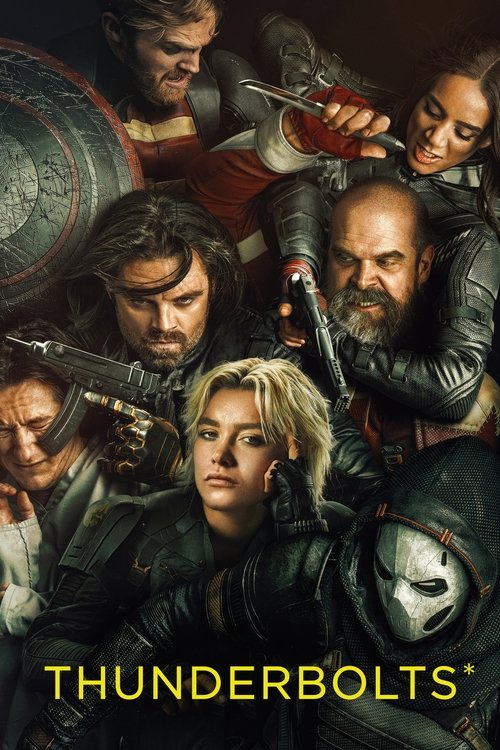
Thunderbolts*
2025 · Jake Schreier
For when you want a blockbuster with feelings — big-screen action comfort food that also takes mental health seriously. An easy pick for a group night that leaves more residue than expected.
What it's about
A handful of burned-out operatives from the Marvel universe's margins — assassins, super-soldiers, and government castoffs including Yelena Belova, Bucky Barnes, and the boisterous Red Guardian — discover they've been lured into a death trap by CIA spymaster Valentina Allegra de Fontaine. Forced to work together to survive, this team of nobody's-first-choices ends up confronting a threat that has less to do with punching and more to do with the darkest corners of their own heads.
The experience
Scrappier and sadder than the usual superhero outing — bickering-misfits comedy laced with real melancholy about grief, shame, and depression, before building to a finale that goes somewhere unexpectedly interior. It's fun, but it's the ache that sticks.
Performances
Florence Pugh anchors the film, giving Yelena's numbness and grief a lived-in weight rare for the genre, with David Harbour supplying huge-hearted comic relief as Red Guardian and Lewis Pullman quietly affecting as the enigmatic Bob.
The craft
Jake Schreier directs with an indie sensibility inside franchise scale — grounded handheld action, a muted palette that suits the team's damaged mood, and a third act that trades city-leveling spectacle for something stranger and more psychological.
Why it matters
Widely received as a creative rebound for Marvel's late Multiverse Saga, it showed the superhero machine could still make room for a character-driven story about depression and found family.
Snapshot
Thunderbolts\* is Marvel Studios' thirty-sixth feature and one of the closing entries of the franchise's so-called "Multiverse Saga" (Phase Five). Directed by Jake Schreier from a screenplay by Eric Pearson and Joanna Calo, it assembles a roster of the Marvel Cinematic Universe's antiheroes and second-tier operatives — Yelena Belova (Florence Pugh), Bucky Barnes (Sebastian Stan), Red Guardian/Alexei Shostakov (David Harbour), John Walker/U.S. Agent (Wyatt Russell), Ghost/Ava Starr (Hannah John-Kamen), and Taskmaster/Antonia Dreykov (Olga Kurylenko) — and drops them into a lethal trap engineered by the CIA spymaster Valentina Allegra de Fontaine (Julia Louis-Dreyfus). The film's structural surprise, and the source of its punctuation, is Bob Reynolds (Lewis Pullman), the product of a superhuman program whose two halves — the godlike Sentry and the annihilating Void — externalize the picture's central subject: clinical depression, shame, and the labor of being witnessed. The asterisk is not decorative; it signals the eventual, in-narrative rebranding of the group as "the New Avengers," a reveal the marketing coyly withheld. The result is a comic-book ensemble film unusually organized around interiority rather than spectacle escalation.
Industry & production
The film sits at a transitional moment for Marvel Studios, arriving amid public discussion of "superhero fatigue," uneven post-Endgame box office, and the studio's stated intent to slow output and tighten quality control. Thunderbolts\ functions partly as connective tissue toward the subsequent Avengers films while attempting to reset tone: smaller in scale, character-forward, and tonally adjacent to the studio's earlier misfit-ensemble successes. The project drew on characters seeded across prior properties — Yelena and Alexei from Black Widow (2021), Walker from The Falcon and the Winter Soldier (2021), Ghost from Ant-Man and the Wasp (2018), and Valentina from that same series and Black Widow's* post-credits — so much of its "casting" was really a convergence of existing threads.
Production was based primarily at Trilith Studios in Georgia with additional location work; specifics of the shoot beyond this are not richly documented in the public record, and I will not invent schedule or budget figures. What is on the record is that the screenplay passed through multiple hands — Eric Pearson, a veteran of Thor: Ragnarok and Black Widow, paired with Joanna Calo, whose television pedigree (The Bear, BoJack Horseman) skews toward character comedy and depressive realism — a pairing legible in the finished tone.
Technology
As a contemporary Marvel tentpole, the film was produced within a fully digital pipeline: large-format digital capture, extensive previsualization, and heavy reliance on visual-effects vendors for the Sentry/Void sequences. The Void — rendered as an expanding field of living shadow that swallows Manhattan and, internally, as a labyrinth of Bob's memories — is the film's principal effects showcase. Marvel's post-2020 workflow leaned on virtual production and LED-volume environments across many titles, though the extent of volume usage on this specific film is not something I can confirm precisely and will not overstate. Where the technology is most conspicuous is not in a novel tool but in restraint: the climactic set piece is staged as psychological interior rather than a citywide destruction ballet, so the effects work bends toward mood, negative space, and memory-architecture rather than the fully-rendered armies typical of the franchise.
Technique
Cinematography
The most consequential craft decision was hiring Andrew Droz Palermo, a cinematographer formed in independent and art-house filmmaking — A Ghost Story (2017) and David Lowery's The Green Knight (2021) — rather than a studio-action specialist. His sensibility shows in a warmer, grainier, more naturalistic register than the flatter Marvel house look: motivated practical-feeling light, willingness to sit in shadow, and compositions that isolate figures within frames to underscore loneliness. The Void material, which trades on absence and engulfing black, is a natural fit for a cinematographer comfortable with darkness and silhouette. The film's action photography is comparatively grounded and legible, favoring coverage that keeps performers' faces available over kinetic abstraction.
Editing
Editing is credited to Angus Wall and Harry Yoon. Wall is a longtime David Fincher collaborator (an Academy Award winner for The Social Network and The Girl with the Dragon Tattoo), and Yoon's background includes Minari and prestige television. The cut prioritizes ensemble rhythm — comic timing among the bickering operatives — while reserving a slower, more suspended tempo for the interior Void passages, where cross-cutting between memory and present builds the emotional argument rather than a countdown clock. This is a film edited to let scenes breathe more than the franchise norm.
Mise-en-scène / staging
The production design pointedly downscales: an underground vault, ordinary apartments, a decaying safehouse domesticity around Alexei and Yelena. Against this, the Void sequence supplies the film's one surreal environment — spaces built from shame and recollection, where staging turns theatrical and abstract. The contrast is deliberate: the "real" world is shabby and human-scaled so that the psychological climax registers as a departure into a mind.
Sound
The score is by Son Lux — the trio of Ryan Lott, Rafiq Bhatia, and Ian Chang — best known cinematically for Everything Everywhere All at Once (2022). Their idiom (processed acoustic textures, glitchy percussion, swelling post-rock crescendos) is markedly unlike the brass-forward Marvel default and pulls the film toward indie-drama emotionality. Sound design in the Void leans on enveloping low-end and dropouts to render depression as a sonic condition. This is one of the clearest cases of the MCU importing an art-house music sensibility wholesale.
Performance
Florence Pugh anchors the film, playing Yelena's disaffection with a deadpan grief that gives the ensemble its center of gravity; the picture is, in effect, built around her ability to make numbness watchable. David Harbour supplies comic warmth as the faded Soviet supersoldier, Wyatt Russell a prickly, wounded arrogance, and Lewis Pullman a soft-spoken fragility that must carry both the film's gentlest and most terrifying registers as Bob/Sentry/Void. Julia Louis-Dreyfus plays Valentina as bureaucratic amorality with sitcom timing. The performances are pitched more toward ensemble comedy-drama than heroic posture.
Narrative & dramatic mode
Structurally the film is a "reluctant team assembles" caper that mutates into a psychological rescue drama. Its dramatic engine is not an external doomsday device but an internal one: Bob's despair, weaponized. The screenplay repeatedly refuses the genre's default solution — the climax is not won by defeating the Void in combat but by joining Bob inside his worst memory and refusing to leave him alone in it. Empathy, not force, is the film's dramaturgical resolution, which places it closer to the mode of a recovery narrative than a battle narrative. Comedy runs throughout as a coping register, and the group's found-family formation is the emotional through-line.
Genre & cycle
Thunderbolts\ belongs to the superhero-team subgenre and, more specifically, to the "villains/antiheroes as protagonists" cycle that gained traction across the 2010s and 2020s — a lineage that includes the Suicide Squad films and, tonally, Marvel's own Guardians of the Galaxy*, whose broken-misfits-become-family template it consciously echoes. It also participates in a smaller contemporary current: superhero films that foreground mental health as literal text (comparable in ambition, if not in style, to entries that treat trauma as subject rather than backstory). Within the MCU it reads as a corrective cycle entry — a deliberately de-escalated film after a run of multiverse maximalism.
Authorship & method
Jake Schreier's career is the interpretive key. He emerged from music-video and commercial work and made his features Robot & Frank (2012) and Paper Towns (2015) — modest, character-driven, emotionally attentive films — before directing episodes of Beef (2023), the A24/Netflix series steeped in depression, rage, and self-loathing. His selection signals Marvel's intent to import an indie-television sensibility, and his method here is legible in the film's willingness to stay with feeling. Around him he assembled collaborators from outside the blockbuster mainstream: cinematographer Andrew Droz Palermo (art-house), composers Son Lux (indie/experimental), editor Angus Wall (Fincher's cutting room) alongside Harry Yoon (independent drama), and writers Eric Pearson (Marvel-fluent structure) and Joanna Calo (prestige-comedy interiority). The authorship is best described as a studio-supervised auteur-adjacent effort: Schreier's tonal control operating within Marvel's franchise architecture.
Movement / national cinema
This is a Hollywood studio franchise film, and it would be a category error to assign it to a national "movement." Its more meaningful lineage is institutional — the American superhero blockbuster as a mode — inflected by the indie-to-studio pipeline that has, since roughly the 2010s, funneled art-house and prestige-TV filmmakers into tentpole work. If there is a "movement" claim to be made, it is that Thunderbolts\* exemplifies the studio strategy of grafting independent-cinema personnel and mental-health-forward themes onto commercial IP.
Era / period
The film is a document of mid-2020s Hollywood: the post-pandemic contraction of the theatrical marketplace, visible franchise fatigue, industry disruption in the wake of the 2023 labor stoppages, and Marvel Studios' publicly signaled pivot toward fewer, more carefully differentiated releases. Its thematic preoccupation with burnout, purposelessness, and depression is of a piece with a broader cultural moment, and its self-aware modesty — a superhero film about not wanting to be a superhero — reads as an era-specific response to audience exhaustion with the form.
Themes
The governing theme is depression rendered literal: the Void is what despair does when it is not met with connection, and the Sentry is the seductive, unstable fantasy of being powerful enough to escape one's own mind. Adjacent themes include shame and the wish to be seen without being fixed; loneliness and the formation of chosen family among the discarded; purposelessness after a life defined by violence (Yelena's arc); and moral disposability — the film's antagonist, Valentina, treats human beings as loose ends, so the heroes' assertion of their own worth is itself the resistance. The rebranding coda ("the New Avengers") reframes belonging, not triumph, as the reward.
Reception, canon & influence
Thunderbolts\ was generally received as one of the stronger, more tonally distinctive Marvel releases of its period, with particular praise for Florence Pugh's performance, the mental-health framing, and the picture's willingness to downshift from franchise bombast; I'll flag that I'm characterizing the critical consensus in general terms and will not attach specific scores, quotations, or box-office figures I cannot verify. Influences on the film (backward): the misfit-ensemble warmth of Guardians of the Galaxy; the antihero-squad premise associated with the Suicide Squad films; the indie sensibilities its key crew brought from A Ghost Story, The Green Knight, Beef, and Everything Everywhere All at Once; and, in comics terms, the long-running Thunderbolts concept (villains masquerading as heroes) alongside the Sentry/Void mythology created by Paul Jenkins and Jae Lee. Legacy (forward): its most durable footprint is likely narrative — it functions as the formation story for the MCU's "New Avengers" and a bridge toward the subsequent Avengers* films, meaning its characters and the group's rebranding carry forward regardless of the film's standalone standing. As a craft precedent, it strengthens the studio's evident thesis that art-house directors, cinematographers, and composers can be productively embedded in franchise filmmaking, and it stands among the clearest MCU attempts to treat mental illness as central text rather than metaphorical garnish. Because the film is recent, its long-term canonical position remains genuinely unsettled, and any confident claim about its lasting influence would outrun the available record.
A Deleuzian reading
A figure standing in a wide dark frame, lit from one side, never quite resolved out of the black.
The full Deleuzian reading of Thunderbolts* →
Reception
Landed in May 2025 to the best MCU reviews in years and an instant 'Marvel is back' narrative — then quietly underperformed at the box office, so it's already remembered as the beloved one that audiences skipped.
How Thunderbolts* was received, from release to now →
How to watch Thunderbolts*: what to notice on a first viewing
- Watch how often one light source leaves a character half in shadow. Palermo keeps a single light source and lets the rest of the frame fall dark, unlike the MCU's usual flat, even lighting. The shadow sets the film's tone before the plot does.
- Watch Florence Pugh's face during pauses between fights and jokes. Pugh holds a flat, grief-heavy expression that never quite discharges into action, giving the ensemble its center of gravity. This is what the reading calls the affection-image: feeling registering on a face instead of turning into a punch.
- Listen for when brass drops out and processed textures take its place. Son Lux's score swaps the usual heroic horns for glitchy, processed sound throughout the film. The score signals this team-up runs on mood, not triumph, before you know why.
- Notice how ordinary and shabby the apartments and vault look. Production design keeps the 'real' world plain and human-scaled, unlike typical superhero sets full of gleaming tech. The plain, human-scaled world is the ground the rest of the film stands on.
The whole guide to watching Thunderbolts*, with the keys for a rewatch →
Influences: the films it descends from and the films it influenced
- Guardians of the Galaxy (2014) — Established the MCU template Thunderbolts* inherits: grafting comedic warmth and a curated needle-drop rhythm onto a roster of expendable, damaged misfits so the ensemble reads as a chosen family rather than a mission unit.
- The Suicide Squad (2021) — Supplies the direct structural DNA of the villains-masquerading-as-a-team premise — a roster of low-tier antiheroes assembled under coercion whose expendability is the engine of the drama.
- A Ghost Story (2017) — Source of DP Andrew Droz Palermo's patient held-frame naturalism and contemplative long takes, whose downscaled, grain-forward stillness Palermo carries into the film's anti-blockbuster visual grammar.
- The Green Knight (2021) — Palermo's low-key, largely single-source lighting and painterly murk directly feed the film's silhouette-darkness palette, where figures dissolve into shadow rather than being resolved by fill light.
- Everything Everywhere All at Once (2022) — Son Lux's simultaneously maximalist-and-intimate scoring method — and its treatment of effects as externalized emotional architecture — is the composers' proof-of-concept for scoring the Void as a psychological state.
- Beef (2023) — Transplants wholesale the crew's A24-TV tonal control: Schreier's willingness to sit inside depression and self-loathing, plus co-writer Joanna Calo's prestige-comedy interiority, become the film's emotional operating system.
- Zodiac (2007) — Editor Angus Wall's Fincher-room discipline — precise, unshowy interior cross-cutting that builds tension through withheld information and rhythm rather than spectacle — governs the film's editing lineage.
- The Social Network (2010) — Extends the Wall cutting method the film borrows: rhythmic dialogue cross-cutting between interior psychological registers, prioritizing cadence and reaction over coverage.
- Robot & Frank (2012) — Schreier's own debut establishes his downscaled, character-first method — small mise-en-scène, emotional attentiveness over plot mechanics — that he imports into the franchise architecture.
- Logan (2017) — Precedent for stripping a comic-book property down to grief, exhaustion, and mortality, deliberately shrinking the mise-en-scène away from franchise bombast toward intimate stakes.
- Melancholia (2011) — Model for literalizing depression as an engulfing external force made visually physical — a black annihilation that the Void's erasure-as-negative-space staging echoes.
- Minari (2020) — Editor Harry Yoon's naturalistic emotional rhythm — cutting on breath and glance to let interior family drama breathe — is the cutting sensibility he brings alongside Wall's precision.
- Sound of Metal (2019) — Parallel innovation in rendering a mental/perceptual condition through subjective sound design, the same depression-as-sonic-condition strategy of making an interior state audible rather than illustrated.
- Joker (2019) — Extends the same craft of treating clinical mental illness as a comic-book film's central text, with an auteur importing grimy, grain-forward naturalism into IP filmmaking.
- The Batman (2022) — Parallel move toward naturalistic-grain, silhouette-heavy superhero cinematography and interiorized brooding, downshifting a franchise property into a darkened, psychologically weighted register.
- Chronicle (2012) — Earlier attempt at a grounded, small-scale study of a depressed, isolated powered youth, staging superhuman ability as an expression of psychological damage rather than heroics.
- Captain America: Brave New World (2025) — A contemporaneous post-Endgame-trough entry sharing the reclaimed-Ross/gamma-adjacent government machinery and the same industrial project of retrofitting franchise coherence from underused threads.
Similar films
- Guardians of the Galaxy (2014) — influence & lineage
- Everything Everywhere All at Once (2022) — influence & lineage
- Deadpool & Wolverine (2024) — same viewing thread
- Captain America: The Winter Soldier (2014) — same viewing thread
- Captain America: Brave New World (2025) — same viewing thread
- Iron Man 2 (2010) — same viewing thread
- Iron Man 3 (2013) — same viewing thread
- Deadpool (2016) — same viewing thread
All the films related to Thunderbolts* →
Watch it with: curated runs of related films
- Rogue Heroes, Rigged Systems — A run of slick, propulsive 21st-century spectacle — spies, super-soldiers, sci-fi survivors, and dystopian rebels all squaring off against some vast machine or shadowy apparatus — best watched back-to-back when you want momentum, style, and a lone figure taking on the whole board.