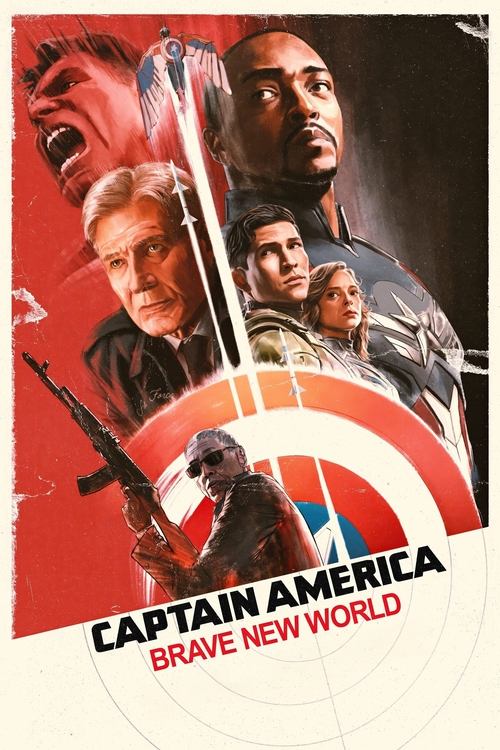
Captain America: Brave New World
2025 · Julius Onah
For a low-commitment action night when you want spectacle, a conspiracy to untangle, and to keep current with the Marvel saga — comfort-food blockbuster viewing, not a challenge.
What it's about
Sam Wilson is settling into being Captain America — a man with no super-serum, just a shield, wings, and conviction — when a meeting with newly elected President Thaddeus Ross erupts into an international incident. What looks like a rogue attack unspools into a global conspiracy involving mind control, a contested cache of a priceless new metal, and an enemy who has been waiting in the shadows for years. Sam has to clear names, prevent a war, and prove the shield belongs to him.
The experience
It moves like a political thriller wearing superhero armor — briefings, betrayals, and set-piece action — briskly paced and squarely aimed at franchise fans. Tense in stretches, familiar in shape.
Performances
Harrison Ford steps into the role of Thaddeus Ross and gives the film its gravitational center — a weathered, volatile president whose scenes with Anthony Mackie carry real friction.
The craft
Julius Onah grafts conspiracy-thriller mechanics — paranoia, cover-ups, a hero framed by circumstance — onto the superhero tentpole, with aerial action built around Sam's wings rather than brute strength. The effects showcase is engineered for a big screen.
Why it matters
It's the film that formally hands Captain America to Sam Wilson on the big screen and pulls Harrison Ford into the Marvel universe, while paying off plot threads the franchise left dangling for over fifteen years.
Snapshot
Captain America: Brave New World is the thirty-fifth feature in the Marvel Cinematic Universe and the first Captain America film to center Anthony Mackie's Sam Wilson, who inherited the shield at the close of the Disney+ series The Falcon and the Winter Soldier (2021). Directed by Julius Onah, it is a political-conspiracy thriller grafted onto the superhero tentpole: Sam, newly partnered with the still-elected President Thaddeus Ross (Harrison Ford, assuming a role originated by the late William Hurt), is drawn into a plot involving mind control, a contested cache of the Celestial-derived metal adamantium, and the long-dormant villain Samuel Sterns. The film is most historically notable for two things — it recruits Ford into the franchise and pays off narrative threads left hanging since The Incredible Hulk (2008), reaching back nearly seventeen years to reactivate a corner of the MCU most audiences had forgotten. It arrived in February 2025 amid widely reported reshoots and a franchise in a period of critical and commercial recalibration.
Industry & production
The picture is a Marvel Studios production distributed by Walt Disney Studios, developed under Kevin Feige's oversight as part of the MCU's so-called "Multiverse Saga." It originated in the wake of The Falcon and the Winter Soldier, whose showrunner Malcolm Spellman and writer Dalan Musson carried Sam's arc forward into features. The project was announced under the working title Captain America: New World Order before being renamed Brave New World — a shift toward Aldous Huxley's phrase, though the connection is more resonant than literal.
Production is inseparable from its reshoots, which were extensively reported in the trade press as reshaping the film's plot and emphasis. It is well documented that additional photography occurred and that the story was altered in the process; the precise nature and extent of those changes is not something the public record establishes with confidence, and I won't reconstruct specifics beyond what was confirmed. The multi-writer credit — screenplay attributed to Rob Edwards, Spellman and Musson, and Onah with Peter Glanz — is itself a signature of a long, contested development, arbitrated through the usual Writers Guild process.
Two casting circumstances shaped the production's public profile. First, Ford replaced Hurt as Ross following Hurt's death in 2022, lending the franchise a star of unusual gravity for a supporting antagonist. Second, the inclusion of Sabra (Ruth Bat-Seraph), a character whose comics origin is an Israeli super-soldier and Mossad operative, drew controversy given the Israel–Gaza context; Marvel publicly signaled a revised, less nationally specific approach to the character. Both are matters of record; the internal deliberations behind them are not.
Technology
Brave New World was produced as a contemporary digital, heavily visual-effects-driven studio film — the standard Marvel pipeline of digital acquisition, extensive greenscreen and virtual set extension, and volume-scale post-production compositing. Its most conspicuous technological undertaking is the Red Hulk: Ross's climactic transformation is a full CG character built on Ford's performance, requiring facial-capture and body-simulation work to translate a septuagenarian star into a rampaging, muscle-bound creature while preserving recognizable expression. That the film's marketing and much of its climax hinge on this reveal makes the VFX department a de facto co-author of the finale. Elsewhere the film leans on the aerial choreography that has defined Sam Wilson since The Winter Soldier (2014) — wingsuit flight rendered through CG augmentation of wire and rig work — now extended to his protégé Joaquin Torres. Detailed technical attributions for specific vendors and toolsets are not something I can confirm without inventing them.
Technique
Cinematography
Kramer Morgenthau (ASC) served as director of photography. Morgenthau, whose credits include Thor: The Dark World and substantial prestige-television work, brings a comparatively grounded, contrast-forward sensibility suited to the film's thriller ambitions. The register the film reaches for is that of the political-conspiracy picture — controlled interiors of the White House and government facilities, hard key light on faces during interrogation-style exchanges — before opening up into the wide, saturated spectacle of the aerial and Red Hulk sequences. Whether the film fully reconciles those two visual modes is a fair critical question; the tonal seam between chamber thriller and superhero climax is one of its structural tensions.
Editing
The editing carries the burden of the film's much-discussed reshoots, and pacing was among the qualities critics scrutinized. The cut must braid several strands — Sam's investigation, Isaiah Bradley's framing, Ross's presidential crisis, and Sterns's manipulation — into a compact runtime, and it favors a brisk, expository forward drive over lingering. I will not attribute the cut to a specific editor, as I cannot verify the credited editing team without guessing.
Mise-en-scène / staging
The film's production design foregrounds institutional space: the Oval Office, Camp David-style retreats, the corridors of state, and a climactic set piece staged among Washington's cherry blossoms outside the White House. This is deliberate — the film wants the iconography of American power as its backdrop, the better to literalize Ross "seeing red." The staging of the Sam–Ross relationship as a series of two-handers in loaded official rooms is the film's strongest formal idea, positioning a Black Captain America in negotiation with, and finally in opposition to, the presidency itself.
Sound
Sound design divides along the film's two registers: the restrained, dialogue-forward mix of its thriller passages and the enveloping low-frequency assault of the Red Hulk climax. The transformation sequence is a set piece as much for the sound department as for VFX. Specific mixing and design credits are not something I'll assert without confirmation.
Performance
Mackie anchors the film with the earnest, principled Sam Wilson he has developed across a decade, a Captain America defined by diplomacy and doubt rather than Rogers's certainty. Ford supplies the film's gravitational center, playing Ross as a man of hardened conviction straining against forces — political and physiological — beyond his control; his committed presence lends the transformation genuine pathos. Carl Lumbly returns as Isaiah Bradley, the wronged super-soldier whose framing gives the film its moral stakes, and Tim Blake Nelson reprises Samuel Sterns from 2008, aged into bitter, deformed vengefulness. Danny Ramirez (Joaquin Torres), Shira Haas (Ruth Bat-Seraph), and Giancarlo Esposito (Sidewinder) fill out the ensemble.
Narrative & dramatic mode
The dramatic mode is the paranoid political thriller in superhero dress — the mode Captain America: The Winter Soldier established as this sub-franchise's house style. The engine is investigation: an assassination attempt, a framed innocent, a hidden hand pulling strings, a race to expose the mastermind before a geopolitical crisis (here, an international scramble for adamantium harvested from the dead Celestial Tiamut) erupts. Sterns's mind-control scheme, working through Ross, drives toward the reveal that the enemy is inside the highest office. The film's structure is essentially a mystery with a monster-movie third act bolted on, and its dramatic satisfaction depends on how gracefully the conspiracy resolves into the Red Hulk confrontation — a transition critics found variably persuasive.
Genre & cycle
The film sits at the intersection of three cycles. It belongs, first, to the ongoing MCU serial — a chapter that must both stand alone and service continuity. Second, it extends the Captain America sub-cycle's turn toward the conspiracy thriller. Third, and most distinctively, it participates in the MCU's late-phase strategy of narrative reclamation: mining The Incredible Hulk (2008) — long the franchise's orphaned installment, complicated by rights and recasting — for Sterns, the Leader, and the residue of gamma science. In this the film is a bet that continuity itself is a draw, that the pleasure of long-deferred payoff can substitute for novelty. It also participates in the franchise's identity-passing arc, the handoff of legacy mantles (Captain America, Falcon) to new bearers.
Authorship & method
Julius Onah is the film's most interesting authorship question. A Nigerian-American filmmaker, Onah came to the project from the studio thriller The Cloverfield Paradox (2018) and, more tellingly, the taut, morally uneasy drama Luce (2019) — a chamber piece about a Black adoptee, expectation, and the surveillance of Black excellence. That background maps suggestively onto Brave New World's concerns with a Black man asked to embody American ideals and with Isaiah Bradley, the super-soldier the state used and erased. How much of Onah's authorial signature survives the machinery of a reshot tentpole is precisely the kind of thing that cannot be cleanly adjudicated from outside; the tension between a director of intimate ethical dramas and a spectacle franchise is the film's most compelling behind-the-camera story, and an honest account leaves it partly open.
His key collaborators: cinematographer Kramer Morgenthau; composer Laura Karpman, an Emmy-winning composer (of Ms. Marvel and The Marvels) who brings a distinct voice to a franchise long criticized for anonymous scoring, carrying forward Sam Wilson's musical identity; and the writing team of Rob Edwards, Malcolm Spellman, Dalan Musson, and Peter Glanz, whose collective credit reflects a screenplay passed through many hands. I can't reliably name the credited editor(s), and won't invent an attribution.
Movement / national cinema
This is American studio cinema at its most industrial — the franchise blockbuster as a mode of national-cultural production, financed and distributed by Disney for a global market. Yet the film is unusually explicit about American material: the presidency, the shield, the historical wound of Isaiah Bradley (a fictional analog to real histories of Black men experimented on and discarded by the state). If there is a "national cinema" frame, it is the MCU as an American myth-making apparatus interrogating, however cautiously, the icon it sells. Onah's diasporic perspective and Mackie's stewardship of a Black Captain America give that interrogation more charge than the format usually permits.
Era / period
Brave New World is a product of the MCU's post-Endgame trough — the period after 2019 in which the franchise, having concluded the Infinity Saga, struggled to define a new throughline and faced sharpened critical fatigue, streaming-television overextension, and volatile box office. Films of this era carry the burden of continuity-management and the anxiety of a formula whose novelty has worn. The picture also belongs to the specific moment of Hollywood's post-strike, cost-conscious recalibration and of Disney's public commitment to reducing franchise output. Reading the film as an artifact of an empire in retrenchment — leaning on legacy characters and star casting (Ford) to shore up a wavering brand — is, arguably, the most illuminating period lens.
Themes
The film's governing theme is inheritance and its costs: Sam bearing a shield made by and for someone else; Isaiah Bradley bearing the scars of a country that used him; Ross literally consumed by the rage — "seeing red" — that his hardline history embodied. Adjacent to this is legitimacy: who is permitted to represent America, and what it means for a Black man to hold that emblem in negotiation with, and finally against, the president. The Sterns plot dramatizes manipulation and the erosion of agency at the top of power. And beneath the spectacle runs a quieter meditation, inherited from Onah's earlier work, on the surveillance and instrumentalization of Black bodies by the state. Whether the tentpole apparatus lets these themes breathe or flattens them into plot is the film's central critical debate.
Reception, canon & influence
Critical reception was mixed to unfavorable; the film was widely characterized as a functional but uninspired entry, praised chiefly for Ford's commitment and Mackie's earnestness and faulted for a workmanlike script, the visible seams of its reshoots, and an uneasy tonal marriage of conspiracy thriller and monster spectacle. I'll refrain from citing specific aggregate scores or box-office figures, as I cannot verify exact numbers reliably; it is accurate to say the film's commercial performance and reviews were read, in trade and cultural commentary, through the broader narrative of "superhero fatigue" and MCU underperformance.
Influences on the film (backward): Its clearest lineage is Captain America: The Winter Soldier (2014) and the 1970s paranoid political thrillers that film drew on. Structurally and characterologically it is downstream of The Falcon and the Winter Soldier (2021) and, unusually, of The Incredible Hulk (2008), whose dangling threads it exists in part to resolve. The Red Hulk and the Leader derive from Marvel Comics gamma mythology.
What it shaped (forward): As a recent release, its legacy is still unsettled and should be described as such. Within the MCU it advances Sam Wilson as the standing Captain America, introduces adamantium and the Celestial "island" as ongoing resources, and repositions Ross for future stories — connective tissue whose payoff depends on films not yet in the record. Its more durable significance may be as a case study: a data point in the ongoing critical and industrial reckoning with the sustainability of the franchise model, and an example of a distinctive independent director absorbed into, and partly subsumed by, the tentpole system. Any firmer verdict on its influence would be premature.
A Deleuzian reading
There is a lawn outside the White House where the cherry trees bloom, and *Brave New World* stages its climax there, among the blossoms, with a red thing tearing through them.
The full Deleuzian reading of Captain America: Brave New World →
Reception
Landed in February 2025 to some of the worst reviews in MCU history, opened big and then dropped fast — in barely a year it's already shorthand for post-Endgame franchise fatigue rather than a film anyone's rushing to reappraise.
How Captain America: Brave New World was received, from release to now →
How to watch Captain America: Brave New World: what to notice on a first viewing
- Watch how Onah frames Sam and Ross across desks in official rooms. Onah stages their relationship as a series of two-handers in loaded government spaces, a Black Captain America facing the presidency itself. It is the film's simplest staging and its strongest formal idea, turning a room into a power struggle.
- Watch hard key light on faces during interrogation scenes. Morgenthau keeps the thriller passages contrast-forward and controlled before the film opens into wide, saturated action spectacle. The lighting change marks the seam between the chamber thriller and the superhero climax.
- Listen for the shift from dialogue-forward mix to low-frequency rumble. Sound design splits between a restrained, talky register for the conspiracy plot and an enveloping bass assault once action takes over. The soundtrack tells you which movie you're in before the picture does.
- Watch Mackie pause before he acts in confrontations. Mackie plays Sam Wilson as diplomacy and doubt rather than inherited certainty, always taking a beat before responding. Deleuze calls that gap the interval, the space where a response gets chosen instead of triggered automatically.
The whole guide to watching Captain America: Brave New World, with the keys for a rewatch →
Influences: the films it descends from and the films it influenced
- Captain America: The Winter Soldier (2014) — Establishes the template Onah copies wholesale: transplanting the 1970s conspiracy-thriller grammar — a rotted institution exposed from within, handheld two-shots, an assassin turned against the hero — into the superhero form, right down to reusing Sam Wilson as the audience's grounded eyes.
- The Incredible Hulk (2008) — Supplies the literal dangling threads the film exists to reclaim — Samuel Sterns/The Leader, gamma biology, and Thunderbolt Ross — so its plot architecture is built as continuity-repair salvage of a 17-year-old orphan entry.
- The Manchurian Candidate (1962) — Originates the trigger-programmed assassin — a sympathetic pawn conditioned to kill on cue and later horrified at himself — the exact device driving Isaiah Bradley's mind-controlled attack at the White House.
- The Parallax View (1974) — Models the visual rhetoric of institutional power spaces — the individual dwarfed and boxed by monolithic corporate/governmental architecture — that Onah and Morgenthau restage in the film's monument-scaled interiors.
- Three Days of the Condor (1975) — Provides the paranoid structure of a lone, decent operative discovering the intelligence apparatus he serves has been turned against him, with no clean institution left to trust.
- Seven Days in May (1964) — Prototypes the corridors-of-power coup thriller — a conspiracy aimed at destabilizing a sitting president, dramatized through tense two-handers in office suites rather than action set-pieces.
- Klute (1971) — Gordon Willis's hard-key-into-pooled-darkness interrogation lighting is the direct cinematographic reference for Kramer Morgenthau's chiaroscuro interview and confrontation scenes.
- All the President's Men (1976) — Its staging of institutional bureaucracy as suspense — patient blocking through vast official rooms, information as the true action — underwrites the film's talk-driven government-office sequences.
- The Falcon and the Winter Soldier (2021) — Directly sets up Sam Wilson's reluctant assumption of the shield and introduces Isaiah Bradley and the theme of a state that used and erased a Black super-soldier, which this film inherits as its emotional spine.
- Luce (2019) — Onah's own chamber method — ethically charged two-hander interrogations and the surveillance of Black excellence forced to embody others' ideals — is the authorial signature he imports into the tentpole's quieter scenes.
- Eternals (2021) — Introduces the emergent Celestial and the buried-giant mythology that this film draws on as the 'island' and adamantium resource, borrowing its cosmic-object lore as ongoing franchise material.
- The Bourne Supremacy (2004) — Shares the post-9/11 idiom of the programd asset unlearning his conditioning amid kinetic, verité-flavored pursuit through official spaces — the action grammar grafted onto the political-thriller skeleton.
- Black Panther (2018) — Extends the same craft of a Black hero negotiating legacy, statehood, and the cost of embodying a nation's ideals, treating the superhero frame as a vehicle for racial-political inheritance rather than pure spectacle.
- Ms. Marvel (2022) — Laura Karpman's first MCU work, where she developed the melodic, character-anchored scoring voice she carries into this film against the franchise's reputation for anonymous music.
- The Marvels (2023) — Karpman's immediately prior franchise score, establishing the thematic and orchestral idiom she reuses to give Sam Wilson a continuous musical identity here.
- Thunderbolts* (2025) — A contemporaneous post-Endgame-trough entry sharing the reclaimed-Ross/gamma-adjacent government machinery and the same industrial project of retrofitting franchise coherence from underused threads.
Similar films
- Captain America: The Winter Soldier (2014) — influence & lineage · same viewing thread
- Thunderbolts* (2025) — influence & lineage · same viewing thread
- Black Panther (2018) — influence & lineage
- Iron Man 2 (2010) — same viewing thread
- Deadpool & Wolverine (2024) — same viewing thread
- Iron Man 3 (2013) — same viewing thread
- Mission: Impossible - Dead Reckoning Part One (2023) — same viewing thread
- Deadpool (2016) — same viewing thread
All the films related to Captain America: Brave New World →
Watch it with: curated runs of related films
- Rogue Heroes, Rigged Systems — A run of slick, propulsive 21st-century spectacle — spies, super-soldiers, sci-fi survivors, and dystopian rebels all squaring off against some vast machine or shadowy apparatus — best watched back-to-back when you want momentum, style, and a lone figure taking on the whole board.