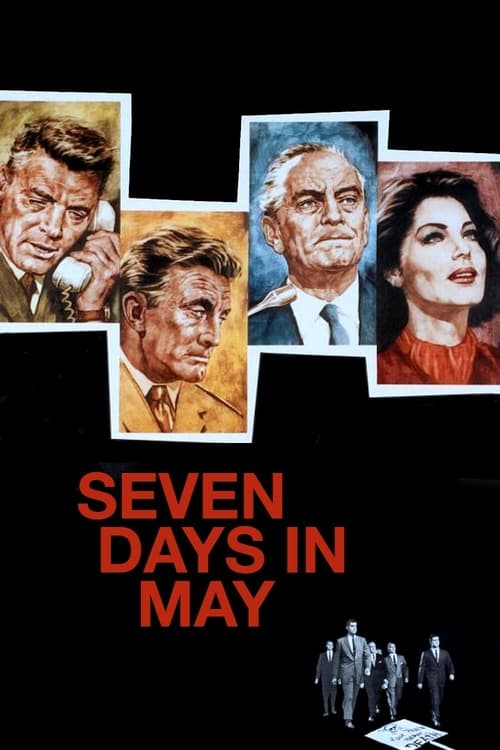
Seven Days in May
1964 · John Frankenheimer
For when you want a smart, grown-up thriller that trusts you to keep up — the kind you argue about afterward. More bracing than comforting, especially in a jittery political season.
What it's about
An American president has just signed a nuclear disarmament treaty with the Soviets, and the country's most decorated general regards it as treason. A Marine colonel working at the Pentagon starts noticing small things that don't add up — a private betting pool, a base that doesn't officially exist — and comes to suspect his own superiors are planning a military coup, set for seven days out. He takes what he knows to the White House, where a weary president must decide whether to believe the unbelievable.
The experience
A slow-coiling, talk-driven thriller where the tension comes from phone calls, missing memos, and men in rooms deciding the fate of the republic. It's sober and gripping rather than flashy, and it leaves you rattled by how plausible the whole thing feels.
Performances
Burt Lancaster and Kirk Douglas square off as the charismatic general and the loyal colonel who exposes him, and Fredric March gives the president a tired, stubborn decency that anchors the whole film.
The craft
Rod Serling's screenplay turns a bestselling novel into lean, quotable confrontations, and John Frankenheimer directs in stark black and white with a cold, surveillance-age precision — banks of TV monitors, long corridors, faces isolated in the frame. It's a film of rooms and voices that still feels visually charged.
Why it matters
Made in the shadow of the Cuban Missile Crisis and released just months after Kennedy's assassination, it caught America's Cold War paranoia at its peak and became a touchstone for every later thriller about the government turning on itself.
Snapshot
Seven Days in May is a Cold War political thriller that imagines an attempted military coup d'état against a sitting American president — not by a foreign power, but by the Pentagon's own most decorated soldier. Adapted by Rod Serling from the 1962 bestselling novel by Fletcher Knebel and Charles W. Bailey II, and directed by John Frankenheimer at the height of his early-career command, the film stages an ideological duel between a dovish president who has signed a nuclear disarmament treaty with the Soviet Union and a charismatic Joint Chiefs chairman who regards that treaty as treason. Its tension is procedural rather than ballistic: the "weapons" are memoranda, betting slips, phone logs, and the quiet detective work of a loyal Marine colonel who stumbles onto evidence of the plot. Released in February 1964, only months after the assassination of John F. Kennedy, the film arrived freighted with a national anxiety it had been conceived to dramatize, and it remains one of the most intelligent expressions of the period's fear that American institutions might be subverted from within. It is the central panel of Frankenheimer's loosely grouped paranoia cycle, sitting between The Manchurian Candidate (1962) and Seconds (1966).
Industry & production
The film was a product of the star-driven independent production model that reshaped Hollywood in the late 1950s and early 1960s. It was mounted by Kirk Douglas's company (Joel Productions) in concert with the Seven Arts orbit, produced by Edward Lewis — Douglas's frequent partner, who had also shepherded Spartacus — and released through Paramount. Douglas, who plays the subordinate role of Colonel "Jiggs" Casey rather than the showier part of the rebel general, was a principal engine behind getting the project made, an instance of a star using his production muscle to back serious, message-driven material.
The casting represents a concentration of mid-century American screen authority. Burt Lancaster takes the general, Kirk Douglas the colonel who exposes him, Fredric March the embattled President Jordan Lyman, and Ava Gardner the general's discarded former mistress whose private letters become political ammunition. Edmond O'Brien plays the bourbon-soaked Southern senator Raymond Clark; Martin Balsam, George Macready, and Whit Bissell fill out the political and military ranks. The film is also notable as the screen acting debut of John Houseman — the producer and Mercury Theatre éminence grise — in the small but pivotal role of Admiral Barnswell.
The most cited piece of production lore concerns the White House itself: by widely repeated accounts, President Kennedy looked favorably on the novel and the film, reportedly seeing value in a public airing of the danger of a militarist coup, and the production was permitted to stage a protest sequence near the White House gates. Frankenheimer used his television-honed methods to grab footage of a staged demonstration in a semi-guerrilla fashion. These details are part of the established history of the production, though the precise nature of any cooperation should be treated as reported rather than documented to the letter. Kennedy's assassination in November 1963 inevitably altered the climate into which the film was released, sharpening its themes of institutional fragility.
Technology
Technologically the film is a black-and-white, standard-ratio studio production whose innovations lie less in hardware than in Frankenheimer's exploitation of the visual grammar of broadcast and surveillance technology. The director, a graduate of live television, was unusually attentive to the screen-within-the-screen: closed-circuit monitors, banks of television sets, teletypes, and telephones recur as both plot devices and compositional motifs. The film treats the electronic apparatus of mid-century government and media as a visible texture of power, anticipating a later cinema of monitors and consoles. The deep-focus photography depends on the fast lenses and lighting practices of the era, and Frankenheimer's fondness for wide-angle optics that bend and exaggerate space is a recurring technical signature.
Technique
Cinematography
Ellsworth Fredericks's black-and-white cinematography is built around deep focus and the aggressive use of wide-angle lenses, a Frankenheimer hallmark of the period. Foreground objects loom enormous while background figures remain crisp, so that a face and the room conspiring around it occupy the same plane of attention. Compositions are frequently distorted and off-balance, with figures shot from low angles against ceilings or boxed by doorways, windows, and the rectangular frames of television screens. The monochrome palette gives the Washington interiors a documentary austerity while allowing pools of shadow that suit the conspiratorial material. The look is of a piece with the cool, hard-edged modern style Frankenheimer pursued across his early features.
Editing
Ferris Webster, who had cut The Manchurian Candidate, edits with a brisk, information-dense rhythm appropriate to a story that advances through the accumulation and verification of clues. The film cross-cuts between parallel lines of action — the colonel's investigation, the senator's reconnaissance trip, the president's deliberations — building suspense from the assembly of a case rather than from physical jeopardy. Webster's pacing is taut without being frantic, allowing the long dialogue confrontations to breathe while keeping the procedural machinery turning.
Mise-en-scène / staging
Frankenheimer's staging is the film's signature achievement. He composes in depth, frequently placing actors at sharply different distances from a wide-angle lens so that a single unbroken shot holds a conversation's full power dynamic. Characters are framed within frames — set against television monitors, glass partitions, and architectural geometry that suggests both surveillance and entrapment. The settings are the corridors, offices, and clubrooms of official Washington, rendered with a sense of institutional weight. The climactic confrontations are staged as theatrical set-pieces, the camera holding on faces as ideological argument carries the drama.
Sound
Jerry Goldsmith's score is spare and percussive, leaning on martial and mechanical textures — drums, a sense of marching tread — that underscore the threat of militarism without swamping the dialogue. Much of the film's tension is carried in talk, and the sound design respects that, foregrounding the clipped exchanges, telephone voices, and the ambient hum of the electronic government. The interplay of restrained scoring and dialogue-forward mixing keeps the emphasis on argument and detection.
Performance
The performances are pitched at the level of contained intensity the material demands. Lancaster's General Scott is magnetic and self-righteous, a man whose patriotism has curdled into the conviction that he alone can save the republic; the role channels Lancaster's physical authority into something coldly messianic. Douglas plays Casey as a soldier of divided loyalty, troubled and watchful, his discovery of the plot a crisis of conscience as much as duty. Fredric March's President Lyman is the film's moral center — weary, unglamorous, and finally resolute in his defense of constitutional order. Edmond O'Brien's garrulous, hard-drinking senator provides both color and pathos and earned the film's most prominent acting recognition. Ava Gardner brings a bruised dignity to a role that exists largely to supply the plot with leverage, and John Houseman's brief turn as the admiral lends a note of patrician gravity.
Narrative & dramatic mode
The film operates in the mode of the procedural political thriller, deriving suspense from investigation, deduction, and institutional maneuver rather than action. Its dramatic engine is a ticking clock — the seven days of the title, the window in which the coup is to be sprung — and a structure of escalating verification, as Casey and the president's loyalists assemble proof against a conspiracy they cannot openly name. Crucially, the film withholds the spectacle of violence almost entirely; the coup is defeated not by force but by exposure, by the production of evidence that compels the conspirators to stand down. This gives the work an unusually talky, argument-driven texture, culminating in extended verbal confrontations in which the competing philosophies of governance — civilian constitutional authority versus a militarized national-security absolutism — are stated outright.
Genre & cycle
Seven Days in May belongs to the early-1960s cycle of Cold War nuclear-anxiety films and, more specifically, to the brief vogue for stories of American institutions endangered from within. It is most naturally paired with The Manchurian Candidate (1962), Frankenheimer's own earlier conspiracy thriller, and with Fail Safe (1964) and Dr. Strangelove (1964), the two nuclear-crisis films released the same year — the former in deadly earnest, the latter as savage satire. Where those films locate catastrophe in accident or system failure, Seven Days in May locates it in deliberate domestic subversion, making it the period's definitive treatment of the coup-from-within scenario. It is also a precursor to the conspiracy thrillers of the 1970s, sharing their distrust of concentrated, unaccountable power.
Authorship & method
The dossier's central authorial intelligence is John Frankenheimer, whose grounding in live television — directing for anthology series such as Playhouse 90 — shaped a style defined by deep-focus staging, wide-angle distortion, multi-plane composition, and a fascination with screens and electronic mediation. The early-1960s run of The Manchurian Candidate, Seven Days in May, and Seconds constitutes his most coherent statement: a body of work obsessed with paranoia, brainwashing, conspiracy, and the vulnerability of the individual conscience to institutional manipulation. His collaborators here are central to the achievement. Rod Serling — best known for The Twilight Zone — supplied the literate, morally pointed screenplay, adapting Knebel and Bailey's novel into crisp confrontations. Cinematographer Ellsworth Fredericks executed the deep-focus monochrome look. Editor Ferris Webster, continuing the partnership begun on The Manchurian Candidate, gave the film its procedural drive. Composer Jerry Goldsmith — early in a major career — provided the lean, martial score. Producer Edward Lewis and star-producer Kirk Douglas made the project possible within the independent model.
Movement / national cinema
The film is a thoroughly American work, a product of Hollywood's transitional moment between the studio system and the more independent, subject-driven cinema of the 1960s. It does not belong to a formal movement so much as to a national tendency: the post-war American liberal cinema that used genre to dramatize political and social anxieties. Frankenheimer's visual modernism — sharp, cool, architectural — reflects a sensibility shaped by television and by contemporary currents in graphic design and photography, distinct from both classical Hollywood gloss and the European art cinema of the same years, though alert to their innovations.
Era / period
Seven Days in May is inseparable from its moment: the early 1960s, a period of acute nuclear dread following the Cuban Missile Crisis of 1962, of fierce debate over disarmament and test-ban treaties, and of right-wing suspicion that civilian leadership was insufficiently militant against communism. The fictional treaty at the film's heart maps directly onto contemporary anxieties about negotiating with the Soviets, and the figure of a popular, hawkish general defying civilian authority resonated with real-world tensions between the Kennedy administration and elements of the military and the far right. The assassination of President Kennedy, occurring between the film's production and its release, lent the project's warnings about violence to the constitutional order a tragic and unintended topicality.
Themes
The film's governing theme is the supremacy of civilian, constitutional authority over military power — the foundational American principle that the soldier serves the elected government, not the reverse. Around this it organizes a cluster of concerns: the seductive danger of charismatic certainty, embodied in a general who believes his patriotism licenses treason; the fragility of democratic institutions and the ease with which fear can be marshaled against them; the tension between security and liberty in the nuclear age; and the lonely burden of individual conscience, dramatized in Casey's decision to inform on a commander he admires. President Lyman's defense of his office becomes a defense of process itself — the conviction that the proper answer to a perceived enemy is not the strongman but the patient operation of law. The film is finally an argument for democratic restraint over the apocalyptic temptations of the era.
Reception, canon & influence
Contemporary critical reception was substantially favorable, with particular praise for Frankenheimer's direction, Serling's screenplay, and the ensemble of veteran performers; the film was recognized at the major awards with attention to Edmond O'Brien's supporting performance and to its production design, reflecting its standing as a prestige political drama. (Precise award outcomes and any box-office figures should be confirmed against the record rather than asserted here.) Over time the film has settled into the canon as a benchmark of the intelligent Cold War thriller and as a key text in Frankenheimer's reputation.
Looking backward, the film draws on a lineage of American social-problem and political cinema, on the live-television aesthetic of moral-issue drama that Frankenheimer and Serling both emerged from, and on the immediate literary source's anchoring in real contemporary political fears. Looking forward, its influence runs through the paranoid conspiracy thrillers of the 1970s — films that likewise distrust hidden centers of power and dramatize the individual's discovery of institutional rot — and through subsequent screen treatments of coups, rogue generals, and threats to constitutional order. Its core scenario, the military plot against an elected president foiled by the rule of law, has recurred repeatedly in American film and television, and the film remains a touchstone whenever that nightmare returns to the cultural imagination. As a demonstration that political argument can carry a thriller without recourse to spectacle, it continues to be studied and admired.
A Deleuzian reading
Look at how Frankenheimer frames a man who wants power.
The full Deleuzian reading of Seven Days in May →
Reception
A hit and a critical success on release in early 1964 — landing just months after the JFK assassination gave it an eerie charge — and it never really fell out of favour; it's since settled in as the sober middle panel of Frankenheimer's 60s paranoia run, periodically 'rediscovered' whenever civil-military tension is back in the news.
How Seven Days in May was received, from release to now →
Influences: the films it descends from and the films it influenced
- Citizen Kane (1941) — Gregg Toland's deep-focus, wide-angle photography keeping foreground and far background in equal sharpness — and the recurring frames-within-frames and low-ceiling compositions-in-depth — is the visual grammar Frankenheimer and Fredericks adopt to stage power as a spatial relationship.
- Twelve Angry Men (1957) — The live-television model of moral argument as drama — a confined ensemble talked through a constitutional crisis in near-real time, shot in deep-focus monochrome with lenses that crowd the players — is the anthology-drama DNA Frankenheimer shared with Lumet.
- Advise and Consent (1962) — Preminger's procedural anatomy of Washington maneuvering, staged in long deep-focus takes that hold whole institutional rooms in frame, models the idea that political process itself — committees, protocol, the rulebook — can carry a feature without action.
- Seconds (1966) — The trilogy's closing panel pushes the screens-and-mediation paranoia further through James Wong Howe's extreme wide-angle and fisheye distortion, extending the deep-focus-as-entrapment device into outright optical derangement.
- Z (1969) — Carries the procedural-investigation engine forward: an institutional cover-up exposed step by step through rapid cross-cutting and a momentum-building reconstruction, proving political argument can drive a propulsive thriller.
- The Day of the Jackal (1973) — Inherits the clinical ticking-clock procedural — a plot against the head of state assembled and countered through methodical, documentary-flat detail and parallel cutting between conspirator and the state apparatus closing in.
- The Conversation (1974) — Extends the screens-and-monitors motif and the individual-conscience-versus-hidden-power theme into the surveillance age, where electronic mediation of reality becomes the very subject.
- The Parallax View (1974) — Gordon Willis's composition-in-depth and frames-within-frames dwarf the lone investigator inside monolithic institutional architecture — the spatial vocabulary of power Frankenheimer borrowed from Kane, now weaponized for 70s conspiracy paranoia.
- Three Days of the Condor (1975) — The core arc of an individual discovering institutional rot and being hunted by hidden centers of power becomes the template, played as procedural paranoia within the intelligence bureaucracy.
- All the President's Men (1976) — Distills the procedural-investigation drive into pure method — fact-checking and document-chasing as suspense — staged in Willis's deep-focus institutional interiors that make architecture itself express concealed authority.
- Twilight's Last Gleaming (1977) — The most direct narrative descendant: a rogue general seizes a missile silo to coerce the government, with split-screen multi-panel staging extending Frankenheimer's interest in simultaneous action and electronic command-and-control surfaces.
- Thirteen Days (2000) — Revives the same civilian-versus-military-authority crisis as ticking-clock procedural — an elected administration restraining hawkish Joint Chiefs — dramatizing constitutional control of force through process rather than spectacle.
- Path to War (2003) — Frankenheimer's earlier portrait of executive authority under pressure uses the identical blocking vocabulary — figures arranged against architectural surfaces to visually encode rank and resistance — that Path to War carries forward as its primary grammar of power.
- A House of Dynamite (2025) — Ensemble staging of military-civilian institutional conflict with performance locked to professional competence under duress, establishing the procedural political thriller's mode of inhabiting command and bureaucratic spaces without aestheticizing them.
- The Sum of All Fears (2002) — Models the sober, institutionally-neutral rendering of Washington corridors of power — desk-level procedural staging of a national-security crisis — that John Lindley's controlled, non-expressive camerawork descends from.
- The Manchurian Candidate (1962) — The immediately prior panel of Frankenheimer's paranoia trilogy, cut by the same editor Ferris Webster, sharing the deep-focus staging, the obsession with screens/TV monitors mediating reality, and the theme of the individual conscience versus institutional manipulation.
- The Best Man (1964) — Fellow Playhouse 90 live-TV alumnus adapting a literate political teleplay (Gore Vidal) into crisp black-and-white backroom confrontations — the same prestige-political-drama-as-thriller mode emerging from the same television school in the same year.
- Fail Safe (1964) — A same-year Cold War ticking-clock procedural built on stark deep-focus monochrome and electronic war-room screens, dramatizing the chain of command and civilian-versus-military control of catastrophe with the same restraint-over-spectacle ethic.
- Dr. Strangelove (1964) — The same nuclear-dread war-room scenario of a rogue military seizing the initiative against civilian authority, staged with wide-angle distortion in cavernous deep-focus sets — the satirical mirror image of Frankenheimer's straight treatment.
Similar films
- The Manchurian Candidate (1962) — influence & lineage
- Fail Safe (1964) — influence & lineage
- Thirteen Days (2000) — influence & lineage
- Seconds (1966) — influence & lineage
- The Parallax View (1974) — influence & lineage
- The Conversation (1974) — influence & lineage
- The Day of the Jackal (1973) — influence & lineage
- Three Days of the Condor (1975) — influence & lineage