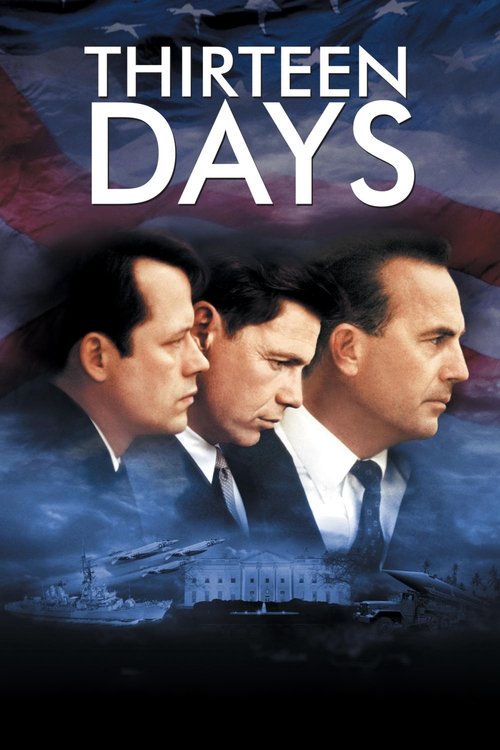
Thirteen Days
2000 · Roger Donaldson
For when you're in the mood for something smart and gripping rather than explosive — a history lesson that plays like a thriller. Great for viewers who love watching institutions under pressure.
What it's about
October 1962: American reconnaissance photos reveal Soviet missile bases under construction in Cuba, and for thirteen days the world sits on the edge of nuclear war. Seen from inside the Kennedy White House — through presidential aide Kenny O'Donnell, President Kennedy, and his brother Robert — the film follows the arguments, back-channels, and brinkmanship as a handful of men try to find any option between backing down and Armageddon.
The experience
Genuinely tense despite being almost entirely men arguing in rooms — the film makes deliberation itself feel like combat, and knowing how it ends doesn't loosen the knot in your stomach. Talky, dense, and absorbing.
Performances
Bruce Greenwood's JFK is the standout — measured, wary, and burdened, capturing the loneliness of the decision without doing an impression.
The craft
The screenplay compresses a sprawling geopolitical crisis into a clean, propulsive procedural, cutting from Oval Office debates to reconnaissance flights to keep the stakes physical. It sits in the tradition of the great talk-driven institutional thriller, where the drama is in what gets said and what carefully doesn't.
Why it matters
It arrived as a turn-of-the-millennium prestige history piece and remains one of the standard dramatizations of the Cuban Missile Crisis, often used to teach how close the Cold War came to catastrophe.
Snapshot
Thirteen Days dramatizes the October 1962 Cuban Missile Crisis from inside the Kennedy White House, compressing the standoff between the United States and the Soviet Union into a taut political procedural. Directed by Roger Donaldson and released by New Line Cinema, the film stars Kevin Costner as presidential aide Kenneth P. O'Donnell, Bruce Greenwood as John F. Kennedy, and Steven Culp as Robert Kennedy. Its dramatic engine is not combat but deliberation: men in suits arguing around tables, parsing reconnaissance photographs, and weighing the difference between a measured response and the end of the world. The film belongs to a particular American tradition — the talk-driven institutional thriller in the lineage of Fail Safe and All the President's Men — and it arrived at the turn of the millennium as a prestige history picture aimed at adult audiences. Critically respected for its earnestness and craftsmanship, and pointed at by historians for its liberties (chiefly the inflation of O'Donnell's role), it remains one of the more serious mainstream attempts to render the texture of high-stakes governmental crisis as suspense.
Industry & production
Thirteen Days was produced through Beacon Communications, the company headed by Armyan Bernstein, with Costner serving as both star and producer alongside Peter Almond. The project reflects a recognizable late-1990s model: a star using his clout to mount a serious, fact-based drama with limited commercial guarantees. Costner had a long history of pairing star vehicles with material of civic or historical weight — JFK, Dances with Wolves — and Thirteen Days extended that pattern, reuniting him with Donaldson, who had directed him in the Cold War thriller No Way Out (1987).
The screenplay by David Self drew on The Kennedy Tapes: Inside the White House During the Cuban Missile Crisis, the documentary edition of secretly recorded ExComm deliberations assembled by historians Ernest R. May and Philip D. Zelikow. (The film's title comes from Robert Kennedy's posthumous memoir Thirteen Days, but the screenplay's spine is the transcript record rather than RFK's account.) This grounding in primary-source audio gave the production an unusual claim to authenticity in its dialogue, even as the dramatic framing departed from the record.
The film was an expensive prestige undertaking for New Line, then best known for genre fare, and it did not perform strongly enough at the box office to be counted a commercial success relative to its cost; precise figures are best left to the trade record, but the picture is generally remembered as a financial disappointment that nonetheless earned respect. It opened in limited release in late December 2000 to qualify for awards consideration before expanding in early 2001. Despite favorable reviews, it was largely passed over in the major awards races.
Technology
Thirteen Days was shot photochemically on 35mm at a moment when digital intermediates and CGI were beginning to reshape historical filmmaking, and the production used both old and new tools to manufacture period authenticity. The most conspicuous technical strategy is its manipulation of image texture: portions of the film are rendered in desaturated, grainy, or black-and-white registers meant to evoke 1960s newsreel and surveillance imagery, intercut with full-color dramatic scenes. This created a documentary patina — the sense that the audience is watching history bleed through archival emulsion — without relying on actual stock footage for the dramatized sequences.
The film's limited aerial-reconnaissance and military set pieces, including the low-level overflights of Cuba, used visual-effects work to extend and stage material that could not be captured practically with period aircraft. These effects are deployed sparingly and in service of verisimilitude rather than spectacle, consistent with the film's overall priority on plausibility over scale. The U-2 and RF-8 Crusader sequences function as punctuation — brief eruptions of physical danger between the long interior scenes of argument — and the technology serves to make those eruptions credible rather than to dominate the picture.
Technique
Cinematography
The film was photographed by Andrew Lesnie, the Australian cinematographer who had shot Babe and would shortly become internationally prominent for The Lord of the Rings. His work here is the opposite of fantasy spectacle: a controlled, naturalistic interior style built around the geography of conference rooms, corridors, and the Oval Office. Lesnie shifts deliberately between color and monochrome or sepia-inflected passages, using changes in film texture as a structural and emotional device — the grainier, cooler registers reading as historical document, the warmer color scenes as intimate present-tense drama. Within the meeting scenes he favors compositions that map the political hierarchy of a room, placing Kennedy, his brother, and the Joint Chiefs in spatial relationships that make institutional tension legible. The camera is mobile but rarely showy, threading between speakers to keep the long dialogue exchanges kinetic.
Editing
Cut by Conrad Buff — an editor with experience on large-scale action films including Terminator 2 and Titanic — Thirteen Days faces the central problem of the talk-driven thriller: how to generate suspense from conversation. Buff's solution is rhythmic compression. The editing sustains momentum across protracted deliberations by cross-cutting between simultaneous pressures (the ExComm table, the Pentagon, the blockade line, the diplomatic back-channels), so that the film feels like a countdown even when nothing physical is happening. The interpolation of newsreel-styled imagery is also an editorial gesture, stitching the dramatized material into a sense of unfolding public history.
Mise-en-scène / staging
The production design by J. Dennis Washington reconstructs the early-1960s corridors of power with a muted, period-correct palette — dark suits, fluorescent and lamp-lit rooms, the bureaucratic furniture of the Cabinet Room and Pentagon. The mise-en-scène is fundamentally about confinement: the drama is staged in enclosed spaces where the stakes are global but the action is verbal, and the staging exploits that irony. Bodies are arranged to dramatize argument — hawks leaning in, the President holding back, aides hovering at the room's edges. The few exterior and military scenes are staged to feel like incursions of the real world into a sealed deliberative bubble.
Sound
Sound design supports the film's documentary ambitions, and the use of period radio and television broadcasts — most notably the dramatization surrounding Kennedy's televised address to the nation and Adlai Stevenson's confrontation at the United Nations — locates the private crisis within a public soundscape. Trevor Jones's score underscores the tension without overwhelming the dialogue, leaning on portentous, building cues that mark the escalation toward the brink. The film generally trusts silence and the texture of voices in a room, reserving musical emphasis for transitions and the set-piece moments of public confrontation.
Performance
Performance is the film's true special effect. Bruce Greenwood's John F. Kennedy was widely praised as a restrained, intelligent portrait that resists impersonation in favor of inhabiting the man's wary deliberateness; it is generally regarded as the film's finest work. Steven Culp's Robert Kennedy provides the moral counterweight, and the supporting ensemble of Cold War figures — generals, advisers, diplomats — is filled with character actors who give the deliberations weight. The most discussed performance is Costner's: his Boston accent as O'Donnell drew criticism, and the larger problem is structural rather than histrionic — the screenplay's elevation of O'Donnell to an emotional fulcrum the historical figure did not occupy. Costner's everyman presence is the film's audience surrogate, but it is also the seam where dramatization most visibly strains against history.
Narrative & dramatic mode
The film operates in the mode of the procedural countdown thriller, organizing thirteen days of crisis into a ticking-clock structure. Its dramatic question is epistemological and ethical at once: what do we actually know, and what should we do about it? Suspense is generated less by external events than by the risk of misjudgment — the fear that a single miscalculation by a pilot, a captain, or a general could trigger catastrophe. The narrative filters the crisis through O'Donnell, giving the institutional story a domestic and personal frame (the aide as husband and father, glimpsing the abyss). This is a familiar strategy for humanizing history, and it is also the film's chief liberty. The dramatic mode is fundamentally one of restraint and dread rather than action, asking the audience to find tension in the difference between options that all sound reasonable in the room.
Genre & cycle
Thirteen Days sits at the intersection of the historical drama and the political thriller, and more specifically within the sub-tradition of the Cold War "men-in-rooms" film: pictures in which nuclear annihilation is debated rather than depicted. Its clearest antecedents are Fail Safe (1964) and, in its fascination with the mechanics of governance, All the President's Men (1976). It also revisits territory dramatized for television in The Missiles of October (1974), the earlier teleplay account of the same crisis. As a cycle marker, the film belongs to a turn-of-the-millennium wave of serious, fact-based prestige dramas about American institutions and recent history, made for adult audiences and pitched toward awards recognition — a category that would grow increasingly difficult to finance at this budget level in the years that followed.
Authorship & method
Roger Donaldson is the film's organizing intelligence, and Thirteen Days is characteristic of his career-long interest in competent professionals under institutional pressure. Born in Australia and formed as a filmmaker in New Zealand (Sleeping Dogs, Smash Palace), Donaldson built a Hollywood career on tense, craftsman-like genre pictures — No Way Out, Dante's Peak, The Bank Job — and on a recurring fascination with men tested by systems larger than themselves. His method here is one of disciplined classical staging in service of the material, suppressing directorial flourish in favor of clarity and momentum.
His key collaborators shape the film decisively. Screenwriter David Self translated transcript and historical record into a propulsive structure, making the consequential choice to route the story through O'Donnell. Cinematographer Andrew Lesnie supplied the dual-register visual language that distinguishes the film texturally. Editor Conrad Buff imposed the countdown rhythm that keeps deliberation suspenseful. Composer Trevor Jones provided the escalating tension without melodrama, and production designer J. Dennis Washington built the credible architecture of early-1960s power. The authorship is collaborative in the studio sense, but Costner's role as star-producer is also formative: this is a film made because a star chose to spend his capital on serious history.
Movement / national cinema
Thirteen Days is firmly a product of Hollywood, but it is worth noting that several of its principal craftspeople — Donaldson and Lesnie among them — emerged from the Australasian film world, part of the broader migration of antipodean talent into the American industry across the 1980s and 1990s. The film does not belong to a self-conscious movement; rather, it represents the mainstream prestige tradition of American historical filmmaking, in which national myth is examined through the dramatization of recent governmental crisis. Its sensibility is institutional and patriotic-but-questioning, characteristic of post-Watergate American cinema's ambivalent fascination with the machinery of state.
Era / period
Released at the very end of 2000, the film arrived in a brief window before September 11, 2001 reframed American anxieties about catastrophe and the use of force. Viewed retrospectively, Thirteen Days reads as a late-Cold-War retrospective made in the post-Cold-War interregnum — a moment when nuclear standoff could be treated as settled history and as a cautionary study in restraint. Its valorization of deliberation over reflexive military action, and its skepticism toward hawkish certainty, carry an implicit argument that would take on different resonance in the more militarized decade that followed. Industrially, it belongs to a period when studios still mounted mid-to-large-budget adult dramas theatrically — a model that would erode in subsequent years.
Themes
The film's central theme is the moral weight of restraint: the idea that the highest form of leadership in a crisis may be the refusal to act on the most aggressive option. It dramatizes the tension between civilian and military authority, repeatedly setting Kennedy's caution against the Joint Chiefs' pressure for strikes, and it treats the management of one's own apparatus — the generals, the diplomats, the chain of command — as the real battlefield. Related themes include the fallibility of intelligence and interpretation (the reconnaissance photographs that must be read correctly), the loneliness of decision, and the thin membrane between order and catastrophe. Running beneath these is a meditation on contingency: the recognition that survival hinged on individual judgments that could easily have gone otherwise.
Reception, canon & influence
Critically, Thirteen Days was received as a respectable, intelligent, and unusually serious mainstream drama, with particular praise for Greenwood's Kennedy and for the film's willingness to sustain tension through talk. The principal reservations concerned its historical liberties — above all the elevation of Kenneth O'Donnell to a central role that historians noted overstated his actual influence in the ExComm deliberations — and Costner's accent and prominence. The film was a financial disappointment relative to its cost and was largely overlooked in the major awards, leaving it admired more than celebrated.
Looking backward, the film's influences are clear: the transcript-based historiography of The Kennedy Tapes, the earlier dramatization in The Missiles of October, and the genre DNA of Fail Safe and All the President's Men. Looking forward, its legacy is modest but real. Thirteen Days stands as a reference point for the "deliberation thriller" — the film often cited when later pictures dramatize high-level governmental decision-making as suspense, from war-room dramas to procedural accounts of intelligence crises. It also functions as a durable teaching text: its grounding in primary-source deliberation has made it a fixture in discussions of leadership, decision-making, and the Cuban Missile Crisis well beyond film culture. If it did not reshape the commercial landscape, it nonetheless demonstrated that the argument in the room — competing options, weighed in real time under existential pressure — could carry a feature film, and it remains among the more credible screen accounts of how close the world came, and how it stepped back.
A Deleuzian reading
Start with the photograph.
The full Deleuzian reading of Thirteen Days →
Reception
A box-office disappointment in 2001 despite solid reviews — its $80M budget never came close to earning out — it's since settled into 'underrated political thriller' status, regularly cited among the better dramatizations of the Cuban Missile Crisis.
How Thirteen Days was received, from release to now →
Influences: the films it descends from and the films it influenced
- Seven Days in May (1964) — Direct ancestor of the film's civil-military tension — Pentagon brass pressuring civilian leadership toward force, with restraint dramatized as the harder political act.
- Apollo 13 (1995) — The immediate sibling in the historical control-room procedural — real-time crisis solved by experts at consoles, restraint and competence valorized, outcome known yet wrung for tension.
- Fail Safe (1964) — Adopts Fail Safe's procedural real-time institutional drama format for the Cuban Missile Crisis: parallel intercutting between decision-making bodies, close-up behavioral ensemble performance in crisis-room staging, dialogue-driven tension without action sequences — applying the Lumet war-room grammar to the historical event Fail Safe fictionally mirrored.
- Pressure (2026) — Supplies the ExComm template of technical argument staged as action, and alternates colour with black-and-white passages to rhyme the dramatised material against newsreel texture — an early, cruder version of Pressure's archive seam.
- Fail-Safe (1964) — Donaldson borrows its core proof that a nuclear crisis can be sustained almost entirely through men telephoning and arguing in sealed rooms, with suspense generated by the weighing of options rather than by depicted action.
- Twelve Angry Men (1957) — The template for staging argument itself as suspense — a fixed deliberating body, shifting coalitions, and an everyman holdout (here O'Donnell) who reframes the room's momentum.
- Dr. Strangelove (1964) — Ken Adam's War Room architecture established the iconography of confined high-command decision space that Dennis Washington's early-'60s power interiors deliberately echo and de-satirize.
- The Missiles of October (1974) — The prior transcript-based dramatization of the identical ExComm deliberations, establishing the primary-source fidelity that David Self's screenplay extends with the later-declassified Kennedy tapes.
- All the President's Men (1976) — Model for the procedural-realist treatment of Washington power — institutional texture, paperwork and phone calls as drama, and an everyman surrogate routing the audience through elite rooms.
- Z (1969) — Set the kinetic political-procedural grammar — propulsive cutting through investigation and deliberation that Conrad Buff's countdown editing inherits to keep talk-heavy scenes urgent.
- The Day of the Jackal (1973) — Foundational procedural-countdown construction: a known historical outcome made suspenseful purely through methodical, clock-driven accumulation of operational detail.
- No Way Out (1987) — Donaldson's own Pentagon thriller and a Costner vehicle — the same director-star testing a competent professional inside a paranoid corridor-of-power machine, a method he refines here.
- JFK (1991) — Pioneered the integration of period broadcast and newsreel material with dramatized scenes, and the dual-register photochemical switching between archival-grade and dramatic textures that Lesnie systematizes.
- The Insider (1999) — Contemporary sibling proving talk and institutional pressure could carry a serious adult thriller, using performance and slow-build dread in conference rooms rather than incident.
- Zero Dark Thirty (2012) — Descendant 'deliberation thriller' that inherits the procedural account of an intelligence crisis — analysts presenting competing readings to decision-makers, suspense located in the argument over certainty.
- Bridge of Spies (2015) — Extends the Cold War men-in-rooms negotiation drama, dramatizing restraint-over-force statecraft through patient back-channel talk rather than confrontation.
Similar films
- Seven Days in May (1964) — influence & lineage
- Fail Safe (1964) — influence & lineage
- JFK (1991) — influence & lineage
- All the President's Men (1976) — influence & lineage
- Apollo 13 (1995) — influence & lineage
- The Hunt for Red October (1990) — shared sensibility
- Path to War (2003) — shared sensibility
- The Sum of All Fears (2002) — shared sensibility