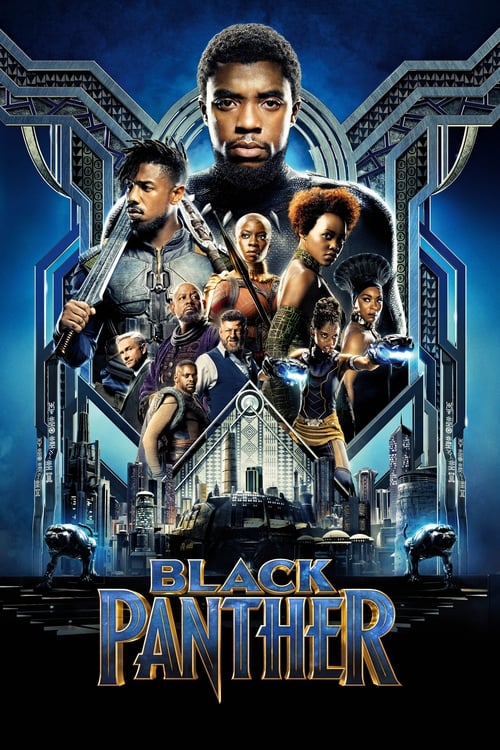
Black Panther
2018 · Ryan Coogler
Sinners transformed him from Marvel's best franchise steward into the era's proof that original films can still be blockbusters; his ownership-reversion deal with Warner Bros. sparked an industry argument about whether directors owning their films sets a "dangerous precedent." A rare director whose business terms became discourse.
For a big, satisfying event-movie night — with family, with friends, with popcorn — when you want blockbuster scale that also gives you something to talk about after. Broadly comforting, quietly provocative.
What it's about
After his father's death, T'Challa returns to Wakanda — a hidden African nation whose vibranium technology has made it the most advanced civilization on Earth — to take the throne and the mantle of the Black Panther. His reign is immediately tested by challengers from within and by an outsider whose claim strikes at Wakanda's deepest secret: what the country owes to the world, and to the people it left behind.
The experience
A superhero spectacle that plays like a royal succession drama — big, vibrant, and crowd-pleasing, but with a moral argument at its center that gives the conflict real weight. You come for the action and world-building and leave arguing about who was right.
Performances
Chadwick Boseman brings genuine regal gravity to T'Challa, and Michael B. Jordan's Killmonger became an instant benchmark for the sympathetic antagonist — wounded, magnetic, and arguing a case the film refuses to dismiss. Letitia Wright and Danai Gurira steal scenes all around them.
The craft
Wakanda is one of the great feats of modern production design — Afrofuturist architecture, Ruth E. Carter's Oscar-winning costumes drawing on real African traditions, and Ludwig Göransson's Oscar-winning score built from instruments and recordings gathered on the continent. It's a film whose look and sound carry as much meaning as its script, and it deserves a big screen and good speakers.
Why it matters
A genuine cultural moment: a global blockbuster centering Black heroes, artists, and aesthetics that became one of the highest-grossing films of its era and the first superhero film nominated for Best Picture. It reset expectations for what a franchise movie could be about.
Snapshot
Ryan Coogler's Black Panther is a superhero blockbuster that transcended the genre that housed it. Produced by Marvel Studios and distributed by Walt Disney Pictures, the film arrived in February 2018 as the eighteenth entry in the Marvel Cinematic Universe yet functioned simultaneously as a standalone work of Afrofuturist world-building, a Shakespeare-inflected succession drama, and a pointed interrogation of Black political identity in the post-colonial world. Its fictional setting — Wakanda, a reclusive African nation made immensely powerful by a meteorite deposit of the fictional metal vibranium — gave Coogler and his collaborators a canvas to explore aesthetics, politics, and cultural longing largely absent from studio blockbusters. The film was the first superhero film nominated for the Academy Award for Best Picture and became one of the highest-grossing releases of its decade, cementing Chadwick Boseman's T'Challa alongside the most recognizable characters in mainstream cinema.
Industry & production
Black Panther was commissioned off the momentum of Coogler's Creed (2015), which had revitalized the Rocky franchise and demonstrated his capacity to bring emotional specificity to genre material. Marvel Studios president Kevin Feige had been developing a Black Panther standalone since at least 2013, when T'Challa's MCU integration was being planned in parallel with Captain America: Civil War (2016), in which Boseman made his franchise debut. Coogler was attached to write and direct in 2015, and he brought in Joe Robert Cole — his collaborator and a former Disney Writers Program alumnus — to co-write the screenplay.
Principal photography was based primarily at Pinewood Studios Atlanta, then the largest sound-stage complex in North America, with location work conducted in South Korea for the Busan sequences and additional second-unit capture. The film's budget is reported in the range of two hundred million dollars. Its commercial performance on release was extraordinary: Black Panther earned one of the largest domestic opening weekends in box-office history to that point and ultimately crossed one billion dollars globally within weeks, sustaining its theatrical run well into the spring. It broke multiple records for Black-led studio releases, a distinction made meaningful precisely because those records reflected how long such films had been withheld.
The production's cultural ambition was matched by its logistical scale. Production designer Hannah Beachler and costume designer Ruth E. Carter undertook extensive research into sub-Saharan African material cultures — architectural traditions from Ethiopia, Mali, Nigeria, and South Africa; textile and body-ornamentation practices from Maasai, Ndebele, Himba, and Tuareg communities, among many others — synthesizing these into a coherent, internally consistent visual lexicon for Wakanda rather than flattening African diversity into a generic signifier. Both received Academy Awards for their work: Carter became the first Black woman to win the Oscar for Best Costume Design; Beachler, with set decorator Jay Hart, became the first Black woman to win Best Production Design.
Technology
The film deploys the full toolkit of contemporary large-scale visual effects production: environment extensions for the Wakandan capital city of Birnin Zana (the Golden City), digital doubles for the ritual combat sequences at Warrior Falls, and the vibranium-powered technology that forms Wakanda's material culture — kinetic-energy-absorbing suits rendered in particle simulations. The production was shot in a format compatible with IMAX theatrical presentation, and the Warrior Falls sequence in particular was staged and composed to exploit the expanded frame.
Cinematographer Rachel Morrison shot on digital capture, calibrating the camera's response to darker skin tones with particular care — a technical concern with documented roots in the bias of analog film stocks toward lighter complexions and one that Morrison addressed through lighting design, lens selection, and direct engagement with the colorist in post. Morrison had completed Mudbound (2017) immediately before Black Panther; her nominations for both the American Society of Cinematographers award and — in Mudbound's case — the Academy Award for Best Cinematography (the first woman nominated in that category) marked a significant moment in the recognition of women working in large-format production.
Technique
Cinematography
Morrison's visual approach resists the desaturated, neutralizing palette common to MCU entries of the early-to-mid 2010s. The film is densely chromatic: the royal purples and muted golds of the Wakandan court; the warm reds of the Warrior Falls ritual; the neon blues and pinks of the Busan casino. Where many franchise films use color as accent, Black Panther uses it structurally, with each major environment carrying its own tonal signature. The lenswork tends toward a classically composed mid-range — wide shots that establish geography with genuine grandeur, closer framings that preserve intimacy during the dialogue-heavy succession debates. The Busan car-chase sequence adopts a more propulsive, handheld register, a deliberate tonal shift that marks the journey outside Wakanda's borders as disordering.
Editing
The film was co-edited by Michael P. Shawver, a Coogler regular since Fruitvale Station (2013), and Debbie Berman. The editorial rhythm is relatively relaxed by blockbuster standards, holding on performances and allowing scenes to breathe between action sequences. Coogler and his editors structure the film's central political tension — T'Challa's conservatism against Killmonger's revolutionary grievance — through intercutting that gives both men roughly equivalent persuasive real estate, so that the film's climax functions less as a hero's triumph than as the provisional closing of an unresolved debate.
Mise-en-scène / staging
Coogler's staging consistently flattens the distinction between spectacle and intimacy. The throne-room scenes and the open-air ritual combats are composed with ceremonial formality — deep staging, symmetrical arrangements, figures ranked by status — while the film's private conversations are often shot in two-shot or tight singles that foreground the faces of Black actors in ways rarely foregrounded in comparable-scale productions. The Warrior Falls set, constructed and extended digitally, is one of the film's most ambitious spatial gambits: a vast natural amphitheatre where succession is settled by physical contest, staged to read simultaneously as athletic spectacle and ancient constitutional procedure. Coogler gives the ritual genuine weight rather than using it as a pretext for action, so that when Killmonger performs it with brutalizing efficiency, the scene's horror registers not as genre surprise but as political argument.
Sound
Composer Ludwig Göransson traveled to Senegal and other West African locations to record traditional instruments — the kora, djembe, and various chordophones — before composing the score, integrating these materials into an orchestral and electronic framework so that the sonic world of Wakanda carries acoustic specificity rather than generic "African" percussion codes. The score received the Academy Award for Best Original Score. Complementing the Göransson underscore is the Kendrick Lamar-curated companion album Black Panther: The Album, released simultaneously with the film. The relationship between the two is not one of integration — the album is not the film's score — but of cultural parallel: Lamar's project performed its own commentary on the film's themes, and the combination amplified the cultural event around the release.
Performance
Chadwick Boseman's T'Challa is a study in formal restraint: Boseman plays a man trained to command through stillness, to project authority by withholding rather than projecting. The performance becomes expressive precisely in the moments when T'Challa's composure falters — the grief sequences in the ancestral plane, the moment of defeat at the Falls. Michael B. Jordan's Killmonger operates on the opposite register: kinetically physical, volcanic in affect, capable of sudden quiet that lands as more threatening than the volatility. Jordan had worked with Coogler on both Fruitvale Station and Creed; their shared shorthand allows the performance to carry maximum compression, the biographical backstory registering in the body before it is explained in dialogue. Danai Gurira as Okoye and Letitia Wright as Shuri brought distinct comedic and dramatic registers that widened the film's tonal range; Winston Duke's M'Baku found real menace and unexpected warmth in a supporting role that the script might easily have let pass.
Narrative & dramatic mode
The film's plot architecture has been widely compared to Hamlet: a prince returns home following his father's death, inherits a throne shadowed by disputed legitimacy, and must confront a rival whose claim of injustice is not entirely illegitimate. Coogler and Cole do not translate the comparison literally, but the structure is operative — the ancestors who appear in visionary sequences function something like the ghost of Hamlet's father, and the question of rightful succession is genuinely open rather than merely nominal.
More distinctive is the film's willingness to dramatize a political debate without resolving it cleanly. Killmonger's argument — that Wakanda's isolationism is complicity in Black suffering globally; that the tools of liberation must be seized by any means necessary — is given full dramatic weight, and T'Challa's counter, that Wakanda should share its resources through solidarity rather than weaponized retribution, reads more as a pragmatic wager than a moral refutation. This ambivalence, unusual in franchise filmmaking, generated a substantial critical conversation about whether the film endorsed or merely dramatized its villain's politics. That the conversation could not be settled is a mark of the screenplay's genuine sophistication.
Genre & cycle
Black Panther arrives at the apex of the superhero cycle that had been building since the MCU's launch with Iron Man (2008), but its genre affiliations extend beyond the superhero film. Its succession drama belongs to political tragedy; its Busan sequences operate within action-thriller conventions indebted to the James Bond franchise; its ancestral-plane sequences invoke the fantasy film and, more specifically, a lineage of magical-realist cinema in which the dead address the living. The film's engagement with Afrofuturism places it in dialogue with a speculative tradition extending from Sun Ra's cosmic jazz through Octavia Butler's fiction to Janelle Monáe's conceptual pop — a tradition in which African diasporic artists have used speculative futurity as a counter to the historical foreclosures of slavery and colonialism.
Authorship & method
Ryan Coogler, born in 1986 in Oakland, California, established his aesthetic across three features before Black Panther: Fruitvale Station (2013), a near-real-time dramatization of the killing of Oscar Grant by a BART officer, which won the Grand Jury Prize and Audience Award at Sundance and Cannes's Prix de l'Avenir; and Creed (2015), which took the Rocky franchise's formulas and infused them with the specific weight of Black masculine aspiration and mentorship. Coogler's consistent preoccupations — inheritance, the burden borne between generations, the cost extracted from Black men by American and diasporic institutions — find in Wakanda an enlarged canvas rather than a departure.
Joe Robert Cole, co-writer, provided structural scaffolding and a complementary perspective on the political material; their collaboration produced a screenplay unusually focused on internal ideological debate for a franchise film. Rachel Morrison's visual partnership has been discussed above. Göransson's sonic world-building was integral rather than decorative. The contributions of Hannah Beachler and Ruth E. Carter belong with the principal creative authorship of the film: their design decisions are not subordinate to Coogler's direction but co-constitutive of it — Wakanda would not exist as a coherent imaginative space without the visual logic they constructed.
Movement / national cinema
Black Panther does not belong to a single national cinema. It is an American studio production shaped at every creative level by the Black American experience and, in its design and scoring, by pan-African aesthetic research. It participates in what might be called a Black Atlantic cinema — works made within and against Hollywood's structures, engaging the history of the African diaspora as primary subject matter rather than background texture. In this genealogy, it sits alongside Julie Dash's Daughters of the Dust (1991), Spike Lee's political films, and more recently Barry Jenkins's work, while also representing a different mode of engagement: the strategic occupation of the largest possible platform rather than independent production.
The film's Afrofuturist commitments connect it to a speculative tradition with explicitly pan-African dimensions, one concerned with imagining Black futures not defined by colonial dispossession. Wakanda — a nation that never colonized and never was colonized, that accumulated technological capacity without the extraction capitalism that structured actual African history — is the enabling fiction of this project: a counter-factual that allows the film to ask what Black sovereignty might look like without first having to narrate the catastrophe that prevented it.
Era / period
Black Panther appeared in the second year of the Trump administration, and its political allegories — the nativist impulse to withdraw from the world versus the argument for solidarity and redistribution — were legible to broad audiences as contemporary rather than merely mythological. The film belongs to a moment of heightened visibility for Black-led major studio productions: Get Out (Jordan Peele, 2017) had demonstrated that a Black-directed, Black-authored genre film could achieve large commercial success and critical prestige simultaneously. Black Panther operated at a different scale but in a similar cultural register, functioning as a cultural permission structure — the demonstrated evidence that a fantasy epic built around Black characters, aesthetics, and political questions was commercially viable for a major studio.
Themes
The film's dominant thematic axis is the tension between isolationism and solidarity — Wakanda's long historical choice to conceal its resources and the moral cost that choice entails. This debate is not resolved by the narrative so much as re-stated: T'Challa's final decision to open Wakanda to the world is a beginning, not a conclusion, and the film knows it.
Beneath this runs a sustained exploration of diasporic identity, articulated primarily through Killmonger. As an African-American — the child of an Wakandan prince and an American woman, raised in Oakland, shaped by poverty and state violence — he belongs fully to neither Wakanda nor the United States, and his fury is partly the fury of exclusion. The ancestral plane sequence in which he speaks with his murdered father is the film's emotional core: a son who never received what sons are owed, whose grief has curdled into world-historical rage. The film treats this origin with sympathy without endorsing what it produces.
The question of tradition and its costs runs throughout: Wakandan ritual, monarchy, and gender hierarchy are presented with affection but not uncritically. The Dora Milaje — Wakanda's elite all-female warriors, commanded by Okoye — embody a feminism encoded into the film's institutional structure, not merely into individual characterization.
Reception, canon & influence
Black Panther received immediate critical acclaim: reviews emphasized its thematic ambition, the quality of its performances, and the novelty of its aesthetic achievement within franchise filmmaking. It was the first superhero film nominated for the Academy Award for Best Picture, and its three wins — Costume Design, Production Design, Original Score — were the most any superhero film had received to that point. Golden Globe nominations followed, including Best Drama.
Backward influences — what shaped the film — include, most directly, the Black Panther comics themselves. The character was created by Stan Lee and Jack Kirby, first appearing in Fantastic Four #52 (July 1966), the first Black superhero in mainstream American comics. The Christopher Priest run of the 1990s and early 2000s significantly developed T'Challa as a political figure of global strategic intelligence. Ta-Nehisi Coates's 2016 comic run, which emphasized Wakandan internal politics and the question of monarchy's legitimacy, overlapped in its preoccupations with the film's screenplay, though the film was developed largely independently of it.
Cinematically, Coogler has cited the influence of classical Hollywood genre films, and the film's visual ambition connects to the tradition of large-scale world-building in science fiction cinema — 2001: A Space Odyssey, the work of Steven Spielberg, and the Afrofuturist visual experiments of artists including Wanuri Kahiu and the broader tradition of African speculative art. The James Bond franchise is legible in the Busan sequences' mixture of glamour and action-thriller mechanics.
Forward influence — what the film shaped — is still accumulating. Most immediately, it altered the calculus by which studios assess the commercial viability of Black-led franchise films, a shift that has since influenced production slates across the industry. Within the MCU, it established a template for franchise entries that aspire to cultural specificity — later films would attempt, with variable success, to build their world-building around particular cultural or political identities. The film's aesthetic vocabulary, particularly its Afrofuturist synthesis of technological modernity with African material culture, entered visual culture broadly, influencing fashion, music-video production, and speculative fiction illustration.
The death of Chadwick Boseman in August 2020, from colon cancer at forty-three, charged the film retrospectively with an intensity it could not have anticipated. Boseman had concealed his diagnosis while completing production on Black Panther and several subsequent MCU films; his performance, already notable for its gravity and formal precision, was re-read in the light of what he had been carrying. The sequel, Black Panther: Wakanda Forever (Coogler, 2022), did not recast T'Challa, processing Boseman's death within the film's narrative. Black Panther thus occupies a position in cinema history that cannot be separated from the life of the actor who carried it, a conjunction that makes critical analysis of the film inseparable from its human dimensions.
A Deleuzian reading
Erik Killmonger peels off his shirt in the Wakandan throne room and his torso turns out to be a ledger — raised scars in ranks across the skin, one welt for every life he has taken.
The full Deleuzian reading of Black Panther →
Reception
It landed in 2018 as a full-blown cultural event — record-breaking box office, think-pieces everywhere, and the first superhero film ever nominated for Best Picture. Years on it's survived MCU-fatigue reappraisal better than almost any of its peers, though the wobbly CGI of the third act has become the standard asterisk.
How Black Panther was received, from release to now →
Influences: the films it descends from and the films it influenced
- Fruitvale Station (2013) — Coogler's debut established his core performative mode — characters who compress profound grief behind outward civic composure — which becomes the foundational register for Boseman's T'Challa, a king required to conduct statecraft while privately mourning his father.
- Creed (2015) — Coogler refined with Jordan the technique of reading character through bodily inscription — Adonis Creed's physique as inherited legacy and self-made aspiration — which he transfers directly to Killmonger, whose ritual scarification is designed to be decoded as a colonized subject's wound-map.
- Selma (2014) — Bradford Young's skin-tone digital calibration on this film — specific exposure and color-temperature protocols for honoring dark skin under digital sensors — altered industry practice and directly informed Rachel Morrison's chromatic approach to Wakandan faces and the film's palette-structuring decisions.
- Do the Right Thing (1989) — Lee established the formal technique of embedding a politically irrefutable argument inside the antagonist's position — Buggin' Out's legitimate grievance, Radio Raheem's dignity — without narratively resolving it, which Coogler transfers directly to Killmonger's anti-colonial case, structurally refusing to dismiss it even as T'Challa prevails.
- Malcolm X (1992) — Lee choreographed Black political oratory as a spatial and physical event — the posture of authority at the podium, the congregation as acoustic chamber, the cut between speaker and crowd as political call-and-response — supplying the compositional grammar Coogler uses to stage the competing sovereignty speeches.
- The Lion King (1994) — Disney's Hamlet adaptation mediated the succession-tragedy structure — African royal family, waterfall ceremonial challenge site, a charismatic rival's murder of the father-king, exile followed by spiritual summons and return — through which Black Panther routes its Shakespearean architecture without direct debt to Olivier or Branagh.
- Ran (1985) — Kurosawa's staging of hereditary legitimacy as public spectacle — the court pageantry that doubles as political argument, the natural landscape as formal arena for succession ritual — provides the compositional grammar for the warrior-falls challenge sequence's fusion of ceremony, combat, and dynastic claim.
- 2001: A Space Odyssey (1968) — Kubrick established that speculative technology could express a civilization's philosophical values through aesthetic form alone — the HAL interface as dehumanizing rationalism made legible through design — the template Wakanda's Vibranium infrastructure applies to encode an African epistemology of technological harmony within material culture.
- Mad Max: Fury Road (2015) — Miller proved that a fully realized speculative society could be communicated through costume, body modification, and material culture alone without expository dialogue — proved at industrial scale — which Ruth Carter and Hannah Beachler adopted as the organizing principle for Wakandan world-building.
- The Dark Knight (2008) — Nolan demonstrated that the superhero genre could sustain tragic performance and sustained moral philosophy sufficient for awards consideration; the Academy's expansion of Best Picture to ten nominees — triggered in part by this film's exclusion — created the specific institutional aperture through which Black Panther's nomination passed.
- Captain America: The Winter Soldier (2014) — Inherits Winter Soldier's proof that an MCU tentpole can fully inhabit another genre's grammar — here political-succession drama — and its appetite for grounded, ideologically inflected stakes over weightless spectacle.
- Judas and the Black Messiah (2021) — King extends Coogler's model of the irresolvable revolutionary antagonist: Fred Hampton's coherent political program, like Killmonger's, is embedded in the narrative as an argument the film cannot fully endorse or structurally dismiss, sustaining the same productive irresolution that makes the antagonist's position haunt the film after his defeat.
- Shang-Chi and the Legend of the Ten Rings (2021) — Cretton directly inherited the studio-validated industrial template Black Panther established — a Marvel franchise film whose world-building, visual language, and tonal register is centered within a specific non-Western cultural tradition — applying it to Chinese martial arts cinema's formal vocabulary rather than Afrofuturist synthesis.
- The Woman King (2022) — Prince-Bythewood directly inherits Black Panther's formal vocabulary for staging African ceremonial combat as political argument — the spatial logic of public challenge, the choreography of a people's martial tradition as sovereignty claim — scaling it to the Dahomey Agojie and refusing the same apologetics about African military power.
- Black Panther: Wakanda Forever (2022) — Coogler extends and deepens the ceremonial deep-staging and chromatic-palette vocabulary he developed in the first film, now using Afrofuturist world-building to process collective grief through state ritual — the mise-en-scène of T'Challa's funeral requiring the visual architecture of sovereignty to bear the weight of Boseman's actual death.
- Moonlight (2016) — Jenkins and cinematographer James Laxton developed specific protocols for capturing Black masculine emotional interiority through digital chromatics — decisions about skin tone, light temperature, and color grading — establishing shared technical practice that informed Black Panther's approach to registering Boseman's interior life on camera.
- Get Out (2017) — Peele, working simultaneously within the same cultural formation, employs production design as encoded racial argument — the Armitage house's colonial trophy culture readable as power structure — sharing with Black Panther the technique of making the built environment carry the film's political thesis without dialogue stating it.
- Mudbound (2017) — Morrison's very next film, where the same DP's Oscar-nominated command of skin tone and natural-source lighting proves the technical method she first fully realized on Mudbound.
- Spider-Man: Brand New Day (2026) — The direct precedent of an intimate-drama director importing an authorial voice and ensemble-driven emotional stakes into the MCU without surrendering personality to formula.
- The Odyssey (2026) — Establishes Göransson's percussion-driven, texture-forward scoring method — rhythm as primary orchestral material — the compositional voice he brings to Nolan's recent films.
- Captain America: Brave New World (2025) — Extends the same craft of a Black hero negotiating legacy, statehood, and the cost of embodying a nation's ideals, treating the superhero frame as a vehicle for racial-political inheritance rather than pure spectacle.
Similar films
- Judas and the Black Messiah (2021) — influence & lineage
- The Dark Knight (2008) — influence & lineage
- Avengers: Infinity War (2018) — shared sensibility
- The Avengers (2012) — shared sensibility
- Captain America: The Winter Soldier (2014) — shared sensibility
- Avengers: Endgame (2019) — shared sensibility
- Spider-Man: Into the Spider-Verse (2018) — shared sensibility
- Black Widow (2021) — shared sensibility
All the films related to Black Panther →