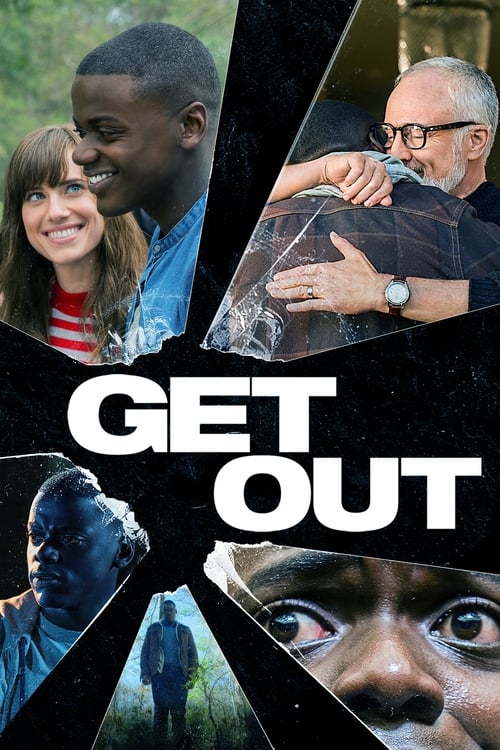
Get Out
2017 · Jordan Peele
The face of the "elevated horror" era and the rare director whose name alone markets a film; Nope divided audiences between "masterpiece about spectacle" and "muddled," which is exactly the argument his fans enjoy having. Every delay of his fourth film generates news cycles.
For when you want horror that's about something — a scare you'll be dissecting with friends for days. Great with a crowd; it plays like a rollercoaster with a thesis.
What it's about
Chris, a young Black man, drives upstate with his white girlfriend Rose to meet her parents for the weekend. The family is welcoming — effusively, strenuously welcoming — and Chris reads the awkwardness as clumsy liberal nerves about the relationship. But the weekend keeps producing small wrongnesses: odd guests, odder staff, conversations that feel like appraisals. What he eventually uncovers is far stranger than anything he braced himself for.
The experience
A masterclass in escalating unease — funny, needling, and genuinely scary, often in the same scene. It tightens like a ratchet, and half the pleasure is how much dread it wrings from a compliment or a smile.
Performances
Daniel Kaluuya anchors everything, doing volumes of work with stillness and a single welling close-up that became instantly iconic, while Lil Rel Howery's TSA-agent best friend delivers the audience's inner monologue to huge comic effect.
The craft
Jordan Peele's Oscar-winning screenplay is a Swiss watch — every early oddity pays off, which makes it one of the great rewatch films — and his direction moves between social satire and full-blown horror without ever dropping either. Made lean and cheap, it looks and sounds far bigger than its budget.
Why it matters
A $4.5 million production that earned over $255 million, won Best Original Screenplay, and redrew the line between genre film and prestige cinema — launching Peele as a major American director and putting 'the Sunken Place' into the cultural vocabulary overnight.
Snapshot
Jordan Peele's debut feature arrived in February 2017 as one of the most precisely calibrated genre films in American cinema's recent memory — a horror-thriller that uses the mechanics of the paranoia film to anatomize the specific terror of being Black in white liberal America. Shot for approximately $4.5 million under the Blumhouse Productions model, it returned over $255 million worldwide, won the Academy Award for Best Original Screenplay, and effectively redrew the boundary between "genre" cinema and films considered worthy of serious critical attention. Its central metaphor — the Sunken Place, a dissociative void where a Black man is imprisoned inside his own body while a white usurper commandeers his physical existence — entered cultural discourse almost immediately, used to describe any state of voiceless marginalization. Rare among horror films, it has been debated in both academic film theory and mainstream political commentary without losing coherence in either register.
Industry & production
Peele developed the script over several years while still primarily known as the co-creator and star of the Comedy Central sketch series Key & Peele (2012–2015). He brought the project to Blumhouse Productions, the low-budget horror label founded by Jason Blum whose micro-budget, high-profit model — shaped by the Paranormal Activity franchise — had by the mid-2010s demonstrated reliable returns on cost-conscious productions. Blumhouse co-produced with QC Entertainment (Sean McKittrick and Raymond Mansfield). Universal Pictures handled domestic distribution.
The casting of Daniel Kaluuya, a British actor, in the central role of Chris Washington was initially a point of external discussion — some critics questioned whether a British performer could authentically inhabit an American Black experience — a debate Peele addressed directly in interviews, noting that the universality of racial terror did not require national specificity. The supporting cast drew on actors with substantial television and stage pedigrees: Bradley Whitford, Catherine Keener, Allison Williams, and Betty Gabriel, whose performance as Georgina became one of the film's most discussed elements. LilRel Howery as Rod Williams provided the film's tonal safety valve, a comedic counterweight that Peele — drawing on his own comedy background — wielded with structural precision.
Principal photography took place largely in and around Montevallo, Alabama, standing in for an unnamed upstate New York location. The production design by Rusty Smith deliberately avoided any period specificity in the Armitage estate's décor, selecting objects and furnishings that felt both aspirationally cultured and faintly wrong — a visual vocabulary of liberal taste that carries latent menace.
Technology
The film was shot digitally on the Arri Alexa, the industry-standard camera for prestige and mid-range productions in this period, using anamorphic lenses to give the frame a slightly wider, more cinematic character than most genre productions of comparable budget. Cinematographer Toby Oliver used this format to create images with controlled depth of field, keeping backgrounds in soft but legible focus — significant for a film whose horror depends on the audience noticing what Chris does not.
The Sunken Place sequences involved post-production visual effects work to construct the sensation of falling through a void while remaining frozen in a receding chair — a practical and digital composite that needed to read simultaneously as a real psychological state and a patently absurd one. The effect was deliberately low-fi in certain respects: Peele wanted the Sunken Place to feel like a space between representation and abstraction rather than a fully rendered digital environment.
Technique
Cinematography
Oliver's work keeps the camera in close, deliberate sympathy with Chris for much of the film, but with a crucial, recurring strategy of slight withdrawal: the camera holds at a distance that positions Chris in a white expanse — a lawn, a hallway, a sunlit garden — where he is surrounded but exposed. Wide shots of the Armitage property consistently show him as the only dark figure in a pale frame. This is not expressionistic distortion but photorealist precision: the horror inheres in accurate representation of a social situation.
Close-ups on Kaluuya's eyes are the film's primary emotional instrument. Oliver and Peele hold on them during the hypnosis sequences, the party scenes where Chris processes microaggressions in real time, and the final confrontation. Kaluuya's capacity to communicate interior states through stillness — his eyes filling with tears without his face otherwise moving — made this strategy cinematically viable. The eye-level camera position during the hypnosis scenes, Missy's teacup filling the foreground, creates a geometry of domination that reads as almost banal before it becomes terrifying.
Editing
Gregory Plotkin edited the film, bringing experience from the Paranormal Activity series and Happy Death Day. The editing manages the film's unusual tonal demand: Get Out is, for much of its running time, as much a comedy of social discomfort as a horror film, and the cuts between Chris's contained social performance and Rod's freeform paranoia (conducted by phone from the city) provide release. Plotkin's pace tightens progressively and without calling attention to itself: scenes that run at near-social-realist length in the first act compress into rapid cutting by the third. The auction sequence, where the bidding on Chris is conducted in elaborate coded gesture, is edited with a stillness that makes the revelation land with the force of a cut rather than a scene.
Mise-en-scène / staging
Peele's staging is built on a grammar of social space and its violations. The Armitage house is staged as a home that performs hospitality while systematically removing Chris's options for exit or refuge. The placement of the Black workers — Walter tending the grounds, Georgina maintaining the interior — keeps Black physical labor at the visual periphery of white domestic comfort, a composition that quotes historical American spatial arrangements with deliberate accuracy.
The garden party sequence stages the film's central social horror as a kind of promenade: white guests circulate around Chris with the barely contained appetite of collectors examining a lot. The spatial choreography here makes visceral a dynamic that operates through politeness: Chris cannot move without encounter, cannot decline without offense. The staging makes the predatory structure visible to the audience before it is legible to the protagonist.
Sound
Michael Abels, a Los Angeles-based composer with no prior major feature credits, wrote one of the more formally inventive horror scores of the decade. Abels drew on African choral traditions, specifically Swahili-language voices, to create a sonic register that is both aesthetically alien to conventional Hollywood horror scoring and culturally specific in its implications: the ancestors of the African diaspora sounding a warning that the protagonist cannot hear. The opening sequence is underscored with "Sikiliza Kwa Wahenga" ("Listen to the Ancestors"), establishing this register immediately.
The sound design uses the teacup's stirring as a hypnotic trigger — a domestic sound rendered disorienting through repetition and association. The choice of this particular sound, so thoroughly benign in itself, carries the film's central thesis: in this world, ordinary social gestures are the instruments of violence.
The deployment of Childish Gambino's "Redbone" during the opening sequence is among the more precisely chosen needle-drops in recent American film. The song's falsetto plea — "stay woke" — is both thematically explicit and, in the context of the film's events, darkly ironic.
Performance
Kaluuya's performance operates on the register of controlled suppression — Chris is a man who has spent a lifetime managing white discomfort, calibrating his responses to minimize friction. The film's psychological complexity depends on the audience understanding, without being told, the labor this represents. Kaluuya makes the labor visible in micro-adjustments: the slight smile that doesn't reach the eyes, the pause before a socially acceptable response. Betty Gabriel's Georgina is the film's most disturbing performance precisely because Gabriel plays two states simultaneously — the servile, over-bright cordiality of the "good help" and the flicker of a different consciousness trying to break through. Her tears during the dinner scene are the film's most unsettling image.
Narrative & dramatic mode
The film is a paranoia thriller that knows its genre and uses the audience's fluency with it as an instrument of misdirection and delayed revelation. Peele structures the first two acts to make Chris's growing unease seem like potential overreaction — the film briefly entertains the possibility that its protagonist is misreading social awkwardness as threat. This is itself a genre mechanism, borrowed from the Gothic and the Hitchcockian thriller, but here the mechanism does double duty: the film implicates the audience in the same dismissal of Black anxiety that the white characters perform, then makes the implication part of the horror.
The narrative's climax inverts the conventional horror ending in which the protagonist escapes: Chris, at the moment of apparent liberation, is stopped by a police car — and the film holds on that image before revealing that it is Rod's vehicle, not law enforcement. The relief this produces is specific: the audience has been primed, by 100 minutes of precise instruction, to understand that police arrival would not mean rescue. That priming is the film's most politically explicit gesture, and it lands as narrative rather than argument.
Genre & cycle
Get Out belongs to a lineage of social-horror and paranoia films that runs from Don Siegel's Invasion of the Body Snatchers (1956) through Roman Polanski's Rosemary's Baby (1968) and Bryan Forbes's The Stepford Wives (1975) — films in which suburban normalcy conceals systematic violence against individuals who fail to conform to the community's hidden requirements. Peele has cited Rosemary's Baby and The Stepford Wives as direct precursors: both feature protagonists isolated in domestic environments, surrounded by apparently benevolent people whose helpfulness is the instrument of their predation.
The film also draws on a tradition of Black horror — or horror that uses genre to address specifically Black American experience — that includes Blacula (1972), Bernard Rose's Candyman (1992), and the literary mode of social horror represented by Shirley Jackson and, more immediately, by the speculative fiction tradition that includes Octavia Butler. The film's premise — the bodily appropriation of a Black man by whites seeking to inhabit his physical vitality — carries specific historical resonance: the long history of white American culture simultaneously marginalizing and commodifying Black bodies.
Get Out helped consolidate, and largely named, a cycle sometimes called "elevated horror" or "social horror" — a marketing and critical category applied to prestige-minded genre films that deploy horror conventions in the service of explicit sociological argument. Subsequent films placed in this cycle, including Hereditary (2018), Midsommar (2019), and Us (2019), varied considerably in their formal and thematic concerns; the category is contested and the genealogy not always tidy. What is clear is that Get Out's commercial and critical success altered the conditions under which studios and distributors would consider such projects.
Authorship & method
Jordan Peele came to the project as a scholar-practitioner: his comedy work in Key & Peele had consistently engaged with race through formal parody of genre conventions — action film tropes, movie-trailer clichés, the conventions of the buddy comedy — and the move to horror represented a tonal shift but not a methodological one. Peele has spoken extensively about the film as a response to the Obama-era discourse of "post-racial" American society, which he understood as a fantasy that made racism harder to name rather than less prevalent. The screenplay was reportedly drafted starting around 2012, during Obama's second term, and its depiction of liberal racism — the Armitages are not Confederate-flag racists but NPR listeners who voted for Obama — was a deliberate target.
Toby Oliver's cinematography, Michael Abels's score, and Gregory Plotkin's editing each brought distinct competencies to what was, for all three, a project of unusual visibility relative to their prior work. Abels in particular — a formally trained composer who had worked in concert music and documentary — brought an academic seriousness to the score that is audible in its structural coherence across the film.
Movement / national cinema
The film is legible within two distinct American cinema traditions. The first is the Blumhouse micro-budget horror model, which by 2017 had demonstrated a reliable capacity to generate profitable returns on $5-10 million productions by controlling costs and leaning into genre mechanics. The second is the tradition of Black American filmmaking — including the work of Spike Lee, Charles Burnett, and John Singleton — that uses American genre conventions to conduct social analysis from a Black American perspective. Get Out is unusual in occupying both traditions without tension: its low budget was a feature of the Blumhouse model; its social specificity placed it in a longer lineage of politically conscious Black cinema.
Era / period
The film is a document of the Obama era's final months and the immediate pre-Trump political landscape — a moment when a certain discourse of racial progress had achieved mainstream respectability and, in Peele's reading, was functioning as a mechanism for suppressing rather than addressing structural racism. Its release in February 2017, three weeks into the Trump administration, gave its themes an intensified resonance that Peele did not entirely intend or predict. The film captures a specific ideological formation — progressive white liberalism as a site of racial violence — that had particular salience in the political climate of 2016–2017.
Themes
The film's central themes cluster around the commodification and appropriation of Black bodies: the Coagula procedure literalizes a historical relationship between white American culture and Black American physicality, in which Black bodies are simultaneously desired, exploited, and denied subjectivity. The "Sunken Place" functions as a spatial metaphor for W.E.B. Du Bois's concept of double consciousness — the awareness of being seen through a white gaze — taken to its logical and horrifying extreme: a state in which Black interiority is entirely displaced, the self imprisoned in its own body while a white consciousness occupies it.
The film is also a critique of a particular form of performative liberalism: the Armitages' ostentatious anti-racism (Dean's insistence that he would have voted for Obama a third time; the party guests' compliments on Chris's physique and appearance framed as progressive appreciation) is the precise mechanism through which the horror is delivered. The social scripts of liberal racial discourse become instruments of predation.
The deer — introduced in the opening scene, where a Black man is lured and abducted from a suburban street, and recurring as both plot element and motif — links the film's horror to the logic of the hunt: the stalking, trapping, and mounting of a specimen for display.
Reception, canon & influence
Get Out received near-unanimous critical acclaim on release, with reviewers across mainstream and academic outlets noting its formal accomplishment alongside its social argument. At the 90th Academy Awards, Peele won Best Original Screenplay — the first Black screenwriter to win in that category — and received nominations for Best Picture, Best Director, and Best Actor (Kaluuya). The scale of its awards recognition was remarkable for a horror film, a genre that the Academy had historically disregarded.
Looking backward, the film's influences are legible in the specific genre vocabulary it deploys: the suburban-paranoia structure of Rosemary's Baby and The Stepford Wives; the social-commentary horror of George Romero's Night of the Living Dead (1968), which used the zombie genre to address racial violence with a directness mainstream American cinema could not otherwise accommodate; the body-horror tradition of Eyes Without a Face (1960) and various transplant narratives; and the long tradition of American Gothic literature in which the apparent civility of domestic space conceals atrocity. The Manchurian Candidate (1962) is a structural precursor for the hypnosis-as-political-control framework.
Looking forward, Get Out's influence on American horror is difficult to overstate. It demonstrated that a horror film could engage explicitly with race as subject matter — rather than as subtext — and achieve both commercial success and critical legitimacy. Peele's own Us (2019) extended the formal ambition while complicating the social allegory. Films including His House (2020), Antebellum (2020), and The Vigil (2019) expanded the social-horror cycle's address to other marginalized communities. The film's success also changed the commercial calculus for studios considering prestige-horror projects with explicit political content.
Its place in the emerging canon is assured: the film appeared on numerous decade-best lists for the 2010s, and its central metaphor — the Sunken Place — has achieved the rare status of cultural shorthand legible outside any knowledge of the film itself.
A Deleuzian reading
A spoon touches the side of a china cup.
The full Deleuzian reading of Get Out →
Reception
An instant sensation in February 2017 — a $4.5M horror movie that grossed over $250M and briefly held a perfect Rotten Tomatoes score — and it hasn't cooled since: it won Peele the Best Original Screenplay Oscar and now routinely tops best-of-the-2010s lists.
How Get Out was received, from release to now →
Influences: the films it descends from and the films it influenced
- Rosemary's Baby (1968) — Polanski's staging of the predatory promenade — the protagonist encircled by smiling neighbors whose social choreography is itself the menace — is the direct compositional model for the Armitage party sequences, where domestic hospitality is rendered threatening through proximity, formation, and the camera's refusal to cut away from the crowd closing in.
- Night of the Living Dead (1968) — Romero's placement of a Black male protagonist at the center of a genre film whose white ensemble literally sidelines him in survival deliberations — Ben excluded from the barricade decision — is the structural and staging precedent for Get Out's racial-labour-periphery compositions, where Chris occupies the frame's social center while remaining the party's organisational margin.
- The Manchurian Candidate (1962) — The diegetic hypnosis trigger — a specific sensory cue that overwrites consciousness and installs a programd state (the playing card's appearance; the cut to the blank tournament-hall fantasy) — is the direct structural and sonic ancestor of Missy's teacup-stir mechanism and the Sunken Place sequence, including the staging of the controlled body continuing to function while the self is displaced.
- Eyes Without a Face (1960) — Franju's surgical body horror — elite figures harvesting physical material from unwilling donors through medical procedure, with clinical formality displacing moral outrage — establishes the procedural grammar that Get Out's Coagula transplant inherits: the doctor-as-orchestrator, the screened room, the patient who cannot resist because the body has already been prepared.
- Invasion of the Body Snatchers (1978) — Kaufman's dual-state performance model — actors playing both the original self and the replacement consciousness inhabiting the same body with a subtly flattened affect that reads as wrongness before it reads as horror — is the performance grammar Get Out inherits for the Coagula subjects, whose microperformance of suppressed identity is the film's central acting challenge.
- The Stepford Wives (1975) — Forbes literalises bodily appropriation within a suburban domestic space where perfect servitude signals that the self has been overwritten; Get Out inherits this staging grammar wholesale, encoding the Armitage household's Black domestic labor as the equivalent sign — the too-smooth gait, the delayed affect, the smile that arrives a half-beat late.
- Society (1989) — Yuzna's 'shunting' — the wealthy literally fusing with and absorbing lower-class bodies in scenes of grotesque surgical body horror — is the specific generic ancestor for the Coagula procedure's logic: elite consciousness occupying a desired body as a form of class consumption, with the horror located not in death but in the continued living of the host as a vehicle for another's will.
- Guess Who's Coming to Dinner (1967) — Kramer establishes the formal vocabulary of the liberal-family-meeting genre — white household performing racial progressivism as social display, with the dinner table as ritual stage — which Get Out inherits as its surface genre before inverting it: the Armitage table is the same set dressed for horror rather than comedy, and Peele's audience-implication narrative depends on viewers recognizing the genre being subverted.
- The Silence of the Lambs (1991) — Demme's direct-address close-up — the camera placed at the interlocutor's eye level so the character appears to look out at the audience — is the specific technical ancestor for Oliver's close-up-eye shots in Get Out, which use the same grammar to implicate the viewer in the act of scrutinizing a Black subject, making the audience complicit in the Armitages' appraising gaze.
- District 9 (2009) — The most critically developed extension of District 9's coerced-empathy mechanism: both films engineer genre situations that force a predominantly white audience into prolonged identification with a protagonist being systematically othered and physically violated by institutional power, using genre conventions to make that empathy structural rather than voluntary.
- Seconds (1966) — Reprises the covert surgical procedure by which an organization seizes and inhabits another person's body, the most-cited modern echo of Seconds.
- Invasion of the Body Snatchers (1956) — Reworks loss-of-self-by-replacement as racial allegory; the 'sunken place' converts produce the same uncanny affectless-normality that tips Bennell off to the pods.
- Us (2019) — Peele extends the dual-state performance technique beyond Get Out's requirements: Lupita Nyong'o must embody both Adelaide and Red as a single body inhabited from opposite directions simultaneously, and Michael Abels's African choral score — present in Get Out as social-horror texture — is developed into overt musical theatricality as the Tethered's leitmotif, making the score a structural argument rather than an atmosphere.
- His House (2020) — Weekes transplants Get Out's racial-labour-periphery staging and controlled-suppression performance mode into a refugee-asylum context — the protagonists must perform gratitude and compliance for the British state while concealing supernatural knowledge — extending Peele's demonstration that horror's institutional threat can be located in the bureaucratic apparatus of a liberal state rather than in an overtly hostile one.
- Antebellum (2020) — Bush and Renz directly borrow Get Out's inverted-horror-ending structure — the genre reveal that retrospectively reframes all prior imagery as political allegory — applying it to antebellum slavery as the concealed horror, with the audience-implication narrative working to indict the viewer for having accepted the surface genre's terms before the inversion forced them to reckon with what they were actually watching.
- They Cloned Tyrone (2023) — Supplies the social-thriller mechanics — a benign surface concealing a systematized bodily-appropriation scheme against Black people, revealed via a slow procedural of clues.
- Ready or Not (2019) — Perfects the horror-comedy satire of a beaming affluent family harvesting an outsider, using genteel hospitality as the mask over predation — the class-horror template that primed 2019 audiences.
- Don't Worry Darling (2022) — Defines the 'elevated genre' social-horror method DWD emulates — a placid privileged enclave weaponizing hospitality, with associative intrusive imagery and a reveal that recodes the whole film as bodily subjugation allegory.
- Fresh (2022) — Establishes the post-2017 template Fresh works in: weaponizing a charming, affluent liberal host as predator and deploying a late plot pivot that recodes an ordinary courtship as systematized bodily harvesting-as-argument.
- Companion (2025) — Models the social-thesis genre film on intimate betrayal — the partner and host you trust are the apparatus of your captivity — plus bodily-control horror and a reveal that recodes an entire romance as predation.
- Hope (2026) — Michael Abels's method — non-English choral voice used as a diegetic-adjacent warning signal over sparse strings — is the scoring idiom he imports into Hope, where invented-language vocalisation crosses the line between score and sound design.
- Hereditary (2018) — Aster's tonal-compression editing — hard cuts between domestic naturalism and horror imagery with no genre-signalling buffer, trapping the audience in the protagonist's unreliable social reality — is the closest formal sibling to Plotkin's Get Out editing, both films using the withholding of conventional horror cues to make the viewer uncertain whether they are watching a drama or a genre film until the reveal has already occurred.
- Midsommar (2019) — Aster pushes the predatory-promenade staging to its structural limit: the Hårga's ritualized hospitality sequences are choreographed exactly as Get Out's party scenes are — smiling community members encircling the outsider protagonist — with harsh Nordic daylight replacing darkness to strip away horror's conventional atmospheric camouflage and expose the choreography as the threat itself.
- The Witch (2015) — Eggers's deployment of anamorphic lenses, non-genre scoring, and period-authentic diction to argue that horror could sustain formal rigor established the aesthetic template — later consolidated as A24 prestige horror — that made Get Out's Academy positioning legible; without Eggers demonstrating that the genre could attract serious critical infrastructure, Peele's film would have had a narrower reception path.
- Sorry to Bother You (2018) — Riley's 'white voice' device — a Black protagonist literally performing a white vocal persona as the condition of professional survival — is the sonic-performance analog to the Sunken Place: both films use a single, formally rendered device to show the self overwritten by dominant culture's requirements, making the mechanics of appropriation explicit rather than metaphorical, and both resolve the device through body horror (the equisapiens; the auction).
- Parasite (2019) — Bong uses spatial geometry as political argument with equivalent precision: who stands in which rooms, who serves whom, and who moves through a space they do not own are choreographed as class analysis, the Parks' home structured analogously to the Armitage house as a space where labor is performed for those who regard the labourer's body as an instrument rather than a subject.
- Black Panther (2018) — Peele, working simultaneously within the same cultural formation, employs production design as encoded racial argument — the Armitage house's colonial trophy culture readable as power structure — sharing with Black Panther the technique of making the built environment carry the film's political thesis without dialogue stating it.
- BlacKkKlansman (2018) — A Black genre film released the year before BlacKkKlansman that uses horror mechanics to carry a structural political argument about racial performance and white liberal complicity; both films belong to the same cycle of Black American cinema where thriller/horror scaffolding bears political argument rather than providing escape from it.
- The Invisible Man (2020) — Peele's film is the immediate cultural template for elevated horror organized around legible social critique: both films use genre mechanics to externalize a specific form of systemic victimization while maintaining the psychological interiority required for the single-POV structure to generate political rather than merely visceral horror.
- Nope (2022) — Peele and Daniel Kaluuya establish the anti-theatrical performance mode — horror expressed through controlled physiological suppression rather than outward display — that Kaluuya carries directly into OJ, making withheld interiority the signature register of Peele's protagonists across both films.
- Weapons (2025) — Structural misdirection in which one genre primes expectations that a concealed second genre subverts; community complicity as the disclosed horror mechanism; the structural reveal retroactively reframes all prior social interactions as a unified system of concealment.
- Sinners (2025) — Peele inaugurates the contemporary Black horror cycle by formalizing white liberal hospitality as a mechanism of Black dispossession — using horror genre mechanics to carry the specific texture of anti-Black violence rather than generic threat — establishing the cycle's formal contract that Sinners inhabits as its most formally ambitious subsequent entry.
- A Quiet Place (2018) — The cited crystallizer of 'elevated horror' — atmosphere-first, allegory-driven studio genre filmmaking — establishing the commercial template AQP exploits a year later.
Similar films
- Us (2019) — influence & lineage
- Parasite (2019) — influence & lineage
- Sorry to Bother You (2018) — influence & lineage
- Hereditary (2018) — influence & lineage
- Nope (2022) — shared sensibility
- BlacKkKlansman (2018) — shared sensibility
- Moonlight (2016) — shared sensibility
- Blindspotting (2018) — shared sensibility
All the films related to Get Out →