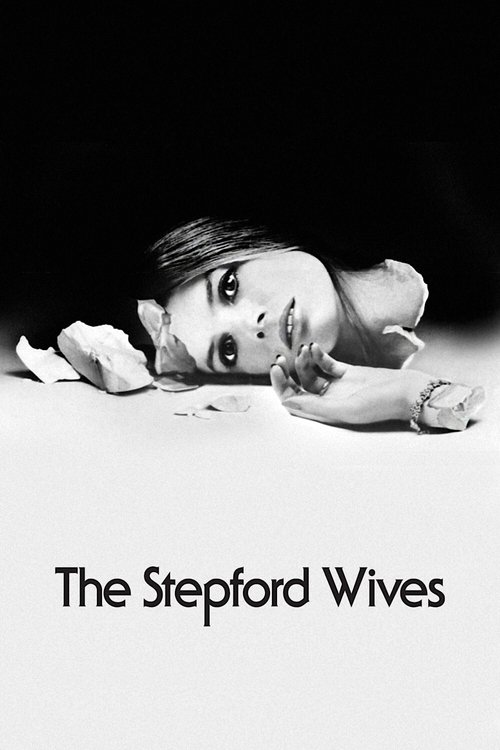
The Stepford Wives
1975 · Bryan Forbes
When you're craving unease more than gore — a thinking person's horror film for a night when you want to be unsettled and then argue about it afterward. More challenge than comfort; it's designed to get under your skin and stay.
What it's about
A photographer moves with her husband and kids from Manhattan to the immaculate Connecticut suburb of Stepford, where something is off: the local wives are all gorgeous, glazed, and blissfully devoted to housework and their husbands. With her wry new friend Bobbie — another recent transplant who hasn't yet drunk the Kool-Aid — she starts pulling at the town's perfect surface, and what's underneath is worse than either of them imagined.
The experience
A slow-burn creep rather than a jump-scare machine — the horror is in the smiles, the small talk, the sunlit kitchens. It builds a steady, suffocating dread that pays off in an ending people don't shake off easily.
Performances
Katharine Ross anchors it with mounting, believable panic, and Paula Prentiss is the film's live wire — funny, loose, and human in a town of mannequins, which makes the stakes real.
The craft
Adapted by William Goldman from Ira Levin's novel, the film weaponizes pleasantness: bright suburban light, manicured lawns, and chirpy pleasantries doing the work that shadows do in other horror films. Bryan Forbes directs at a deliberate simmer, letting wrongness accumulate detail by detail.
Why it matters
Its title entered the language — 'Stepford wife' is now shorthand for smiling, hollowed-out conformity — which almost no film can claim. It remains a foundational text of feminist horror and suburban paranoia.
Snapshot
The Stepford Wives is a quiet, creeping work of suburban science-fiction horror that has long since outgrown the film itself: its title became an English-language idiom for a smiling, submissive, hollowed-out conformity, a fate the picture imagines being engineered onto women by their own husbands. Adapted by William Goldman from Ira Levin's 1972 novel and directed by the British filmmaker Bryan Forbes, it follows Joanna Eberhart (Katharine Ross), an aspiring photographer who moves with her husband and children from Manhattan to the manicured Connecticut town of Stepford, where the wives are uniformly beautiful, beaming, and devoted to housework and their husbands' pleasure. As Joanna and her sharp, irreverent new friend Bobbie (Paula Prentiss) probe the town's eerie domestic placidity, they uncover the work of the local Men's Association: the wives of Stepford are being killed and replaced by obedient animatronic replicas. Conceived at the height of the second-wave women's movement, the film is at once a paranoid thriller in the Invasion of the Body Snatchers lineage and a pointed feminist allegory about the male reaction to women's liberation — a fable in which the "perfect" wife is literally a machine. Received with mixed reviews in 1975, it has since become a durable cultural touchstone and a foundational text of feminist horror.
Industry & production
The film was produced by Edgar J. Scherick, a former television executive (he had helped launch ABC's Wide World of Sports) turned independent producer, through his production interests; it was released by Columbia Pictures. The source was Ira Levin's slim, much-discussed 1972 novel — Levin being already established as Hollywood's most reliable supplier of upmarket paranoid horror after Rosemary's Baby (filmed by Roman Polanski in 1968) and later the author of The Boys from Brazil. Adapting Levin's high-concept premise fell to William Goldman, then at the peak of his screenwriting reputation following Butch Cassidy and the Sundance Kid and on the cusp of All the President's Men.
The production is unusually well documented in one respect because Goldman wrote about it at length in his memoir Adventures in the Screen Trade, where he recounts a sharp creative disagreement with director Bryan Forbes over the conception of the replacement wives. By Goldman's account, he had envisioned the robot wives as overtly sexualized — voluptuous fantasy figures in revealing dress — whereas Forbes preferred a more demure, old-fashioned image, with the wives costumed in long floral dresses and broad-brimmed garden-party hats. The disagreement is bound up with casting: Forbes gave a prominent role (Carol Van Sant) to his wife, the actress Nanette Newman, and the more matronly, romantic styling of the wives is often attributed to that fact. The published record from Goldman's side frames this as a fundamental misjudgment that softened the satire; whatever the merits, the dispute is one of the better-attested behind-the-scenes facts about the film and a rare documented instance of an author-screenwriter publicly second-guessing a finished picture.
Casting placed Katharine Ross — already iconic from The Graduate and Butch Cassidy — at the center as Joanna, with Paula Prentiss as the wry, doomed Bobbie, Peter Masterson as Joanna's complicit husband Walter, and Patrick O'Neal as the urbane, sinister head of the Men's Association, Dale "Diz" Coba. Tina Louise appears as the pre-conversion Charmaine, and the young Dee Wallace has an early small role. The film was shot largely on location in Connecticut's affluent Fairfield County commuter belt — Westport, Darien, and surrounding towns — whose real geography of clapboard houses, colonial main streets, and leafy lanes supplies the film's authentic suburban surface.
Technology
The Stepford Wives is, in its physical means, a conventional mid-1970s 35mm location production, and it claims no technical innovation in its own making; its power comes from performance, atmosphere, and editing rather than from any optical or effects apparatus. Where technology is central is thematically: the film's horror is explicitly a horror of automation. The mechanism of the plot is robotics — specifically the audio-animatronics of the theme-park era, and the film makes the lineage literal by establishing that Dale Coba, the Men's Association's ringleader, formerly worked at Disneyland building animatronic figures. This grounds the fantasy in a real and recognizable 1970s technology: the lifelike mechanical humanoids of Disney's "Great Moments with Mr. Lincoln" and the Pirates of the Caribbean, here repurposed to manufacture compliant wives. The replicas are realized not through elaborate special effects but largely through performance and suggestion — the actresses playing their own "perfected" doubles with a glazed, gliding affect — which keeps the film's uncanniness psychological rather than mechanical. It would be invention to credit the film with technical breakthroughs in effects; its sophistication lies in turning a familiar consumer-age technology into an image of patriarchal fantasy.
Technique
Cinematography
The cinematography is by Owen Roizman, one of the defining American cameramen of the 1970s, whose credits already included The French Connection and The Exorcist. Roizman shoots Stepford in clear, bright, autumnal New England light — a deliberately attractive, sunlit suburban surface whose very wholesomeness becomes oppressive. The visual strategy is one of pastoral irony: the prettier the town looks, the more wrong it feels. Against this Roizman builds an increasing sense of entrapment as Joanna's suspicions mount, using the orderly geometry of the houses and supermarket aisles to frame the women as figures arranged within a controlled environment. The film's restraint is part of its craft — there is little overt expressionist lighting; the dread is smuggled into ordinary daylight, which makes the late turn into nightmare all the more disquieting.
Editing
The editing (credited to Timothy Gee) is keyed to the slow-burn structure of the paranoid thriller: information is parceled out at Joanna's pace, and the film's tension derives from accumulation rather than shock. The cutting holds on the wives' unnervingly serene faces and on the small behavioral wrongnesses — a repeated phrase, a mechanical glitch — that signal something beneath the surface. The pacing is patient, even leisurely, in the manner of 1970s adult thrillers, building domestic normality so thoroughly that its disruption registers as violation. The film accelerates only in its final movement, as Joanna's discovery and flight tighten the rhythm toward the celebrated supermarket coda.
Mise-en-scène / staging
The production design maps the iconography of the upper-middle-class American suburb with precision: spacious kitchens, station wagons, immaculate lawns, and the men's clubhouse with its colonial respectability. The staging contrasts two registers of femininity — Joanna and Bobbie in jeans and unbuttoned, lived-in clothing, against the converted wives in their long pastel dresses and sun hats, an image of an idealized, almost Victorian domestic womanhood. That costuming choice (the focus of the Goldman–Forbes dispute) is the film's central visual idea: the "perfect" wife is dressed not as a sexual fantasy but as a nostalgic one, a return to a pre-feminist domestic order. The recurring tableaux of wives gliding through supermarket aisles, reciting devotion to housework, stage conformity as a kind of choreography.
Sound
The score is by Michael Small, a composer who had become the period's specialist in paranoia, having scored Alan J. Pakula's Klute and The Parallax View. Small's music for The Stepford Wives leans on deceptively gentle, lyrical, almost lullaby-like motifs that curdle into unease — the sonic equivalent of the film's sunlit dread, sweetness turned sinister. The sound design exploits the wrongness of the wives' voices and catchphrases (the much-quoted "I'll just die if I don't get this recipe"), the flatness and repetition signaling the mechanical underneath. The film's most unsettling effects are often aural: a stuck phrase, a too-even cadence, the hum of the ordinary suburb.
Performance
Performance carries the film. Katharine Ross plays Joanna as an intelligent, modern, slightly anxious woman whose growing certainty that something is wrong is met with the gaslighting placidity of everyone around her; her grounded ordinariness is what makes the encroaching horror legible. Paula Prentiss is the film's vital spark as Bobbie — fast-talking, funny, profane, recognizably a real woman — which makes her eventual conversion into a serene, recipe-reciting automaton the film's most chilling single stroke; the contrast between Prentiss's two registers is the performance on which the picture's horror pivots. Patrick O'Neal gives Coba a smooth, affectless menace, and Peter Masterson makes Walter's ordinary, weak complicity quietly devastating — the horror here is not a monster but an average husband. Nanette Newman and the other "wife" performers sustain a difficult mode of blank, beatific wrongness throughout.
Narrative & dramatic mode
The film's dramatic mode is the paranoid thriller crossed with allegory. Structurally it follows the classic pattern of the lone sane person in a world that has been taken over — the protagonist perceives a truth that everyone around her denies, is progressively isolated as allies are converted or revealed to be complicit, and is driven toward a confrontation she cannot win. The engine is dread rather than action: the slow erosion of Joanna's support and sanity. Crucially, the film withholds and then confirms its science-fiction premise late, so that much of its running time plays as ambiguous psychological suspense — is Joanna paranoid, or is the town genuinely monstrous? — before resolving into horror. The famous ending refuses the consolation of rescue: rather than the heroine's triumph, the film closes on her absorption into the very order she resisted, the supermarket gliding with serene replicas. This downbeat, ironic closure is characteristic of 1970s American genre cinema and gives the allegory its sting: the system wins.
Genre & cycle
The Stepford Wives sits at the intersection of several cycles. It belongs to the lineage of body-snatcher paranoia descending from Invasion of the Body Snatchers (1956) — the small community secretly replaced by inhuman duplicates, the lone figure who sees the truth — and to the broader 1970s wave of paranoid thrillers about hidden conspiracies and institutional malevolence (a kinship underscored by Michael Small's scoring, shared with Klute and The Parallax View). It is also an "Ira Levin adaptation," part of a recognizable run of upscale domestic horror — Rosemary's Baby most of all — in which the threat is intimate, located in marriage, home, and neighborly community rather than in the gothic exterior. And it is a foundational entry in what would later be recognized as feminist horror: genre filmmaking that literalizes the anxieties of women's social experience, here turning the backlash against women's liberation into a science-fiction conspiracy. The robotic-double premise also connects it to the era's emergent fears about automation and artificial humans.
Authorship & method
Authorship of The Stepford Wives is genuinely divided, which is part of its history. The premise and its satirical clarity belong to Ira Levin's novel; the screenplay's structure and dialogue to William Goldman, a writer of pronounced craft and strong opinions; and the finished film's tone — its softer, more romantic-nostalgic image of the wives, its measured British-inflected restraint — to director Bryan Forbes. Forbes was an established figure of British cinema (an actor, writer, and director associated with kitchen-sink-era and well-made literary films such as Whistle Down the Wind and The L-Shaped Room), and The Stepford Wives is an unusual American assignment for him. The documented friction between Goldman's conception and Forbes's execution — the dispute over how the wives should look and what the satire should emphasize — means the film is best understood as a negotiated object rather than a single auteur's vision, and critics have long debated whether Forbes's gentility blunted or merely modulated the material's edge.
The key collaborators give the film its surface and mood: cinematographer Owen Roizman supplied the ironic, sunlit New England realism; composer Michael Small contributed the unnerving lullaby score that ties the film to the decade's paranoia cinema; and the casting of Paula Prentiss against type — comic vitality extinguished into machine-serenity — is the film's single most effective creative decision. Forbes's choice to cast his wife, Nanette Newman, among the wives is both a piece of authorship and the proximate cause of the costuming debate. Beyond what Goldman set down in his memoir, the granular record of the collaboration is thin, and it would overstate the evidence to assign specific scenes to one hand or another.
Movement / national cinema
The film is a product of 1970s American studio-affiliated independent production — the Hollywood "New" era in which adult-oriented, downbeat, socially engaged genre pictures found backing — though it is directed by an Englishman, giving it a slightly outsider's view of American suburban mores. It does not belong to a formal movement so much as to the cultural moment of second-wave feminism: it is one of the first Hollywood genre films to take the women's liberation movement directly as its subject, refracting the era's debates about marriage, domestic labor, and female autonomy through horror. Its national-cinematic identity is American suburban, its anxieties those of the affluent Northeastern commuter class, observed with an anthropological precision that the location shooting in Connecticut reinforces.
Era / period
The Stepford Wives is inseparable from its early-1970s moment. It arrives directly out of the women's movement — The Feminine Mystique (1963) had already named the suffocation of the educated suburban housewife, and the National Organization for Women and the broader feminist ferment of the era form the film's immediate context; the script even nods to consciousness-raising and the women's movement explicitly. The film dramatizes the male backlash against these changes: the fantasy of restoring an idealized, pre-liberation domesticity, achieved here by literal erasure of the women who have begun to want more. The period's specific textures — the Manhattan-to-Connecticut flight of the professional class, the consumer abundance of the suburban supermarket, the men's clubs and their casual chauvinism — locate the story precisely. The technology of the threat, audio-animatronics, is likewise of its moment, the theme-park robotics of the era turned to domestic tyranny.
Themes
The governing theme is the patriarchal fantasy of the perfect wife as a contradiction in terms — a "perfect" woman being, by the film's logic, no longer a person but a machine. From this flows the film's critique of marriage as an institution capable of demanding the annihilation of the self: the husbands of Stepford choose obedient simulacra over their actual, complicated wives, and the horror is that ordinary men make this choice. The film is centrally about conformity and its enforcement — the pressure on women to perform contentment, to subordinate ambition (Joanna's photography, Bobbie's wit) to domestic service. It is about identity and replacement, the erasure of individuality, and the uncanny terror of the almost-human double. It engages directly with the politics of women's liberation and the backlash it provoked. And it carries a subtler theme of complicity and isolation: Joanna is betrayed not by a distant monster but by her own husband and her converted friends, so that the film's deepest dread is the loneliness of seeing a truth no one will share.
Reception, canon & influence
On its 1975 release, The Stepford Wives drew a mixed critical reception. Some reviewers found it a slow, slightly muffled thriller whose satirical premise outran its execution — a complaint sometimes laid at Forbes's measured, genteel direction — while others recognized the sharpness of its central idea and the disquieting effectiveness of its ending. Its commercial performance was modest rather than spectacular, and precise figures are not asserted here. What is indisputable is the film's afterlife: its title entered the language, "Stepford wife" becoming a standard idiom for a docile, conformist, artificially perfect woman, and "Stepford" an adjective for any eerily uniform, soulless community. Few films of its era have so thoroughly colonized everyday speech.
Influences on the film run backward to Ira Levin's novel and, through it, to the domestic-horror template of Rosemary's Baby; to the body-snatcher paranoia of Invasion of the Body Snatchers; to The Twilight Zone tradition of suburban science-fiction allegory; and to the 1970s conspiracy thriller, with which it shares both its dread of hidden cabals and (via Michael Small) its musical signature.
Its influence forward is broad and ongoing. The film generated a run of television sequels (Revenge of the Stepford Wives, The Stepford Children, The Stepford Husbands) and a high-profile 2004 theatrical remake directed by Frank Oz with Nicole Kidman, which recast the material as broad satire. More importantly, it is now regarded as a foundational text of feminist horror, a lineage critics trace forward to films that literalize women's social anxieties — the cycle that includes later works using genre to anatomize gender, marriage, and bodily autonomy. Its core image — the perfect, smiling wife as automaton — has become a permanent piece of cultural shorthand, invoked in debates about gender roles, conformity, and artificial humanity far beyond the world of film. Whatever the qualms about its pacing or its director's restraint, The Stepford Wives endures as the rare genre picture whose central metaphor proved more powerful than the movie itself, and whose title remains in daily use half a century on.
A Deleuzian reading
You remember Bobbie before you remember anyone else.
The full Deleuzian reading of The Stepford Wives →
Reception
Dismissed by many in 1975 as a glossy, slow thriller — Betty Friedan famously trashed it as a rip-off of the women's movement — it's since been reclaimed as a foundational feminist-horror satire, its stock rising further every time a remake or imitator fails to match it.
How The Stepford Wives was received, from release to now →
Influences: the films it descends from and the films it influenced
- Invasion of the Body Snatchers (1956) — Supplies the replaced-spouse engine Stepford domesticates — a protagonist insisting loved ones have become affectless duplicates, driven by the slow-dawning revelation that the entire community is already converted.
- Rosemary's Baby (1968) — The other Ira Levin adaptation establishes the domestic-conspiracy template: a wife's mounting paranoia about a cabal of blandly pleasant neighbors, withheld behind realist apartment/suburb surfaces and confirmed only in a downbeat closing reveal.
- The Manchurian Candidate (1962) — Pioneers the programmed-human conspiracy — ordinary people covertly reengineered into controllable automatons by a hidden organization — the device Stepford transposes from Cold War politics to marriage.
- Les Diaboliques (1955) — Models the slow-burn marital thriller of delayed revelation, building dread inside an oppressively ordinary bourgeois setting rather than through overt shocks.
- Klute (1971) — Source of Michael Small's paranoia-scoring method — wordless female vocalize and lullaby-as-menace — which Small recycles to give Stepford its unnerving musical signature.
- The Exorcist (1973) — Owen Roizman's naturalistic, available-light realism that grounds horror in documentary-plain domestic surfaces — the same ironic sunlit ordinariness he brings to Stepford's New England.
- Whistle Down the Wind (1961) — Establishes Forbes's genteel, pastoral British restraint and innocent-POV framing — the directorial temperament critics credit with modulating (or blunting) Stepford's satirical edge.
- The Boys from Brazil (1978) — Another Ira Levin source built on mass-produced, engineered identical humans serving a concealed agenda — Levin's replicated-person dread extended into cloning.
- The Stepford Wives (2004) — Direct remake that recasts the automaton-wife premise as broad comic satire, foregrounding the very gentility-versus-edge tension that divided the 1975 production.
- Get Out (2017) — Peele-acknowledged debt: an affable suburban enclave whose smiling, servile residents are revealed as appropriated bodies, deploying Stepford's delayed-revelation structure to literalize social anxiety as horror.
- Ex Machina (2015) — Extends Stepford's core image — the manufactured perfect woman as the site of male control — into the gynoid whose engineered compliance becomes the instrument of the man's undoing.
- Don't Worry Darling (2022) — Explicitly Stepford-derived: a nostalgically styled mid-century suburb where husbands secretly subjugate wives into smiling domestic perfection, reusing the costuming-nostalgia and delayed-reveal machinery.
- Swallow (2019) — Carries the feminist-horror project forward by literalizing a controlled housewife's lost autonomy inside pastel, design-magazine domestic perfection that mirrors Stepford's pastoral irony.
- Vivarium (2019) — Weaponizes the uniform suburban tract — identical pastel houses — into an entrapment device against a couple, extending Stepford's 'eerily uniform community' staging into surreal horror.
- But I'm a Cheerleader (2000) — Its satire of enforced feminine conformity — women literally reprogrammed into idealized housewives — is the structural blueprint for the reprogramming-camp's manufactured gender roles.
- They Cloned Tyrone (2023) — Gives the 'replacement to enforce conformity' plot machine — a controlled populace swapped for compliant duplicates, discovered through creeping wrongness in familiar faces.
- Obsession (2026) — Literalizes the fantasy of replacing a partner with an idealized, compliant double — the obsessive wish rendered as replacement horror.
- Barbie (2023) — Pioneers production design of manufactured feminine perfection — the uncanny, immaculate housewife as satirical object — that Barbieland's flawless plastic womanhood critiques.
- Companion (2025) — Establishes the gendered horror of the manufactured, programmed-compliant female partner as consumer product, and the domestic-uncanny reveal that a 'perfect' wife is engineered — the template Companion updates for the app era.
- The Parallax View (1974) — Contemporaneous Pakula/Michael Small conspiracy picture sharing Stepford's dread of an unseen organization and the decade's cold, minimalist scoring idiom.
- Westworld (1973) — Literalizes the audio-animatronic servant indistinguishable from a human until it malfunctions, working the same uncanny-automaton-as-attendant anxiety in the same year-adjacent moment.
- Blink Twice (2024) — Men engineering women into pleasant, compliant, memory-stripped versions of themselves inside an insular affluent enclave — the domestication-as-erasure premise Blink Twice literalizes.
- Invasion of the Body Snatchers (1978) — Runs the same replacement-by-conformity engine — loved ones returning as placid, affectless duplicates — as a suburban companion piece to the film's urban strain.
Similar films
- Rosemary's Baby (1968) — influence & lineage
- Invasion of the Body Snatchers (1956) — influence & lineage
- Don't Worry Darling (2022) — influence & lineage
- Invasion of the Body Snatchers (1978) — shared sensibility
- It Follows (2015) — shared sensibility
- The Shining (1980) — shared sensibility
- The Texas Chain Saw Massacre (1974) — shared sensibility
- Sound of Falling (2025) — shared sensibility