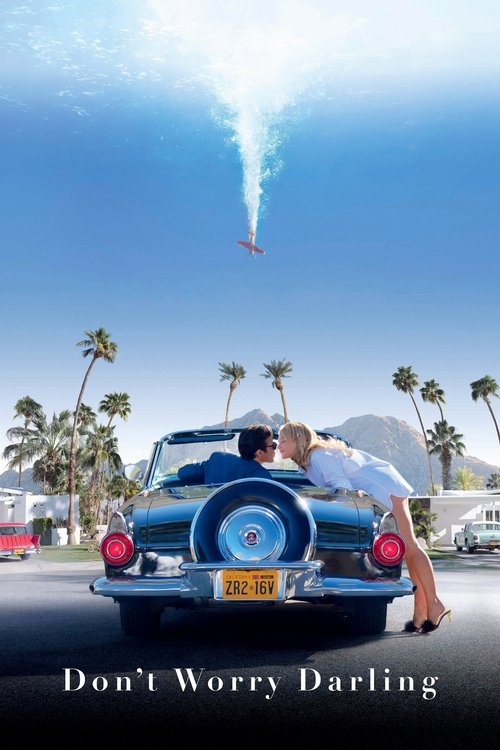
Don't Worry Darling
2022 · Olivia Wilde
The press tour that ate the movie: Wilde-LaBeouf-Pugh feuds, "Miss Flo," and Spitgate frame-by-frame forensics — the modern template for production drama as the actual cultural product.
For when you're in the mood for a stylish mystery-box evening — something pretty to look at that keeps you guessing, more slick entertainment than heavy challenge.
What it's about
Alice and Jack live in Victory, a sun-drenched 1950s company town in the desert where the husbands drive off each morning to a classified project and the wives cook, clean, and cocktail. Everything is perfect — the houses, the parties, the charismatic leader who runs it all — until Alice starts noticing things that don't add up, and asking the one question nobody in Victory asks: what is this place, really?
The experience
A glossy, slow-tightening paranoid thriller — martinis and pastel dresses on the surface, dread underneath. It's less about jump scares than the mounting claustrophobia of being told you're crazy when you know you're not.
Performances
Florence Pugh carries the film, selling every stage of Alice's unraveling with a conviction that outpaces the material around her; Chris Pine is coolly unnerving as Victory's silver-tongued founder.
The craft
The midcentury production design and costuming are immaculate — a whole desert utopia built to look like an advertisement — and the camera drinks in the synchronized, too-perfect rhythms of suburban ritual. The unease is largely visual: mirrored surfaces, choreographed housewives, a paradise framed just a little too neatly.
Why it matters
One of the most talked-about releases of its year — as much for its off-screen drama as on — and a lightning rod in the ongoing wave of thrillers about controlled women and manufactured domestic bliss.
Horror · Psychological horror · Suspense & terror · Techno-horror. Sunlit 1950s desert suburbia, pastel and perfect, where a wife's growing suspicion meets a chorus insisting she's imagining things.
Snapshot
Don't Worry Darling is Olivia Wilde's second feature, a paranoid-woman thriller that dresses a science-fiction premise in the sun-bleached iconography of the American 1950s. Florence Pugh plays Alice, a housewife in Victory, a purpose-built desert company town whose men vanish each morning to a secret "Victory Project" while their wives keep immaculate houses. Alice's growing suspicion that the world is a lie resolves, in the third act, into a reveal: Victory is a coercive simulation into which men — led by Chris Pine's guru Frank — have inserted their partners to live out a retrograde domestic fantasy. The film sits at the intersection of The Stepford Wives, The Matrix, and Get Out, and reaches for a pointed commentary on incel and "manosphere" culture. It is also, unavoidably, one of the most gossip-saturated releases of its decade: its off-screen drama came to overshadow the film itself. As an artifact, it is best understood as a high-gloss, ambitious, and critically divisive attempt to weaponize mid-century glamour against the ideology that glamour once sold.
Industry & production
The project originated as a spec screenplay by Carey Van Dyke and Shane Van Dyke that topped the 2019 Black List, the industry's annual survey of admired unproduced scripts. New Line Cinema (under the Warner Bros. umbrella) won a competitive bidding war for it. Wilde, coming off the acclaim of Booksmart (2019), attached to direct, and brought in her Booksmart collaborator Katie Silberman to substantially rewrite the material; the finished film credits screenplay to Silberman with story to the Van Dykes and Silberman. Wilde produced alongside Silberman, Roy Lee, and Miri Yoon.
The production is inseparable from the publicity that engulfed it. Shia LaBeouf was originally cast as Jack and departed the film; Wilde stated publicly that she had fired him to protect her cast's process, after which LaBeouf disputed that account and released correspondence — including a video message from Wilde referencing "Miss Flo" — suggesting he had exited on his own terms. He was replaced by Harry Styles, whose relationship with Wilde became tabloid fodder. Reports of tension between Wilde and Pugh circulated widely, fueled by Pugh's conspicuously limited promotional participation (she attended the Venice premiere but skipped the press conference, citing her Dune: Part Two schedule). At CinemaCon, Wilde was reportedly served custody documents by former partner Jason Sudeikis while onstage presenting the film. The Venice premiere produced "Spitgate," a viral clip that appeared to show Styles spitting toward Pine — an incident both camps denied. This constellation of stories dominated coverage to a degree that measurably shaped how the film was received.
Distributed theatrically by Warner Bros., the film opened in September 2022. Reported figures place its production budget in the mid-$30-million range and its worldwide gross somewhat above that, making it a modest rather than blockbuster commercial performer; precise final tallies should be treated as approximate here rather than cited as hard numbers.
Technology
The salient technical story of Don't Worry Darling is not capture format but controlled artificiality. The film's look is engineered to feel hyperreal — saturated, symmetrical, and slightly too perfect, an aesthetic strategy that supports the plot's reveal that Victory is a fabricated world. Public documentation of the exact capture medium is thinner than the film's other production details; the imagery is consistent with the digital, large-format-sensor workflow typical of cinematographer Matthew Libatique's recent work, though the format is not the film's defining technical choice and I won't assert specifics the record doesn't firmly support. More consequential were the practical resources: the production leaned heavily on real mid-century modern architecture and location shooting in and around Palm Springs, California, using genuine period homes rather than fully synthetic environments. That decision — building the "simulation" out of authentic 1950s modernism — is itself a technological/aesthetic argument, grounding the film's uncanniness in real spaces rather than visual effects.
Technique
Cinematography
Matthew Libatique — a frequent Darren Aronofsky collaborator (Requiem for a Dream, Black Swan, Mother!) and an Oscar nominee for A Star Is Born — shoots Victory with a deliberately seductive, postcard cleanliness: strong symmetry, clean horizons, chlorine-blue pools, and desert light rendered as luxury. This surface beauty is periodically ruptured by the film's "intrusion" imagery — kaleidoscopic, Busby Berkeley–style formations of dancers that erupt into Alice's perception as glitches in the reality. Libatique also deploys claustrophobic devices as Alice's dread mounts: walls that seem to press inward, a sequence in which she is trapped against glass, tightening frames. The camera's polish is the point — the more flawless the compositions, the more the viewer, like Alice, should distrust them.
Editing
Affonso Gonçalves cut the film. Gonçalves is best known for restrained, mood-driven work with directors including Todd Haynes (Carol) and Jim Jarmusch (Only Lovers Left Alive), plus Beasts of the Southern Wild. Here his task was the opposite of restraint in the "intrusion" passages: the editing splices Alice's controlled domestic routine against fragmentary, associative flashes — mirrored dancers, an eye, cracking eggshells, geometric patterns — that seed the mystery before the narrative explains it. The film alternates a measured, almost languid rhythm in Victory's daily life with accelerating, disorienting cutting as the simulation destabilizes.
Mise-en-scène / staging
This is the film's strongest and most-praised register. Production designer Katie Byron and costume designer Arianne Phillips (a longtime Madonna collaborator, Oscar-nominated for Walk the Line and Once Upon a Time in Hollywood) construct a mid-century idyll of curved modernist homes, conversation pits, cocktail hours, and precisely coordinated wardrobes. The aesthetic descends visibly from Slim Aarons's poolside society photography and the Mad Men revival of period glamour. Recurring motifs organize the staging: circles and symmetry (the town's radial layout, the forbidden central "headquarters"), reflective surfaces and mirrors, eggs, and the ballet/showgirl vocabulary tied to Alice's suppressed memories. The forbidden center of the community — the site everyone is instructed not to approach — functions as the film's spatial engine of dread.
Sound
John Powell's score is one of the film's more distinctive choices. Powell, celebrated chiefly for the Bourne films and for animation (How to Train Your Dragon), builds unease from vocal and percussive textures rather than conventional thriller strings; a wordless humming motif — a tune Alice cannot stop repeating — recurs as an aural clue and eventually a key to the mystery. The sound design toggles between the plush ambient calm of Victory (ice in glasses, pool water, radio) and abrasive intrusions that mirror the visual glitches, using audio to signal the reality's instability before the images fully confirm it.
Performance
Florence Pugh's performance is the near-universal exception to the film's mixed notices. She carries the film's shift from contented wife to terrified investigator with a physical, unguarded intensity, anchoring scenes whose writing critics often found underpowered. Chris Pine plays Frank with a smooth, cultish menace that many singled out as effective. Harry Styles, in his first major dramatic lead, drew more divided responses; his standing as a global pop star inevitably colored reception of the work. Wilde herself plays Bunny, and the supporting ensemble includes Gemma Chan as Frank's wife Shelley, KiKi Layne as the destabilized Margaret whose "breakdown" first cracks Victory's façade, and Nick Kroll.
Narrative & dramatic mode
The film operates in the "paranoid woman" or gaslight-thriller mode — the lineage running from Gaslight (1944) and Rosemary's Baby through The Stepford Wives — in which a female protagonist perceives that her reality is wrong and is systematically told she is imagining it. Structurally it is a mystery built on restricted narration: the audience is largely bound to Alice's limited, manipulated point of view, so that her destabilization is ours. The film withholds its science-fiction premise until a late reveal, meaning much of the runtime plays as social realism turned uncanny before the genre "rules" retroactively reframe everything. This is the same delayed-reveal architecture as The Matrix or Get Out, and it invites — and received — the standard objection to such structures: whether the twist's internal logic survives scrutiny after the fact.
Genre & cycle
Don't Worry Darling belongs to a clear contemporary cycle of feminist-inflected genre films that use horror and science fiction to dramatize gendered control: Get Out (2017) as the template for "social horror," Us, The Invisible Man (2020), Promising Young Woman (2020), and the Stepford Wives remake conversation. It also converses with the era's television — Marvel's WandaVision (2021), which similarly trapped a woman inside a nostalgic domestic sitcom-reality, and Black Mirror's simulated-consciousness episodes. Its specific genre synthesis — 1950s domestic melodrama surface over a simulated-reality science-fiction chassis — is closest to a fusion of The Stepford Wives and The Matrix, with Pleasantville and The Truman Show as tonal cousins in their use of a too-perfect artificial town.
Authorship & method
As director, Wilde's method here extends the confident stylization of Booksmart into far more controlled, design-forward territory, prioritizing atmosphere, movement, and production craft. In interviews she framed the film as an explicit response to reactionary gender politics; she has said the Frank character was informed by figures she associated with the "incel community," naming Jordan Peterson as a reference point for the kind of pseudo-intellectual authority the film critiques (remarks reported in her 2022 press interviews). Her key collaborators form the spine of the film's identity: Silberman as writer and creative partner; Libatique as cinematographer supplying the seductive-then-suffocating image; Byron and Phillips building the mid-century world; Gonçalves shaping the intrusion-driven rhythm; and Powell providing an unconventional, vocally-driven score. The frequent critical verdict was that this collaboration produced a film whose craft outran its screenplay — that the direction and design were more assured than the story's thematic follow-through.
Movement / national cinema
This is a work of mainstream American studio filmmaking, produced within the Warner Bros./New Line system and squarely inside Hollywood's genre economy. It is not affiliated with a formal movement, but it can be located within a loose 2010s–2020s tendency — sometimes called "elevated genre" or "prestige horror/thriller" — in which auteur-branded directors use genre frameworks to carry explicit social argument, a space substantially defined by A24 and Blumhouse but here operating at major-studio scale.
Era / period
The film is doubly period-marked. Its diegetic setting is a fantasy 1950s — the postwar suburban ideal of the single-earner household, the housewife, and consumer modernism — which the film stages precisely in order to expose it as ideology. But it is thoroughly an artifact of the early 2020s: its real subject is the contemporary online resurgence of that ideal in "trad wife" aesthetics and manosphere rhetoric, and its reception was shaped by the celebrity-media ecosystem of its exact moment. The tension between the two periods — 1950s surface, 2020s anxiety — is the film's organizing idea.
Themes
The film's central theme is coercive control masquerading as care: the men of Victory imprison their partners in a fantasy while insisting it is a gift, dramatizing gaslighting as a total environment rather than an interpersonal act. From this flow its other concerns — the seductiveness and violence of nostalgia; the reactionary male fantasy of a world in which women's autonomy (Alice, in the real world, is revealed to have a demanding professional life) is erased in favor of domestic servitude; consent and bodily/cognitive sovereignty; and the ideology of "the good life" as a mechanism of subjugation. The recurring images — the forbidden center, the mirror, the too-perfect egg, the humming song — all cluster around the theme of a manufactured reality whose beauty is precisely what conceals its cruelty.
Reception, canon & influence
Critical reception was mixed to negative, with a notable split: near-consensus praise for Pugh's performance, Pine's menace, and the production/costume design, set against widespread criticism that the screenplay's ideas were underdeveloped and its third-act logic shaky. Many reviewers argued the film gestured at a sharp thesis about the manosphere without dramatizing it rigorously. This critical reception cannot be cleanly separated from the extraordinary volume of off-screen coverage, which arguably crowded out substantive engagement with the film on its own terms — a dynamic several critics noted at the time.
Influences on the film (backward): the through-line is unmistakable — The Stepford Wives (Ira Levin's novel and the 1975 film) for the wives-as-fantasy premise; Gaslight and Rosemary's Baby for the disbelieved-woman structure; The Matrix, The Truman Show, and Pleasantville for the manufactured-world reveal; Get Out for social horror as genre method; Busby Berkeley musicals for the kaleidoscopic dance imagery; and the visual language of Slim Aarons and Mad Men for the mid-century palette.
Legacy (forward): given its recency and divided reception, its cinematic influence is too early — and too thin — to claim with confidence, and honesty requires saying so. Its most durable footprint to date is twofold and largely extra-cinematic: first, as a defining case study in how a press tour's drama can eclipse a film, a reference point in discussions of celebrity-media dynamics; and second, as a time-stamped document of early-2020s cultural anxiety about the manosphere, incel ideology, and the aestheticized return of retrograde domesticity. Whether it earns a lasting place in the genre canon alongside its own influences remains unsettled; for now its significance rests more on Pugh's performance, its craft, and its cultural moment than on any demonstrated line of influence on the films that followed.
A Deleuzian reading
The picture window.
The full Deleuzian reading of Don't Worry Darling →
Reception
In September 2022 the press-tour chaos completely swallowed the film — critics called it a handsome muddle with a great Florence Pugh performance, and it's still remembered less as a movie than as the drama that surrounded it, though it did solid box office off the spectacle.
How Don't Worry Darling was received, from release to now →
How to watch Don't Worry Darling: what to notice on a first viewing
- Count how often a composition lines up perfectly symmetrical. Libatique shoots Victory like an advertisement. Clean horizons, centered frames, chlorine-blue pools, desert light handled as luxury. The look is borrowed from poolside society photography, and it is a little too flawless to be a place. The film needs you to want this town before it can do anything with the wanting, so the beauty is the mechanism.
- Look at the town's layout and the place nobody may approach. Victory is built radially with the desert as its wall and one forbidden site at the middle. Every surface in it is either mirrored or immaculate. Nothing is dirty, scuffed, or out of place anywhere. A world with no dirt is a world with no evidence, and the instruction not to go to the center is the engine of the dread.
- Watch the ice in the glasses, the eggs, the morning departures. Victory runs on repeated objects and repeated hours. Cocktails at the same time, men leaving together, breakfast laid out identically. You learn what each thing means by habit. Then one of them stops behaving. The suspense comes from an ordinary object falling out of its routine, which forces you to interpret instead of recognize.
- Listen for the tune Alice keeps humming to herself. Powell builds the score from voices and percussion rather than thriller strings. A wordless hum keeps returning, and it belongs to no radio in this town. The mix flips between plush calm and abrasive interruption. Sound tells you the world is unstable before any image confirms it, which is why the unease arrives early and without a cause.
- Notice the quick flashes that cut into ordinary domestic scenes. Gonçalves splices fragments into the routine: mirrored dancers in kaleidoscopic formations out of Busby Berkeley, an eye, a cracking shell, a geometric pattern. The flashes make the routine feel wrong before you can name why.
The whole guide to watching Don't Worry Darling, with the keys for a rewatch →
Influences: the films it descends from and the films it influenced
- The Stepford Wives (1975) — Supplies the core structural device DWD rebuilds: the affluent planned community whose too-perfect domesticity is literalized as engineered female compliance, staged through immaculate mid-century interiors that curdle from aspirational to carceral.
- Gaslight (1944) — Establishes the disbelieved-woman mechanics DWD runs on — a husband systematically reframing his wife's accurate perceptions as instability, with the audience locked into her restricted, doubted point of view.
- Rosemary's Baby (1968) — Model for restricted subjective horror in domestic space: a smiling conspiratorial community and a controlling partner, filmed so we share the heroine's dawning, gaslit paranoia rather than any outside confirmation.
- The Truman Show (1998) — Precedent for the manufactured-idyll reveal — a sunlit, symmetrical, retro-perfect town exposed as an authored simulation built around and for a single controlled protagonist.
- Pleasantville (1998) — Directly models the 1950s-surface/contemporary-anxiety collision, using an idealized mid-century Americana as a stylized prison whose repressive gender order is the thing being critiqued.
- The Matrix (1999) — Blueprint for the delayed simulated-reality reveal in which comfortable perceived life is a coercive digital construct, complete with the glitch/intrusion cues that leak the truth to protagonist and viewer.
- Get Out (2017) — Defines the 'elevated genre' social-horror method DWD emulates — a placid privileged enclave weaponizing hospitality, with associative intrusive imagery and a reveal that recodes the whole film as bodily subjugation allegory.
- Dance, Girl, Dance / Busby Berkeley musicals (1935) — Source of the kaleidoscopic overhead choreography — mirrored, circular, radially symmetric bodies-as-ornament — that DWD samples for its intrusion montages, turning geometric spectacle into imagery of women arranged into pattern.
- Black Swan (2010) — Shares cinematographer Matthew Libatique's method of the seductive-then-suffocating image and mirror/doubling motifs, plus a percussive, psychologically invasive sound design tracking a woman's unraveling perception.
- The Village (2004) — The 'secret present' device is played out: a period-styled idyllic community with a rule-bound perimeter turns out to be a constructed present-day simulation built by a patriarch who rules through fear and nostalgia.
- Barbie (2023) — Later, larger execution of the same idea — an artificial, symmetrical mid-century-adjacent utopia built on prescribed gender roles, its pastel perfection ruptured by intrusions that expose the patriarchal machinery beneath.
- Don't Move / Fresh (2022) — Continues DWD's paranoid-woman thriller in elevated-genre packaging, using seductive glossy surfaces and a delayed reveal to expose a charming man's regime of captivity and coercive control-as-care.
- Suspiria (2018) — Parallel deployment of dance as horror grammar and an unconventional, vocally-textured score, staging female bodies in choreographed formation as a coercive system to be uncovered.
- Us (2019) — Extends the same intrusion-driven editing and doppelgänger/mirror motif within elevated genre, using scored percussive stingers and delayed exposition to reframe an ordinary reality as engineered duplication.
- Vivarium (2019) — Contemporary sibling in the manufactured-suburb trap — identical, symmetrical, hyperreal show-home housing as inescapable simulation enforcing domestic roles, shot with the same eerie clean-surface flatness.
- Swallow (2019) — Same mid-century-modern idyll as gilded cage: a designed, color-coordinated domestic surface photographed as suffocation, dramatizing coercive control-as-care through a woman's suppressed interiority.
- Promising Young Woman (2020) — Shares the candy-colored, hyper-stylized production design deployed against reactionary gender politics — the 'craft-outruns-thesis' elevated-genre mode staging a pointed critique of male entitlement.
- WandaVision (2021) — Parallel use of a lovingly reconstructed retro domestic paradise revealed as a coercively maintained simulation, with reality-glitch intrusions puncturing a woman's authored idyll.
- Booksmart (2019) — Wilde's own prior feature, whose confident, movement-forward, needle-drop stylization and choreographed set-pieces DWD escalates into more controlled, design-forward hyperreal symmetry.
- The Invite (2026) — Wilde's prior star-ensemble study of a curdling marriage and a maintained social façade, staged in claustrophobic, controlled domestic interiors — direct authorial continuity.
- Blink Twice (2024) — Another actress-turned-director genre debut about a woman in a manufactured paradise recovering the suppressed memory of the men controlling her, built on retro-saturated design.
Similar films
- The Stepford Wives (1975) — influence & lineage
- Promising Young Woman (2020) — influence & lineage
- Us (2019) — influence & lineage
- The Invite (2026) — same viewing thread
- The Drama (2026) — same viewing thread
- Midsommar (2019) — shared sensibility
- Where the Crawdads Sing (2022) — shared sensibility
- Blink Twice (2024) — shared sensibility
All the films related to Don't Worry Darling →
Watch it with: curated runs of related films
- When Love Gets High-Concept — Watch these when you want a love story with a speculative or absurdist hook — an AI girlfriend, an afterlife way-station, a reanimated corpse, a marriage under siege — comedies that use a wild premise to say something real about coupling.
- Minds Rented, Bodies Owned — A run of sci-fi thrillers and horror where someone wakes up to find their body, memories or relationships belong to a company, a lab or a controlling man. Watch them together and the same nightmare keeps coming back: the self as somebody else's property.