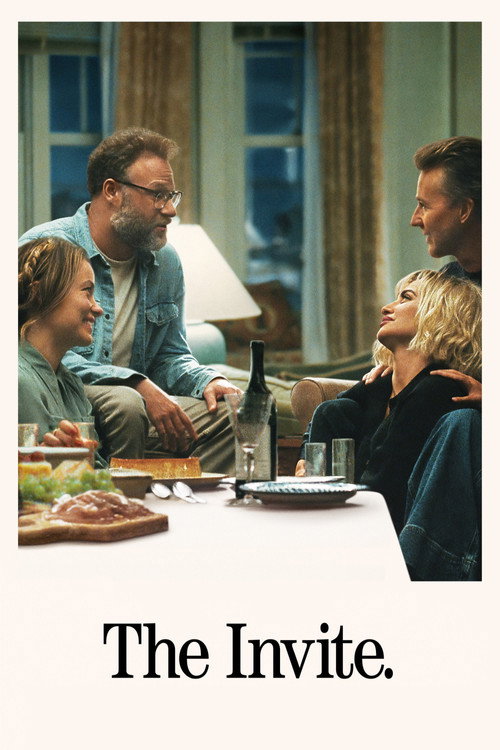
The Invite
2026 · Olivia Wilde
For date night when you're feeling brave, or a group watch where everyone will be debating the couples afterward. It's a comedy, but the kind that pokes at real nerves — reach for it when you want laughs with teeth, not comfort food.
What it's about
Joe and Angela's marriage is running on fumes in their San Francisco apartment, and their nightly torment is the couple upstairs — whose very audible passion comes through the ceiling. So they invite the neighbors down to dinner. Over one evening at one table, small talk curdles into confession, provocation, and open marital warfare.
The experience
A pressure-cooker comedy that keeps tightening — funny in the squirmy way where you laugh and then glance at your own partner. It plays out in real time in one apartment, and the escalation from polite chitchat to scorched earth is the whole ride.
Performances
Seth Rogen and Olivia Wilde make the frayed marriage painfully recognizable, while Penélope Cruz and Edward Norton are a delight as the serene, unnervingly candid guests who keep lobbing grenades into the small talk.
The craft
Adapted by Rashida Jones and Will McCormack from a Spanish hit with stage-play bones, and the theatrical constraint is the point: one room, four actors, no exits, every scene wound tighter than the last. Wilde directs it like a farce with the timing of a thriller — the comedy lives in what's said versus what's meant.
Why it matters
Wilde's third feature and a warmly received Sundance premiere that reset the conversation around her as a director, reviving the grown-up dinner-party comedy in the process.
Olivia Wilde's third feature — after the exuberant Booksmart and the embattled Don't Worry Darling — is a chamber farce, and the constraint suits her: one apartment, one evening, four actors, no exits. Adapted by Rashida Jones and Will McCormack from Cesc Gay's Spanish hit The People Upstairs (itself born as a stage play), it traps a curdling marriage — Seth Rogen's failed musician, Wilde's restless wife — in a dinner party with the upstairs neighbors whose nightly, very audible passion has become the couple's private torment. Penélope Cruz and Edward Norton play the guests as serene provocateurs, and the film's comedy runs on the gap between what married people say at the table and what they mean — escalating from small talk to open warfare with the mechanics of a well-made play. It premiered at Sundance in 2026 to some of the warmest reviews of Wilde's directing career before A24 sent it to theaters. The pleasure is old-fashioned: four movie stars in a room, a script that keeps tightening, and a director confident enough to simply let them combust.
Reception
Premiered at Sundance 2026 to warm reviews and was instantly framed as Olivia Wilde's redemption picture — the film that moved the conversation off the Don't Worry Darling press-tour circus and back onto her actual directing.
How The Invite was received, from release to now →
Influences: the films it descends from and the films it influenced
- Who's Afraid of Virginia Woolf? (1966) — Adapts a single-set stage play into a booze-fueled, near-real-time war between a movie-star married couple whose party games weaponize humiliating subtext against invited guests — the template for star-ensemble marital cruelty confined to one room.
- Carnage (2011) — Compresses Yasmina Reza's well-made play into one apartment in near-continuous real time, letting two bourgeois couples' performed civility curdle into farce — the direct blueprint for the single-location provocateur dinner.
- The Celebration (Festen) (1998) — Stages a family dinner party as a pressure cooker in which a dinner-table toast unleashes buried transgression, pioneering the escalating-revelation structure that turns hospitality into exposure.
- The Exterminating Angel (1962) — Traps bourgeois guests in a single drawing room after a dinner party, their manners visibly decomposing over unity of place — the origin point of the dinner-party-as-social-trap.
- The Discreet Charm of the Bourgeoisie (1972) — Builds its satire from repeatedly interrupted dinner parties, using the ritual of the shared meal to skewer upper-class hypocrisy and self-regard.
- The Rules of the Game (1939) — Structures social hypocrisy as an ensemble comedy of manners, orchestrating a country-house gathering where romantic infidelities and class masks collide in farcical simultaneity.
- Rope (1948) — Confines a single-apartment dinner gathering to strict unity of time, wringing tension from a secret hidden in plain sight among the guests — a masterclass in one-location suspense staging.
- Scenes from a Marriage (1973) — Dissects a marriage in crisis at chamber scale through long two-hander confrontations whose calm surfaces escalate into raw accusation — the model for subtext-driven domestic torment.
- Long Day's Journey Into Night (1962) — Rigorously preserves a single-house stage play's unity of place, letting a family's mutual torment escalate over one continuous day of accusation and evasion.
- Bodies Bodies Bodies (2022) — Confines a young star ensemble to a single house party where performed intimacy slips into accusatory farce, extending the one-location, mask-slipping social-escalation chamber piece.
- The Party (2017) — A real-time, single-flat black comedy where a celebratory gathering detonates the guests' marital and ideological hypocrisies through cascading revelation among an ensemble of stars.
- Closer (2004) — Adapts Patrick Marber's stage play into cruelly articulate scenes where sexual betrayal is delivered as verbal subtext and offscreen confession rather than shown.
- Beatriz at Dinner (2017) — Constructs a single-evening dinner party around one provocateur guest whose mere presence forces the wealthy hosts' class hypocrisy into the open.
- Force Majeure (2014) — A festival-arthouse comedy of cringe that detonates a marriage through a single social embarrassment, escalating via subtext and mortified silence at communal meals.
- Triangle of Sadness (2022) — Stages the wealthy at a captive shipboard dinner until decorum collapses into farce, extending the arthouse-satire mode of social hypocrisy exposed through ritual eating.
- Don't Worry Darling (2022) — Wilde's prior star-ensemble study of a curdling marriage and a maintained social façade, staged in claustrophobic, controlled domestic interiors — direct authorial continuity.
Similar films
- Don't Worry Darling (2022) — influence & lineage · same viewing thread
- Who's Afraid of Virginia Woolf? (1966) — influence & lineage
- Triangle of Sadness (2022) — influence & lineage
- Force Majeure (2014) — influence & lineage
- The Drama (2026) — same viewing thread
- Fresh (2022) — same viewing thread
- Palm Springs (2020) — same viewing thread
- Wild Tales (2014) — often watched together
All the films related to The Invite →
Watch it with: curated runs of related films
- When Love Gets High-Concept — Watch these when you want a love story with a speculative or absurdist hook — an AI girlfriend, an afterlife way-station, a reanimated corpse, a marriage under siege — comedies that use a wild premise to say something real about coupling.