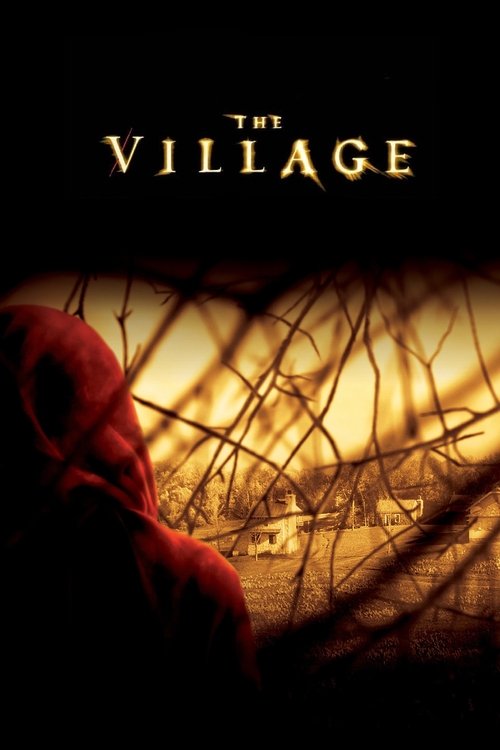
The Village
2004 · M. Night Shyamalan
For a quiet, contemplative evening when you want atmosphere and a story to argue about afterward rather than jump scares. Reach for it when you're in the mood for something melancholy and old-fashioned that still gets under your skin.
What it's about
An isolated 19th-century Pennsylvania settlement lives by an uneasy truce: the villagers stay out of the surrounding woods, and the unnamed creatures said to live there stay out of the village. When an act of violence leaves a young man gravely wounded, a blind young woman must do the forbidden thing — cross through the forest toward the outside world — and the community's carefully kept arrangements begin to strain.
The experience
Hushed, deliberate and strange — less a scare machine than a slow-burning mood of candlelight, formal speech and dread at the treeline. It plays as a mournful romance wrapped in a mystery, and it asks for your patience before it shows its hand.
Performances
Bryce Dallas Howard, in her first major role, is luminous as the blind Ivy — fearless, funny and completely convincing — and Joaquin Phoenix does a lot with stillness and silence as the reserved Lucius.
The craft
Roger Deakins shoots the village in amber lantern light and deep forest shadow, turning color itself into a warning system, and James Newton Howard's violin-driven score — one of the most admired of its decade — carries half the film's emotion. Shyamalan's patient, locked-down framing makes every rustle at the edge of the woods count.
Why it matters
Divisive on release and reassessed ever since, it has become one of the most argued-over entries in Shyamalan's run of original thrillers — a film whose reputation keeps climbing as viewers return to it for its mood and ideas rather than its twist.
Snapshot
The Village is M. Night Shyamalan's fourth studio feature and the fourth in a run of original, self-written supernatural thrillers that began with The Sixth Sense (1999). It is set in what appears to be an isolated 19th-century Pennsylvania settlement, surrounded by woods where unnamed creatures ("Those We Don't Speak Of") are said to live. An unspoken truce keeps the villagers inside their borders. After Lucius Hunt (Joaquin Phoenix) is stabbed by the jealous, intellectually disabled Noah Percy (Adrien Brody), the blind Ivy Walker (Bryce Dallas Howard) travels through the forest to "the towns" for medicine. The film then reveals that the village is a modern-day enclave. Its founding elders, people bereaved by violent crime, built it inside a privately owned wildlife preserve to shut out the late 20th century. They invented the creatures and act them out in costume to keep their children inside.
Its first reception was divided and often hostile, aimed mostly at the final revelation. Its standing has since become more complicated. Critics now commonly read it as an allegory of the post-9/11 politics of fear. Roger Deakins's photography, James Newton Howard's Oscar-nominated score and Bryce Dallas Howard's breakthrough performance are widely admired. It is often treated as the hinge between Shyamalan's commercial peak and the critical decline of his mid-career.
Industry & production
The film was made by Touchstone Pictures (Walt Disney) with Shyamalan's Blinding Edge Pictures and Scott Rudin Productions. Shyamalan, Rudin and Sam Mercer produced. It was the last of Shyamalan's Disney-backed films before his move to Warner Bros. for Lady in the Water (2006). Michael Bamberger's book The Man Who Heard Voices (2006) documents how the director's relationship with Disney's leadership broke down during the development of that next project. Reported working titles included The Woods.
Coming after the major box-office success of Signs (2002), the film had a substantial studio budget and a heavily secretive marketing campaign. The trailers sold it as a creature-horror film, which arguably set up the audience's later sense of having been misled. It opened at number one in the United States in late July 2004 and grossed well internationally, though less than Signs. Exact budget and gross figures differ between sources and are not repeated here.
The production built its village as a standalone set in the countryside near Chadds Ford, Pennsylvania, in keeping with Shyamalan's practice of shooting in and around the Philadelphia area. Kirsten Dunst was reportedly attached to the role of Ivy before withdrawing. Shyamalan then cast Bryce Dallas Howard after seeing her on stage, and this was her first leading film role. The cast took part in a pre-production period of period living, learning crafts and chores of the era, which publicity materials described as a kind of "boot camp." How detailed and how long this was is known mainly from promotional sources.
Before release, the author Margaret Peterson Haddix and her publisher Simon & Schuster pointed out similarities to her young-adult novel Running Out of Time (1995). That book is also about a girl who leaves an apparently 19th-century village that turns out to be a modern-day site, in order to get medicine. The resemblance was widely reported in the press. As far as the public record shows, it did not result in a judgment against the film.
Technology
The film was shot on 35mm film. It was the first time Shyamalan worked with Roger Deakins, after Tak Fujimoto had shot The Sixth Sense and Signs and Eduardo Serra had shot Unbreakable. The technical record (camera packages, lab process, whether there was a digital intermediate) is not well documented in widely available sources, and this dossier does not speculate about it.
The main craft achievements were analogue and practical:
- The village set. A full set of buildings, a meeting house, and a watchtower over the forest edge, lit for both day and night exteriors.
- The creature suits. Hooded figures in red cloaks with quill- or spine-like protrusions, kept partly hidden throughout. They work only because they are seen so little.
- Night and forest lighting. Lantern light, moonlight and fog in the Covington Woods had to stay readable while still keeping the frame uncertain.
The color design was its own kind of technical system. Red is banned in the village as "the bad color" and yellow is the "safe color" of the guardian cloaks. This required close coordination between photography, costume (Ann Roth) and production design (Tom Foden).
Technique
Cinematography
Deakins's images are restrained and painterly. Daylight scenes favor muted earth tones, wheat-colored fields and grey-green woods, with color held back so that the banned red and the protective yellow stand out sharply when they appear. Many commentators have compared the look to the rural realism of Andrew Wyeth, whose home and subject was Chadds Ford. The comparison is an apt critical observation, not a documented citation by the filmmakers.
Deakins and Shyamalan prefer composed, often static frames and long takes, which let dread build inside the shot rather than through cutting. A much-discussed example comes when the creatures enter the village. Ivy stands on the porch with her hand stretched out into the dark, trusting that Lucius will reach her. The camera holds on her in near-stillness, and his hand arrives at the last moment in slow motion. The image reduces the film's ideas about faith, blindness and protection to a single gesture.
The forest sequences rely on mist, deep shadow, and the yellow of Ivy's cloak against grey-brown trees. These pictorial choices let a blind protagonist's journey be shown without any pretense of a point-of-view shot.
Editing
Christopher Tellefsen edited the film. The cutting serves Shyamalan's preference for measured, almost ceremonial rhythm. Scenes start and end on held beats. Information is released slowly, and important facts (the elders' black boxes, the forbidden color, the boundary markers) are introduced early and paid off later.
The structure is built toward revelation. The film delays its two largest disclosures: the elders made the creatures, and the "19th century" is a staged present. Then it releases them in quick succession during Ivy's journey and the ending. Critics disagreed sharply over whether this second-half turn feels earned or mechanical. Cross-cutting between Ivy in the woods and the elders' confessions in the village shapes much of the final act.
Mise-en-scène / staging
The village is staged as a moral diorama. It has a central green, a meeting hall where the elders sit in a row like a tribunal, and a perimeter marked by watchtowers, torches, and offerings of skinned animals that the villagers take as warnings. Costume and props mark social roles. The yellow cloaks belong to ritual protection, and the black boxes hold each elder's hidden past.
Shyamalan often places his actors frontally or in strict geometric groupings. The rehearsed formality of village speech and manners ends up as part of the film's subject, since the whole community is a performance put on by the elders. In that sense the staging is self-aware: a costume-drama style that turns out to be literally a costume drama.
Sound
James Newton Howard's score was nominated for the Academy Award for Best Original Score. It features solo violin by the concert violinist Hilary Hahn, whose lyrical and sometimes plaintive lines carry the romance between Ivy and Lucius and the film's mood of mourning. It was Howard's fourth consecutive collaboration with Shyamalan, and the score is generally considered among his finest work for the director.
The sound design depends on what is not seen: rustling in the woods, faraway creature calls, the clatter of the watchtower bell, and silences that leave the audience straining to listen, much as Ivy does. Ivy's blindness makes sound a narrative device. Much of the forest passage is built around what she hears and how she interprets it.
Performance
Bryce Dallas Howard's Ivy is the film's emotional center and the performance most often praised, even by critics who disliked the film overall. She plays blindness as alertness rather than limitation, mixing directness, humor and physical courage. Joaquin Phoenix's Lucius is buttoned-up and nearly mute, a character who speaks most clearly in writing and in action. Adrien Brody's Noah, fresh from his Oscar for The Pianist, has been both admired and criticized. The way the film uses intellectual disability as a plot device has drawn objections.
The elders are played by William Hurt, Sigourney Weaver, Brendan Gleeson, Cherry Jones and Celia Weston. Their performances are deliberately stiff in period manner, which takes on new meaning once the conceit is revealed. Judy Greer, Michael Pitt, Jesse Eisenberg and Fran Kranz appear in supporting roles. Shyamalan gives himself a brief cameo, as he usually does, as an office worker at the preserve, seen mostly in a reflection.
Narrative & dramatic mode
The film blends a pastoral romance, a monster story, a quest narrative and a fable. Its first half is a slow chamber drama of village life, including a funeral, courtship, and Lucius's petition to cross the woods. A creature incursion breaks it up. The second half becomes a quest. Ivy, blind and accompanied by two young men who soon turn back, crosses the forbidden woods, confronts a "creature" (who is Noah in a costume), and climbs over a wall into the modern world.
Revelation is the dramatic device. It works in two stages: first for the audience and Ivy (the creatures are a fiction), then for the audience alone (the century is a fiction). The film ends with the elders choosing to keep the lie going and folding Noah's death into the legend. This leaves the ending morally unresolved rather than redemptive. Its mode is closer to parable than to a horror film. Characters speak in a stylized, archaic register, and the story's stakes come from belief rather than physical danger.
Genre & cycle
The Village was marketed as horror but plays as a hybrid of period melodrama, psychological thriller and allegorical fable. It belongs to Shyamalan's early-2000s cycle of "twist" films (The Sixth Sense, Unbreakable, Signs), and audiences arrived expecting a final reversal. That expectation framed its reception.
It also belongs to the long American tradition of stories about utopian or closed communities, and it shows affinities with the British folk-horror tradition, especially in its isolated community governed by rituals and taboos. The film complicates genre by making the monster an institution and not a creature. Fear itself is the instrument of social control.
Authorship & method
Shyamalan wrote, directed and produced the film, keeping the self-originated, director-centered control established on his earlier hits. His method is visible throughout: original screenplays built around a secret, a firm preference for suggestion over display, deliberate pacing, faith and grief as dramatic material, Pennsylvania settings, and a personal cameo.
Key collaborators:
- Roger Deakins (cinematography): his first and only Shyamalan film to date. He brought a naturalistic, painterly style that many critics consider the film's strongest element.
- James Newton Howard (composer): a regular Shyamalan collaborator. With Hilary Hahn as soloist, he produced an Oscar-nominated score.
- Christopher Tellefsen (editor): known for independent and prestige work. He shaped the slow-release structure.
- Tom Foden (production design) and Ann Roth (costumes): they built the imagined period world and its color code.
- Scott Rudin and Sam Mercer (producers): Mercer was a long-standing partner on Shyamalan's Disney-era films.
Movement / national cinema
The film belongs to American studio cinema of the early 2000s. It is a rare case of an original, auteur-identified genre film released at full studio scale during an era increasingly dominated by franchises. It is not part of any formal movement. It fits within regional American filmmaking, since Shyamalan's base in Philadelphia and the Pennsylvania landscapes are central to his identity as a filmmaker. Its pastoral imagery draws on a recognizably American tradition of rural Pennsylvania and New England iconography.
Era / period
The film was released in summer 2004, during the Iraq War and in the middle of the U.S. presidential campaign. It came three years after the September 11 attacks, at a time when the color-coded Homeland Security Advisory System (introduced in 2002) was a familiar part of American public life. Many critics then and since have tied the film's color code (red as danger, yellow as protection), its leaders who manufacture fear to keep the population in line, and its hidden-from-view governing secrets to that political climate. Shyamalan's own statements on this reading are not clearly documented. The allegory is best treated as a strong critical interpretation rather than an announced authorial intention.
The diegetic period is double: an apparent late 19th century, and a concealed present. That doubling is itself the film's main statement about nostalgia.
Themes
- Fear as governance. The elders keep their utopia going by inventing a threat. The film asks whether protection built on deception can be justified, and it leaves the question open.
- Grief and retreat. Each elder joined the community after losing someone to violent crime. The black boxes hold those traumas. The village is a collective act of mourning turned into a social structure.
- Innocence and its cost. The attempt to escape violence produces violence anyway (Noah's stabbing of Lucius) and denies the children medicine and knowledge.
- Nostalgia as fiction. The "19th century" is a reconstruction. The film criticizes the American wish to retreat into an idealized past.
- Faith and sight. Ivy, who cannot see, perceives most clearly: she senses people's "colors" and sees through her elders' fictions. Her blindness points to the film's ideas of faith, trust and moral vision.
- Love as courage. The romance gives Ivy her motive to cross the boundary, and it is the film's clearest alternative to the elders' politics of fear.
Reception, canon & influence
Critical reception. The first reviews were mixed to negative. Much of the criticism targeted the twist, which many reviewers found predictable, contrived, or a betrayal of the menace the marketing had promised. Roger Ebert was among the film's harshest critics. Even negative reviews regularly praised Bryce Dallas Howard, Deakins's photography and Howard's score. The score's Academy Award nomination is the film's main formal honor. In the narrative of Shyamalan's career, the film is often cited as the point where his twist-based reputation turned from asset to liability. Over the following years, critical reappraisal has grown, especially around its political allegory and its formal craft. Some critics now count it among the director's most personal and ambitious films. Its reputation is still contested and has not been settled.
Influences on the film (backward). These are affinities and lines of descent identified in critical commentary, not necessarily ones the director acknowledged:
- American literary traditions of the Puritan and closed community, including Hawthorne's "Young Goodman Brown" (its forest of temptation and terror) and Shirley Jackson's "The Lottery" (ritual inside an apparently idyllic community).
- The suggestion-based horror of Val Lewton's RKO productions, whose strategy of the unseen threat Shyamalan's films are often compared with.
- The folk-horror motif of the sequestered community, with The Wicker Man (1973) as a frequent touchstone.
- Peter Weir's Witness (1985), which places Pennsylvania plain-living communities in contact with the modern world.
- Andrew Wyeth's paintings, in the film's visual palette.
- The Haddix novel controversy, noted above, as a possible though unconfirmed precedent for its structural conceit.
Legacy (forward). The film's influence is mostly a matter of recurring motifs and affinities, not direct lineage:
- Rule-bound survival under unseen monsters. Later films such as The Witch (2015), It Comes at Night (2017) and A Quiet Place (2018), and the novel and film of Bird Box, center on families or communities organized around strict rules, sensory limits, and a threat beyond a boundary.
- Folk horror and closed communities. The 2010s revival of folk horror and stories of closed communities, including Shyamalan's own production of the TV series Wayward Pines (2015), whose pilot he directed, return to the premise of a sealed town controlled by managed fear and hidden history.
- "Secret present" settings. The device of a period setting revealed to be staged in the present has become a recognizable trope, and The Village is now its standard popular reference point.
- Bryce Dallas Howard's career. The film launched her career, and she reunited with Shyamalan on Lady in the Water.
Within Shyamalan's own body of work, its concerns return in his later films: communities and families cut off from the world, and adults deciding what children should know.
Influences: the films it descends from and the films it influenced
- Cat People (1942) — Lewton's unit perfected horror built from offscreen threat, sound cues and shadowed thresholds. The Village stages its creatures the same way: glimpsed red cloaks at the edge of the frame and sound from the treeline, with almost nothing shown in full.
- I Walked with a Zombie (1943) — The long, silent nocturnal walk through rustling vegetation toward a threat that is never confirmed is the model for Ivy's blind passage through Covington Woods, where pace and ambient sound carry the dread.
- The Wicker Man (1973) — It provides the folk-horror template of a sealed community whose elders run a ritual order on a managed belief system. An outsider-facing investigation slowly exposes that the community's cosmology was built by its leaders.
- Witness (1985) — Weir and John Seale shot Pennsylvania plain-dress communities in diffused natural light with a muted wardrobe palette. That painterly, Wyeth-adjacent rendering of 19th-century living set beside modernity is the visual model Deakins develops.
- Picnic at Hanging Rock (1975) — Weir's period community under repression treats the surrounding wilderness as an unexplained, sublime threat. He builds unease through stately compositions, decorous performance and a landscape that swallows its young.
- Days of Heaven (1978) — Almendros's natural-light, magic-hour photography of agrarian America turns rural period life into painting, the American-pastoral tableau Deakins carries into the Village's fields and porches.
- The Crucible (1996) — The Puritan tribunal of elders is staged as a governing body that enforces a collective fear. Its formal period diction and stiff manner of speech prefigure the Village's council scenes and deliberately archaic dialogue.
- The Sixth Sense (1999) — Shyamalan's own plant-and-payoff architecture began here. Color coding (red marking the uncanny), static long takes and a recontextualizing final revelation are the system The Village pushes into a double, two-stage twist.
- Signs (2002) — A family is sealed inside a farmhouse against a barely glimpsed menace at the cornfield's edge, with a fixed-frame suspense grammar and a James Newton Howard ostinato score. The Village scales that siege up from a household to a community.
- Sleepy Hollow (1999) — Builds its entire design system on chromatic costume coding as plot mechanism — the safe color versus the bad color enforced across every garment — and reveals its woods-monster as a costume operated by the elders to control the settlement, the same manufactured-supernatural reveal delivered through production design.
- Lady in the Water (2006) — Shyamalan reunites with Bryce Dallas Howard and James Newton Howard in another enclosed community, an apartment complex, governed by invented rules and lore that its members have to interpret together.
- Wayward Pines (2015) — The pilot Shyamalan directed turns the Village's premise into a series: a sealed town held together by managed fear, a fenced perimeter with monsters beyond it, and a hidden present-day truth kept by its founders.
- The Witch (2015) — Eggers's Puritan homestead uses archaic period diction, natural and candle light, a desaturated palette and a forest edge as the boundary of terror. It is a rigorous continuation of the Village's literal-costume-drama approach to folk horror.
- It Comes at Night (2017) — A family's survival is organized around strict rules: a red door, masks and no going out at night. The threat beyond the treeline is kept offscreen, so fear itself becomes the household's form of government.
- A Quiet Place (2018) — A rural family runs on a sensory rule set, a sense limit used as a narrative device, with planted objects (the nail, the fireworks, the hearing aid) paying off in the climax. It is a direct heir to the Village's plant-and-payoff design under an unseen boundary threat.
- Bird Box (2018) — A blindfolded journey through a forest toward safety, with the camera and sound sharing the protagonist's sightlessness, extends Ivy's blind passage through the woods into a whole film's structure.
- Midsommar (2019) — A sunlit, color-coded closed community (white garments, ritual flower palettes) is run by elders whose rules enforce communal cohesion. It updates the Village's bright, pastoral folk horror, where dread comes from order rather than darkness.
- Old (2021) — People are trapped in a bounded natural space by a force they can't explain, and a late reveal shows that an organized group with a rationalized purpose designed their confinement. It reworks the Village's double revelation of benevolent-seeming control.
- Don't Worry Darling (2022) — The 'secret present' device is played out: a period-styled idyllic community with a rule-bound perimeter turns out to be a constructed present-day simulation built by a patriarch who rules through fear and nostalgia.
Similar films
- Signs (2002) — influence & lineage
- The Sixth Sense (1999) — influence & lineage
- A Quiet Place (2018) — influence & lineage
- The Haunting (1963) — shared sensibility
- Oddity (2024) — shared sensibility
- A Girl Walks Home Alone at Night (2014) — shared sensibility
- Kishkindha Kaandam (2024) — shared sensibility
- Blue Heron (2026) — shared sensibility