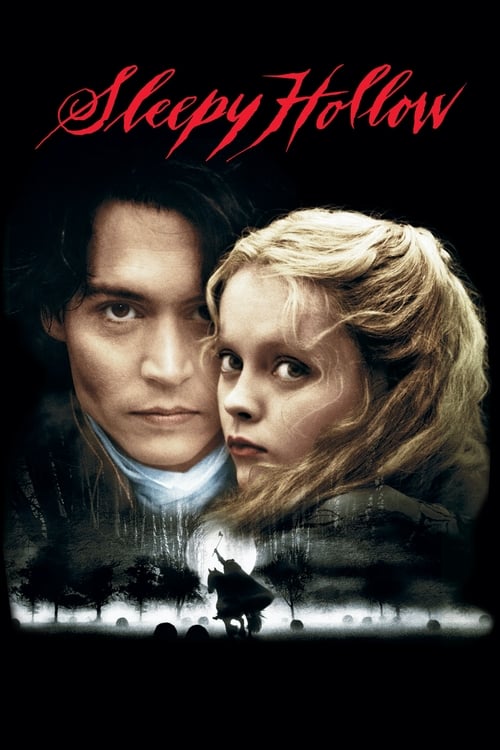
Sleepy Hollow
1999 · Tim Burton
For a foggy October night when you want pumpkins, candlelight, and a good spooky yarn — Halloween comfort viewing with real style, not a film that will genuinely traumatize you.
What it's about
A young New York City constable with newfangled ideas about scientific detection is packed off to a remote Hudson Valley hamlet in 1799 to investigate a string of beheadings. The locals insist the killer is a legendary headless horseman risen from the grave; Ichabod Crane, a nervous rationalist with a case full of strange instruments, sets out to prove them wrong. What he finds in the fog-shrouded woods keeps testing which of them has it right.
The experience
A plush, autumnal gothic that's more macabre fairy tale than straight horror — creepy and atmospheric rather than terrifying, shot through with dry, jumpy humor. It moves like a whodunit, with just enough gore to keep the fireside-legend chill real.
Performances
Johnny Depp plays Crane as a fainting, squeamish detective — a hero who flinches at everything he investigates — and the choice makes the film; Christina Ricci brings a serene, otherworldly calm as the local heiress who becomes his ally.
The craft
This is Tim Burton at his most designed: an entire village and forest built and drained of color until the screen is nearly black-and-white, so every splash of blood lands like a shout. The Oscar-winning art direction, the perpetual fog, and Danny Elfman's swooning score make it one of the great-looking studio gothics — absolutely worth a big screen or the lights off.
Why it matters
It won the Academy Award for Art Direction and cemented the Burton–Depp partnership that defined mainstream gothic fantasy for the following decade, reviving the look of classic British horror for a new audience.
Snapshot
Tim Burton's seventh feature takes Washington Irving's 1820 folk tale and performs a genre transplant on it: the credulous schoolmaster of the original becomes a rationalist New York constable armed with a case of proto-forensic instruments, and the Headless Horseman — a prank in Irving, and probably a hoax — becomes literally, arterially real. The result is a gothic whodunit, a Hammer horror picture crossed with a Conan Doyle deduction plot, shot in a near-monochrome palette where the only saturated color is blood. Released at the tail end of 1999, on the eve of the century its story is also poised against, it won the Academy Award for Art Direction and consolidated the Burton–Johnny Depp partnership as the defining director–star relationship of the era's mainstream fantastic cinema. It is Burton's most designed film, and arguably his most controlled: the loose, sketchbook energy of Beetlejuice or Pee-wee's Big Adventure replaced by an airless, hermetic world built entirely on and around English soundstages.
Industry & production
The project originated not with Burton but with Kevin Yagher, a special makeup effects artist (best known for A Nightmare on Elm Street prosthetics and the Tales from the Crypt Crypt Keeper), who developed it as a relatively contained horror film he intended to direct, from a screenplay by Andrew Kevin Walker. Walker was, at that point, the writer of Se7en (1995), and his draft carried that film's procedural grimness — a detective plot in which bodies accumulate and the investigator's rationalism is progressively assaulted. Creative disagreements ended Yagher's involvement as director; he retains a story credit alongside Walker's screenplay credit. Burton came aboard and the film's scale expanded accordingly, moving from a modest genre piece to a studio production with a full-scale built village.
Financing and distribution ran through Mandalay Pictures with Paramount handling the U.S. release; Scott Rudin and Adam Schroeder produced. Rudin's involvement is worth noting, since he had produced Burton's other literary-adjacent projects of the period and represented a producorial sensibility oriented toward writers and prestige material rather than toward franchise mechanics.
The screenplay was reworked during production; Tom Stoppard is widely reported to have performed an uncredited polish, chiefly on dialogue and on the plot's mystery scaffolding, though the specifics of the credit arbitration are not part of the public record and shouldn't be overstated. What is visible on screen is a script with two competing metabolisms: Walker's serial-killer clockwork, in which each murder advances an investigation, and Burton's fairy-tale symbolism, in which each murder is a tableau.
Production took place almost entirely in England, based at Leavesden Studios, with the village of Sleepy Hollow constructed as a standing exterior set and English country-house locations serving the Van Tassel estate. The decision to shoot a story set in the Hudson Valley entirely in Hertfordshire was aesthetic as much as economic: Burton wanted the enclosed, artificial, weather-controlled world of the British horror studios he had grown up watching, not the actual American landscape. The film is set in 1799 and released in 1999 — a symmetry the ending makes explicit when Crane returns to New York "just in time for the new century."
Technology
Sleepy Hollow sits at a hinge point in effects history and uses both sides of it. The Horseman's headlessness was achieved through a hybrid method: Christopher Walken played the Hessian in the flashbacks with his head intact and filed teeth; for the headless present-tense scenes the rider was performed by stunt and sword specialist Ray Park — the same year he played Darth Maul in The Phantom Menace — with his head and neck covered for digital erasure, the plate work then composited by Industrial Light & Magic. Kevin Yagher, retained as special makeup effects designer, supplied the practical severed heads, prosthetics and gore.
The film also predates the digital intermediate as standard practice; O Brother, Where Art Thou? (2000) is usually cited as the first feature to be fully digitally graded. Sleepy Hollow's celebrated desaturation was therefore not a color-correction decision applied downstream but a production decision executed in front of the lens and in the lab — through the design of the sets and costumes themselves, through filtration, atmospherics and lighting, and through photochemical timing. That distinction matters for the film's texture: the grays are physically present in the frame, in painted wood and dyed cloth and pumped smoke, not extracted from a fuller image afterward.
Technique
Cinematography
Emmanuel Lubezki shot the film, and it is an instructive outlier in his career. The cinematographer later synonymous with available light, wide lenses and unbroken handheld takes (Children of Men, The Tree of Life, Birdman) here produces his most frankly artificial work: heavily diffused, smoke-filled studio light, a palette drained toward silver and slate, and a hard reservation of red for blood and for the Van Tassel interiors' firelight. Skies are perpetually overcast or storm-lit; the Western Woods are lit as a stage set, with visible beams and no pretense of naturalism. The camera is mobile but formal — crane moves that reveal the village as a diorama, low angles that make the Tree of the Dead monumental. Lubezki received an Academy Award nomination for the work. The photography's governing idea is not realism but the look of an old horror film remembered, which is a different thing from the look of an old horror film.
Editing
Chris Lebenzon, Burton's editor since Batman Returns, cuts the decapitations for elision and rhythm rather than dwell: the blade enters frame, the head departs, the body registers the fact a beat later. The film's black comedy lives almost entirely in that beat. Structurally, the editing has a harder job — reconciling a mystery plot that requires exposition (suspects, motives, the Van Garrett inheritance, the Hessian's history) with a horror plot that requires atmosphere. Lebenzon handles it by interleaving Crane's flashbacks to his mother in fragmentary, near-subliminal bursts, so that psychological backstory arrives as intrusion rather than as explanation. The film's most criticized passages are the late-third-act reveals, where the accumulated conspiracy has to be unpacked verbally and the cutting turns dutiful.
Mise-en-scène / staging
This is the film's center of gravity and the reason for its Oscar. Rick Heinrichs — a Burton collaborator going back to the Disney short Vincent (1982) — designed a world of forced perspective, warped verticals, and a limited material vocabulary: dark wood, bone, wet stone, mud. The village is a closed system, geographically legible and psychologically claustrophobic; the Tree of the Dead is a practical set piece designed to bleed. Colleen Atwood's costumes work as chromatic notation rather than period fidelity: Crane in severe black, Katrina in pale near-white, Lady Van Tassel in the deep reds that eventually declare her. Burton stages compositions frontally and symmetrically far more often than in his earlier work, which gives the film its storybook-plate quality — each scene arranged as an illustration.
Sound
The soundscape is built around absence and impact. The Western Woods are unnaturally quiet — the ambient bed thinned out so that hoofbeats, when they arrive, arrive as an event. Danny Elfman's score is among his darkest and least melodic for Burton: a churning, chromatic orchestral texture with wordless choir, more indebted to European horror scoring and to Bernard Herrmann's density than to the whimsical themes of Edward Scissorhands or Batman. Elfman had briefly stepped away from Burton around Ed Wood (scored by Howard Shore); Sleepy Hollow is the fullest statement of their resumed collaboration.
Performance
Depp plays Ichabod Crane against every convention of the action-detective: fastidious, squeamish, prone to fainting, physically recessive. Depp has described wanting a more delicate, even effete reading of the character — an approach reportedly reined in by the production, including a proposal for heavier prosthetic features that was not adopted. The performance is deliberately comic without being camp, and it anchors the film's argument that reason and terror can inhabit the same body. Christina Ricci's Katrina is played straight and slightly opaque, functioning more as gothic emblem than as psychological portrait. Miranda Richardson gives the film's most dynamic performance in a dual role as Lady Van Tassel and the Crone. The supporting bench is a deliberate roll call of British character actors and horror history — Michael Gambon, Richard Griffiths, Ian McDiarmid, Jeffrey Jones, Michael Gough (Burton's Alfred, in one of his last live-action appearances), and, as the Burgomaster, Christopher Lee, whose casting is the film's clearest signature of allegiance. Martin Landau, freshly Oscared for Burton's Ed Wood, appears uncredited as the first victim.
Narrative & dramatic mode
The film's structural gambit is to run a fair-play detective story inside a supernatural frame. Crane arrives with a methodology (observation, dissection, evidence) that the town's murders appear to refute; the film's turn is not that the supernatural is debunked but that it is real and also being manipulated — the Horseman is a genuine revenant and a weapon, wielded by a human conspirator with an ordinary motive of dispossession and inheritance. This lets the mystery resolve without dissolving the horror, and it preserves Crane's rationalism at a reduced altitude: he cannot explain the Horseman, but he can identify who holds the skull.
Braided through this is a trauma narrative delivered in flashback — Crane's mother, a "child of nature," destroyed by his pious father — which supplies the psychological motive for his rejection of superstition. The two lines converge in the film's thesis: dogma kills, and so does the refusal to look.
Where the film is weakest is in its middle-act mechanics. The conspiracy requires a lot of ledger-keeping, and Katrina's arc — suspicion, exoneration, rescue — is thinner than the material around it.
Genre & cycle
Sleepy Hollow is a period gothic horror, but its specific lineage is the studio gothic: Universal's 1930s cycle, Hammer's Technicolor revival under Terence Fisher, Roger Corman's Poe adaptations with Vincent Price, and the Italian gothic of Mario Bava — Black Sunday (1960) in particular, with its misted forest, its witch's revenge, and its fusion of erotic and morbid imagery. The burning windmill climax is a direct citation of Frankenstein (1931). Simultaneously, the film belongs to the late-1990s serial-killer procedural cycle that Walker's Se7en helped define, transposed into knee breeches.
It also sits inside a small revival of literary-source American gothic at the turn of the millennium, and it belongs to Burton's own cycle of films about outsiders whose difference is legible on the body and in the manner.
Authorship & method
Burton's method here is design-first: the world is settled before the story is staged, and the film's meaning is carried by production design at least as much as by script. This is why the credit list matters so much. Heinrichs (production design, with set decorator Peter Young) and Atwood (costume) had both worked with Burton repeatedly; Lebenzon (editor) and Elfman (score) were long-term collaborators; Lubezki was the newcomer, brought in for a single Burton film, and the tension between his instincts and the material's artifice is productive rather than incoherent. Walker supplies the plot engine; Burton supplies the iconography and the tone, and the seams between them are visible.
Burton's authorial signature is legible in the recurring motifs — the pale outsider, the hostile provincial community, the sympathetic monster, the fairy-tale forest, the childhood wound — but Sleepy Hollow differs from his earlier work in its formality. It is the first film in which his gothicism is executed with full studio resources and adult content, and the last in which his design vocabulary feels genuinely discovered rather than repeated.
Movement / national cinema
Nominally an American film about American folklore, Sleepy Hollow is in practice a British studio production made by an American director in homage to British horror. Its craft lineage runs through Bray and Pinewood as much as through Hollywood, and its ancestry in German Expressionism — chiaroscuro, distorted architecture, the mise-en-scène of dread — arrives secondhand through the Universal cycle that Expressionist émigrés helped create. That triangulation (American folklore, British craft, German visual grammar, Italian gothic color logic) is the film's real national position.
Era / period
The film is doubly period-conscious: it depicts the last months of the eighteenth century and was released in the last months of the twentieth. Its 1799 is the historical moment when Enlightenment method met a countryside still governed by omen, and the film stages that collision without simply awarding the argument to reason. Released in November 1999, it also arrives at the precise industrial moment when practical horror craft and digital compositing could be combined at high budget without the digital dominating — a window that closed quickly in the following decade.
Themes
The film's central opposition is reason against superstition, but it declines the usual resolution. Crane's instruments are not vindicated and not humiliated; they are shown to be insufficient rather than wrong. Against this runs a sustained critique of religious cruelty: Crane's father, the pious torturer, is the film's true monster, and the Reverend Steenwyck's congregation is complicit in the town's rot. Property and inheritance supply the mundane engine — the Van Garrett will, dispossession, illegitimacy — so that the supernatural turns out to be in service of the most ordinary human motive.
Beneath these sits Burton's persistent concern with the body: heads separated from bodies, the head as the seat of reason and the body as the seat of appetite, and a Horseman who is pure severed drive. The Tree of the Dead — a wound in the world through which the buried returns — is the image that ties the trauma plot, the property plot and the horror plot together.
Reception, canon & influence
Reception. Critical response was broadly favorable, with near-unanimous praise for the film's design, atmosphere and photography, and recurring reservations about emotional coolness and third-act exposition — the familiar charge that Burton's worlds outpace his stories. It performed strongly at the box office, especially internationally, and confirmed that Burton could carry an R-rated horror film commercially. The industry verdict was decisive in craft categories: an Academy Award for Art Direction (Heinrichs and Young), with nominations for Lubezki's cinematography and Atwood's costumes, and comparable recognition in the design categories at the BAFTAs. It has since settled into a stable position as one of the two or three Burton films most often defended by people who are otherwise skeptical of Burton.
Influences on the film (backward). Irving's 1820 tale supplies the names, the geography and the Horseman; almost everything else is imported. Hammer's Fisher-era gothic supplies the color logic, the fog, the village-versus-monster structure and, via Christopher Lee, the direct genealogical claim. Bava's Black Sunday supplies the witch-revenge armature and the dead-forest imagery. Universal's Frankenstein supplies the windmill. Corman's Poe films supply the interior gothic and the trauma-flashback grammar. Walker's Se7en supplies the forensic procedural spine. Disney's 1949 The Adventures of Ichabod and Mr. Toad is the version of the story most American viewers actually carried into the theater, and Burton's film plays against its comic register throughout.
Legacy (forward). Three lines run outward. First, the visual: the film's desaturated period gothic — gray-on-gray with red accents, built rather than located — became a widely copied register for early-2000s studio genre filmmaking, visible in From Hell (2001) and its descendants, and in Burton's own later Sweeney Todd: The Demon Barber of Fleet Street (2007), which is essentially this film's palette applied to a musical. Second, the partnership: as the third Burton–Depp collaboration after Edward Scissorhands and Ed Wood, it established Depp's mannered, research-driven, comically fragile leading-man mode as a bankable proposition, with consequences that ran through Charlie and the Chocolate Factory, Sweeney Todd, Alice in Wonderland and Dark Shadows. Third, the property: the film reintroduced the Horseman as a viable horror franchise figure for a modern audience, a re-legitimation that is part of the background to later adaptations, including Fox's Sleepy Hollow television series (2013–2017), though that show draws its premise more directly from Irving than from Burton.
Its most durable technical legacy may be the least conspicuous: it is one of the last major gothic horror films whose look was authored on set and in the lab rather than in a grading suite, and it is frequently cited on that basis in discussions of what the digital intermediate gained and cost.
A Deleuzian reading
The blade comes into frame.
The full Deleuzian reading of Sleepy Hollow →
Reception
A solid hit with decent-but-mixed reviews in 1999 (praised look, shrugged-at script), it's since climbed into 'actually one of Burton's best' territory — now routinely cited as the last film of his great run before the remake era.
How Sleepy Hollow was received, from release to now →
How to watch Sleepy Hollow: what to notice on a first viewing
- Count how many things in the frame have any real color. Lubezki drains almost everything toward silver and slate with diffusion and pumped smoke. Red is held back for blood and for firelight in the Van Tassel house. Atwood dresses Crane in black and Katrina in near-white. Restriction turns red into an event rather than a color. When it arrives, the film's own rules have been broken.
- Watch the body for a second after the head is gone. Lebenzon cuts every beheading the same way. The blade enters frame, the head departs, and then the body stands there for a beat before it registers what happened. That delay is where the film keeps its comedy. The film never dwells on the wound. Burton gets his horror and his joke out of timing rather than out of showing you more.
- Listen to how little you hear in the Western Woods. The ambient bed is thinned almost to nothing. No birds, barely any wind. So hoofbeats arrive as an event, from a direction the map of the village does not contain. Elfman's score churns underneath with a wordless choir. Silence gives the woods a beyond. Something can come from outside the world the film has shown you.
- Look at how often a shot is arranged flat and symmetrical. Heinrichs built the village with forced perspective and warped verticals from dark wood, bone, wet stone, and mud. Burton frames it head-on and centered, and the crane moves present the whole place like a diorama. Each scene is arranged as an illustration. You are looking at a storybook plate, and the film never pretends otherwise.
- Watch Crane faint, flinch, and hide behind his instruments. Depp plays the detective as fastidious, squeamish, and physically useless. He brings lenses and calipers to a place that keeps producing bodies. The comedy is dry rather than camp, and he never grows out of the squeamishness. Burton casts the investigator as a bad body with a good method. Reason and terror end up sharing one nervous system.
The whole guide to watching Sleepy Hollow, with the keys for a rewatch →
Influences: the films it descends from and the films it influenced
- Frankenstein (1931) — Supplies the burning-windmill climax wholesale — a studio-built rickety timber structure lit as a single vertical set-piece, with the torch-bearing villager mob staged as frontal advancing ranks that Burton restages almost shot-for-shot.
- Vampyr (1932) — Rudolph Maté's trick of shooting through gauze to bleed a milky haze into every exterior is the direct precedent for Lubezki's diffused, contrast-flattened fog, and Dreyer's near-silent, ambient-thinned soundtrack prefigures the film's drained sound beds where footfalls and hoofbeats arrive against nothing.
- The Adventures of Ichabod and Mr. Toad (1949) — Fixes the Horseman's pop-iconography — black silhouette on a black horse, sword raised, flaming pumpkin hurled at the fleeing rider — and the chase-through-the-hollow geography of covered bridge as sanctuary line, which Burton quotes while inverting its comic register into procedural horror.
- Night of the Demon (1957) — Establishes the debunking-rationalist protagonist as a horror engine: a credentialed skeptic with instruments and case files whose method is systematically destroyed by the phenomenon he came to disprove, which is exactly Ichabod's arc from measuring devices to belief.
- Dracula (1958) — Hammer's color logic via Jack Asher — a muted green-grey-brown ground reserved so that arterial red reads as the only saturated event in frame — plus Fisher's frontal proscenium staging of the monster's entrance and the village-versus-monster structure; Christopher Lee's casting makes the debt a signed genealogical claim.
- Black Sunday (1960) — Donates the armature outright: an executed witch's curse working through a bloodline into the present, plus Bava's dead-forest imagery of bare clawing branches in rolling ground fog and his crypt lighting built from hard low sources — Burton translates the monochrome into desaturation rather than abandoning it.
- The Pit and the Pendulum (1961) — Corman and Floyd Crosby's trauma-flashback grammar — childhood memory delivered in fragmentary, chromatically distorted inserts with warped lenses and gelled color, withheld and repeated until complete — is the template for Ichabod's mother-and-iron-maiden flashbacks, along with the wholly interior, built-not-located gothic.
- The Innocents (1961) — Freddie Francis's practice of masking frame edges with black filters and lighting candle-scale interiors for deep focus, so figures sit inside pools of darkness that eat the widescreen corners, is the photographic method Lubezki adapts for Van Tassel interiors and the church.
- Edward Scissorhands (1990) — Sets the working method reused here — Elfman's wordless children's-choir-and-celesta ostinato as the pale outsider's leitmotif, Atwood dressing the community in coded blocks of color against a monochrome protagonist, and Depp as a physically constrained, near-mute fragile figure.
- Bram Stoker's Dracula (1992) — The immediate precedent for authoring a gothic entirely in-camera and in the lab — forced-perspective sets, in-camera mattes, reverse-motion and optical trickery instead of digital compositing — with Eiko Ishioka's costumes carrying narrative information through color the way Atwood's do here.
- Forrest Gump (1994) — ILM's rotoscoped erasure of Gary Sinise's legs — a live performer shot in a keyable covering, then subtracted while the surrounding practical world is untouched — is the exact technique behind the Horseman: an actor performing in a blue hood so the head can be removed without disturbing the practical costume, blood and horse.
- Se7en (1995) — Andrew Kevin Walker's own forensic spine transplanted intact — the detective who works from autopsy findings, evidence catalogs and pattern-reading through a series of escalating corpses, in a rain-and-dark city drained to near-monochrome — grafted onto Irving's folktale as the film's plot engine.
- From Hell (2001) — Takes the whole package forward: Peter Deming shooting a wholly built period London in gray-on-gray with red accents, Depp as a fragile investigator whose opium visions arrive as fragmentary chromatic flashback inserts, and a forensic procedural that resolves into an establishment conspiracy.
- The Village (2004) — Builds its entire design system on chromatic costume coding as plot mechanism — the safe color versus the bad color enforced across every garment — and reveals its woods-monster as a costume operated by the elders to control the settlement, the same manufactured-supernatural reveal delivered through production design.
- Sweeney Todd: The Demon Barber of Fleet Street (2007) — Essentially this film's palette applied to a musical: Dariusz Wolski pushes the desaturation to near-monochrome so that practical arterial throat-cut gore is the only saturated element, with Depp again playing a mannered, research-built revenant figure over an Elfman-arranged score.
- The Wolfman (2010) — The clearest inheritor of the studio-gothic revival formula — a built English village and manor, Rick Baker's practical prosthetic transformations and dismemberment gore extended by digital assist, an Elfman score, and a rationalist Scotland Yard inspector inserted as procedural counterweight to the monster.
- Crimson Peak (2015) — Extends the design-first gothic to its limit — a fully built house shot by Dan Laustsen in bruised desaturated tones with costume color assigned per character as characterization — and keeps the practical-performer-plus-digital-erasure approach to its ghosts while the actual villainy turns out to be a human murder plot the haunting is testifying against.
- Miss Peregrine's Home for Peculiar Children (2016) — Burton's desaturated controlled palette and gothic tableau framing, again with Atwood, are the compositional template Delbonnel refines here.
- Brotherhood of the Wolf (2001) — Runs the same rationalist-naturalist-arrives-in-a-hostile-village structure with an on-screen autopsy as investigative centerpiece, and resolves its beast as a manufactured instrument of a human conspiracy — the supernatural-manipulated turn — in a built provincial France of fog and desaturated interiors.
- Fear Street: 1666 (2021) — Colonial-American gothic that unpacks a present-day curse through a flashback witch origin — the withheld-revelation, exoneration-of-the-accused-witch structure 1666 formalizes.
- Dracula (2025) — Elfman-scored, artificially heightened period gothic where digital/optical atmosphere manufactures a stylized historical world — the same fusion of Elfman tone and constructed period image.
Similar films
- Edward Scissorhands (1990) — influence & lineage
- Sweeney Todd: The Demon Barber of Fleet Street (2007) — influence & lineage
- Vampyr (1932) — influence & lineage
- Bram Stoker's Dracula (1992) — influence & lineage
- Frankenstein (1931) — influence & lineage
- The Innocents (1961) — influence & lineage
- Crimson Peak (2015) — influence & lineage
- Night of the Demon (1957) — influence & lineage