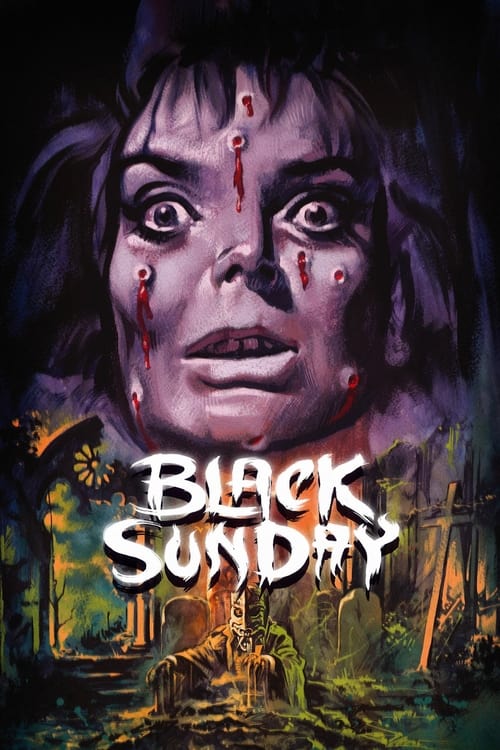
Black Sunday
1960 · Mario Bava
A vengeful witch, Asa Vajda, and her fiendish servant, Igor Jauvitch, return from the grave and begin a bloody campaign to possess the body of the witch's beautiful look-alike descendant: Katia. Only a handsome doctor with the help of family members stand in her way.
Snapshot
La maschera del demonio (Italy, 1960), released in English-speaking markets as Black Sunday and in Britain eventually as Revenge of the Vampire, was Mario Bava's first officially credited feature as director. It is one of the founding texts of Italian Gothic horror. The film opens in seventeenth-century Moldavia with the execution of the witch Asa Vajda (Barbara Steele). A spiked bronze mask is hammered onto her face, and before she dies she curses the descendants of her brother. Two centuries later, two travelling physicians, Dr. Thomas Kruvajan (Andrea Checchi) and his younger colleague Dr. Andrej Gorobec (John Richardson), stumble into her crypt. Kruvajan's spilled blood begins her resurrection. Asa then sets out to take over the body of her identical descendant, Princess Katia (also Steele).
The plot is conventional, but the film's style is not. Bava shot it in black and white, and its deep-focus compositions, mobile camera, fog-filled sets and frank violence made it a landmark of the form. It also made Barbara Steele the defining face of 1960s European horror. Through its American release by American International Pictures (AIP), it became one of the most widely seen Italian horror films of its time.
Industry & production
The film came out of Italy's popular genre industry at the end of the 1950s. Studios and small production companies were then feeding a booming domestic market and an export market for adventure, peplum (sword-and-sandal) and, briefly, horror films. Italian horror had an uncertain commercial history before this. Riccardo Freda's I Vampiri (1957), generally cited as the first Italian sound-era horror film, did poorly at the domestic box office. Bava had photographed that film and finished directing it after Freda left the production. He did the same on Freda's science-fiction horror Caltiki – il mostro immortale (1959). Those uncredited rescues, together with his work completing La battaglia di Maratona (The Giant of Marathon, 1959), are usually cited as what earned him a project of his own from Galatea Film, the Rome company that produced La maschera del demonio.
The international success of Hammer Films' Gothic colour remakes, especially The Curse of Frankenstein (1957) and Dracula (1958), showed that period horror could be exported. Italian producers saw a market they could serve cheaply. The film was made on a modest budget, largely on studio sets and in Roman-area locations. The specific figure is not reliably documented in the standard sources.
AIP bought the film for North American distribution. The company retitled it Black Sunday, re-dubbed it with a new English script, trimmed several of the more violent moments, and replaced Roberto Nicolosi's score with a new one by Les Baxter. Released in the United States in early 1961, it did well for AIP. This encouraged the company's continued use of European horror and its Gothic cycle with Roger Corman, which Steele joined that year in The Pit and the Pendulum.
In Britain the British Board of Film Censors refused the film a certificate. It was not released there until 1968, in a cut version titled Revenge of the Vampire. The ban helped give the film its reputation as unusually strong material.
Technology
Bava chose black-and-white 35mm at the moment when colour was becoming the norm for Gothic horror, largely because of Hammer. The choice was partly about cost. It was also aesthetic, and it served the film's lineage in German Expressionism and Universal horror. Bava's background shaped the technical approach. He was the son of Eugenio Bava, a sculptor turned cameraman and special-effects technician of the silent era. Mario had worked for years as a director of photography and effects specialist known for solving production problems in camera with miniatures, glass shots, forced perspective and optical tricks.
The film relies on practical and in-camera effects rather than laboratory optical work. Examples include Asa's ruined face slowly regaining its eyes, the wound pattern left by the mask's spikes, and the final reveal of the witch's decayed body beneath her robe. Bava had used a well-known technique on I Vampiri: makeup visible under one coloured filter and invisible under another, so a face could age on camera without a cut. Some accounts suggest related methods were used here. The exact technical breakdown of individual shots in La maschera del demonio is not documented in detail, and claims about specific shots should be treated cautiously.
The ghostly carriage that carries the revived Javutich is shot in slow motion. This simple camera-speed effect is one of the film's most imitated images.
Technique
Cinematography
Bava photographed the film himself, with Ubaldo Terzano as camera operator. The images are built on deep shadow, raking side light and a grey scale full of fog, torchlight and candle glow. Many lighting set-ups pick out faces against near-total darkness, so that heads and hands seem to float. The camera moves a great deal for a low-budget film of its era. Slow tracking shots and dollies through the crypt, the castle corridors and the ruined chapel create a constant sense of being drawn forward into space. The crypt sequence is often singled out: the camera explores the tomb, the glass-fronted sarcophagus and the cracked crucifix while the effects work exposes Asa's mask-scarred face.
Bava's eye for composition shows in his frames within frames, his low-angle views of looming architecture and his habit of staging menace in the deep background of a shot while foreground figures remain unaware. Critics often use the word "painterly" for the film's images. That is apt, since Bava had trained in painting before turning to cinema.
Editing
Mario Serandrei edited the film and also has a co-writing credit. He was a senior figure in Italian cinema and long associated with Luchino Visconti. The film's pacing contrasts patient, atmospheric passages with sudden shocks: the hammer blow on the mask, the burning of a body, a face suddenly appearing in a doorway. Cutting is used to build suspense around off-screen space. Characters turn toward sounds and doors, and the cut sometimes withholds the threat and sometimes delivers it abruptly. The prologue is a compact, violent set-piece that sets the film's tone before the main narrative begins. The AIP release made a number of trims, so the film's rhythm differs slightly between the Italian and American versions.
Mise-en-scène / staging
The settings are the Gothic genre's standard places: a crypt, a ruined chapel, a castle with secret passages, a portrait gallery, a desolate countryside of dead trees and mist. Bava turns them into a coherent visual world. Studio sets are dressed with cobwebs, decaying stone and statuary, and fog machines blur the line between interior and exterior.
The portrait of Asa that hangs in the Vajda castle sets up the film's motif of doubling. Its presence also anticipates the gallery-and-painting imagery of later Italian Gothics. Staging regularly places characters at the edge of darkness. One recurring device is a figure emerging slowly from shadow into a pool of light.
The film's violence was strong by the standards of its day. The mask is hammered home in close-up. A spike-wound face is shown in detail. Javutich bursts from his grave, and a body is consumed by fire. That violence goes a long way toward explaining its censorship history.
Sound
The Italian version uses a score by Roberto Nicolosi. For AIP's American release Les Baxter wrote a new score, which many American viewers knew for decades as the film's music. The two scores create different atmospheres, and there is ongoing debate among enthusiasts about their merits. Most current scholarship prefers the Italian version as closer to Bava's intentions, though both are part of the film's history.
As was usual in Italian production of the time, the dialogue was post-synchronized. The American dub was a separate English-language track with its own script. Sound effects carry a large share of the dread: howling wind, creaking wood, hoofbeats, bells. The silent slow-motion carriage stands out precisely because it is quiet.
Performance
Barbara Steele's dual role is the film's centre. As Asa she is commanding and malevolent. In the prologue her curse is delivered through a defiant stare. In the crypt, Bava's camera turns her damaged, returning face into the film's chief source of horror. As Katia she plays a pale, anxious heroine. Steele was a British actress who had been under contract to the Rank Organisation and had worked briefly in Hollywood. Her large eyes, sharp cheekbones and slightly uncanny poise suited Bava's lighting closely, and critics have long noted that the film's visual identity is bound up with her face.
The supporting players work in a more conventional register:
- John Richardson plays the stalwart young physician.
- Andrea Checchi is the older doctor who becomes Asa's victim and servant.
- Ivo Garrani plays Prince Vajda, Katia's terrified father.
- Arturo Dominici plays Javutich, Asa's lover and accomplice, whose mud-covered rising from the grave is a highlight.
- Enrico Olivieri plays Katia's brother Constantine.
Because the dialogue was dubbed, the vocal performances in any given version reflect the dubbing process as much as the actors' work on set.
Narrative & dramatic mode
The film's source is a loose debt to Nikolai Gogol's story Viy (1835). The credits acknowledge it, but the plot takes little beyond a witch, a vampiric revenant and a rural Slavic setting. The screenplay is credited to Ennio De Concini and Mario Serandrei, with contributions from Bava and others. It shapes the material into a classic Gothic melodrama: an ancestral curse, a castle family under siege, an innocent heroine threatened with replacement by her evil double, a rational hero who must accept the supernatural, and a climax that ends the curse through fire and the crucifix.
The dramatic mode is operatic rather than psychological. Characters are largely types, and the emotional pull comes from atmosphere, set-pieces and the uncanny doubling of Asa and Katia, not from interior conflict. The film moves through a series of visits, each structured as a scene of discovery or attack. Night follows night as the threat closes in on the castle. The ending plays out the film's central dualism: the hero must tell the real Katia from the false one and see through appearance to the corruption beneath.
Genre & cycle
Black Sunday is a Gothic horror film. It combines witchcraft, vampirism (Asa and Javutich feed on blood and take their victims' life-force), and revenant and possession motifs. It sits at the start of what historians call the Italian Gothic cycle, a burst of black-and-white and colour period horror between roughly 1960 and the late 1960s. The cycle includes:
- Riccardo Freda's L'orribile segreto del Dr. Hichcock (1962) and Lo spettro (1963)
- Antonio Margheriti's Danza macabra (Castle of Blood, 1964)
- Bava's own I tre volti della paura (Black Sabbath, 1963), La frusta e il corpo (The Whip and the Body, 1963) and Operazione paura (Kill, Baby… Kill!, 1966)
Steele went on to star in several of these films. Her presence became a kind of trademark of the cycle.
Internationally, the film belongs to the post-Hammer revival of period horror. That revival spread from Britain to Italy, Spain and the United States, where AIP and Corman's Poe adaptations took up the same territory.
Authorship & method
Mario Bava (1914–1980) came to directing late, after a long career as a cinematographer and effects technician. That background is the key to his authorship. He thought in images and saw the camera as a way to create illusion, and his solutions to low-budget limitations became a personal style. On Black Sunday he was director, cinematographer and co-writer, and he largely supervised the effects. That concentration of roles was unusual even in Italian genre production. It explains why the film's look is so unified, and it ties its expressive choices closely to his hand.
Key collaborators:
- Ubaldo Terzano, camera operator, who continued working with Bava.
- Mario Serandrei, editor and co-writer, whose prestige background in art cinema lent the production experience.
- Ennio De Concini, co-writer, one of the most prolific Italian screenwriters of the era. He worked across genres and later shared an Oscar for Divorzio all'italiana (Divorce Italian Style, 1961).
- Roberto Nicolosi, composer of the original Italian score. Les Baxter wrote the replacement score for AIP.
Bava's later career moved through colour Gothic, peplum, spy spoof and, most influentially, the giallo. He did not regard his own films with great seriousness in interviews. Tim Lucas's study Mario Bava: All the Colors of the Dark (2007) is the most thorough account of his career and an essential source for the film's production history.
Movement / national cinema
The film belongs to Italian popular cinema, the filone tradition in which successful models are quickly imitated in cycles. It is not part of a self-declared artistic movement. Like other Italian genre films aimed at export, it disguises its national origins. The setting is an imagined Eastern Europe, and some crew members took English-sounding pseudonyms in certain credits. The cast mixed Italian and foreign actors with export markets in mind.
The film also marks the point at which Italian popular cinema produced an internationally recognised horror style. That tradition later ran through the giallo of the 1970s and the work of Dario Argento, Lucio Fulci and others. Italian criticism at the time largely ignored or dismissed the cycle. Its critical reputation in Italy grew later, partly through recognition first won abroad, especially in France, Britain and the United States.
Era / period
Black Sunday was released in 1960, the same year as Psycho and Peeping Tom. That year is often taken as a turning point toward more explicit and more psychologically unsettling horror. Bava's film works in a period setting and a supernatural mode. Its graphic violence and its open sexual charge, centred on Steele's double role as virtuous maiden and vampiric seductress, place it within the same loosening of limits.
The era's censorship regimes shaped how it reached audiences. The British ban, the American trims, and the more open showing of violence in continental European markets all affected which version people saw. In Italy, 1960 was also the year of La dolce vita and L'avventura. The country's art cinema was at a high point, while its genre industry turned out cheap films in high volume. Bava's film shows how much craft that genre economy could hold.
Themes
- Doubling and identity. Asa and Katia are played by the same actress and linked by blood and likeness. This dramatises the fear that the self can be taken over and replaced. The portrait in the castle and the climactic test of telling Katia from Asa make the theme concrete.
- The return of the repressed past. Asa's curse falls on the Vajda descendants. The film imagines history as an ancestral crime and punishment that rises from the crypt to reclaim the present. In this regard the film shows clear Gothic heritage.
- Female power and its punishment. The film opens with a woman tortured and executed by Church and family, and it gives her a terrible vengeance. Feminist and genre critics have read Asa as a figure in whom the period's anxieties about female sexuality and authority are both demonised and given dark glamour. Many readings note that the film offers its audience pleasure in Asa's power even as the plot contains it.
- Reason against superstition. The two physicians represent scientific reason. Kruvajan's scepticism leads to his downfall, and Gorobec must accept the reality of evil to save Katia.
- Faith and the sacred. The crucifix, the cross on the tomb and the priest's knowledge are what finally defeat Asa. The film gives Catholic iconography its traditional protective power while presenting the Church's past violence with unsettling cruelty.
- Beauty and decay. The final reveal of Asa's rotted body beneath her youthful face summarises the film's fascination with corruption under surfaces.
Reception, canon & influence
Critical reception. Mainstream critics of the early 1960s mostly treated the film as an exploitation picture, though some noted its visual skill. Its reputation rose steadily through the following decades. French critics associated with the fantastique press were early advocates, and later English-language genre criticism, including writers associated with Video Watchdog (edited by Tim Lucas), established Bava as an auteur. Today Black Sunday regularly appears on critics' and historians' lists of the finest horror films. It is widely treated as the most important single work of the Italian Gothic and as one of the great black-and-white horror films.
Influences on the film.
- Universal horror of the 1930s, especially Dracula and Frankenstein, for the atmosphere of castle and crypt.
- *German Expressionism and Carl Theodor Dreyer's Vampyr (1932)* for chiaroscuro and dreamlike menace.
- Hammer's Gothic films, which showed that period horror could succeed commercially and in export.
- *Gogol's Viy*** as the nominal literary source.
- *Freda's I Vampiri and Caltiki***, on which Bava developed his effects techniques and his visual approach to horror.
Legacy and what it shaped.
- Barbara Steele's career. The film made her an icon. She went on to Corman's The Pit and the Pendulum (1961), Freda's L'orribile segreto del Dr. Hichcock and Lo spettro, and Margheriti's Danza macabra, and she remains the emblematic star of the European Gothic.
- The Italian horror tradition. The film opened the Italian Gothic cycle and led to Bava's later horror films, including Black Sabbath, The Whip and the Body, Kill, Baby… Kill! and Lisa and the Devil (1973). Through Bava's giallo work, especially Sei donne per l'assassino (Blood and Black Lace, 1964), it is a forerunner of Argento and later Italian horror.
- AIP's Gothic cycle. Its American success encouraged AIP's Corman–Poe films and their European imports.
- Later filmmakers. Directors including Martin Scorsese and Tim Burton have cited Bava's influence. Sleepy Hollow (1999) in particular is widely discussed as drawing on the Bava Gothic look. Its images of the mask, the crypt and the slow-motion carriage have been widely quoted.
The film's restoration history, with competing Italian and AIP versions and their different scores and dubs, has itself become part of how it is studied and collected. Its position at the head of the Italian Gothic is secure.
Influences: the films it descends from and the films it influenced
- Dracula (1958) — Bava pushed into the space Hammer opened for X-certificate graphic horror. The spiked-mask prologue and the in-camera reveals of decay and rot are Italian answers to Hammer's on-screen bodily violence.
- Pan's Labyrinth (2006) — Baroque gothic chiaroscuro and macabre practical makeup (the masked, mutilated face) that feed directly into the Pale Man's tactile, lit-from-within horror grotesque.
- Crimson Peak (2015) — Del Toro's cited touchstone: the craning, gliding camera prowling cobwebbed Gothic interiors in high-contrast monochrome that Crimson Peak restages in color.
- Silent Hill (2006) — The prologue execution of a woman by a masked tribunal, shot in near-monochrome fog with an iron mask driven onto the face, supplies both the burning-of-Alessa flashback structure and the visual logic of a mask as instrument of sacralised punishment.
- Sleepy Hollow (1999) — Donates the armature outright: an executed witch's curse working through a bloodline into the present, plus Bava's dead-forest imagery of bare clawing branches in rolling ground fog and his crypt lighting built from hard low sources — Burton translates the monochrome into desaturation rather than abandoning it.
- Valerie and Her Week of Wonders (1970) — Bava's hand-mixed in-frame diffusion — fog, gauze, wind-driven veils and mist raked by hard sidelight — married to a single actress doubled as maiden and crone, the exact apparatus behind Valerie's grandmother/Elsa transfigurations.
- Blood and Black Lace (1964) — Bava's own studio-gothic toolkit — the mask nailed onto a face as the founding image, in-camera fog and glass-shot trickery, wheeled improvised dollies and pull-focus staging worked out on a chamber budget — is exactly what he recolours here, swapping monochrome chiaroscuro for unmixed Eastmancolor gels.
- Castle Freak (1996) — Bava's Italian Gothic set the language of crypt-to-hall castle geography lit with isolated pools of light in surrounding blackness, which Mario Vulpiani carries into a real Umbrian castle.
- Black Sabbath (1963) — Bava worked out his Gothic vocabulary here in black and white (crypts, slow tracking through cobwebbed sets, a vampiric revenant), along with Nicolosi's score and Les Baxter's AIP rescore, and Black Sabbath carries all of it into colour.
- The House by the Cemetery (1981) — Bava's Gothic of crypts and revenants lingers in close-up on rotted, punctured faces. Fulci inherits that slow, intimate camera on the decayed body in Freudstein's cellar reveal.
- The Lords of Salem (2013) — Bava opens with a witch's execution and her curse on her executioners' descendants, and Lords copies that structure, with the vengeance falling on Heidi as Hathorne's heir.