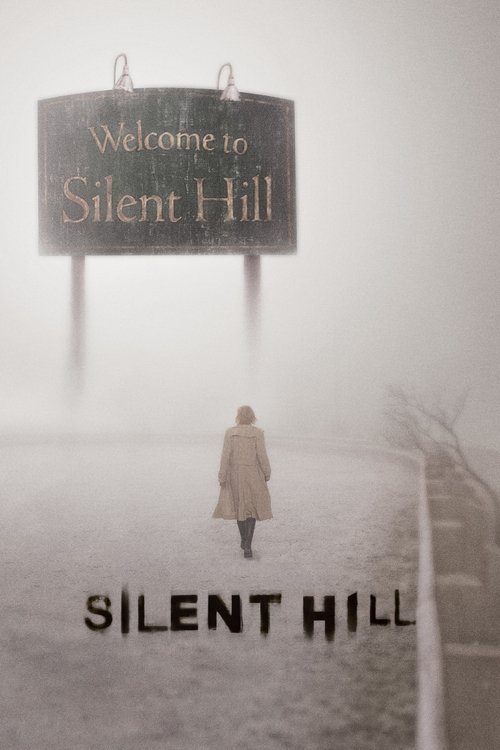
Silent Hill
2006 · Christophe Gans
For when you want horror as atmosphere — to be swallowed by fog, ash, and wrongness rather than startled. A challenge, not comfort viewing; save it for a night you want to feel genuinely unsettled.
What it's about
A desperate mother drives her adopted daughter to Silent Hill, the abandoned town the girl names in her sleepwalking nightmares, hoping to find answers. After a crash on the road in, she wakes to an empty car and a town smothered in fog and falling ash — and every time a siren sounds, the streets peel away into something far worse. Searching motel, school, hospital, and church for her child, she pieces together the atrocity that destroyed the town thirty years ago.
The experience
A slow, dread-soaked descent rather than a jump-scare machine — long stretches of eerie quiet ruptured by full-blown nightmare when the darkness comes. It's disturbing, visually overwhelming, and lingers like a bad dream.
Performances
Radha Mitchell grounds the nightmare as Rose, playing maternal desperation straight enough to keep the surreal imagery anchored, with Sean Bean and Laurie Holden in support.
The craft
Christophe Gans adapted the video game for its imagery rather than its plot, and it shows: the fog town, the ash, the siren-triggered transformations where walls rust and rot in real time, and the parade of practical-suit monsters make this one of the most visually faithful game adaptations ever mounted. The sound design — that siren, the scraping metal — begs for good speakers and a dark room.
Why it matters
Long cited as the rare video game movie that respects its source, it became a touchstone in the argument over whether games can translate to film and kept the franchise's imagery alive for a generation who never played it.
Snapshot
A woman drives her sleepwalking daughter toward the town the child names in her nightmares, crashes on the road in, and wakes to find the girl gone and the town buried in falling ash. What follows is not a mystery so much as a descent: Rose Da Silva walks through a fog-blanked American coal town in which sirens announce a periodic inversion of reality, and each interior — motel, alley, school, hospital, church — delivers a fragment of an atrocity committed thirty years earlier against a child.
Silent Hill is the rare video game adaptation made by a director whose interest was the source's visual grammar rather than its plot beats. Christophe Gans, a former French genre critic who had broken through internationally with Le Pacte des loups (Brotherhood of the Wolf, 2001), assembled a transnational production — French money and French producer, Canadian locations and crew, Japanese intellectual property and composer, American studio distribution — in order to reconstruct on film an aesthetic that had been invented on a PlayStation. The result is a film with a widely acknowledged split: an atmosphere and production design that critics conceded were extraordinary, wired to a screenplay whose final act stops the picture dead to explain itself, and to an invented parallel storyline that most reviewers judged a dilution. It was commercially successful and critically dismissed on release, and it has since drifted upward in estimation to occupy a durable position as the film that proved a game adaptation could be an act of formal translation.
Industry & production
The controlling industrial figure is Samuel Hadida, the French producer and distributor whose Davis-Films and Metropolitan Filmexport had built a business on exactly this configuration: European financing directed at English-language genre pictures with pre-existing brand recognition, shot in Canada for tax efficiency, and placed with an American major for domestic release. Hadida's parallel achievement of the same period was the Resident Evil series with Paul W. S. Anderson; Silent Hill is that model applied to Konami's more prestigious, less action-shaped horror property. TriStar and Sony handled North America. The picture was shot in Ontario, with the derelict downtown core of Brantford standing in for the town — a real municipal ruin, awaiting demolition, dressed and partially destroyed for the film — and studio work completed in the Toronto area.
Konami's cooperation was unusually close for a game license of the era, and by the accounts that circulated at the time Gans secured the rights by campaigning for them directly, presenting the company with a demonstration of his intended approach rather than a conventional pitch. Whatever the exact mechanics, the outcome is visible on screen: the film has access to the games' art direction and to Akira Yamaoka's existing music, and uses both.
The screenplay went to Roger Avary, who had shared the Academy Award for Best Original Screenplay for Pulp Fiction (1994) and directed Killing Zoe and The Rules of Attraction. Avary and Gans made two decisions that determined the film's reception. The first was to change the game's searching parent from a father (Harry Mason, looking for his daughter Cheryl) to a mother, and to build the film around women almost exclusively — protagonist, deputy, cult leader, failed mother, victim. The second was forced on them: a parallel investigation in the ordinary daylight world, in which the husband, Christopher, searches for his wife and child. It has been widely reported, and Gans has said as much in interviews, that this track was added at the producers' insistence, on the grounds that a mainstream horror release could not proceed with a cast essentially devoid of men. The film's most common critical complaint is therefore aimed at its least authored element.
One further industrial note deserves recording. The church climax — a flaying, and a mass evisceration by animate barbed wire — is severe by the standards of studio-distributed horror at any budget level. Silent Hill arrived in April 2006 at the leading edge of the American gore cycle that Saw (2004) and Hostel (2005) had opened, and before the backlash against it hardened. It reportedly opened at the top of the North American box office; the specific grosses I will not supply, but the picture performed well enough that a sequel remained live in development for years.
Technology
The single most interesting technological fact about Silent Hill is that its defining visual element began as a workaround. The 1999 game's dense fog existed because the original PlayStation could not render distance: the fog masked geometry popping into view, converting a hardware limitation into an aesthetic signature so distinctive that it became the franchise's identity. Gans's film reverses the direction of that invention. It reconstructs, with real atmospheric smoke, real particulate ash, and physical sets, an appearance that had originated as a digital compromise — an analog reconstruction of a machine's inability to see far.
Technically the film is a 35mm widescreen production, commonly listed at 2.35:1, finished through a digital intermediate. The DI matters here more than in most horror of the period: the picture's near-monochrome daylight, its bleached ash-greys, and the abrupt shift to sulphurous orange and rust in the Otherworld are grade-dependent, and 2006 is precisely the moment at which shot-by-shot color manipulation became a routine authorial instrument rather than a laboratory negotiation.
Against that, the creature work is emphatically pre-digital in method. Patrick Tatopoulos supervised creature design, and the principal figures — the towering Red Pyramid with its dragged blade, the faceless twitching nurses, the burnt child-things in the alley — are prosthetic and performer-based, with digital augmentation used to extend rather than to replace. This is the main reason the film's monsters have aged as well as they have. The Otherworld transitions are the one place where compositing carries the load: decay travels across a standing set, rust blooming and plaster peeling within a continuous shot, so the transformation is a change in the world rather than a cut to another one.
Technique
Cinematography
Dan Laustsen, the Danish cinematographer who had shot Brotherhood of the Wolf for Gans and Mimic for Guillermo del Toro, and who would later photograph Crimson Peak, The Shape of Water, and Nightmare Alley, treats the fog as an instrument rather than an obstacle. Scattering medium in the air means hard backlight becomes visible as beam and volume; it means a flashlight is a solid object; it means depth can be built out of successive planes of gray rather than out of color or focus. Daylight in the town is flat, sourceless, and drained to near-monochrome. The Otherworld is the opposite regime: total black, punctuated by single-source firelight, strobe, and a rust-orange cast that reads as heat.
The film's most consequential formal decision belongs to camera movement. Gans and Laustsen repeatedly place the camera behind Rose, trailing her at shoulder height as she advances down corridors and alleys — a Steadicam translation of the third-person survival-horror camera, the floating following view through which a player experiences these games. Corridors are entered rather than surveyed; the frame withholds what is around the corner because the camera occupies the position of an accompanying presence rather than an omniscient one. Set against this are recurrent overhead and high-wide compositions of the town under ash, which restore the map view the player also has. The two camera positions between them constitute an argument about what it feels like to play, not merely about what the game looks like.
Editing
Sébastien Prangère, Gans's regular editor since Crying Freeman, cuts the film in long exploratory passages broken by short violent bursts — a rhythm closer to a walking simulator than to a thriller. Passages of traversal are allowed to run without incident, which is where the film's dread accumulates; the attacks, when they come, are cut fast and close, occasionally to near-illegibility. The Otherworld shifts are deliberately not cuts, and the film's refusal to edit its central transformation is a statement of method.
The climax is the film's one sustained exercise in montage in the Italian manner: the church massacre is intercut, accelerating, with the mechanism of barbed wire moving through bodies, in a sequence whose aestheticized cruelty owes a clear debt to Argento. The third act's weakness is also editorial in the sense that it is structural — a long expository flashback, narrated over montage, that arrests the film's forward motion in order to make its mythology explicit. What the game distributed across a hundred found documents, the film delivers in one speech.
Mise-en-scène / staging
Carol Spier's production design is the element on which even hostile reviews agreed. Spier had been David Cronenberg's designer through Videodrome, The Fly, Dead Ringers, Crash, and eXistenZ, and she brings to Silent Hill a Cronenbergian literalism about bodies and buildings being made of the same stuff. The Otherworld is corrugated iron, chain-link, rust, and wet organic matter, derived faithfully from Masahiro Ito's art direction for the games; the ordinary town is post-industrial American ruin, ash-covered, its bureaucratic surfaces intact. The recurring game-derived motif of the filthy public bathroom is retained without apology.
Crucially, the film re-sites the town. The games' Silent Hill was a New England lakeside resort; the film's is a coal town evacuated after an underground seam fire that has burned ever since — a transposition drawn from Centralia, Pennsylvania, which has smoldered beneath its abandoned streets since 1962. This grounds a Japanese-authored nightmare in a specifically American form of ruin, and it gives the ash a cause.
Creature staging is choreographic rather than dramatic. Roberto Campanella — the Toronto choreographer whose creature work would later serve del Toro repeatedly — shaped the movement of the nurses and the Red Pyramid, and the nurse sequence is built as a dance: blind figures that convulse into motion only when light reaches them, so that Rose's survival depends on holding a flame still in the dark among bodies that are all around her.
Sound
Akira Yamaoka, the composer of the games, supplies the film's music, with Jeff Danna providing additional score and arrangement. This is the adaptation's deepest act of fidelity, because Yamaoka's idiom is inseparable from the property: industrial noise, detuned and scraped guitar, ambient drone, and — against all of it — passages of lyrical, almost country-inflected melody and vocal songs written for the games. Pre-existing game cues sit alongside new material, and the film does not attempt to convert them into conventional orchestral horror scoring.
Two sound elements are imported wholesale as mechanisms. The air-raid siren, low and geographically vast, is the herald of the Otherworld — a warning with no referent, in a town with nothing left to warn. And radio static functions as a proximity detector, as it does in the games: interference rising means something is near, which turns an audio artifact into the film's principal suspense device.
Performance
Radha Mitchell carries almost the entire picture in reaction, frequently alone, frequently against elements added afterward, and the performance is calibrated to exhaustion rather than to terror — a mother's stubbornness outlasting her fear. Jodelle Ferland, around eleven at the time, plays the multiple facets of the child — Sharon, the burned Alessa, and the avenging Dark Alessa — and was singled out in even dismissive reviews as the film's most striking presence; the split role asks her to be both the victim and the intelligence taking revenge for the victim, and she distinguishes them without prosthetic assistance.
Laurie Holden's Cybil is the film's one figure of straightforward competence, a police officer applying procedure to a situation with no procedure. Deborah Kara Unger — a Cronenberg veteran from Crash — plays Dahlia as a woman hollowed by complicity, and Alice Krige's Christabella supplies the film's cold center: a cult leader whose serenity is indistinguishable from cruelty, played with the stillness Krige had brought to Ghost Story and Star Trek: First Contact. Sean Bean, stranded in the daylight subplot, does what can be done with a role designed to reassure a marketing department.
Narrative & dramatic mode
The film's dramatic mode is the katabasis: a parent descends into an underworld to retrieve a child, passes a series of gatekeepers, and returns changed and incomplete. The Demeter–Persephone shape is explicit enough that the ending's refusal of reunion — mother and daughter reaching home but remaining inside the fog, unable to be perceived by the living — reads as the myth's condition rather than as a sequel hook.
Structurally, Silent Hill preserves the architecture of a survival-horror game and takes both its strength and its failure from that decision. Progress is spatial rather than causal: Rose advances by entering places, acquiring objects and documents, and surviving encounters, and the plot's information arrives as found text. This produces genuine exploratory dread and an almost complete absence of dramatic escalation, which is why so many reviewers described the film as atmospheric but inert. The added daylight track compounds the problem by resolving ambiguity the fog was generating: what the games left as a solipsistic uncertainty — is any of this outside her head? — becomes a two-track mystery with an answer.
Genre & cycle
The film sits at the junction of three cycles. It belongs to the mid-2000s video game adaptation boom, whose reputational baseline had been set by Resident Evil (2002) and pushed lower by Uwe Boll's House of the Dead (2003) and Alone in the Dark (2005) and by Doom (2005); Silent Hill was received as the exception that proved the category could support a serious visual intelligence. It belongs to the American aftermath of the J-horror remake wave — The Ring (2002), The Grudge (2004), Dark Water (2005) — sharing that cycle's central figure of the wronged girl whose suffering becomes a self-propagating curse. And it belongs to the folk-horror lineage of the isolated religious community: a town that produced its own hell by burning a child as a witch.
Authorship & method
Gans's authorship is best understood as critical authorship. He emerged from Starfix, the French genre magazine he helped found in the early 1980s, part of a generation of French cinephiles whose canon ran through Hong Kong action, Italian gothic, and American horror rather than through the Nouvelle Vague. His filmography is short and consistently adaptive — a segment of Necronomicon (1993), the manga adaptation Crying Freeman (1995), Brotherhood of the Wolf (2001), Silent Hill, and later La Belle et la Bête (2014) — and in each case the method is the same: take a pre-existing image system seriously enough to reconstruct it, then stage it with maximum plasticity.
The collaborators make the point. Laustsen supplies a continuity between Gans's European gothic and del Toro's; Spier imports Cronenberg's materialism; Yamaoka guarantees the sonic identity of the source; Campanella turns monsters into choreography; Tatopoulos keeps them physical; Prangère holds the rhythm. Avary's screenplay is the weakest joint in this assembly, and it is instructive that the film's reputation has survived it — evidence that in this particular register, design, sound, and camera can carry a picture over a script.
Movement / national cinema
Silent Hill is a document of the French genre offensive of the early 2000s, a loosely coordinated attempt by French producers and directors to compete in international genre markets on their own terms. Gans's Brotherhood of the Wolf had proved the export case; Alexandre Aja moved from Haute Tension (2003) to Hollywood with The Hills Have Eyes in the same year as Silent Hill; Pitof and Jan Kounen made comparable crossings. This wave is distinct from — though contemporaneous with — the transgressive art-horror grouped under the New French Extremity. Hadida's Davis-Films is its industrial spine.
It is equally a Canadian film in labor terms. Ontario locations, Toronto studios, and a heavily Canadian crew and supporting cast (Holden, Unger, Kim Coates, Ferland, Spier, Campanella) make it a characteristic product of the runaway-production system, and its debt to Cronenberg's technical lineage is not coincidental but a consequence of shooting where that lineage lives.
Era / period
April 2006 is a specific moment. Digital intermediates had just made drained, unified palettes an available authorial choice; the gore cycle was ascendant and not yet embarrassing; the J-horror remake had exhausted its novelty; and the game industry had grown large enough that its properties were being treated as major licenses rather than as curiosities. The same year produced Pan's Labyrinth, and the two films share personnel, a taste for the fairy tale's cruelty, and a conviction that the fantastic should be built rather than rendered.
Themes
The film's organizing subject is motherhood tripled. Rose is the adoptive mother who will walk into fire for a child not biologically hers; Dahlia is the biological mother who failed to protect hers and has been punished with survival; Christabella is the community mother who offered a child to the fire to keep the town pure. Nothing else in the film is developed with comparable care, and the near-total exclusion of men from the supernatural space is structural rather than incidental: Christopher and Officer Gucci cannot cross over, and their inability to reach the place where the story happens is the film's clearest formal statement.
Around that sits an account of religious fanaticism as self-imprisonment. The cult survives inside its church, certain of its righteousness, having manufactured the hell it believes itself besieged by — an image with obvious purchase in the American mid-2000s, and one the film stages without flattering the congregation's sincerity. The Carrie lineage is explicit in the abused child split into a suffering body and an avenging will, and the film is unusually willing to let the avenger be correct. Beneath all of it runs a materialist theme inherited from both Cronenberg and the games: walls made of flesh, bodies made of architecture, a town whose interior is a psyche and whose fire is a real fire that will not go out.
Reception, canon & influence
The critical response on release was decisively negative in aggregate and oddly specific in its concessions: reviewers praised the production design, the creature work, the sound, and the sustained atmosphere, and rejected the screenplay's explanatory third act, the redundant husband subplot, and a violence some found gratuitous. Audiences were more favourable, and the film opened strongly.
Backward, its influences arrive doubled, because much of what the film inherits it inherits through the games. Team Silent — Keiichiro Toyama's direction, Masahiro Ito's monster and environment design, Yamaoka's score — had themselves drawn on Adrian Lyne's Jacob's Ladder (1990), whose convulsive figures are the direct ancestors of the nurses' twitch; on Lynch, for the small American town with a second town beneath it; on Kubrick's The Shining, for corridors as psychological instrument; and on Clive Barker, for the sacralised sadism that Pyramid Head consummates. Gans adds his own layer: Argento and Bava for chromatic nightmare architecture and witch-cults, Carpenter's The Fog for a revenant town arriving on weather, Don't Look Now and Poltergeist for the parent misrecognising a small figure, and Centralia for the ground.
Forward, its legacy is threefold. It became the standing counter-example in every subsequent argument about video game adaptation — the demonstration that fidelity to a game's look and camera could work where fidelity to its plot could not — and that argument ran for well over a decade before Detective Pikachu, Arcane, and The Last of Us changed the terms. Its personnel network fed directly into Guillermo del Toro's later gothic period, with Laustsen, Spier, and Campanella all crossing over; the volumetric, fog-lit gothic of Crimson Peak and The Shape of Water is continuous with the work done here. And within the franchise it produced Silent Hill: Revelation (2012), directed by Michael J. Bassett in 3D and poorly received, before Gans himself returned to the property with Return to Silent Hill, an adaptation of the second game, which reached screens in early 2026 — recent enough that its critical standing is not yet settled and I will not characterize it.
Twenty years on, the 2006 film's position is stable and slightly paradoxical: a picture whose script almost no one defends, and whose images are still being copied.
Reception
Critics savaged it in 2006 — Ebert and company called it gorgeous nonsense — but two decades of 'actually, Silent Hill was good' takes have flipped it into the standard rebuttal whenever someone claims video game movies can't work.
How Silent Hill was received, from release to now →
How to watch Silent Hill: what to notice on a first viewing
- Watch the camera stay behind Rose's shoulder in corridors. Gans and Laustsen keep the Steadicam trailing at shoulder height, withholding what waits around each corner, translating the third-person game view into film. You become an accompanying presence rather than an all-seeing viewer, which is where the dread comes from.
- Wait for the low air-raid siren before the world changes. The siren always precedes the shift into the Otherworld's black, fire-lit regime, a warning with nothing left to protect. A siren with no rescuer coming tells you safety in this town is only ever temporary.
- Notice daylight scenes go flat gray while the Otherworld turns rust-orange. Laustsen builds two visual regimes: sourceless, near-monochrome fog by day, single-source firelight and strobe once the siren sounds. The color alone tells you which reality you are standing in before anything happens.
- Watch the nurses stay frozen until light touches them. Campanella choreographs the blind creatures to convulse into motion only when illuminated, turning Rose's flashlight into both weapon and trigger. Her survival depends on controlling where the light falls, not on fighting anything directly.
- Track how long the film lets you walk before anything happens. Prangère cuts long uninterrupted passages of traversal, then breaks them with short, fast, almost illegible bursts of violence. The dread accumulates in the walking, so the attacks land as ruptures rather than routine scares.
The whole guide to watching Silent Hill, with the keys for a rewatch →
Influences: the films it descends from and the films it influenced
- Jacob's Ladder (1990) — The convulsive head-shake — a performer thrashing at low frame rate, then printed back at speed so the motion reads as impossibly fast and boneless — is the exact technique Gans reuses for the Nurses and Colin, inherited via Team Silent, who lifted it first.
- The Shining (1980) — Established the low, gliding Steadicam that trails a figure from behind through corridors at a fixed distance, letting architecture rather than cutting generate dread — the direct model for Silent Hill's third-person trailing camera and its refusal to cut during traversal.
- The Fog (1980) — Treats machine fog as a lit performer — backlit and cross-lit so it has volume, edge and direction of travel — arriving on a guilty town as weather; Laustsen's fog rigs and the ash-fall are the same instrument at larger scale.
- Suspiria (1977) — Argento's gelled primaries thrown across corridor and stairwell so that a building becomes a chromatic diagram of a witch-cult is the grammar Gans reproduces through digital-intermediate grading rather than gels.
- Black Sunday (1960) — The prologue execution of a woman by a masked tribunal, shot in near-monochrome fog with an iron mask driven onto the face, supplies both the burning-of-Alessa flashback structure and the visual logic of a mask as instrument of sacralised punishment.
- Hellraiser (1987) — Barker's design principle — the executioner as liturgical figure, flesh bound to metal and leather, moving with ceremonial slowness rather than monster speed — is what Masahiro Ito abstracted into Pyramid Head and what Patrick Tatopoulos then built as a practical suit.
- A Nightmare on Elm Street (1984) — Codified the redress: one set built twice, the second version rusted, grated, steam-lit and industrial, so the shift between worlds is a set-decoration event — precisely the Otherworld strategy Carol Spier executes, with Gans doing the change in-shot rather than by cut.
- Poltergeist (1982) — The child audible from an adjacent spatial layer through electrical carrier noise, with static level functioning as a proximity meter for the mother, is the operating logic of Rose's handheld radio.
- Don't Look Now (1973) — The parent chasing a small red-coated figure misread as the lost daughter, plus the associative flash-cut that splices a premonition into an unrelated present-tense scene, both survive in Rose's pursuit of Sharon and in the film's expository flashback montage.
- Blue Velvet (1986) — The template of a plausible small American town with a second town beneath it, disclosed by a slow push into darkness over a bed of low industrial drone — the sound-design move that Yamaoka turns into Silent Hill's sub-audible bed under empty streets.
- Videodrome (1983) — Carol Spier's materialist production design here — institutional rooms built from real degrading substances so that decay is physical rather than dressed on — is the method she brings to Silent Hill's Otherworld surfaces of rust, wet meat and chain-link.
- Mimic (1997) — Laustsen's first sustained system of hard shafts through atmosphere in wet subterranean sets, with the creature kept as a costumed performer moving inside that haze rather than a composite, is the exact photographic and staging package he redeploys for Gans.
- Silent Hill: Revelation (2012) — Reproduces the inherited toolkit as checklist — siren cue, ash-fall, the peeling in-shot transition from town to Otherworld — but converts the trailing traversal camera into stereoscopic 3D coverage cut short, which is why the atmosphere does not survive the transfer.
- Crimson Peak (2015) — Laustsen's volumetric haze lit with saturated single-hue sources inside a gothic interior, graded to hold one dominant color per space, is a continuation of the Silent Hill lighting practice with the same DP on a bigger build.
- The Shape of Water (2017) — Locks a near-monochrome teal grade across the whole picture in the DI and keeps its creature as a suited performer whose movement is choreographed rather than keyframed — the two Silent Hill techniques, Laustsen's and Campanella's, running together.
- Annihilation (2018) — Uses in-shot compositing to let a body change while the camera holds — no cut to hide the seam — and stages its mimic humanoid as a performer matching another actor's movement, extending Silent Hill's refusal to cut across a transformation.
- The Last of Us (2023) — Settles the argument Silent Hill opened by adapting the game's camera and sound rather than its plot — over-the-shoulder trailing coverage during traversal, and the source composer retained to write the screen score, exactly the Yamaoka arrangement.
- Backrooms (2026) — Translates video-game spatial logic to film — fog, rusting industrial transitions, and dread as something you navigate through rather than watch.
Similar films
- Jacob's Ladder (1990) — influence & lineage
- The Shining (1980) — influence & lineage
- Nosferatu the Vampyre (1979) — shared sensibility
- Heart of Glass (1976) — shared sensibility
- Resident Evil (2002) — shared sensibility
- Resident Evil (2026) — shared sensibility
- Insidious (2011) — shared sensibility
- Carnival of Souls (1962) — shared sensibility