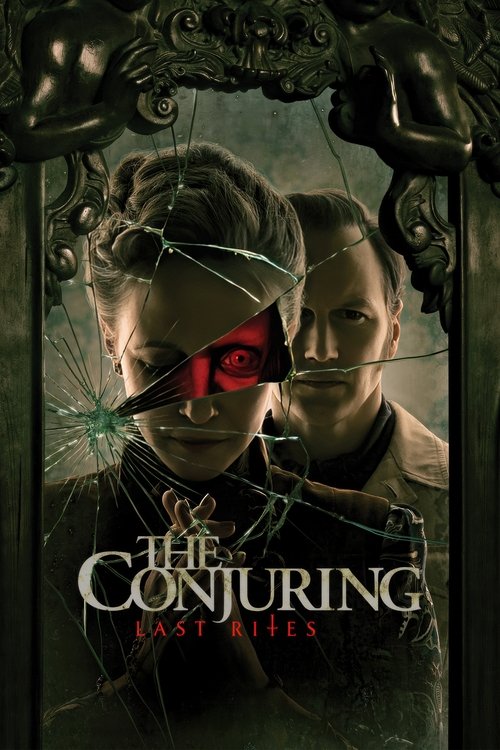
The Conjuring: Last Rites
2025 · Michael Chaves
For a proper lights-off scary movie night, especially if you've followed the Warrens this far and want the goodbye. Comfort-horror in the best sense: frightening in the moment, familiar in shape.
What it's about
Paranormal investigators Ed and Lorraine Warren, older now and feeling the cost of decades spent facing the dark, take on one final case: a family in 1980s Pennsylvania tormented by entities in their home. The case pulls in the Warrens' own family — including their now-grown daughter — as the couple confronts forces that seem aimed at them personally. It's built as a farewell, closing the story that began with their first on-screen investigations.
The experience
A steady drip of dread punctuated by big jump scares, but threaded with something warmer than usual — this one is as much about a marriage as a haunting. It's tense, occasionally sentimental, and paced like a send-off.
Performances
Patrick Wilson and Vera Farmiga anchor the film with the lived-in tenderness they've built over a decade of playing this couple — their ease with each other is the series' real special effect.
The craft
The haunted-house craft is polished franchise machinery: patient camera moves that make you scan the frame, sound design that weaponizes silence, and a 1980s period dressing that adds texture. It plays best loud and in the dark, where the quiet stretches can do their work.
Why it matters
The closing chapter of the series that rebuilt mainstream supernatural horror into a blockbuster universe — a finale for the franchise that defined studio horror for over a decade.
Horror · Haunted house & ghost story · Possession & occult · Religious horror. A polished 1980s haunting where slow-drip dread and loud jump scares frame a tender farewell to a demon-hunting married couple.
Snapshot
The Conjuring: Last Rites is the fourth and final entry in the mainline Conjuring series and the closing chapter in the on-screen chronicle of paranormal investigators Ed and Lorraine Warren, played across the series by Patrick Wilson and Vera Farmiga. Directed by Michael Chaves — his third feature within the franchise after The Curse of La Llorona (2019) and The Conjuring: The Devil Made Me Do It (2021) — the film draws on the Warrens' involvement in the Smurl family haunting, a case they publicized in the 1980s in West Pittston, Pennsylvania. Positioned explicitly as a valediction ("Last Rites"), the picture is engineered to close a narrative arc that began with James Wan's The Conjuring (2013), foregrounding the Warrens' aging, their marriage, and the passing of the torch to their now-grown daughter Judy. It is at once a self-contained haunted-house thriller and a franchise capstone, and it should be read as both: a genre exercise operating inside a highly codified studio horror brand, and a deliberate act of closure for characters who had become the connective tissue of an entire cinematic universe.
Industry & production
The film is a product of New Line Cinema, the Warner Bros. horror label that has housed the Conjuring Universe since 2013, developed under the producing partnership of James Wan (through his Atomic Monster banner) and Peter Safran. That producing structure is the single most important industrial fact about the film: the Conjuring Universe — which by this point encompassed the Annabelle trilogy, the two Nun films, and The Curse of La Llorona — is one of the most profitable horror franchises in the history of the medium, built on comparatively modest budgets and strong theatrical multiples. Last Rites was greenlit and marketed as the conclusion of the flagship line, a framing that carries commercial logic: a definitive "final" Warren film concentrates the audience goodwill accumulated across more than a decade into a single event release.
The return of both Wilson and Farmiga was the non-negotiable condition of the project's identity; the series' commercial appeal has always rested more on their warmth and chemistry than on any individual scare set-piece. The picture also elevates the character of Judy Warren, with the role of the adult Judy central to the generational hand-off the film dramatizes. I want to be careful here: precise budget and box-office figures for a 2025 release sit at the edge of what I can verify without inventing numbers, so I will not assign them. What can be stated with confidence is the strategic shape — a legacy-sequel finale released theatrically by a major studio, timed to the late-summer/early-autumn horror corridor that the franchise has historically owned.
Technology
Technologically, Last Rites belongs to the mature digital-cinema paradigm that has defined the franchise since its inception. The Conjuring films have consistently favored large-format digital capture and a controlled, cinematic image rather than the handheld found-footage aesthetic that dominated low-budget horror in the 2000s and 2010s. The saga's visual signature — deliberate, gliding camera moves; deep, legible frames; darkness that is textured rather than merely absent — depends on modern high-dynamic-range sensors and precise digital grading to render shadow detail without collapsing into murk.
The other technological through-line is practical, not digital: the franchise's house style has always privileged in-camera effects, physical creature and makeup work, and old-school mechanical gags (doors, mirrors, hidden compartments, wire work) over conspicuous computer-generated imagery. CGI is used, but as augmentation and cleanup rather than as the primary vehicle of the scare. This is an aesthetic decision with technological consequences: it dictates set construction, lighting design, and a shooting methodology built around staging real events in real space. Where digital tools are most visible is in the invisible labor — rig removal, compositing of atmospheric elements, and the grade — rather than in foregrounded spectacle.
Technique
Cinematography
The Conjuring series' cinematographic identity, established by John R. Leonetti and Don Burgess in the early films and continued by Michael Burgess on Chaves's franchise entries, is built on the expressive slow move and the withheld reveal. Where I cannot independently confirm the exact camera department for Last Rites, the stylistic grammar is inherited and consistent: the camera behaves as a curious, patient observer, often craning or dollying toward a threshold — a doorway, a staircase, a mirror — and lingering in the moments before something appears. The framing tends to place negative space where the audience expects a threat, weaponizing the empty portion of the composition. Lighting favors deep pools of shadow shaped by practical sources (a lamp, a window, a flashlight), with the period 1980s setting encouraging warm, slightly desaturated interiors. This is anti-strobe, anti-shaky-cam horror photography: legibility is the point, because the fear depends on the viewer scanning a clearly rendered frame for the thing that shouldn't be there.
Editing
The franchise's cutting logic is one of suppression and delay. Rather than accelerating into rapid montage at moments of terror, the Conjuring films characteristically hold shots longer than is comfortable, letting tension accrue before a jump. The editorial rhythm alternates between these sustained, dread-building passages and sharp, percussive cuts synchronized to a stinger. In a finale designed for closure, editing also carries a structural burden — intercutting the present-day case with the emotional throughline of the Warrens' relationship and legacy — so the film's assembly must braid procedural investigation with character valediction. Specific editorial credits for this individual film I will not assert without confirmation, but the mode is the series' established one: patience punctuated by shock.
Mise-en-scène / staging
Production design is central to the series' effect, and Last Rites, rooted in the Smurl haunting, foregrounds the lived-in American home as its principal set. The Conjuring aesthetic treats the domestic interior as a character: wood paneling, floral wallpaper, cluttered mantels, and the accumulated objects of a working-class family life become the field across which the supernatural intrudes. The horror is staged as a violation of the ordinary — the uncanny emerges from precisely observed normalcy. The Warrens' own artifact room, the repository of "cursed" objects that has recurred across the franchise, functions as a mise-en-scène of memory, a museum of prior films that suits a finale's retrospective mood. Staging privileges spatial clarity: the audience is oriented within the geography of the house so that off-screen space and blocked sightlines can be exploited.
Sound
Sound is arguably the franchise's most important technical weapon, and Joseph Bishara's contribution as composer is foundational. Bishara has scored the mainline Conjuring films from the beginning, developing a dissonant, texturally aggressive idiom that fuses orchestral horror convention with abrasive, almost musique-concrète clusters, prepared instruments, and unsettling vocal and percussive elements. His scores refuse conventional melodic comfort, and his stingers are engineered to be physically startling. Beyond the score, the series' sound design mines the vocabulary of the ordinary house — creaks, clocks, footsteps, the mechanical clunk of a door — building a soundscape of domestic realism that is then ruptured. The withheld silence before a scare is as carefully constructed as the scare itself.
Performance
Performance is where Last Rites most clearly departs from generic horror. Wilson and Farmiga have, across the franchise, grounded escalating supernatural absurdity in a fundamentally sincere portrait of a long marriage — tender, faithful, mutually protective. Their playing is notably un-ironic; the films ask the audience to take the Warrens' devotion, both marital and religious, at face value, and the actors deliver it without wink. In a finale explicitly about aging, mortality, and legacy, that accumulated emotional credit is the film's core resource. The elevation of Judy Warren adds a generational dimension, giving the performances a valedictory register: the picture is partly about what the older couple pass on. This character-first approach is the franchise's true innovation within studio horror, and the finale leans on it hardest.
Narrative & dramatic mode
Last Rites operates in the franchise's signature dual mode: the supernatural-procedural and the domestic melodrama. On one axis it is a case file — the Warrens summoned to a haunted home, investigating, escalating, and confronting an entity, following the investigation-to-exorcism structure the series inherited from The Exorcist and from the real Warrens' self-mythology. On the other axis it is a marriage-and-family drama, using the horror apparatus to externalize interior stakes: faith tested, mortality faced, a parental legacy transferred. The "last rites" framing is doubly loaded, naming both a Catholic sacrament for the dying and the film's own function as the series' funeral rites. The dramatic mode is therefore elegiac in a way most horror is not; the finale seeks catharsis and closure rather than the open-ended dread that typically closes a horror film to leave room for sequels.
Genre & cycle
The film sits at the confluence of several horror traditions. Its bedrock is the haunted-house and possession film, with clear ancestry in The Exorcist (1973), The Amityville Horror (1979) — itself a Warren-associated case — and Poltergeist (1982), whose suburban-family-under-siege template the Conjuring films openly update. It also belongs to the specific 2010s cycle of "based on a true case" supernatural horror that The Conjuring itself catalyzed, a cycle defined by period settings, Catholic iconography, and the investigator-as-protagonist. Within that cycle, Last Rites is a terminal, self-reflexive entry: a legacy sequel that closes a shared universe, aligning it with the broader 2020s studio strategy of franchise culmination. It is worth noting the film's conservatism as genre — it is not a reinvention but a consolidation, delivering the expected pleasures of the form with the added weight of finality.
Authorship & method
The presiding authorial intelligence over the Conjuring Universe is James Wan, who as director of the first two mainline films established the visual and tonal template and who, as producer here, remains the franchise's guiding hand alongside Peter Safran. Michael Chaves is the credited director, and by Last Rites he is the most experienced hand in the universe's day-to-day filmmaking, having directed La Llorona, The Devil Made Me Do It, and The Nun II (2023). Chaves's method is fundamentally custodial and craft-oriented: he executes and extends Wan's established grammar rather than imposing a radically personal signature, a stance appropriate to a house-style franchise. Among key collaborators, composer Joseph Bishara is the most stable and identifiable authorial voice after Wan himself, his sonic identity being inseparable from the films' effect. Screenwriting on the mainline series has drawn on David Leslie Johnson-McGoldrick and the writing team of Ian Goldberg and Richard Naing, who worked within the franchise on earlier entries; I will not assign the precise final writing credits for this film without confirmation, but the authorship is best understood as collective and producer-driven rather than singular. This is authorship as brand stewardship — a mode of filmmaking in which continuity of tone across many hands is itself the artistic achievement.
Movement / national cinema
The film is a work of mainstream American studio horror, produced within the Hollywood system by a major studio's genre label. It does not belong to an avant-garde or national art-cinema movement; rather, it exemplifies the industrial "cinematic universe" strategy that has dominated American blockbuster filmmaking since the 2010s, applied to the horror genre at a mid-budget scale. If it participates in any broader current, it is the post-2013 revival of adult-oriented, theatrically successful studio horror — a wave to which the Conjuring franchise was itself the commercial keystone, demonstrating that R-rated supernatural films built on craft and character could anchor a durable, expandable brand. Its sensibility is thoroughly American: Catholic, suburban, mid-century-to-1980s in texture, and rooted in a specifically American folklore of the haunted home and the itinerant demonologist.
Era / period
Two temporal frames matter. The film's diegetic period is the 1980s, consistent with the franchise's tendency to set its cases in the recent-historical past — a choice that removes the smartphone and the security camera, restoring the isolation and slow information that classical horror requires, while bathing the material in period production design and a nostalgic, analog warmth. Its production era is the mid-2020s, a moment defined industrially by the maturity (and, some argued, the fatigue) of the cinematic-universe model and by horror's continued theatrical strength as one of the few genres reliably drawing audiences to cinemas. Last Rites reflects both: a period-set story told with contemporary digital craft, released as a franchise's deliberate conclusion at a time when studios increasingly sought to close as well as open their long-running series.
Themes
The film's governing themes are faith, marriage, mortality, and inheritance. Across the franchise the Warrens' Catholic faith is treated not as superstition but as functional armor against genuine evil, and the finale presses on the limits of that faith as the characters age. Marriage is the series' true subject — the endurance and cost of a lifelong partnership conducted in proximity to darkness — and a "last" film inevitably makes that partnership's finitude explicit. Mortality and legacy follow: the "last rites" title binds the sacramental care of the dying to the question of what the Warrens leave behind, a question answered through the generational passage to Judy. Beneath these runs the franchise's persistent theme of the family home as sanctuary under siege, the demonic reframed as an assault on domestic and marital love. It is a fundamentally sentimental and even devotional body of work, and the finale foregrounds that sentiment.
Reception, canon & influence
On the influences flowing into the film: Last Rites is a late tributary of a well-mapped river. Backward, it draws on The Exorcist, The Amityville Horror, Poltergeist, and the classical haunted-house tradition, filtered through James Wan's own foundational Conjuring and Conjuring 2, which are the film's most immediate models. It also draws on the real Warrens' public case-history and the true-crime-adjacent "based on true events" mode. Forward, the film's legacy is primarily as a capstone: it closes the mainline Warren narrative and thereby reshapes the Conjuring Universe's future, which must continue, if at all, without its central couple. The franchise's broader influence is already historically secured — The Conjuring (2013) is widely credited with reviving mainstream, theatrical, craft-driven supernatural horror and with pioneering the horror "shared universe," a template widely imitated across the 2010s and 2020s. Last Rites inherits and concludes that influence rather than initiating a new one.
On critical reception: because this is a very recent release, I will not manufacture specific review verdicts, aggregate scores, or box-office totals. What can be said responsibly is that the film arrived carrying enormous franchise expectation as an announced finale, and that the series' critical history is instructive — the Wan-directed originals earned notably strong reviews for their craft and performances, while later universe entries, including Chaves's, met more mixed critical responses even as they remained commercially robust. The honest scholarly position is that Last Rites should be evaluated on that continuum, and that a fuller reception and legacy assessment will require the distance the recency of its 2025 release does not yet permit.
A Deleuzian reading
There's a move the *Conjuring* films make a dozen times a picture, and *Last Rites* makes it again.
The full Deleuzian reading of The Conjuring: Last Rites →
Reception
Landed in September 2025 to shrugging reviews but a monster box office, and the dust settled fast: fans now file it less as a horror movie than as a sentimental series finale — the 'goodbye to Ed and Lorraine' episode that's more teary than terrifying.
How The Conjuring: Last Rites was received, from release to now →
How to watch The Conjuring: Last Rites: what to notice on a first viewing
- Watch the camera stop and hold at a doorway. It cranes or dollies toward a threshold, a door, a staircase, a mirror, then simply waits there before anything happens. The gap between perceiving and acting is where the film's whole tension actually lives.
- Notice the empty half of the frame during quiet scenes. Compositions leave negative space exactly where you expect a threat to appear, weaponizing the part of the image with nothing in it. The threat is placed exactly where the empty part of the picture makes you look hardest.
- Notice the ordinary household objects filling every room. Wood paneling, floral wallpaper, cluttered mantels, the accumulated clutter of a working family's home fills the frame the supernatural will violate. The horror depends on how precisely ordinary this home looks before anything goes wrong in it.
- Listen for silence right before the score finally hits. Bishara withholds his dissonant clusters and stingers for as long as possible, so the quiet itself becomes part of the dread. The withheld sound does more work than the loud sound that eventually arrives.
- Watch how the Warrens act like an ordinary married couple. Wilson and Farmiga play their devotion, faith, and worry completely straight, without any ironic distance from the material. Taking their bond seriously is what lets the scares land as something more than mechanics.
The whole guide to watching The Conjuring: Last Rites, with the keys for a rewatch →
Influences: the films it descends from and the films it influenced
- The Exorcist (1973) — Establishes possession-as-medical-procedural staged inside a realistic domestic bedroom, plus the sincere clergy-versus-affliction register and 'based on a real case' authority the Warren films inherit wholesale.
- The Amityville Horror (1979) — Originates the 'drawn from the Warrens' real case files' marketing mode and the haunted suburban house whose architecture — windows, staircase, basement — is choreographed as a threat map.
- Poltergeist (1982) — Model for the ordinary suburban family as emotional anchor and the domestic-realism production design in which familiar objects (TV, closet, children's toys) are turned hostile.
- The Haunting (1963) — Codifies house-as-character grammar and terror produced by suggestion, negative space, and off-screen sound rather than a shown apparition — the suppression-and-delay logic Last Rites runs on.
- The Changeling (1980) — Source of the slow, withholding camera glide down an empty corridor toward a delayed reveal, wedded to elegiac ghost-as-unfinished-business plotting.
- The Innocents (1961) — Deep-focus widescreen framing that plants figures in the corners of negative space, forcing the viewer's eye to discover the threat before the cut acknowledges it.
- The Entity (1982) — Early 'based on a true case' domestic haunting that treats the family home and the afflicted woman's ordinary routines as the site of assault, prefiguring the true-case cycle's realism.
- Insidious (2010) — Wan's own establishment of the withheld-then-punctuated reveal cut married to Joseph Bishara's dissonant string-cluster stings — the exact sonic-visual jump grammar Chaves executes here.
- The Conjuring (2013) — The foundational template: roaming crane and Steadicam long takes that survey the haunted house, plus the tender, sincere Warren marriage installed as the series' emotional center.
- The Conjuring 2 (2016) — The most immediate model — a period-set domestic haunting structured around Ed and Lorraine's marriage under mortal threat, with the reveal choreography (Crooked Man, Valak) Last Rites echoes.
- Longlegs (2024) — Extends the occult-procedural-meets-negative-space aesthetic, using wide empty frames and withheld reveals with a period-inflected true-crime texture descended from the Conjuring mode.
- Annabelle: Creation (2017) — Extends the universe's house-tour suspense through long, patient camera moves that exploit doorways, dumbwaiters, and negative space to withhold the reveal.
- The Conjuring: The Devil Made Me Do It (2021) — Chaves's earlier mainline entry that tilts the series toward procedural investigation while sustaining the Warren-marriage core — the direct precedent for his custodial method here.
- The Nun II (2023) — Chaves's prior universe film refining his execution of Wan's grammar and Bishara-scored set-pieces, demonstrating the house-style stewardship Last Rites completes.
- Sinister (2012) — Parallel true-crime-inflected domestic haunting where a researcher's investigation drives the dread and diegetic-object horror (found home-movie footage) anchors the scares.
- Hereditary (2018) — Stages the domestic interior as a dollhouse-character with meticulous slow lateral moves and negative-space compositions that conceal the supernatural in plain sight — the art-horror refinement of the same staging debt.
Similar films
- The Conjuring: The Devil Made Me Do It (2021) — influence & lineage · same viewing thread
- The Conjuring (2013) — influence & lineage
- The Conjuring 2 (2016) — influence & lineage
- Sinister (2012) — influence & lineage
- The Haunting (1963) — influence & lineage
- The Exorcist (1973) — influence & lineage
- Final Destination Bloodlines (2025) — same viewing thread
- Five Nights at Freddy's (2023) — same viewing thread
All the films related to The Conjuring: Last Rites →
Watch it with: curated runs of related films
- Fresh Blood: 2020s Studio Horror — A run of the decade's mainstream fright machine — abduction shockers, franchise revivals, and one arthouse throwback — best watched back-to-back to feel how modern horror hunts its prey.
- The Fear of God — A run of horror where faith is the battleground: believers, doubters and zealots meet the devil, damnation and an afterlife that answers back, from Puritan farms and Roman convents to the catacombs under Paris.