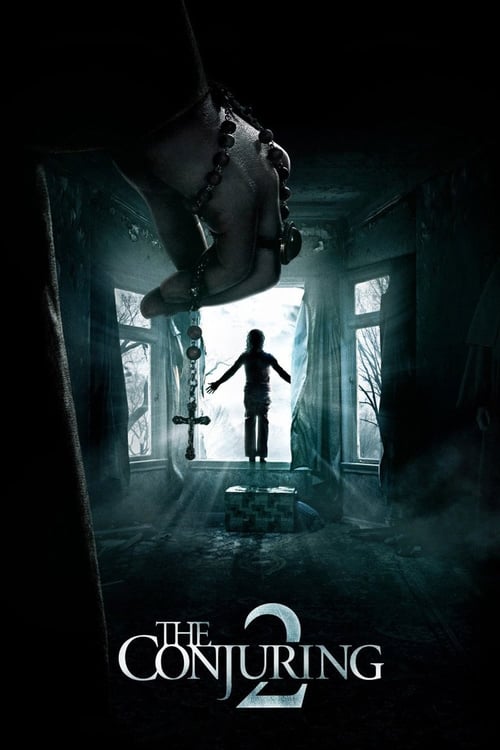
The Conjuring 2
2016 · James Wan
When you're craving a real scare done properly — the crowd-pleasing kind you watch with the lights off and someone to grab, not the kind that ruins your week.
What it's about
London, 1977. In a shabby Enfield council house, a single mother raising four children begins reporting things that can't be explained — furniture moving, voices that aren't hers, a presence fixated on her youngest daughter. Paranormal investigators Ed and Lorraine Warren cross the Atlantic to help, arriving weary and wondering whether this case is real, a hoax, or something worse than both. It's drawn from the notorious real-world 'Enfield Poltergeist' case.
The experience
A patient, craftsmanlike scare machine — long stretches of creeping dread punctuated by expertly sprung jolts, with an unexpectedly warm emotional core in the Warrens' marriage and the family's exhaustion. It's frightening but never mean; you're scared with the characters, not at their expense.
Performances
Patrick Wilson and Vera Farmiga ground the whole enterprise, playing the Warrens' partnership with a sincerity that makes the supernatural feel like it has stakes; Frances O'Connor is quietly devastating as a mother at the end of her rope.
The craft
James Wan is a master of the engineered scare, and here his roving camera, patient framing, and use of silence turn a cramped house into a haunted instrument. The 1970s London period detail is rich and rain-soaked, and the sound design does half the frightening — worth good speakers or headphones.
Why it matters
Cemented the Conjuring series as the anchor of modern horror's biggest shared universe and confirmed Wan as the era's defining mainstream horror director.
Horror · Haunted house & ghost story · Possession & occult. A malicious spirit haunts a single mother's 1970s London council house, with long creeping dread and expertly timed jolts, scary but kind.
Snapshot
The Conjuring 2 is a supernatural horror film directed by James Wan and released in 2016 by Warner Bros. Pictures through New Line Cinema, the studio's second entry in the paranormal-investigator franchise begun with The Conjuring (2013). Where the first film dramatized the Perron family haunting in 1971 Rhode Island, the sequel relocates real-life demonologists Ed and Lorraine Warren — again played by Patrick Wilson and Vera Farmiga — to north London, where they investigate the case of the Hodgson family. The film is a period piece set in 1977, drawing on the widely publicized "Enfield Poltergeist," the alleged haunting of a council house on Green Street in Enfield, which became one of Britain's most notorious and disputed paranormal episodes. The film is at once a domestic melodrama about a beleaguered single mother, a coming-of-age story built around a possessed adolescent daughter, and a slow-burn haunted-house showcase for Wan's much-imitated craftsmanship. It also served a strategic function: as the anchor of the growing "Conjuring Universe," it seeded the demon nun Valak, who would headline the 2018 spin-off The Nun. Commercially it performed strongly worldwide, consolidating the franchise as one of the most profitable horror properties of the decade.
Industry & production
The film was produced under the New Line/Warner Bros. banner with Peter Safran and James Wan among the producers, continuing the collaboration that made the first Conjuring a surprise blockbuster on a modest budget. The success of the 2013 film — and of the Annabelle spin-off that followed in 2014 — established a template: relatively contained production costs, a hard PG-13-to-R-territory approach that maximized dread over gore, and a "based on a true case" framing borrowed from the Warrens' real archive of investigations. The Conjuring 2 was reportedly mounted on a larger budget than its predecessor, reflecting studio confidence, though I would treat any precise figure with caution; the film is generally understood to have been made in the modest-tens-of-millions range and to have earned several times that worldwide, a ratio typical of the franchise's economics.
Production was based largely in Los Angeles, where the Enfield council house and its street were recreated on sets and locations, supplemented by second-unit and establishing material to evoke 1970s London. This choice — building a convincing English terrace far from England — speaks to the industrial logic of the franchise: control over the environment mattered more to Wan's meticulous camera choreography than location authenticity. The period setting required substantial art-department work to render the gray, economically strained Britain of the late 1970s, a texture the film leans on heavily for atmosphere.
Crucially, the production sat at a pivot point in Wan's career. He had just directed Furious 7 (2015), a massive studio tentpole, and The Conjuring 2 represented a return to the genre that made his name before he moved fully into blockbuster territory (he would go on to Aquaman). The film thus carries the polish of a director operating with major-studio resources while still working in the intimate, craft-forward register of horror.
Technology
The Conjuring 2 was shot digitally, and its technical program is defined less by novel tools than by the disciplined use of conventional ones in service of sustained camera movement. Wan and cinematographer Don Burgess favored fluid, motivated moves — cranes, dollies, and stabilized rigs that let the camera drift through the Hodgson house as an unsettling, quasi-subjective presence. The film relies heavily on practical, in-camera effects and physical staging: doors, furniture, and set pieces rigged to move, actors performing contortions and levitation-adjacent gags with mechanical assistance, and lighting effects achieved on set rather than added later. Digital visual effects are present but generally deployed to enhance or extend practical work — most conspicuously in the design of the demonic apparitions such as Valak the nun and the "Crooked Man" — rather than to build spectacle from scratch. This hybrid, practical-first approach is central to the franchise's aesthetic identity and to its reputation among genre audiences for "old-fashioned" scares.
Technique
Cinematography
Don Burgess, an experienced Hollywood cinematographer, gives the film a controlled, desaturated palette suited to a rainy, economically depressed London winter — cold blues and grays, pools of warm domestic lamplight, and deep shadow used as a reservoir of threat. The signature technique, inherited and refined from the first film, is the slow, uninterrupted camera move: the frame glides across a room, past a doorway, or down a hallway, encouraging the viewer to scan the negative space for something that may or may not be there. Wan repeatedly withholds the payoff, letting composition and duration generate dread before any apparition arrives. Wide and medium framings dominate over frantic cutting; the camera often keeps its distance, making the domestic space itself the subject. Several set pieces are built around a single mobile take that reframes to reveal — or conspicuously fails to reveal — a presence, a strategy that trusts the audience's eye rather than the edit.
Editing
Editor Kirk M. Morri, a longtime Wan collaborator, cuts for patience. The film's rhythm alternates long, tension-accruing passages of near-static or slowly moving imagery with sharp punctuations at moments of shock. Morri and Wan are careful to earn their jump scares by establishing extended stretches without them, so that the eventual cut or sound-cue lands harder against an established calm. The editing also manages the film's considerable length and its double structure — the Warrens' arc and the Hodgsons' arc — braiding the two households and the couple's own marital and spiritual anxieties into a single escalating line.
Mise-en-scène / staging
The Hodgson house is the film's central instrument. Its cramped rooms, patterned wallpaper, worn furnishings, and the recurring visual motifs — a television, an armchair, a tent of blankets, a basement — are arranged so that Wan can exploit thresholds, reflections, and off-center space. Much of the horror is staged through blocking: characters positioned so that the audience sees what they do not, or the reverse. Wan's staging is theatrical in the best sense, treating each set as a stage with clearly established geography that he can then violate. The 1977 period dressing is integral, grounding the supernatural in a specifically lived-in, class-marked British domesticity.
Sound
Sound design is arguably the film's most powerful tool. Composer Joseph Bishara, who scored the first film and also appears as a physical performer of demonic figures across the franchise, provides a dissonant, percussive, string-heavy score punctuated by sudden stabs. Beyond music, the film's sound team builds an environment of creaks, low-frequency rumbles, distorted vocalizations, and abrupt silences; the deep, guttural voice associated with the possessed household and the "Bill Wilkins" persona is a key auditory motif. The alternation of near-silence and violent sonic accent is the mechanism behind most of the film's scares, and the mix is engineered to make the domestic soundscape itself feel unstable.
Performance
Vera Farmiga and Patrick Wilson return as Lorraine and Ed Warren, and the film invests unusually heavily — for a horror sequel — in their relationship. Wilson plays Ed with an earnest, protective warmth, including a much-noted scene in which he sings Elvis Presley's "Can't Help Falling in Love" to reassure the frightened family; Farmiga plays Lorraine as increasingly haunted by premonitions of loss, giving the couple a genuine emotional stake. On the Hodgson side, Frances O'Connor plays the overwhelmed single mother Peggy, and Madison Wolfe delivers the film's most demanding performance as Janet, the adolescent daughter at the center of the alleged possession — a physically and vocally punishing role that anchors the horror in a child's vulnerability. The performances collectively pull the film toward family drama, which is central to its appeal.
Narrative & dramatic mode
The film operates in the mode of the "true-case" supernatural investigation, framed by the Warrens' documented status as ghost hunters and structured around the classic haunted-house escalation: first disturbances, escalating manifestations, arrival of the investigators, crisis of doubt, and climactic confrontation. Distinctively, The Conjuring 2 threads a strong skepticism subplot — the real Enfield case was dogged by accusations that the children faked phenomena, and the film incorporates this ambiguity, staging a sequence in which Janet appears to be caught cheating and the Warrens must weigh fraud against genuine haunting. This gesture toward doubt lends the melodrama a measure of self-awareness. Overlaid on the Hodgson plot is a parallel dramatic line concerning Lorraine's foreboding vision of Ed's death and her fear for their own family, so that the couple's spiritual mission carries a personal cost. The result is a dual-family structure in which the resolution of the haunting is also the reaffirmation of the Warrens' marriage and faith.
Genre & cycle
The Conjuring 2 belongs to the 2010s revival of the classical supernatural horror film — the haunted-house and demonic-possession tradition that runs from The Exorcist and The Amityville Horror through Poltergeist — reworked for a contemporary franchise economy. It stands at the center of the "Conjuring Universe," the shared-continuity horror brand that New Line built around the Warrens, encompassing the Annabelle films, The Nun, and The Curse of La Llorona. Within the broader horror landscape of its moment, it represents the studio, atmosphere-and-craft wing of the genre, distinct from both the found-footage cycle (Paranormal Activity) and the "elevated horror" art-house strain then emerging (The Witch, It Follows). Its emphasis on period setting, practical scares, and character sympathy positions it as a mainstream, broadly accessible entry in the possession cycle.
Authorship & method
James Wan is the film's defining author, and The Conjuring 2 is a mature statement of the craft-forward, patience-based horror style he developed across Saw, Insidious, and the first Conjuring. His method privileges camera movement, spatial clarity, practical effects, and the deliberate withholding of the scare — building "the anticipation of the scare" as much as the scare itself. His key collaborators form a recurring repertory. Cinematographer Don Burgess brought major-studio polish to the film's controlled, desaturated period look. Composer Joseph Bishara supplied the dissonant score and, characteristically, physically embodied demonic figures on set, blurring the line between music and monster. Editor Kirk M. Morri shaped the film's patient, dread-accruing rhythm across a long runtime. The screenplay is credited to Chad Hayes and Carey W. Hayes — the twin screenwriters of the first film — together with James Wan and David Leslie Johnson, a writing team that balanced the "true case" material with the invented mythology (Valak, the Crooked Man) required to feed a growing universe. The collaboration is notably stable across the franchise, and much of the series' consistency of tone flows from this continuity of authorship.
Movement / national cinema
The film is a Hollywood studio production and does not belong to a national film movement in the art-cinema sense, but it is worth noting its transnational subject and texture. Its story is thoroughly British — a specific 1977 English council-estate haunting, steeped in the class realities of Callaghan-era Britain — yet it was realized largely on American soundstages by an Australian-raised, Malaysian-born director working within the American studio system. It thus sits within a globalized commercial horror practice rather than any regional cinema, even as it makes the working-class British domestic milieu essential to its atmosphere and sympathy.
Era / period
The Conjuring 2 is doubly period-marked. As a text it is set in 1977, and it invests heavily in evoking that moment: the material culture, the economic strain, and the media environment (the real Enfield case drew press and researchers, and the film gestures at that scrutiny). As a product, it belongs to the mid-2010s golden age of franchise horror, when a modestly budgeted possession film could reliably return large multiples and anchor a shared universe. It arrives after the found-footage boom had begun to fade and alongside the rise of prestige horror, occupying the commercial mainstream between them. Its confident, retro-classical aesthetic — practical scares, orchestral dread, family melodrama — reads partly as a deliberate answer to the disposable digital aesthetics of much 2010s horror.
Themes
The film's central theme is family under siege — specifically the vulnerability of a single mother and her children, with the haunting functioning as an externalization of domestic precarity, poverty, and the fear of a home that cannot be kept safe. Adolescence and possession are tightly bound: Janet's ordeal maps onto the classic horror figure of the imperiled teenage girl whose body becomes a battleground, and the film's ambiguity about fraud shadows this with anxieties about belief, attention, and adult credulity toward children. Faith and doubt form a second axis, embodied in the Warrens: the film treats their Catholic-inflected spiritual conviction sympathetically while dramatizing skepticism as a real and reasonable pressure. Finally, marriage and mortality run through Lorraine's premonition of Ed's death, so that the horror plot doubles as a meditation on the fear of losing a partner. Naming and knowledge — the classic exorcism logic that to name a demon is to gain power over it — provides the climactic thematic mechanism.
Reception, canon & influence
Critically, The Conjuring 2 was generally well received for a horror sequel, with reviewers frequently singling out Wan's directorial craft, the committed performances of Wilson, Farmiga, and Wolfe, and the film's atmosphere, while some noted its considerable length and reliance on familiar genre beats. It is broadly regarded as one of the stronger mainstream studio horror films of its period and a rare sequel that sustains, rather than dilutes, its predecessor's reputation — though I would treat any specific aggregate scores or precise grosses as details to verify against a reliable source rather than assert from memory.
Its influences flow backward from the foundational works of supernatural horror — The Exorcist above all, plus the haunted-house lineage of The Amityville Horror and Poltergeist — and from the documented real-world Enfield case and the Warrens' own celebrity as paranormal investigators, a public record that is itself contested and that the film treats selectively. Forward, its most concrete legacy is institutional: The Conjuring 2 introduced Valak, the demon nun, whose striking design proved popular enough to generate the spin-off The Nun (2018) and its own sequels, and it cemented the "Conjuring Universe" as a durable, self-replicating franchise model that Hollywood studios sought to imitate throughout the late 2010s. More diffusely, the film reinforced and popularized a house style — the slow reveal, the mobile camera scanning charged negative space, the practical scare over CGI spectacle — that shaped a wave of subsequent studio horror and marked Wan as one of the most influential genre stylists of his generation.
A Deleuzian reading
The camera is moving down a hallway in a council house in Enfield, 1977.
The full Deleuzian reading of The Conjuring 2 →
Reception
A rare horror sequel that landed as well as the original in 2016 — critics praised it, it made over $300M — and its stature has only grown as fans now routinely rank it at or near the top of the whole Conjuring Universe.
How The Conjuring 2 was received, from release to now →
How to watch The Conjuring 2: what to notice on a first viewing
- Watch the camera glide slowly across each room before anything happens. Wan repeatedly moves the camera down hallways and past doorways, letting you scan the empty frame for a shape that may or may not be there. The dread comes from your own scanning, not from what the film shows you.
- Listen for the long stretches of near-silence before each jolt. Editor Kirk Morri builds extended calm passages, then breaks them with a sudden cut or sound-cue, so scares land against an established quiet. The scare works because the film first trains your ear to expect nothing.
- Notice the cold blue-gray light against small pools of warm lamplight. Cinematographer Don Burgess keeps the house desaturated and damp-looking, with warmth confined to small domestic sources like lamps and the television. The palette makes the home itself feel underfed and unprotected, matching the family's poverty.
- Watch where each character stands relative to doorways and thresholds. Wan blocks scenes so the audience often sees something a character in the room cannot, using thresholds, reflections, and off-center space. The house's geography becomes a trap the film can spring on people inside it.
- Notice how physically demanding Janet's possession scenes look for Madison Wolfe. Her body twists, her voice drops, and the performance carries the horror more than any effect layered over it. The film roots its scares in a child's visible strain, not just special effects.
The whole guide to watching The Conjuring 2, with the keys for a rewatch →
Influences: the films it descends from and the films it influenced
- The Exorcist (1973) — Establishes the possession-as-medical/theological-investigation structure and the guttural, non-human voice emanating from a possessed child that Conjuring 2 directly inherits in the Enfield interrogation scenes and Janet's altered voice.
- The Haunting (1963) — Pioneers the withheld scare built from a slowly craning camera scanning charged empty rooms and sound-only threats, the exact 'anticipation over payoff' grammar Wan uses in the panning hallway takes.
- The Innocents (1961) — Deep-focus staging that plants an ambiguous figure in the far background of the frame while foreground action distracts — the blocking-reveal technique Wan deploys with the Crooked Man and the nun in doorways.
- The Amityville Horror (1979) — Founds the 'based on the Warrens' true case-file' template and the family-in-a-cursed-house docudrama framing that the Conjuring films adopt as their brand.
- Poltergeist (1982) — Model for the working-class family under supernatural siege rendered through practical, in-camera set effects (moving furniture, self-animating objects) rather than opticals, which Wan revives against the CGI era.
- The Changeling (1980) — Patient, dread-accruing haunted-house rhythm anchored by a séance/investigation subplot and a slow tracking exploration of a large house — the measured tempo Kirk Morri sustains across the long runtime.
- The Entity (1982) — Directly influences the Enfield material as a 'documented' paranormal-assault case centered on a woman/family, foregrounding the skeptic-investigator framing the film reuses.
- Saw (2004) — Wan's origin point for the reveal-timed edit and mechanical dread, where withholding then abruptly disclosing spatial information (the body, the trap) becomes the scare engine later refined into the withheld jump-scare.
- The Conjuring (2013) — Direct predecessor supplying the Hayes-brothers 'true case' screenplay method, Warren repertory casting, desaturated period palette, and the slow-mobile-take house scan that Conjuring 2 continues verbatim.
- The Nun (2018) — Spun directly out of Conjuring 2's Valak design, extending the demon-nun iconography and the practical-costume scare into a period-set origin film within the shared universe.
- Annabelle: Creation (2017) — Conjuring Universe sibling that inherits Wan's slow-reveal blocking and darkness-based practical scares, extending the franchise's self-replicating case-file model.
- Lights Out (2016) — Produced by Wan, it distills his blocking-reveal into a single device — a figure that materializes only in darkness and vanishes in light — the negative-space scare grammar of Conjuring 2 reduced to its essence.
- Hereditary (2018) — Extends Wan's slow, motivated camera creeping across static domestic space and the blocking-reveal of a figure hidden in shadowed corners, weaponizing negative space in the dollhouse-like frame.
- The Conjuring: Last Rites (2025) — The most immediate model — a period-set domestic haunting structured around Ed and Lorraine's marriage under mortal threat, with the reveal choreography (Crooked Man, Valak) Last Rites echoes.
- Insidious (2010) — The immediate prototype of the mobile camera gliding through the house toward negative space, plus Joseph Bishara's dissonant string score and his practice of physically performing the demon on set.
- Sinister (2012) — Parallel studio-horror investigation film pairing a true-crime research framing with a dissonant, guttural sound-design score, sharing Conjuring 2's dread-through-audio approach and skeptic-protagonist arc.
- The Babadook (2014) — Family-under-siege horror that, like Conjuring 2, builds its monster from tangible practical craft and staging in the corners of the frame rather than CGI, privileging atmosphere and blocking.
- It Follows (2014) — Shares the slow 360-degree scanning take that dares the viewer to locate a lurking figure within the frame, the same anticipatory camera-as-threat technique central to Conjuring 2's set pieces.
- The Conjuring: The Devil Made Me Do It (2021) — Immediate predecessor sharing screenwriter David Leslie Johnson-McGoldrick, providing scripting continuity; supplies the silence-to-sting sound design and the demon-as-physical-antagonist (the Crooked Man, the Nun) that Bishara's score and staging carry forward.
Similar films
- The Conjuring (2013) — influence & lineage · same viewing thread
- Sinister (2012) — influence & lineage · same viewing thread
- The Haunting (1963) — influence & lineage
- The Exorcist (1973) — influence & lineage
- The Babadook (2014) — influence & lineage · same viewing thread
- Hereditary (2018) — influence & lineage · same viewing thread
- The Conjuring: The Devil Made Me Do It (2021) — same viewing thread
- Insidious (2011) — same viewing thread
All the films related to The Conjuring 2 →
Watch it with: curated runs of related films
- Something in the Family Home — A run of hauntings that go after the family unit itself — watch them together and you'll see the Wan-era jump-scare house turn into Aster's grief-rotted dollhouse and the folk-horror homesteads of Java and Japan.
- The House Remembers Its Grief — A run of family hauntings where the ghost is never just a ghost: watch these together to see the slammed-door haunted house of the multiplex slowly turn into mourning, guilt and things the family won't say.