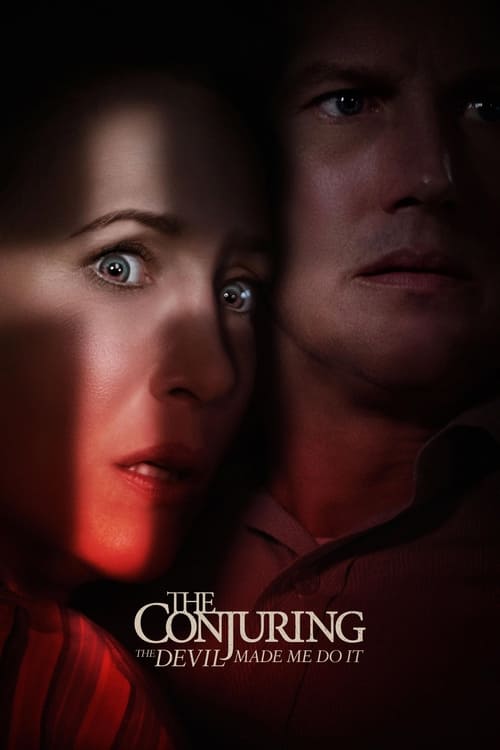
The Conjuring: The Devil Made Me Do It
2021 · Michael Chaves
For a horror night when you want scares with a plot to follow — franchise comfort-food fear rather than an endurance test, best watched in the dark with someone to grab.
What it's about
Paranormal investigators Ed and Lorraine Warren take on the case that shook them most: a young boy's exorcism goes horrifyingly sideways, and soon a murder suspect claims — for the first time in U.S. history — that demonic possession made him do it. To defend that claim, the Warrens must leave the haunted house behind and follow a trail of evil across 1981 Connecticut, hunting the human force behind the curse.
The experience
Less a slow-creep haunting than a dread-soaked supernatural detective story — jump scares punctuate an investigation that keeps moving. It's intense and grisly in bursts, anchored by the warmth between its two leads.
Performances
Patrick Wilson and Vera Farmiga remain the franchise's secret weapon — their tender, lived-in portrait of the Warrens' marriage gives the mayhem an emotional anchor few horror series have.
The craft
Michael Chaves takes over from James Wan and swaps the haunted-house siege for a road-movie procedural structure, opening with a full-throttle exorcism set piece. The early-'80s period design and roving investigation give this entry a different texture from its predecessors.
Why it matters
A pandemic-era hit that proved the Conjuring Universe could survive a change of director and a change of formula, extending one of horror's most successful modern franchises.
Horror · Possession & occult · Witchcraft · Religious horror. Two married demonologists chase a curse across early-'80s Connecticut: an occult detective story built on jump scares, with a warm heart.
Snapshot
The Conjuring: The Devil Made Me Do It is the third entry in the main Conjuring series and the eighth film in the broader Conjuring Universe launched by James Wan in 2013. It marks a decisive structural break from its predecessors: where The Conjuring (2013) and The Conjuring 2 (2016) were haunted-house pictures organized around a single afflicted family and a single location, this film reconfigures Ed and Lorraine Warren (Patrick Wilson and Vera Farmiga) as itinerant investigators pursuing a case across space and time — closer to a supernatural detective procedural than a domestic siege. It is also the first main-series installment not directed by Wan himself, who handed the chair to Michael Chaves while remaining aboard as producer and story co-author. The film dramatizes the 1981 Connecticut trial of Arne Cheyenne Johnson, historically notable as the first known American court case in which a murder defense attempted to enter demonic possession as grounds — the "devil made me do it" defense that gives the film its subtitle. Released day-and-date in theaters and on HBO Max in June 2021, it arrived as a pandemic-era studio horror tentpole and as a test of whether the franchise's brand could survive the departure of its founding director.
Industry & production
The film was produced by New Line Cinema and distributed by Warner Bros., with Wan's Atomic Monster and Peter Safran's Safran Company as the franchise's core production entities. By 2021 the Conjuring Universe had become one of the most reliably profitable horror franchises in operation, spanning the Conjuring films, the Annabelle trilogy, The Nun, and The Curse of La Llorona. That commercial track record shaped the production's central creative decision: with Wan increasingly occupied by larger studio commitments, the series needed a director who could preserve its house style without him. Chaves had directed The Curse of La Llorona (2019), a Conjuring Universe entry, which functioned in effect as an audition for the main line.
The most consequential industrial fact surrounding the film is its release model. Warner Bros. released its entire 2021 slate simultaneously in theaters and on the HBO Max streaming service, a strategy adopted in response to the COVID-19 pandemic's disruption of theatrical exhibition. The Devil Made Me Do It was among those titles, and it became a closely watched case study in whether a horror franchise built on communal theatrical scares could perform under a hybrid model. The film opened solidly given the circumstances and was widely reported as the lowest-grossing of the three main Conjuring films; precise comparative figures should be treated cautiously here, but the directional claim — that a shortened exclusive theatrical window and a still-recovering exhibition market depressed its box office relative to its predecessors — is well supported.
Technology
The film was shot digitally, consistent with the series' contemporary studio-horror production norms, and framed for a wide scope aspect ratio in keeping with the classical, widescreen look Wan established for the franchise. The Conjuring films have cultivated a deliberately "analog," period-appropriate texture — this installment is set in 1981 — and the technological work is largely in service of concealing its own modernity: digital capture graded and lit to evoke the muted, slightly desaturated palette of late-1970s and early-1980s American cinema. Practical and physical effects (makeup, contortion performance, practical rigs for the possession set pieces) are foregrounded, with digital effects used to extend and seam rather than to originate the horror imagery. The specifics of the exact camera and lens packages are not something I can state with confidence from the established record, so I will not attribute them; what is clear is that the film participates in the series' preference for the appearance of practicality over overtly digital spectacle.
Technique
Cinematography
Cinematographer Michael Burgess, who had shot The Curse of La Llorona for Chaves, photographed the film, continuing the collaboration rather than importing the series' earlier lensing partners. The visual grammar is inherited from Wan's Conjuring template — long, gliding camera moves; deliberate use of negative space where a threat may or may not materialize; low-key lighting that lets darkness genuinely obscure rather than stylize. The opening exorcism sequence, staged around the possession of the young boy David Glatzel, is the film's most ambitious camera showcase, using sustained movement and shifting frame geometry to disorient. Because the story leaves the haunted house behind for exteriors, woods, morgues, and a subterranean occult set, Burgess's work ranges across more varied environments than the first two films, trading the claustrophobic single-house lighting design for a more mobile, location-hopping palette.
Editing
The picture was cut to sustain the franchise's characteristic rhythm of slow-building dread punctuated by engineered shocks, but its editorial challenge is different from its predecessors': it must sustain a multi-location investigation and a legal-procedural throughline alongside the set-piece horror. The result is a more episodic construction — investigation, revelation, confrontation — that some critics found less taut than the tightly bounded escalation of the first two films. The cross-cutting between the Warrens' inquiry and Arne Johnson's deteriorating condition is the load-bearing editorial structure.
Mise-en-scène / staging
Production design commits fully to a 1981 New England milieu — the Glatzel and Johnson households, the courthouse, and the recurring iconography of the Warrens' occult museum and case archive. The film's signature staged images include the boy's waterbed contortion during the initial possession and the later descent into an occultist's cellar altar, a space designed to read as ritual architecture rather than domestic horror. The transfer of possession from child to adult — the film's central supernatural conceit — is staged as a physical, bodily event, keeping the horror grounded in performers' bodies and practical sets.
Sound
Sound design follows the series' well-honed method: extended near-silence and low ambient tone used to stretch tension, then abrupt, high-amplitude stings to deliver shocks. The franchise's sonic identity — creaking architecture, disembodied whispers, the sudden collapse of a quiet field into noise — is maintained. Joseph Bishara's score (discussed below) is integrated tightly with the sound design, to the point where musical and non-musical sound often become indistinguishable, a deliberate strategy for unsettling the audience.
Performance
The film rests on the continuity of Wilson and Farmiga as Ed and Lorraine Warren, whose warm, faith-centered marriage has been the franchise's emotional anchor across multiple films. Here their relationship is placed under literal threat — Ed suffers a heart attack, and Lorraine's psychic connection becomes the investigative engine — giving both actors more overtly dramatic material than usual. Critics broadly agreed that their performances remained the film's strongest asset even where the plotting faltered. Ruairi O'Connor plays Arne Johnson, the possessed young man on trial; Sarah Catherine Hook plays his girlfriend Debbie Glatzel; Julian Hilliard plays the possessed boy David; and Eugenie Bondurant plays the film's human antagonist, an occultist figure invented to give the diffuse case a corporeal villain.
Narrative & dramatic mode
The film's most significant formal choice is its abandonment of the haunted-house structure in favor of an investigative, quasi-procedural mode. Rather than trapping a family in a possessed home, it follows the Warrens as detectives working backward from a killing to its supernatural cause, introducing a whodunit logic — who cursed this family, and why — that is unusual for the series. This grafts the conventions of the crime thriller and courtroom drama onto supernatural horror: the framing device is a real murder trial, and the dramatic question is whether malevolent agency, human or demonic, can be identified and stopped. The invented occultist antagonist supplies a pursuable human target, converting the abstract dread of the earlier films into a chase. Critics were divided on this hybridization; some welcomed the change of pace, while others felt it diluted the concentrated terror that made the first two films effective, trading atmosphere for plot mechanics.
Genre & cycle
The film sits at the intersection of the possession film, the "based on a true case" supernatural horror cycle, and the franchise-universe blockbuster. Its possession lineage runs directly back to The Exorcist (1973), and it belongs to the 2010s revival of classically constructed, PG-13-adjacent studio horror that Wan's The Conjuring did much to define — a cycle emphasizing craft, restraint, and period setting over gore. Within that cycle, The Devil Made Me Do It represents an attempt to extend a maturing franchise by genre-blending, importing the true-crime and legal-thriller sensibilities that were culturally ascendant in the late 2010s and early 2020s. It is both a horror film and a piece of shared-universe franchise architecture, obligated to sustain continuity with the Warrens' ongoing story and the wider Conjuring mythology.
Authorship & method
The central authorship question is the transition from James Wan to Michael Chaves. Wan, who directed the first two films and effectively authored the franchise's visual and tonal identity, here serves as producer and shares story credit; the screenplay is by David Leslie Johnson-McGoldrick, who had co-written The Conjuring 2, providing scripting continuity across the directorial handoff. Chaves's task was custodial as much as creative — to reproduce a recognizable house style while introducing the structural innovations described above. Reviewers frequently framed the film through the absence of Wan, noting that Chaves competently maintained the franchise grammar without matching Wan's precision in orchestrating suspense.
The key returning collaborator is composer Joseph Bishara, who has scored the Conjuring films (and physically performed demonic figures in earlier entries), lending sonic continuity that partly compensates for the change behind the camera. Cinematographer Michael Burgess carried over from Chaves's La Llorona, making this a Chaves–Burgess authorial pairing operating inside a Wan-established framework. The result is a film with divided authorship: Wan's architecture, Johnson-McGoldrick's script, and Chaves and Burgess's execution.
Movement / national cinema
This is a Hollywood studio production within the American mainstream horror tradition, produced by New Line — a studio with a deep horror lineage stretching back to the Nightmare on Elm Street films — under the Warner Bros. umbrella. It belongs to no art-cinema movement; its relevant "movement" is industrial: the franchise-universe model of interconnected films pioneered in the superhero space and adapted to horror by the Conjuring Universe. Its national-cinema identity is thoroughly American, both in production and in subject — its story is rooted in a specific piece of American legal and cultural history, the 1981 Connecticut trial, and in the distinctly American figures of Ed and Lorraine Warren as popular paranormal investigators.
Era / period
The film is doubly period-marked. It was made and released in 2021, during the pandemic disruption of theatrical exhibition, and it is set in 1981, reconstructing the era of the real Arne Johnson case and of the Warrens' peak public notoriety. This 1981 setting places it within the same cultural moment as the "Satanic panic" that would intensify across the American 1980s, and the film draws on that atmosphere of anxiety about occult conspiracy. As a 2021 release, it belongs to the specific micro-era of hybrid theatrical-streaming distribution, a transitional period in film exhibition whose economics reshaped how such a film could be seen and measured.
Themes
The film's governing theme is faith tested against evil — the endurance of Ed and Lorraine's marriage and religious conviction under supernatural assault, extended here into questions of moral and legal culpability. Its title poses the film's central thematic problem directly: if a person is genuinely possessed, are they responsible for their acts? The narrative literalizes the question of free will versus external malevolent agency, staging it in a courtroom as well as a cellar. Secondary themes include the transmission of evil across bodies and generations (possession passing from child to adult), the vulnerability of the family unit, and the idea of love — specifically marital and romantic devotion — as a protective spiritual force capable of resisting demonic influence. The film also engages, more warily than analytically, with the cultural memory of the Satanic panic and the Warrens' contested status as real historical figures.
Reception, canon & influence
Critically, the film received a mixed-to-moderate reception, generally regarded as the weakest of the three main Conjuring films. Reviewers consistently praised the Wilson–Farmiga performances and the enduring appeal of the Warrens as characters, while faulting the shift away from the concentrated haunted-house dread of the first two installments; the investigative, plot-driven structure was seen by many as a dilution of the series' core strengths and the absence of Wan's directorial hand was frequently noted. It was, nonetheless, a commercial success by the standards of pandemic-era release, extending the franchise's profitability even as it registered as the lowest-grossing main-series entry.
Its influences run backward through the possession-film canon anchored by The Exorcist, through the "true story" supernatural tradition, and most directly through the two Wan-directed Conjuring films whose template it inherits and modifies. The addition of true-crime and legal-thriller elements reflects the influence of those genres' cultural prominence in the period. Looking forward, its principal legacy is as a proof of concept for the franchise's continuation beyond Wan as director and for structural experimentation within the series — demonstrating both the possibilities and the limits of departing from the haunted-house formula. As the concluding chapter of the original Warren trilogy, it also set the terms for how the franchise would later attempt to close out the Warrens' arc. Its longer-term critical standing remains that of a competent but lesser franchise entry — valued for its central performances and its historical subject more than for innovation in the horror craft that defined the series' reputation.
A Deleuzian reading
A boy lies on a waterbed and his spine bends the wrong way.
The full Deleuzian reading of The Conjuring: The Devil Made Me Do It →
Reception
Landed in summer 2021 to the mildest reviews of the main trilogy — the consensus 'weak one' for swapping James Wan's haunted-house clockwork for an occult detective story — and five years on that verdict has barely budged, no reappraisal wave in sight.
How The Conjuring: The Devil Made Me Do It was received, from release to now →
How to watch The Conjuring: The Devil Made Me Do It: what to notice on a first viewing
- Watch the camera drift toward an empty corner of the room. The camera glides off whoever is speaking and settles on empty space where nothing arrives, holding there long enough that the emptiness itself starts to feel occupied. The dread here comes from a corner of the frame doing nothing, not from anything you can actually point to.
- Listen for how long the silence stretches before a sound hits. Bishara's score and the sound design blur into one thing, extended near silence held until it snaps into an abrupt, high amplitude jolt. You cannot tell where the music ends and the scare begins, which is exactly the point of building them as one thing.
- Watch the waterbed react to what is happening to the boy. The film never shows you what has hold of David directly. It shows the mattress rolling and bending under him instead, a physical effect standing in for an invisible cause. You are watching evidence of a force, not the force itself, which is how the film solves the problem of photographing something with no body.
- Watch Lorraine's face when she looks at something you cannot see. Farmiga plays Lorraine as someone perceiving danger the camera will not show us, so her reaction becomes the only evidence you actually get of what is in the room. Her face is doing the work a monster would do in a cheaper film, and it is the more reliable effect of the two.
- Notice the Warrens' occult museum full of collected objects. Ed and Lorraine's case archive and occult museum recur across the film, rooms full of objects from other hauntings, treated like evidence in an ongoing investigation rather than props. The museum tells you this is a franchise that treats its own history as documented fact, not just decoration for one movie.
The whole guide to watching The Conjuring: The Devil Made Me Do It, with the keys for a rewatch →
Influences: the films it descends from and the films it influenced
- The Exorcist (1973) — Establishes the possession-film's core device the sequel inherits directly: staging demonic affliction through practical, in-camera body horror (contorted bodies, physical performance of the demon) intercut with skeptical adult investigators, treating exorcism as a procedural to be documented and verified.
- The Amityville Horror (1979) — Codifies the 'based on a true case' supernatural tradition and the Warren-style investigator brand — a real haunting marketed as documented fact — the exact commercial template Chaves extends by foregrounding the Warrens' case files.
- The Conjuring (2013) — The direct parent: supplies the franchise grammar Chaves is custodian of — Wan's gliding, unmoored camera that pans into empty negative space to withhold the scare, plus the Wilson–Farmiga Warrens as period-set paranormal investigators.
- The Conjuring 2 (2016) — Immediate predecessor sharing screenwriter David Leslie Johnson-McGoldrick, providing scripting continuity; supplies the silence-to-sting sound design and the demon-as-physical-antagonist (the Crooked Man, the Nun) that Bishara's score and staging carry forward.
- Annabelle: Creation (2017) — Sibling within the Conjuring Universe demonstrating the 'franchise beyond Wan' proof of concept — a non-Wan director reproducing the house style of low-key lighting and slow camera glides into negative space that Chaves would inherit.
- The Curse of La Llorona (2019) — Chaves's own prior film and the origin of his authorial pairing with cinematographer Michael Burgess, whose low-key, shadow-heavy lensing carries directly into this entry.
- Insidious (2010) — Wan's earlier collaboration establishing composer Joseph Bishara's dissonant, cluster-chord score and his physical performance as demonic figures — the sonic and embodied-demon method Bishara reprises here for continuity across the directorial handoff.
- The Exorcism of Emily Rose (2005) — The clearest ancestor for the film's structural experiment: it fuses possession horror with a courtroom/legal-thriller frame, cross-cutting supernatural flashbacks against a trial that litigates culpability — precisely the true-crime-plus-legal turn Chaves grafts onto the haunted-house formula.
- The Silence of the Lambs (1991) — Ancestor for the procedural-investigation spine: an investigator following forensic clues toward an occult antagonist, importing whodunit detective logic — tracking a curse to a human culprit — into a horror register.
- Zodiac (2007) — Sibling in period-set true-crime procedure: methodical investigators piecing together a real 1970s–80s case through documents and interviews, the plot-driven investigative structure that supplants concentrated single-location dread.
- The Nun (2018) — Sibling Conjuring-Universe spinoff extending the shared-universe blockbuster model, reusing Bishara's demonic motifs and the franchise's practical-creature staging under a director other than Wan.
- Annabelle Comes Home (2019) — Sibling entry that similarly stages the Warrens as anchoring figures and mines their artifact room, sustaining the Wilson–Farmiga performances as the franchise's connective tissue across non-Wan installments.
Similar films
- The Conjuring: Last Rites (2025) — influence & lineage · same viewing thread
- The Conjuring (2013) — influence & lineage · same viewing thread
- The Conjuring 2 (2016) — influence & lineage · same viewing thread
- Sinister (2012) — influence & lineage · same viewing thread
- The Exorcist (1973) — influence & lineage
- Rosemary's Baby (1968) — influence & lineage · same viewing thread
- Insidious (2011) — same viewing thread
- Satan's Slaves (2017) — same viewing thread
All the films related to The Conjuring: The Devil Made Me Do It →
Watch it with: curated runs of related films
- Something in the Family Home — A run of hauntings that go after the family unit itself — watch them together and you'll see the Wan-era jump-scare house turn into Aster's grief-rotted dollhouse and the folk-horror homesteads of Java and Japan.
- The Fear of God — A run of horror where faith is the battleground: believers, doubters and zealots meet the devil, damnation and an afterlife that answers back, from Puritan farms and Roman convents to the catacombs under Paris.
- Hexes, Covens and Curses — A run through horror's oldest fear, the witch and the curse she leaves behind, from Häxan's silent lecture and Bava's masked revenant through the Polanski coven and Argento's dance academy to Eggers' Puritan forest and Cregger's vanished schoolchildren; watch them near each other to see how each era recasts the same…