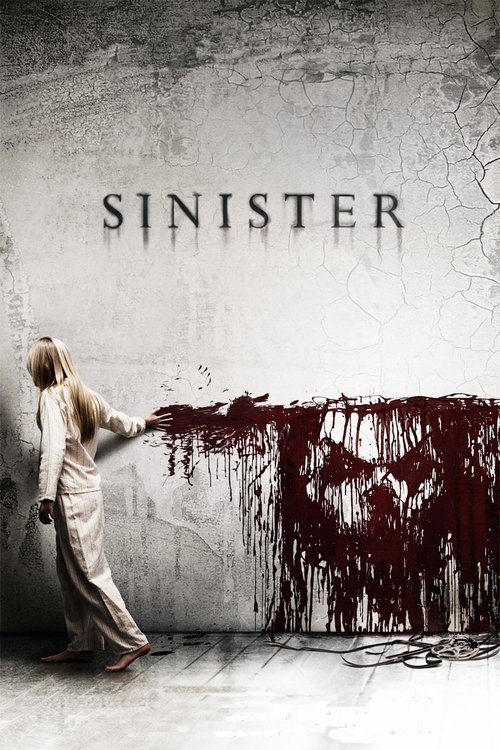
Sinister
2012 · Scott Derrickson
When you're craving a real scare, not a fun one — this is lights-off, dare-a-friend horror that trades in dread rather than gore. Not the pick for a squeamish night.
What it's about
A true-crime writer, a decade past his one bestseller and desperate for another, moves his unsuspecting family into a house where the previous family was murdered — because the case is his next book. In the attic he finds a box of old Super 8 home movies, and what's on those reels is far worse, and far older, than the crime he came to solve.
The experience
Genuinely one of the scariest mainstream horror films of its decade — a slow, dread-soaked investigation punctured by the queasy ritual of watching those murder reels, each one worse than the last. It gets under your skin and stays there past bedtime.
Performances
Ethan Hawke grounds the whole film, playing ambition curdling into obsession — a man who keeps pressing play when every instinct says stop — and his conviction is what makes the terror land.
The craft
Scott Derrickson's masterstroke is the film-within-the-film: grainy, silent 8mm footage that feels obscenely real against the polished frame around it. The sound design is the secret weapon — a scraping, near-industrial score and droning textures that make even empty hallways feel wrong. Watch it loud, in the dark.
Why it matters
A defining hit of the low-budget Blumhouse horror boom, it proved a modest, idea-driven scary movie could dominate multiplexes, and its cursed-footage imagery echoed through a decade of horror that followed.
Horror · Possession & occult · Found footage · Haunted house & ghost story. A failing true-crime writer finds Super 8 murder reels in his new attic: slow-burn dread, droning sound, a few savage jolts.
Snapshot
Sinister is a supernatural horror film in which a fading true-crime author, Ellison Oswalt (Ethan Hawke), moves his family into a house where a previous family was murdered — hoping the case will restore his career — and discovers a box of Super 8 home movies documenting a chain of family killings stretching back decades. The films lead him to a pagan entity, Bughuul, who abducts children and feeds on their souls, using the recorded murders as both lure and conduit. Directed by Scott Derrickson from a screenplay he co-wrote with C. Robert Cargill, and produced under the low-budget Blumhouse model, the picture became one of the defining commercial horror successes of the early 2010s. Its lasting signature is the found-footage-within-a-narrative-film device — the grainy 8mm "murder reels" — and a punishing, near-industrial sound design that helped cement its reputation, later amplified by a widely reported physiological "scariest film" study, as an unusually visceral genre entry.
Industry & production
Sinister is a characteristic product of the Blumhouse Productions system that reshaped studio-adjacent horror after Paranormal Activity (2007) and Insidious (2010). The economic logic was Jason Blum's now-familiar model: a tightly capped budget — widely reported at roughly $3 million — traded for creative latitude, with the upside captured through wide theatrical distribution. The film was produced in association with Alliance Films and IM Global (whose Stuart Ford handled international sales), and released theatrically in the United States by Summit Entertainment in October 2012, a berth timed squarely to the Halloween corridor.
Against its small negative cost, Sinister was a substantial earner; it is generally reported to have grossed on the order of $77–88 million worldwide, a return-on-investment profile that made it exemplary of the Blumhouse thesis that disciplined budgets and strong hooks outperform expensive spectacle in horror. That success directly generated a follow-up, Sinister 2 (2015), directed by Ciarán Foy with Derrickson and Cargill again writing but ceding the chair — a division of labor that itself reflected the franchise-factory instincts of the period.
Production was mounted largely in and around New York State. The domestic scale of the story — one house, one family, a study full of a projector and film cans — suited the budget, concentrating resources on a handful of locations and on the fabrication of the pivotal home-movie footage rather than on effects set-pieces.
Technology
The film's most consequential technical decision was material rather than digital: the "murder films" that drive the plot were shot on genuine Super 8, not faked in post. That choice gives the reels their authentically degraded grain, gate weave, frame stutter, and the mechanical clatter of a projector — textures that digital emulation of the era tended to render too clean. The physicality of the format is thematically load-bearing: Bughuul lives in the images, and the analog medium's imperfections read as a kind of contamination.
The surrounding narrative was captured on contemporary digital cinematography typical of a 2012 low-budget feature, which sets up a deliberate two-tier visual system: the crisp, controlled present against the smeared, unstable past. The projector itself becomes a diegetic technology of dread — the act of threading film, the beam of light, the whir and the click are staged as ritual apparatus. In this sense Sinister belongs to a lineage of horror that treats recording and playback devices (the cursed videotape of Ringu/The Ring, the camcorder of found-footage) as haunted objects; here the specific technology is the mid-century amateur film gauge, which lends the terror a nostalgic, domestic register.
Technique
Cinematography
Christopher Norr's photography organizes the film around darkness as a withholding of information. Ellison spends much of the running time moving through an underlit house with a lamp or the projector's glow as his only source, and the compositions repeatedly bury threat in the deep, unresolved black of doorways, the attic, and the yard at night. The camera favors slow, controlled movement and long-held frames that invite the viewer to scan the edges — a strategy that weaponizes the audience's own looking, since Bughuul and the ghost-children are frequently there, in soft focus or at the frame's margin, before any cut acknowledges them. The 8mm inserts contrast sharply: shot with the flat, sun-struck or harshly overexposed look of amateur footage, their banality (a backyard, a pool, a lawn) is precisely what makes the violence they document obscene.
Editing
Frédéric Thoraval's cutting is built on the rhythm of discovery. The spine of the film is Ellison watching, rewinding, and slowing the murder reels, and the edit models his obsessive scrutiny — freezing, zooming, returning to a detail, so that the audience learns to dread the next frame as he does. The film's most discussed shocks are constructed less as sudden intrusions than as the eye finally resolving something that was patiently held in view; the editing withholds the reverse angle or the reveal until it lands with maximum force. Cross-cutting between Ellison's waking investigation and his mounting sleeplessness blurs the boundary between evidence and hallucination, so the viewer, like the protagonist, loses confidence about what is diegetically "real."
Mise-en-scène / staging
The production design concentrates meaning in the study: the box of films, the projector, the reels labeled with cheerful domestic euphemisms — BBQ '79, Pool Party '66, Sleepy Time '98, Lawn Work '86, Hanging Out '11 — whose innocuousness is the point. Bughuul's mythology is developed through images-within-images: crude symbols and a recurring painted or drawn figure that Ellison uncovers across the reels and in the children's artwork, staging the entity as something that propagates through representation itself. The single-house setting is used to make the familiar uncanny — an attic that shouldn't be occupied, a yard with a tree that recurs across decades of footage — so that domestic space becomes a trap that has closed before the family ever arrives.
Sound
Sound is arguably Sinister's most aggressive instrument. Composer Christopher Young departed from conventional orchestral scoring toward a design-led approach dominated by drones, distorted and processed vocals, metallic scrapes, and rhythmic industrial noise; the "score" is often indistinguishable from sound effect, which keeps the audience in a state of unresolved tension. Crucially, several of the Super 8 sequences are scored not with the composer's cues but with pre-existing experimental and dark-ambient tracks, whose alien textures curdle the home-movie imagery. The exact needle-drop attributions are a matter for the film's music credits rather than for confident summary here, but the strategy is clear and consistent: pair the most mundane images with the most abrasive, non-diegetically "wrong" sound, so that the ear signals horror the eye hasn't yet earned.
Performance
Ethan Hawke anchors the film in a register of ambition and denial. His Ellison is not a passive victim but a compromised man whose vanity — the desire to matter again, to reclaim the fame of a decade-old bestseller — makes him keep watching the very footage that dooms his family. Hawke plays the deterioration physically: the whiskey, the exhaustion, the fraying marriage with Tracy (Juliet Rylance), whose objections give the film its moral counter-voice. James Ransone provides tonal relief and exposition as the eager local deputy who becomes Ellison's remote researcher, while Vincent D'Onofrio appears, largely via webcam, as an academic who supplies the Bughuul mythology — a staging that keeps the budget lean while lending the lore an air of scholarly authority. The child performers (Clare Foley and Michael Hall D'Addario as the Oswalt children) carry the film's cruelest turn, since the mythology's logic runs on and through them.
Narrative & dramatic mode
The film operates as an investigative descent: a detective structure grafted onto a haunting. Ellison functions as reader-surrogate detective, assembling a pattern from fragments, and the audience solves the case alongside him — a mode inherited from literary true crime and from procedural horror. But the dramatic engine is tragic rather than triumphant: every advance in Ellison's knowledge is also an advance in his damnation, and the investigation's success is the catastrophe. The screenplay withholds the full mythology until late, converting exposition into escalation, and it closes on an ironic reversal that recontextualizes the family's arrival as the last move in a game already lost. This fusion of whodunit momentum with foreordained doom gives Sinister a fatalism closer to tragedy than to the survival arc of much mainstream horror.
Genre & cycle
Sinister sits at the intersection of the supernatural-entity horror cycle of the late 2000s–early 2010s and the found-footage boom, without being a pure example of either. It borrows found footage's aesthetic of degraded, "authentic" recording but embeds it inside a conventionally shot narrative — a hybrid that lets it exploit amateur-film verisimilitude while retaining classical control of point of view. In cycle terms it belongs beside the Blumhouse haunted-family films (Insidious, Paranormal Activity and their sequels) that dominated the period, sharing their domestic settings, their child-in-peril anxieties, and their economic model. Its distinctive contribution to the cycle is the cursed-media conceit repurposed for the true-crime era: the boogeyman as a figure who spreads through images and demands that his crimes be recorded and re-watched.
Authorship & method
Scott Derrickson is among the few contemporary American horror directors whose work is explicitly informed by theological conviction; a practicing Christian, he has repeatedly returned to the problem of evil as a genuine metaphysical question rather than a mere genre engine, from The Exorcism of Emily Rose (2005) through Deliver Us from Evil (2014). Sinister extends that preoccupation: Bughuul is framed as an ancient pagan deity, and the film is finally about the seduction of a man who looks too long at evil for the wrong reasons. Derrickson's method here favors dread-building patience and craft-forward suspense over gore, and a willingness to end darkly.
His co-writer, C. Robert Cargill, came to screenwriting from film criticism (writing as "Massawyrm"); the pair's collaboration, which continued through Sinister 2 and later Doctor Strange (2016) and The Black Phone (2021), is central to Derrickson's authorship. By Cargill's own widely repeated account, the seed of Sinister was a nightmare he had after seeing The Ring — an origin that fits the finished film's fixation on cursed footage. Key collaborators shaping the sensibility include cinematographer Christopher Norr, editor Frédéric Thoraval, and composer Christopher Young, whose noise-forward score is inseparable from the film's effect. The specific balance of authorship among these figures beyond their credited roles is not richly documented in the public record.
Movement / national cinema
Sinister is a work of mainstream American commercial horror, not of any avant-garde or national movement. Its most meaningful lineage is industrial: the Blumhouse "micro-budget, wide-release" paradigm that constituted a genuine shift in how American horror was financed and distributed in the 2010s. That said, its cursed-recording premise carries an unmistakable debt to the Japanese horror wave of the late 1990s — above all Ringu (1998) and its American remake The Ring (2002) — so the film can be read as an American absorption of J-horror's media-haunting motif into a domestic true-crime frame.
Era / period
The film is very much of its early-2010s moment. It arrives at the crest of found-footage's mainstream saturation and channels the same cultural appetite for "authentic" recorded horror, while its true-crime-writer protagonist anticipates — rather than rides — the mass true-crime boom that podcasting and streaming would ignite a few years later. Its anxieties are period-specific: the fading print-media author chasing relevance, the archive of amateur film as a repository of buried atrocity, the sense that images once recorded can never be safely un-seen. Technologically it straddles analog and digital, using the obsolescence of Super 8 as a source of uncanny historical depth.
Themes
The governing theme is the corrupting cost of looking. Ellison's tragedy is authorial vanity: he keeps watching the murders because they promise him significance, and the film indicts the true-crime impulse — the monetization of others' deaths — even as it delivers its pleasures. Bughuul, a deity who requires that his crimes be filmed and viewed, literalizes the idea that spectatorship is complicity, implicating the audience in Ellison's compulsion. Around this sit the cycle's recurring anxieties: the family as the unit most exposed to horror, children as both victims and instruments, and the home as a space that offers no safety. Underneath runs Derrickson's persistent metaphysics — evil as an ancient, patient, external agency rather than a psychological aberration — and a bleak meditation on legacy: Ellison wants to leave a mark on the world, and the film grants that wish in the cruelest possible form.
Reception, canon & influence
Critically, Sinister was received as a superior example of studio-adjacent horror: reviewers tended to credit its atmosphere, Hawke's committed lead performance, and the genuine dread of the 8mm sequences, while some registered the familiar mechanics of its jump-scare architecture and third-act exposition. Commercially it was a clear hit relative to cost, reinforcing Blumhouse's ascendancy.
Its influences run backward to the cursed-media horror of Ringu/The Ring, to the found-footage tradition it hybridizes, and to the true-crime and detective structures that shape its plot; Cargill's stated Ring-nightmare origin makes that debt unusually explicit. Looking forward, the film's most concrete legacy is the direct sequel Sinister 2 (2015) and its consolidation of the Derrickson–Cargill partnership, which fed into their later genre work. It also entered popular consciousness through a much-cited physiological study, reported around 2020, that used viewers' heart-rate data to rank Sinister as the "scariest" film in its sample — a piece of extra-critical canonization that has done as much as any review to fix the film's reputation as a benchmark of pure fright. More diffusely, its analog-artifact aesthetic — grainy home-movie footage as a vector for supernatural evil — became a reference point for a strand of 2010s horror invested in the uncanny of obsolete recording media. Beyond these threads, claims about its wider influence should be made cautiously, as the scholarly record on the film remains relatively thin.
A Deleuzian reading
A label on a film can, lettered by hand in a cheerful script: *Pool Party '66*.
The full Deleuzian reading of Sinister →
Reception
In 2012 it landed as a solid Blumhouse hit with mixed-to-decent reviews; a decade on it's routinely crowned the scariest film ever made, after a 2020 heart-rate study ('Science of Scare') put it at #1 — a title horror fans have argued about ever since.
How Sinister was received, from release to now →
How to watch Sinister: what to notice on a first viewing
- Watch doorways, the attic, and the night yard stay unresolved black. Christopher Norr repeatedly buries threat in deep, uncleared darkness instead of lighting it clearly, so you never fully see what a space contains. The dark itself becomes the danger, a place your eyes can't finish searching.
- Notice the frame's edges during long, still indoor shots. Soft-focus shapes sit at the margins of long, still shots, well before any cut confirms what they are. Your own scanning is what finds the threat; the scares work because you went looking.
- Listen for harsh drones or metallic noise under ordinary home-movie footage. Christopher Young pairs mundane images, a lawn, a pool, a backyard party, with abrasive, non-diegetic-feeling sound. The ear signals horror before the eye has any evidence to support it.
- Notice the handwritten labels on the film reels. Cheerful titles like Pool Party '66, BBQ '79, and Lawn Work '86 promise ordinary home movies and deliver the opposite. The friendly labeling is exactly what makes the violence inside each reel land harder.
- Watch Ethan Hawke's hands: pouring whiskey, rewinding the projector, again and again. Hawke plays Ellison's decline through small repeated physical habits rather than big dramatic outbursts. The compulsion to keep watching is shown as a body wearing itself down, not just a decision.
The whole guide to watching Sinister, with the keys for a rewatch →
Influences: the films it descends from and the films it influenced
- Ringu (1998) — Establishes the cursed-recording mechanism — a supernatural entity propagated through a physical analog medium whose act of viewing dooms the watcher — which Sinister transposes wholesale from videotape onto 8mm reels.
- The Ring (2002) — Cargill's stated nightmare-after-The-Ring origin makes the debt explicit; its degraded, high-contrast scratched-film inserts codified the grainy analog-artifact grammar Sinister uses for its snuff home-movies.
- Cannibal Holocaust (1980) — Pioneers found-footage as a recovered-atrocity document that morally implicates the viewer for watching, the exact spectatorship-as-complicity charge Sinister builds around Ellison's compulsive re-viewing.
- Peeping Tom (1960) — Camera-as-murder-instrument and the viewer made complicit in a killer's recorded kills; the 'looking too long at evil' moral that Sinister literalizes in Hawke's ambition-driven projector obsession.
- The Blair Witch Project (1999) — Weaponizes off-frame darkness as the primary withholding device and models the editing rhythm of scanning found footage for the thing you dread to find.
- The Shining (1980) — The isolated-writer-destroying-his-family template plus marginal framing and Penderecki-style dissonant sound design that seeds Christopher Young's noise-forward, musique-concrète-leaning score.
- Rosemary's Baby (1968) — Patient domestic dread organized around an ancient pagan deity quietly encroaching on a family unit, with gore withheld in favor of accumulating unease — Derrickson's Bughuul playbook.
- The Exorcism of Emily Rose (2005) — Derrickson's own prior film supplies the investigative/forensic structure that treats the reality of evil as a genuine metaphysical question rather than a genre engine, the authorship method Sinister extends.
- Se7en (1995) — Dariusz Wolski—wait Khondji—darkness-as-withholding cinematography in which the frame conceals more than it reveals, plus the protagonist poring over an archive of atrocity in a lamplit study.
- Henry: Portrait of a Serial Killer (1986) — The infamous camcorder replay of a family's murder forces the viewer to re-watch recorded killing on a diegetic screen, the diegetic-mismatch home-video dread Sinister systematizes.
- Shutter (2004) — It turns Shutter's camera that sees what the eye cannot into a horror of studying footage. A writer goes through home-movie reels frame by frame and finds a figure hidden at the edges of each one.
- Sinister 2 (2015) — Direct sequel continuing the 8mm-reel mythology and Derrickson–Cargill's Bughuul conceit, shifting the found-footage viewing ritual onto child protagonists.
- The Black Phone (2021) — The Derrickson–Cargill reunion extends period analog-media dread and child-victim mythology with the same craft-forward restraint that favors suspense over gore.
- Skinamarink (2022) — Pushes darkness-as-withholding to an extreme, letting analog grain and off-frame sound carry the entire horror load, the logical endpoint of Sinister's withholding cinematography.
- Late Night with the Devil (2023) — Found-footage/period-broadcast hybrid that frames supernatural evil through recovered obsolete media, extending Sinister's haunted-media-as-container conceit.
- Doctor Strange (2016) — Derrickson and co-writer C. Robert Cargill carry over their horror grammar—faces multiplying, bodies distending, reality decaying at the edges of frame—supplying the uncanny grotesquerie that distinguishes Strange from standardized MCU dramaturgy.
- Bring Her Back (2025) — Models the diegetic home-movie / found-footage-within-the-film as an engine of dread and as literal instruction for a fatal occult ritual.
- undertone (2026) — The film is organized as a series of found reels that a lone protagonist screens alone at night in a house. Each reel escalates, the camera keeps cutting back to the viewer's reactions, and a children's-music motif ties the reels to a malevolent figure. It anticipates Undertone's serial tape structure and its lullaby motifs.
- Zodiac (2007) — The investigative-descent arc in which obsession with case media consumes the investigator's marriage and sanity — the narrative engine of Ellison's true-crime research.
- The Poughkeepsie Tapes (2007) — A serial killer's own home-movie archive presented as a horror text to be discovered and studied — the direct precursor to Bughuul's reels of staged family murders.
- V/H/S (2012) — Same-year anthology built on the uncanny of obsolete recording media — VHS grain, tracking artifacts — as the very vector of supernatural evil, the analog-artifact aesthetic Sinister shares.
- It Follows (2014) — Disasterpeace's noise-and-synth-forward score paired with marginal framing that parks menace at the edge of the widescreen extends Sinister's sound-plus-composition dread grammar.
- Longlegs (2024) — Runs the same true-crime/occult procedural engine, with an investigator decoding analog home-movie footage to uncover a serial demonic pattern across decades.
- Insidious (2011) — Blumhouse contemporary that runs the same playbook: atmosphere-first PG-13-adjacent dread built on Bishara-style abrasive sound stings and quiet-domestic-space-turned-hostile rather than gore.
- The Conjuring (2013) — Structures its horror as an investigator sifting a found family archive, pairing long stretches of silence-and-diegetic-cue dread with an abrasive dissonant score in the same register as Bishara's.
- The Conjuring 2 (2016) — Parallel studio-horror investigation film pairing a true-crime research framing with a dissonant, guttural sound-design score, sharing Conjuring 2's dread-through-audio approach and skeptic-protagonist arc.
- The Conjuring: The Devil Made Me Do It (2021) — Sibling in the true-crime-investigation-meets-occult hybrid, where a researcher combs through found evidence of murders to uncover a supernatural agent, using silence-to-sting sound to punctuate discovery.
- Doctor Strange in the Multiverse of Madness (2022) — Derrickson directed the first Doctor Strange precisely because of his horror pedigree; this film models the sub-bass-drone, dread-forward sound design that the seed inherits and amplifies within the franchise.
- Incantation (2022) — Deploys the found-footage-within-the-film device in which viewing cursed home movies transmits the curse to the watcher — the recursive cursed-media conduit central to Incantation.
- The Conjuring: Last Rites (2025) — Parallel true-crime-inflected domestic haunting where a researcher's investigation drives the dread and diegetic-object horror (found home-movie footage) anchors the scares.
Similar films
- The Blair Witch Project (1999) — influence & lineage · same viewing thread
- The Shining (1980) — influence & lineage
- Henry: Portrait of a Serial Killer (1986) — influence & lineage
- Insidious (2011) — same viewing thread
- undertone (2026) — same viewing thread
- The Conjuring (2013) — same viewing thread
- The Medium (2021) — same viewing thread
- Hereditary (2018) — same viewing thread
All the films related to Sinister →
Watch it with: curated runs of related films
- Something in the Family Home — A run of hauntings that go after the family unit itself — watch them together and you'll see the Wan-era jump-scare house turn into Aster's grief-rotted dollhouse and the folk-horror homesteads of Java and Japan.
- The House Remembers Its Grief — A run of family hauntings where the ghost is never just a ghost: watch these together to see the slammed-door haunted house of the multiplex slowly turn into mourning, guilt and things the family won't say.
- The Camera Kept Rolling — A run of found-footage and fake-documentary horror. Every film rhymes on the same dread: someone points a camera at the dark, insists on filming, and leaves us the recording. It moves from the Maryland woods to Barcelona stairwells, Seoul asylums, Taiwanese curses and Thai shamans.