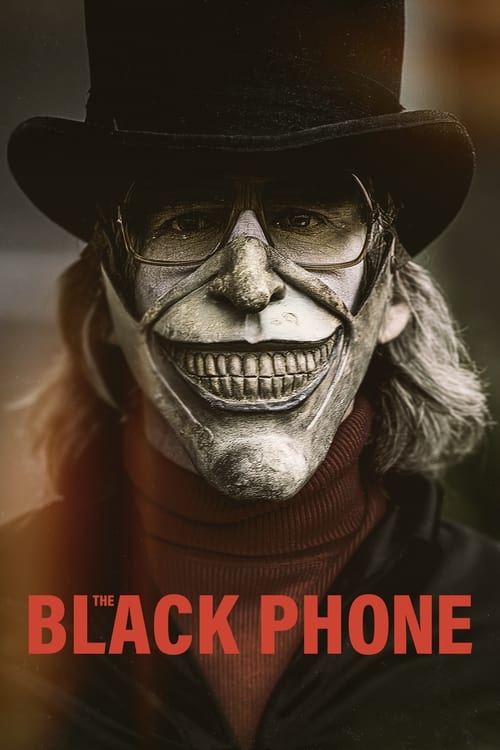
The Black Phone
2022 · Scott Derrickson
When you're craving a real scare but want a story with a heart in it — horror where you're rooting hard for a kid, not just bracing for the next jump. Intense but never hopeless; a strong pick for a tense night that ends with your fist in the air.
What it's about
In a working-class Denver suburb in the late 1970s, a shy, bullied thirteen-year-old named Finney is snatched off the street by a masked child-killer the town calls The Grabber and locked in a bare, soundproofed basement. On the wall hangs a disconnected phone — and it starts to ring. The voices on the line belong to the killer's previous victims, and each one has something to teach Finney about getting out alive.
The experience
A slow-tightening vise: long stretches of dread in that basement punctuated by jolts, but the fear is grounded in something real — schoolyard fights, a violent home, kids looking out for each other. It's scary and genuinely moving at once, and the period grit makes every scrape and bruise feel earned.
Performances
Ethan Hawke works almost entirely from behind a devil mask and makes every half-glimpsed mouth and soft-spoken line skin-crawling — a rare villain turn from an actor who usually plays decent men. Mason Thames carries the film as Finney, and Madeleine McGraw nearly steals it as his foul-mouthed, fiercely loyal little sister.
The craft
Derrickson shoots 1978 suburbia with tactile, lived-in detail — bikes, bruises, wood-paneled kitchens — then lets the supernatural in through sound: the dead ring of that phone, voices crackling down a dead line. The mask design alone, with its interchangeable expressions, does more menace than most films manage with gore. Rewards good speakers; the phone's ring will get under your skin.
Why it matters
A major sleeper hit for Blumhouse that reconfirmed Derrickson as a top-tier horror director after his Marvel detour, and it minted a new iconic masked villain in an era short on them. It also cemented Joe Hill as a source of first-rate screen horror in his own right.
Horror · Serial-killer thriller · Haunted house & ghost story · Teen horror. A boy is locked in a killer's soundproof basement in the 1970s, and a dead phone rings with ghosts: claustrophobic dread, with heart.
Snapshot
The Black Phone is a supernatural horror-thriller adapted from a Joe Hill short story, directed by Scott Derrickson from a screenplay he co-wrote with C. Robert Cargill. Set in a working-class Denver suburb in the late 1970s, it follows Finney Blake (Mason Thames), a bullied thirteen-year-old abducted by a masked child-killer known only as "The Grabber" (Ethan Hawke) and held in a bare, soundproofed basement. A disconnected wall phone begins to ring, carrying the voices of the killer's earlier victims, who coach Finney toward escape. The film braids two registers that Derrickson had long favored: the tactile realism of period American childhood and a restrained supernatural apparatus. Produced by Jason Blum's Blumhouse on a characteristically modest budget, it became a substantial commercial success and re-established Derrickson as a horror director of the first rank after his detour into franchise filmmaking. It is a film about survival, sibling loyalty, and the transmission of trauma — and about the specific dread of a decade when American children disappeared and the culture only slowly learned to speak of it.
Industry & production
The Black Phone was produced by Blumhouse Productions in partnership with Derrickson and Cargill's own Crooked Highway banner, and distributed by Universal Pictures. It sits squarely within the Blumhouse economic model: a tightly capped budget — widely reported at roughly $16–18 million — traded against creative latitude and a favorable back-end for talent. That model has repeatedly produced outsized returns (Blumhouse's Get Out, Split, the Insidious and Purge cycles), and The Black Phone followed suit, earning, per widely reported figures, in the neighborhood of $161 million worldwide — a strong multiple on its cost and one of the more profitable horror releases of its year.
The production carried a clear biographical charge. Derrickson had exited Doctor Strange in the Multiverse of Madness over stated creative differences, and The Black Phone marked his deliberate return to the horror idiom in which he built his name. The 1978 setting was drawn in part from his own memories of growing up in Denver, and the film's texture of casual playground violence, latchkey households, and functional alcoholism reads as personal rather than merely nostalgic. The picture premiered at Fantastic Fest in September 2021 before a theatrical release on June 24, 2022, after a pandemic-related delay from an earlier date. Its reunion of Derrickson, Cargill, and Ethan Hawke — the trio behind Sinister (2012) — gave the project continuity of authorship uncommon in studio-adjacent horror.
Technology
The film was shot digitally, and its craft achievements are largely analog in feeling rather than in capture medium. The most conspicuous technological gesture is the use of grainy Super 8-style footage for the psychic dream sequences of Finney's sister Gwen and for the killer's own imagery — a texture that evokes 1970s home movies and forensic ephemera, and that visually cordons off the supernatural from the film's otherwise naturalistic present. The Grabber's mask, a modular device with interchangeable upper and lower halves that let Hawke expose or conceal mouth and eyes, was designed by the special-effects veteran Tom Savini with Jason Baker; it functions as a piece of practical technology within the fiction as much as a design object, its swappable parts choreographing the character's shifting moods. The soundproofed basement is itself a technological premise — the story's engine is a space engineered to defeat sound, against which the ringing of a dead, unwired telephone becomes the film's central impossibility. Mark Korven's score deploys unconventional acoustic sound-generating instruments (a practice associated with his invention, the "Apprehension Engine"), keeping even the film's dread grounded in physical, hand-made sources rather than synthesized ones.
Technique
Cinematography
Brett Jutkiewicz — who had shot Ready or Not and the 2022 Scream — photographs the film with a muted, period-appropriate palette of browns, ochres, and cold basement grays, favoring available-light naturalism in the suburban exteriors and a claustrophobic, sourced-light look in the cellar. The basement is shot to feel both large and inescapable: the phone on the wall, the small barred window, the mattress, and the door are established as a fixed geography the audience learns as thoroughly as Finney does. Jutkiewicz alternates this confinement with the openness of the neighborhood — bikes, alleys, schoolyards — so that the abduction registers as a violent collapse of scale. The Super 8 inserts provide a deliberate rupture in image quality, marking the psychic and the remembered.
Editing
Cut by Frédéric Thoraval — a French editor best known for the propulsive Taken and Peppermint — the film maintains a patient, escalating rhythm rather than a jolt-driven one. Thoraval's task is unusual for horror: much of the drama is a boy alone in a room on the phone, and the editing sustains tension through the accumulation of small procedural steps (each ghost offering one fragment of a plan) intercut with Gwen's parallel investigation above ground. The cross-cutting between Finney's confinement and Gwen's visions gives the film its two-track momentum and lets the climax converge the supernatural and the physical.
Mise-en-scène / staging
Production design commits fully to 1978: wood paneling, rotary phones, Farrah Fawcett posters, cracked sidewalks, and the low-slung architecture of a Denver suburb. The staging of the basement is the film's central spatial idea — a stripped, near-empty room whose few elements (phone, window, floor) are each seeded as instruments of escape, so that the space reads in retrospect as a puzzle. The Grabber is repeatedly staged as a partial, withholding presence: framed in doorways, masked, often shot so that his intentions are illegible. This staging of concealment is the film's dominant visual strategy.
Sound
Sound is thematically foundational. The premise hinges on a soundproofed room — an environment defined by the suppression of sound — against which the anomalous ring of the black phone becomes the film's recurring shock and lifeline. The voices of the dead are treated with distortion and spatial ambiguity, neither wholly present nor wholly imagined. Korven's largely acoustic score leans on scraped, bowed, and resonant textures that keep the supernatural sonically tethered to something physical, avoiding the digital sheen of much contemporary horror scoring.
Performance
Ethan Hawke, an actor who had rarely if ever played an outright villain across a long career, is the film's most discussed performance precisely because it is a study in withholding: hidden behind the mask for most of his screen time, he acts through posture, breath, vocal register, and the mask's mechanical grins and scowls. Mason Thames, in an early leading role, carries the film's interior arc from passivity to resolve, while Madeleine McGraw as Gwen provides its volatile emotional charge — profane, protective, and frightened — in a performance widely singled out by critics. James Ransone appears in a memorable supporting turn. The child performances are central to the film's success, and the record credibly attributes much of that to Derrickson's direction of young actors.
Narrative & dramatic mode
The film operates in a hybrid mode: a grounded, coming-of-age realist drama about siblings and abuse, fused with a captivity thriller and a ghost story. Its dramatic engine is procedural — escape assembled piece by piece from the testimony of the dead — which lends the supernatural an unusually pragmatic function: the ghosts are not there to frighten so much as to instruct. Structurally, the narrative runs on parallel tracks, Finney below and Gwen above, with the supernatural (the phone; Gwen's dreams) serving as the connective tissue that will eventually let the two converge. The dramatic arc is one of transformation: Finney must metabolize the accumulated knowledge of every boy who failed before him, so that his survival is figured as a collective victory of the murdered over their murderer.
Genre & cycle
The Black Phone belongs to several overlapping cycles at once. It is a Blumhouse-era studio horror film, participating in that company's post-2013 revival of theatrical horror on disciplined budgets. It is a period-set "kids in peril" story in the lineage descended from Stephen King's It and Stand By Me — a lineage the film inherits almost literally, since its source author, Joe Hill, is King's son. And it is a serial-killer thriller drawing on the real cultural memory of 1970s child murders. The film sits within the broader 2010s–2020s wave of nostalgia-inflected horror (alongside phenomena like It Came at Night, the It remakes, and Stranger Things) that mined late-1970s and 1980s Americana for both warmth and dread.
Authorship & method
Scott Derrickson's career braids studio genre work (The Exorcism of Emily Rose, the Doctor Strange MCU entry) with a personal, more austere horror sensibility (Sinister). The Black Phone is the clearest expression of the latter mode, and it is inseparable from his long-running collaboration with C. Robert Cargill, his co-writer here and on Sinister and Doctor Strange. The pair's adaptation expands Hill's compact short story considerably — deepening Gwen's role, the domestic backstory, and the abusive father — while preserving the story's central conceit of the ringing phone. Ethan Hawke's participation extends a relationship that began with Sinister, and his willingness to play a concealed villain speaks to a trust between actor and director. Key craft collaborators — cinematographer Brett Jutkiewicz, composer Mark Korven, and editor Frédéric Thoraval — each bring a distinct pedigree (elevated-horror photography, hand-built acoustic scoring, propulsive thriller cutting) that the film synthesizes. The mask by Tom Savini and Jason Baker links the production to a lineage of American practical-effects craft. Derrickson's stated method here — drawing on autobiography, directing children with unusual care, favoring restraint over spectacle — is legible throughout.
Movement / national cinema
The film is a product of American commercial horror, specifically the Blumhouse-centered ecosystem that reshaped the genre's economics in the 2010s. It is not part of an aesthetic "movement" in the formal sense, but it can be productively read alongside the loosely grouped "elevated horror" tendency of the period — films that pursue character, atmosphere, and thematic seriousness within genre — a tendency signaled here by the presence of Korven, whose scores for The Witch and The Lighthouse helped define that sound. Its national character is emphatically American and regional: a Denver-set, Middle-American story rooted in Derrickson's own geography.
Era / period
Two eras matter. The film's diegetic period is 1978, and it is meticulous about it — the fashion, phones, cars, and the ambient, unsupervised danger of childhood before the "stranger danger" panic hardened into the missing-children movements of the 1980s. That setting is not incidental: the era's real anxieties about abducted children (the period overlaps the years of John Wayne Gacy's crimes, and the film's masked predator and buried victims evoke that cultural memory without claiming to depict it) give the horror its historical weight. The film's production era — the early 2020s — is equally legible in its nostalgia, its Blumhouse economics, and its participation in a broader cultural fascination with reconstructing the analog past.
Themes
The film's governing themes are survival, resilience, and the reclamation of agency by the powerless. Finney begins as a boy who will not fight — for himself against bullies, or for his sister against their father — and his arc is learning to strike back, a lesson delivered by the dead. Childhood abuse runs throughout: the murders are shadowed by the domestic violence of Finney and Gwen's alcoholic, grieving father, so that the basement is only the most extreme of the film's several traps for children. Solidarity among victims is a central idea — each dead boy contributes the piece of knowledge that will finally defeat the killer, making Finney's escape a communal act of the murdered against their murderer. Sibling loyalty, faith and the supernatural (Gwen's dreams framed in the language of prayer), and the porousness between the living and the dead round out the film's concerns.
Reception, canon & influence
Critical reception was broadly favorable. Reviewers praised the film's atmosphere and period craft, Ethan Hawke's against-type menace, and — with notable consistency — Madeleine McGraw's supporting performance; the ghost-coached escape premise was widely singled out as a fresh horror engine. Some critics found the supernatural mechanics or the killer's motivation underdeveloped, a not-uncommon reservation for expansions of short fiction. Commercially it was a clear success, and it is generally regarded as a high point of Derrickson's filmography and of the Blumhouse theatrical slate of its period.
Looking backward, the film's influences are legible: Joe Hill's 2004 short story (from the collection 20th Century Ghosts) as its direct source; the broader Stephen King lineage of imperiled children (It, Stand By Me) that Hill's own work both inherits and answers; the 1970s serial-killer imagination and its real-world referents; the dream-logic supernatural of films in the A Nightmare on Elm Street tradition, echoed in Gwen's prophetic visions; and Derrickson and Cargill's own Sinister, with which it shares a preoccupation with children, home-movie imagery, and predation.
Looking forward, its most concrete legacy is the sequel Black Phone 2 (released in 2025, again directed by Derrickson), which extends the property into a franchise and confirms the original's commercial staying power. More diffusely, the film reinforced several tendencies already ascendant in 2020s horror: the viability of period-set, character-driven genre films on modest budgets; the continued rehabilitation of practical effects and hand-built scoring; and the casting of "serious" dramatic actors as horror antagonists. Its longer canonical standing is still settling — it is recent enough that the historical record of its influence remains thin — but within the Blumhouse era and Derrickson's own body of work, its place is already secure.
A Deleuzian reading
A mattress on a concrete floor.
The full Deleuzian reading of The Black Phone →
Reception
A sleeper hit in summer 2022 — a Blumhouse original grossing over $160M on a small budget with warm reviews — it's since settled in as one of the decade's most beloved mainstream horrors, its status confirmed when the Grabber returned for a 2025 sequel.
How The Black Phone was received, from release to now →
How to watch The Black Phone: what to notice on a first viewing
- Notice the basement's four fixed objects: phone, window, mattress, door. Derrickson establishes each object early and returns to it repeatedly, so you learn the room's geography as thoroughly as Finney does. The room's bareness makes every object matter; nothing here is decoration.
- Watch Hawke communicate only through posture and breath while masked. Savini's modular mask swaps smiling and frowning halves while Hawke's actual face stays hidden almost the entire film. You read the killer's mood through gesture alone, never through an expression.
- Listen for how total the silence is before the phone rings. The basement is built to swallow screaming, so each ring breaks a silence, and the dead voices stay distorted, never quite located in space. A phone dead for years rings anyway; Deleuze calls an object that breaks its usual chain of meaning a demark, forcing you to think instead of assume.
- Track the cuts alternating Finney's basement with Gwen's scenes outside. Thoraval cross-cuts steadily between the two tracks, so each basement scene is answered by a search outside it. Tension accumulates from two parallel searches rather than from jump scares.
- Notice the color shift from the neighborhood's browns to the basement's cold grays. Jutkiewicz shoots exteriors in warm available light and the cellar in a sourced, claustrophobic gray. The palette makes the abduction feel like a collapse of the boy's entire visible world.
The whole guide to watching The Black Phone, with the keys for a rewatch →
Influences: the films it descends from and the films it influenced
- Sinister (2012) — The same Derrickson–Cargill writing team and Ethan Hawke built its horror engine on found analog imagery (Super-8 snuff reels), the exact device The Black Phone reprises with its grainy Super-8 inserts of the killer's crimes.
- The Changeling (1980) — Its plot machine — the ghost of a murdered child methodically feeding the living clues to expose and undo the crime — is the direct template for the procedural 'ghost-coaching' where dead boys phone Finney escape instructions.
- A Nightmare on Elm Street (1984) — Gwen's prophetic dream-visions that leak real investigative information into waking life extend Craven's device of the dream-space as a channel where a child perceives a predator the adults cannot.
- Halloween (1978) — Shares the literal 1978 setting and the mute, mask-wearing predator stalking suburban children, plus Carpenter's restraint of holding the killer as a blank 'shape' rather than a explained motive.
- Friday the 13th (1980) — Tom Savini's practical-effects work here established the American hand-built killer-mask lineage that Savini himself continues in The Black Phone's modular, interchangeable Grabber mask.
- Stand By Me (1986) — Reiner's elegiac period adaptation of a King/Hill-adjacent kids-in-peril story models the film's autobiographical, unusually tender direction of a child ensemble against adult brutality.
- Zodiac (2007) — Fincher's meticulous 1970s-set serial-killer procedural, with its muted period-accurate palette and dread built from process rather than gore, informs Jutkiewicz's desaturated period photography and the film's investigative structure.
- The Silence of the Lambs (1991) — Established the prestige move of casting a 'serious' dramatic actor as a concealed predator assembled from real composite killers — the exact register of Hawke's against-type, mostly-masked Grabber.
- The Sixth Sense (1999) — Its restrained supernatural grammar — the dead seeking a living child to complete their unfinished business, revealed through withheld information — underpins the film's coaching-ghosts conceit and refusal of spectacle.
- It Chapter Two (2019) — Period-set childhood-terror horror riding the late-2010s nostalgia-horror boom the It films crystallized, pairing a supernatural child-hunter with 70s Americana.
- Black Phone 2 (2025) — The direct sequel expands Gwen's prophetic dream-visions into a lead device and carries forward Korven's acoustic scoring and the Grabber's practical Savini mask into franchise form.
- The Boogeyman (2023) — Follows the same playbook of inflating a compact horror short story into a feature by deepening a domestic backstory and centering children menaced within the home.
- Late Night with the Devil (2023) — Extends the tendency the film reinforced — meticulous 1970s period reconstruction and analog-media texture (broadcast/film grain) as the primary source of horror atmosphere on a modest budget.
- Super 8 (2011) — Reaches for the same late-1970s Amblin nostalgia through kids and literal Super-8 footage, sharing the period-palette and the child-filmmaker analog texture the film weaves into its inserts.
- Prisoners (2013) — A child-abduction procedural whose wintry, desaturated cinematography and slow-dread staging of parental helplessness parallel the film's kidnapping engine and period-cold palette.
- The Witch (2015) — Shares composer Mark Korven's method of hand-built acoustic scoring on period and invented instruments, the austere, unsynthesized sound design that gives both films their tactile dread.
- Longlegs (2024) — Buries a marquee dramatic actor (Cage) under grotesque prosthetics as a 1970s-inflected occult serial killer, extending the same 'prestige actor as concealed monster' and analog-period craft.
- Five Nights at Freddy's (2023) — Blumhouse's prestige-horror mode built on 1970s/80s childhood-in-peril nostalgia and a restrained, character-first threat — the same fandom-friendly period-horror craftsmanship.
- The Call (2020) — A disconnected landline carries voices from another time (the dead victims) to a captive in a house. Each call's information changes the outcome, the same device The Call uses.
Similar films
- Sinister (2012) — influence & lineage
- Halloween (1978) — influence & lineage
- Terrifier 2 (2022) — same viewing thread
- Good Boy (2026) — same viewing thread
- Scream (2022) — same viewing thread
- Malignant (2021) — same viewing thread
- Sinners (2025) — same viewing thread
- Black Christmas (1974) — shared sensibility
All the films related to The Black Phone →
Watch it with: curated runs of related films
- Fresh Blood: 2020s Studio Horror — A run of the decade's mainstream fright machine — abduction shockers, franchise revivals, and one arthouse throwback — best watched back-to-back to feel how modern horror hunts its prey.
- Growing Up Is the Monster — Watch these together for horror where adolescence is the curse: a werewolf bite that arrives with puberty, a cheerleader who comes back hungry, a thing that follows you after sex, a possession game played for social media, and childhood evils the kids have to face themselves.