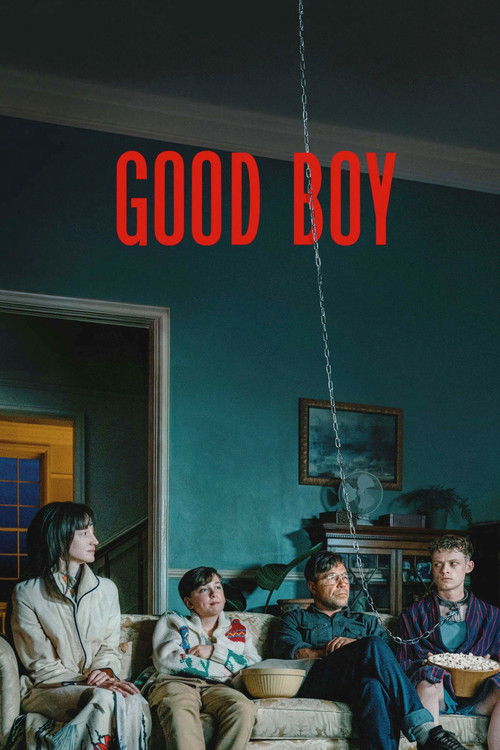
Good Boy
2026 · Jan Komasa
When you're craving a dark, twisty captivity thriller that gets under your skin — a confrontational watch for a night you want to be provoked, not soothed.
What it's about
Tommy is nineteen, volatile, and living for drugs, parties, and fights he films himself starting. Separated from his friends on a drunken night, he's abducted and wakes in the basement of a remote Yorkshire house, held by a family whose strangeness only deepens — and whose purpose for him is nothing he could have predicted. A captivity thriller where the question isn't just escape but what his captors actually want.
The experience
Claustrophobic, harsh, and genuinely unpredictable — it keeps pulling the floor out from under you, and it makes you queasily complicit in wondering whether its awful premise might be doing him good. Uncomfortable by design, with a streak of pitch-black perversity.
Performances
Anson Boon is ferocious as Tommy — feral, hateful, and slowly, unnervingly sympathetic, carrying the film through a role that spends much of its time caged.
The craft
Jan Komasa, in his English-language debut, runs the chamber piece on control: one house, a handful of people, and tension screwed tighter scene by scene. Produced with Jeremy Thomas's backing and shot between Leeds and Warsaw, it has the confidence of European art cinema applied to a nasty genre engine.
Why it matters
The English-language debut of one of Poland's most acclaimed younger directors, launched at Toronto's 50th festival — and released under three different titles in three countries, a small saga in itself.
Snapshot
A Polish director's English-language debut, made by Jerzy Skolimowski's producing unit with Jeremy Thomas, shot in Leeds and Warsaw, and released under three different names in three markets. Good Boy premiered in the Centerpiece section of the 50th Toronto International Film Festival on 5 September 2025; it reached Polish cinemas on 6 March 2026 via Kino Świat, the UK on 20 March as The Good Boy (Signature Entertainment), and the United States as Heel (Magnolia Pictures), the American retitling made to avoid collision with Ben Leonberg's 2025 dog's-eye horror film of the same name. TMDB indexes it under the 2026 date and the original title, which is how this dossier files it.
The premise is a captivity chamber piece with a perverse motive. Tommy (Anson Boon), a nineteen-year-old who films his own violence for an audience, is taken off the street and wakes chained in the basement of a remote Yorkshire house belonging to Chris (Stephen Graham) and Kathryn (Andrea Riseborough), who intend to rehabilitate him. The film runs 110 minutes and is, in genre terms, a black comedy thriller — a description its own distributors have had trouble settling on, which is part of the point.
The record here is unusually good for a film this recent: festival itinerary, crew, funding bodies, awards and reviews are documented. What is not documented, and is not asserted below, is budget, camera format and aspect ratio, and sound-department credits.
Industry & production
The origin story is verifiable and strange. The screenplay's first draft was written in a week by Bartek Bartosik, a Polish software engineer who had spent roughly eight years at a data company and started writing after friends gave him a screenwriting guidebook as a way through depression. Jerzy Skolimowski passed the script to Jan Komasa during the awards campaign for Corpus Christi — that is, in the winter of 2019–20, when Komasa's third feature was en route to an Academy Award nomination for Best International Feature.
In that first version the film was Polish-language, set in Warsaw, and followed a football hooligan; its subject was Polish class antagonism. Skolimowski's long-standing producer Jeremy Thomas pushed for a British transposition. Naqqash Khalid — a Manchester writer-director whose own feature In Camera (2023) is a mordant study of a British Asian actor auditioning for the roles the industry will give him — was brought in to rewrite it for English-speaking actors and to supply working dialect. Yorkshire funding then fixed the location: the film shoots in and around Leeds.
The financing is a textbook post-Brexit European co-production. Skopia Film (Poland — the company of Skolimowski and Ewa Piaskowska) and Recorded Picture Company (UK — Thomas) produce, with Desmar of Singapore attached; support comes from the BFI UK Global Screen Fund, Screen Yorkshire's Yorkshire Content Fund, and the Kujawsko-Pomorskie Film Fund in Poland. HanWay Films handled sales. Thomas, Piaskowska and Skolimowski are the credited producers. Principal photography completed in October 2024.
The UK Global Screen Fund matters structurally: established in 2021, it is part of the apparatus assembled after Britain's loss of Creative Europe access, and it exists precisely to keep British films inside European co-production chains. A Polish script, a Polish director, a Polish camera and cutting team, a British cast and a Yorkshire shoot is exactly the configuration that fund was designed to make possible.
Commercially the film has been modest: a reported worldwide gross of roughly $1.19 million against a long list of territorial distributors (X Verleih in German-speaking Europe, Minerva in Italy, Caramel in Spain, Catchplay in Taiwan, Front Row in the Middle East, among others). This is a festival-and-specialty release, sold on two star names and a hook.
Technology
The most interesting technological question the film poses is a format collision. Tommy's violence exists as footage — phone video, vertical, made for feeds — and the film has to put that footage inside a 110-minute cinema frame without letting it become mere illustration. The device Komasa retained from Bartosik's draft is the one worth naming: a dreamlike scene in which the family gathers around a 1970s television set to watch Tommy's TikToks. A CRT is 4:3, phosphor, warm, communal, and forty years obsolete; a TikTok is 9:16, backlit, solitary, and of the instant. Putting one inside the other is a piece of technological staging that says what the script would otherwise have to argue.
What Komasa took out is equally revealing. Bartosik's draft contained surreal passages in which characters "glitch and disappear." Komasa cut them: "I didn't need the device as we could work with actors to show going cold turkey in a more authentic way." Coming from the director of Suicide Room (2011) — a film built around a motion-captured, rendered online world that the protagonist retreats into — that is a deliberate renunciation. The director who once solved adolescence as a rendering problem now solves it with performers in a room.
Camera format and aspect ratio are not on the public record, and I will not guess at them. What can be said is that the film's mode — long takes in cramped practical interiors, low-light basement work — is the standard use case for large-format digital capture with fast glass, which is the register Michał Dymek has worked in on his recent features.
Technique
Cinematography
Michał Dymek, born around 1990, is one of the most consequential Polish cinematographers of his generation: Sweat (2020) and The Girl with the Needle (2024) for Magnus von Horn, Wolf (2021) for Nathalie Biancheri, Skolimowski's EO (2022), and Jesse Eisenberg's A Real Pain (2024). That filmography is the reason to take the look seriously. EO is a delirium of colour and lens distortion; A Real Pain is patient, plain and observational. Dymek is not a stylist with one signature, and the Good Boy assignment sits at neither extreme.
Reviewers have converged on the same description: a claustrophobic handling of the confined basement, stark low-key lighting, compositions that close the space rather than describe it, and tracking moves used to produce unease rather than geography. One TIFF notice described the basement as being made to feel like a theatrical stage for psychological warfare, which is the correct instinct about what a room of this kind has to do — it is a set within a set, the family's built apparatus, and the camera has to treat it as both prison and workshop.
The single documented departure is instructive: the production was, in its own description, a predominantly interior shoot with one significant outdoor sequence, a picnic, filmed as the last group scene of the schedule. In a film of basements, an exterior is not a change of scenery but a dramatic event, and shooting it last means the actors carried the accumulated interior weeks into open air.
Editing
Agnieszka Glińska cut EO — a film assembled from fragments, points of view and species, and one of the most radically edited European features of the 2020s. She is Łódź-trained, a member of the Polish, European and American academies, and the recruitment of both Dymek and Glińska means the Good Boy post unit is substantially the EO unit, lent to Komasa by its producers.
The demand here is the opposite of EO's. A captivity narrative has a fixed location and a fixed cast; its only variable is duration. Reviewers have credited the film with precise pacing and sustained tension, which in this form means the editor is managing the interval between interventions — how long the audience is left in the cell between the family's attempts on Tommy. Komasa's own account of the restructuring is an editorial statement before it is a script one: the Polish version opened with about forty minutes of Tommy's brutality, and the English version compresses that to roughly five minutes of montage. "In Poland, we have a higher tolerance for brutality in our cinema," Komasa has said. The compression moves the film's centre of gravity from the boy's life to the basement almost immediately, and it means the audience is asked to judge Tommy on a highlight reel — which is, not coincidentally, how Tommy presents himself.
Mise-en-scène / staging
Fletcher Jarvis is the production designer, and his credits point at the film's tonal register more precisely than any synopsis. He designed Peter Strickland's Flux Gourmet (2022) and Christopher Andrews's Bring Them Down (2024), was in the art department on Lynne Ramsay's You Were Never Really Here (2017), and art-directed Nick Rowland's Calm with Horses (2019). That is a line running from British rural hardness to European absurdist interior — exactly the seam this film sits on.
The staging problem is the family. The house is not a lair; it is a home with a programme in the cellar, and the design has to make domestic ordinariness and carceral purpose inhabit the same rooms. Komasa's stated reframing — "The film was initially about Tommy, but then it became about this one family unit… it's all about care in the end for them" — makes the upstairs as important as the down. The family includes a son, Jonathan (Kit Rakusen), and a household worker, Rina (Monika Frajczyk); the presence of employment inside the conspiracy is one of the film's more uncomfortable structural facts, and the film's harshest reviewer has faulted that strand as a distraction.
Sound
No sound-design credit is on the public record, so this section is short by necessity. The score is by Abel Korzeniowski, the Kraków-born composer of A Single Man (2009), Nocturnal Animals (2016), Penny Dreadful and Till (2022) — a writer of lush, rigorously tonal string music whose default mode is romantic dread rather than horror texture. Attaching him to a basement thriller is a tonal decision with an argument in it: Korzeniowski's idiom will treat the family's project as tragic and tender at the exact moments the images treat it as criminal. Given that the film's stated influence is Phantom Thread, that is almost certainly the intended friction.
Performance
This is where the film has drawn its firmest praise. Anson Boon won the Vittorio Gassman Award for Best Actor at the 20th Rome Film Fest on 25 October 2025, and reviewers have consistently named him the revelation: Tommy has to be genuinely repellent and legibly wounded without the film cross-fading between the two. Graham plays Chris with what one TIFF critic called a physicality recalling Javier Bardem, alternating menace and paternal calm; Riseborough's Kathryn begins nearly silent, flattened by grief, and animates as the "treatment" appears to work.
Graham has described building Chris outward from his shoes, and has offered the character's biography as the film's hidden symmetry: Chris is working-class, from Birkenhead, who acquired middle-class aspiration for his wife's sake — "he felt out of place, but would do anything for her" — while Tommy, who performs working-class delinquency, comes from money. Both men are impersonating a class. That is the mechanism the whole film runs on.
Komasa's method, as described by his cast, is emotional escalation through repetition: long takes, scenes run again and again at different intensities, actors pushed past their own control. Graham describes him using calming mantras before a take and then becoming "this mad, beautiful scientist throwing chemicals everywhere." Komasa's own account — "I have to hear the music of the scene… I'm overwhelmed. It's probably my ADHD talking" — is unusually unguarded for a director talking about method. Rakusen remembers the useful version of it: a direction given as the image of a bomb under the table.
Narrative & dramatic mode
The film is a captivity two-hander expanded into a family drama, and its dramatic engine is not will he escape but is it working. That is a significant choice. The escape thriller measures time against a door; the rehabilitation thriller measures it against a person, which means the audience is conscripted into the family's evaluative position — watching Tommy for signs of improvement, and therefore wanting the crime to succeed.
The title history encodes the mode exactly. Good Boy is praise you give a dog. Heel is a command you give a dog. The Good Boy is a description of a person. Every version of the name is a word from the training vocabulary, and the film's central question is whether a human being can be conditioned without being reduced to the animal the grammar implies.
Komasa has named Phantom Thread as an influence, specifically its treatment of love expressed through methods no outside observer would recognise as love. That is the cleanest available description of the film's moral design, and it also flags the risk: a film that insists cruelty is care is only a sentence away from asking an audience to endorse it. The dissenting criticism has landed precisely there.
Genre & cycle
Four cycles converge.
The conditioning film. A Clockwork Orange (1971) is unavoidable, and Komasa has addressed it directly: he regards it as part of cinema's DNA while consciously declining to imitate Kubrick. The differences are the point. Kubrick's Ludovico Technique is state apparatus, administered by institutions in an authoritarian near-future; here the apparatus is two people with a cellar and an idea, and the state is entirely absent. Privatised correction is a 2020s subject, not a 1971 one.
The captivity chamber piece. William Wyler's The Collector (1965) is the English ancestor — a class-inflected abduction in an isolated house, a captor who believes himself a benefactor. The line continues through Misery, Room and 10 Cloverfield Lane.
The strange-family film. Deadline's Damon Wise made the comparison that has stuck: "Like an early Yorgos Lanthimos, the strangeness of the premise does a lot of heavy lifting, but the performers literally bring character to what might easily have been a one-note movie." Dogtooth (2009) is the reference point — the household as a sovereign pedagogical regime with its own vocabulary.
British "hoodie horror." The cycle of late-2000s British films built on middle-class terror of feral youth — Eden Lake (2008) above all, with Harry Brown (2009) alongside it — is the tradition Good Boy is most exposed to, and the one it has been accused of reheating. Little White Lies' Billie Walker, rating it 2/5, allowed that Tommy's TikTok violence carries "realism and the audacity" of Eden Lake and A Clockwork Orange while finding the film's own torture "excruciatingly tame."
There is a fifth context the film could not have anticipated. Adolescence — the Netflix limited series Stephen Graham co-created and starred in, about a thirteen-year-old boy who kills a girl — aired in March 2025 and became the defining Anglophone object of that year's argument about boys, violence and the internet. Good Boy completed photography in October 2024, months before it existed. Critics have nonetheless reached for the pairing; one TIFF review called it "an unofficial Adolescence sequel with a touch of Kubrick." The convergence is real and the causality is not: two projects, sharing an actor, arrived independently at the same national anxiety.
Authorship & method
Komasa, born in Poznań in 1981 to a theatre-actor father and a musician mother, is a Łódź Film School product with an unusually varied filmography: the digital-adolescence Suicide Room (2011), the documentary Warsaw Uprising (2014), the large-scale war film Warsaw 44 (2014), Corpus Christi (2019) and The Hater (2020) — the latter winning him the Polish Eagle for Best Director. His recurring subject across all of it is impersonation as a moral technology: a boy who becomes an avatar, a trolling operative who manufactures identities, and most exactly the ex-convict of Corpus Christi who impersonates a priest and administers real grace. Good Boy inverts that film's proposition. In Corpus Christi a fraudulent authority produces genuine redemption; here a genuine domestic authority attempts redemption by fraudulent means.
2025 was a double debut year: Good Boy premiered at Toronto in September, and Anniversary — an American political thriller with Diane Lane and Kyle Chandler, distributed by Lionsgate and Roadside Attractions — opened in late October. Good Boy got there first and is generally described as the English-language debut, but the two were made close together, and any account of Komasa's transatlantic move has to hold both.
The collaborator map is the story of the film's making. Komasa did not bring his own unit; he was lent Skolimowski's. Piaskowska and Skolimowski produce, Thomas produces, Dymek shoots, Glińska cuts. The Polish contribution is the craft spine and the sensibility; the British contribution is the cast, the dialect, the location and half the money.
Movement / national cinema
Polish cinema of the last decade has had two distinct successes: a domestic art cinema of international reach (Pawlikowski, Szumowska, Agnieszka Holland's Green Border, the late Skolimowski resurgence of EO) and an export pipeline in which Polish directors and crews are absorbed into English-language production. Komasa is now the clearest case of the second. So, in a different register, is Magnus von Horn, the Swedish director working out of Poland whose Sweat and The Girl with the Needle Dymek shot.
The specific lineage that gives this film its authority, though, is the Polish director making an English-language chamber grotesque in a remote British house. Roman Polanski did it twice — Repulsion (1965) and, in the form this film most resembles, Cul-de-sac (1966), a strange couple in an isolated island house invaded by a criminal, played somewhere between menace and farce. Skolimowski did it across Deep End (1970), The Shout (1978) and Moonlighting (1982). With Skolimowski credited as a producer, the inheritance is literal rather than analogical: the tradition handed the project over in person. Komasa's stated ambition of grafting British social realism onto European surrealism is the description of a form Polish émigré directors built in Britain sixty years ago.
Era / period
The film belongs squarely to the mid-2020s argument about young men — the one conducted through the vocabulary of the manosphere, the attention economy, school phone bans and the crisis of boys. It is a period in which the question "what is to be done about young men?" has been asked with real urgency and answered badly, and in which punitive impulses have been re-legitimised across European politics. A film that dramatises private abduction as a corrective measure, and makes the corrective look like it might work, is a provocation calibrated to that moment.
The industrial period markers are equally specific: a post-Brexit funding architecture; a Polish co-production absorbing British regional subsidy; a distribution map of fifteen territorial buyers rather than a single studio; and a title that changed twice because two other Good Boys existed in the same eighteen months — a small, exact symptom of content saturation.
Themes
Care as coercion. Komasa's own framing is that the film became about the family, and that "it's all about care in the end for them." The film's ethical centre is the point at which love and control cannot be separated, and the Phantom Thread citation confirms this was designed rather than stumbled into.
Class as impersonation. Chris from Birkenhead performing middle-class respectability; Tommy from money performing street. Neither man's violence or gentility is native to him. The English relocation sharpened this: the original was an argument about Polish class, and Khalid's rewrite reconstituted it in British terms, where accent does the work of evidence.
The audience as accomplice. Tommy's crimes exist as uploads. His performance requires viewers, and the film's own viewers are the last link in that chain — which is what the 1970s television scene stages.
Grief and substitution. Riseborough's Kathryn is introduced as a woman flattened by loss, and the family's project cannot be separated from whatever it is replacing.
Whether anyone can be made good. The film declines to settle it. Reviewers divide sharply on whether that is nerve or evasion.
Reception, canon & influence
Critical reception. The film has been received as a strong, uneven provocation. Rotten Tomatoes records 87% from 71 reviews with an average of 6.9/10, its consensus (written to the American title) reading: "Wrestling with provocative questions about rehabilitation and having a maniacally fun time while it's at it, Heel is a nutty thriller that has a surprising amount of method to its madness." Metacritic is cooler at 63/100 from 18 critics — "generally favorable" — and that gap between a high approval rate and a middling average score is the signature of a film most critics like and few think major.
The praise is concentrated on performance. Damon Wise's Lanthimos comparison in Deadline credits the cast with rescuing a premise from one-note-ness. Boon's Rome Best Actor prize and the SEMINCI Youth Award at the 70th Valladolid festival are the two significant honours to date. The objections are concentrated on the ending and on the politics: Billie Walker in Little White Lies called it a "lacklustre psychological thriller," faulted a subplot involving the household's Macedonian cleaner, found the climax unsatisfying, and delivered the sharpest charge available against it — that its remedy for toxic masculinity is maternal love, a "misogynistic solution," and that "like many others it failed to answer what is to be done about young men right now." Other notices have praised the setup while finding the finale a retreat.
Influences on the film (backward). A Clockwork Orange, acknowledged and deliberately held at arm's length. Phantom Thread, acknowledged as the model for love as an unrecognisable practice. The Collector and Dogtooth as structural ancestors. Eden Lake and the British hoodie-horror cycle as the genre soil the film grows in and argues with. Polanski's Cul-de-sac and Skolimowski's British films as the national-formal precedent for a Polish sensibility in an English house — a line made literal by Skolimowski's presence as producer. And within Komasa's own work, Corpus Christi, whose question about whether a false authority can produce real change is here run in reverse.
Legacy (forward). A film released in March 2026 has no measurable influence, and claiming otherwise would be invention. What can be stated is the position it occupies and the ways it might matter. It is the first substantial fruit of the Skolimowski–Thomas unit lending its full craft apparatus to a younger director, and if that arrangement continues it constitutes a small transmission system rather than a one-off. It is a test case for the UK Global Screen Fund's premise that British films are better for being made inside European co-production. And it lands in a cycle — films and series about boys, violence and the feed — that will be numerous enough by the end of the decade to be assessed as a movement.
The judgement that will eventually be applied is whether Good Boy is a serious film about the impossibility of correcting a person, or a thriller that borrows that seriousness and then supplies a warm ending. The divided reception suggests it is currently legible as both. That is not a stable position for a film to hold, and which way it settles will depend less on what the film contains than on how the argument it entered resolves.
Reception
Premiered warmly at TIFF 2025 (it sits at 87% on Rotten Tomatoes), then hit its 2026 rollout under a different name — Heel — and drew a scrappier, more divided response, with some calling it Komasa's first miss.
How Good Boy was received, from release to now →
Influences: the films it descends from and the films it influenced
- A Clockwork Orange (1971) — The Ludovico sequence's grammar — a restrained subject, a clinician's calm procedural patter, and a cure audited by induced nausea rather than by conscience — supplies the conditioning vocabulary and the wide-angle distortion that turns a domestic room into a treatment theatre.
- The Collector (1965) — Wyler's structural template of a cellar renovated and provisioned before the captive ever arrives, so that suspense runs on the captor's housekeeping routine and the captive's class-superior manners instead of on escape attempts.
- The Servant (1963) — Losey and Douglas Slocombe's wide-angle deep-focus staging of a single London house — staircases, mirrors and doorways charting a master/servant inversion — is the model for reading the basement-and-kitchen geography as a class-power diagram.
- Cul-de-sac (1966) — The Polish-émigré method of staging absurdist humiliation inside an English house, with tonal whiplash between farce and threat held within long single-location takes, is the national-formal precedent for the black-comic register.
- Deep End (1970) — Skolimowski's outsider's-eye rendering of English institutional interiors — saturated tiled basements, adolescent male fixation escalating in a room below street level — is the formal precedent the producing unit carries directly into the film.
- Moonlighting (1982) — Polish labour working clandestinely inside an English house under renovation, narrated by a foreman who impersonates competence and authority over his own crew, is the template for the class-impersonation device and the household's migrant-worker strand.
- Made in Britain (1982) — Clarke's roaming Steadicam, tracking an uncorrectable English boy through the rooms of the agencies assigned to fix him, is the source of the unease-tracking shots and of the assessment-interview scene as a unit of construction.
- Dogtooth (2009) — The household as a sealed pedagogical regime with a deliberately re-engineered vocabulary, filmed in flat frontal compositions and limb-cropping frames with deadpan delivery of absurd rules — the acknowledged structural ancestor of the training programme.
- Dogville (2003) — Von Trier's choice to run a moral experiment on a bare floodlit stage where every room is visible at once is the conceptual basis for playing the cellar as a theatrical space with marked positions rather than a naturalistic prison.
- Funny Games (1997) — Politeness as the instrument of captivity — antagonists who announce the rules and the timetable to their victims — gives the film its manners-driven dialogue and its withholding of the cathartic escape beat.
- The Master (2012) — The processing scenes — a feral young man and a householder-therapist locked in a fixed two-shot while an invented curative discipline is repeated until it acquires authority — are the model for the film's session structure.
- Phantom Thread (2017) — Anderson's late reversal, in which poisoning and nursing turn out to be a regimen both parties have consented to, is the acknowledged model for love staged as an unrecognisable practice, down to the breakfast table as the duelling ground.
- EO (2022) — The same craft apparatus — Michał Dymek's camera and Agnieszka Glińska's cutting inside the Skolimowski–Thomas unit — already applied its compressed associative montage and low-slung creature-vantage framing to a being trained, punished and passed between owners.
- The Killing of a Sacred Deer (2017) — Gliding wide-lens Steadicam down domestic corridors paired with affectless delivery of monstrous propositions is the precise tonal instrument the film uses for its basement negotiations — the resemblance critics reach for first.
- Saltburn (2023) — A contemporary companion in class impersonation staged as household etiquette, where rooms are allocated as ranks and the interloper's progress is measured by how exactly he can out-perform the family's own manners.
- Adolescence (2025) — The same cycle of boys, violence and the feed taken to the opposite formal extreme — the unbroken take that traps the drama inside the correction system's rooms — where Good Boy compresses that material into a prologue montage and then commits to one cellar.
Similar films
- Dogtooth (2009) — influence & lineage
- Funny Games (1997) — influence & lineage
- Corpus Christi (2019) — influence & lineage
- 28 Years Later (2025) — same viewing thread
- The Black Phone (2022) — same viewing thread
- When Evil Lurks (2023) — shared sensibility
- Blue Heron (2026) — shared sensibility
- Room (2015) — shared sensibility
All the films related to Good Boy →
Watch it with: curated runs of related films
- Fresh Blood: 2020s Studio Horror — A run of the decade's mainstream fright machine — abduction shockers, franchise revivals, and one arthouse throwback — best watched back-to-back to feel how modern horror hunts its prey.