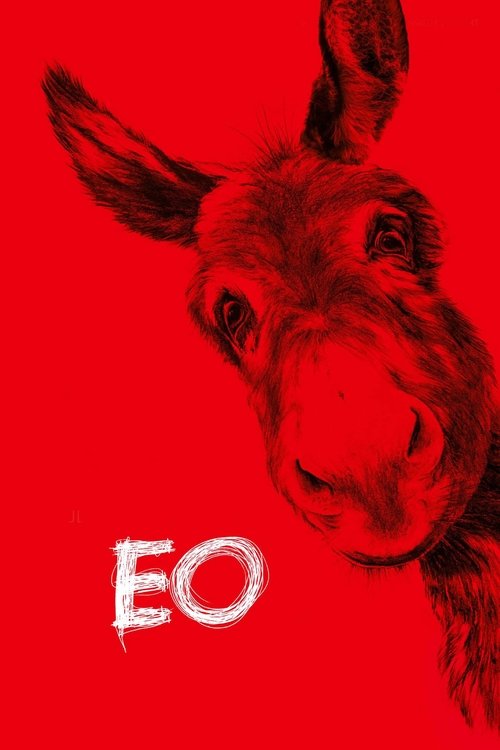
EO
2022 · Jerzy Skolimowski
When you want something genuinely unlike anything else — an art film that works on your senses and your conscience at once. Bring patience and maybe tissues; it's a challenge, but a short and mesmerizing one.
What it's about
EO is a gray circus donkey with melancholy eyes who gets separated from the one person who loves him and passed from hand to hand across Poland and Italy — farms, a rowdy soccer town, a fur farm, a grand villa. The film travels at his side and often through his gaze, watching human kindness and cruelty arrive with equal randomness.
The experience
Strange, gorgeous, and quietly heartbreaking — stretches of pure sensory cinema, pulsing red light and roaring crowds, broken by moments of tenderness that catch you off guard. It's more an experience to surrender to than a plot to follow, and it will wreck animal lovers in the best way.
Performances
The donkey himself (played by several animals) gives one of the most affecting screen presences in recent memory — Skolimowski finds real expressiveness in those eyes — and Isabelle Huppert drops in for a brief, tart appearance.
The craft
Skolimowski goes maximalist: expressionist red washes, swooping camera passages, an immersive sound design and surging orchestral score that put you inside an animal's overwhelmed senses. It's one of the most visually audacious films of its decade — see it big and loud if you can.
Why it matters
It shared the Jury Prize at Cannes and earned an Oscar nomination for Best International Feature, a late-career triumph that proved an octogenarian director could out-experiment filmmakers half his age.
Snapshot
EO is Jerzy Skolimowski's picaresque odyssey told largely from the vantage of a gray donkey who is passed, sold, lost, and rerouted across contemporary Poland and Italy. Conceived as an open homage to Robert Bresson's Au Hasard Balthazar (1966) — the one film Skolimowski has repeatedly said moved him to tears — EO takes Bresson's premise of a beast of burden as a passive register of human cruelty and grace and detonates it into something sensuous, expressionistic, and ecological. Where Bresson is austere, Skolimowski is maximalist: pulsing red light, swooping drone passages, robot dogs, a roaring stadium, a fur farm. The film premiered in competition at the 2022 Cannes Film Festival, where it shared the Jury Prize, became Poland's submission for the Academy Awards, and earned a nomination for Best International Feature Film at the 95th Oscars. It marked the return of an octogenarian director — Skolimowski was born in 1938 — to international prominence, and was received as both a late-career capstone and one of the boldest "animal-perspective" films ever attempted.
Industry & production
EO is a Polish–Italian co-production, developed and produced by Skolimowski with his longtime creative and life partner Ewa Piaskowska through their company Skopia Film, with Italian co-production partners enabling the film's substantial Italian segment. It was made with backing from the Polish Film Institute, the customary backbone of ambitious Polish auteur cinema. The budget was modest by the standards of the film's logistical ambition: the production crossed multiple countries, staged sequences in a working stadium, on highways, in stables, on a fur farm, and at an Italian villa, and depended on extensive animal handling and wrangling.
The central logistical fact of the production is the casting of the donkey. Because no single animal could carry the range of moods and physical demands the script required, EO was played by several donkeys — six is the figure consistently reported — sourced in part from Italy and trained for specific actions and temperaments. Animal welfare was a foregrounded concern, both ethically and practically, and the production worked with trainers and (per the filmmakers' public statements) animal-rights consultation; the film's own sympathies are explicitly anti-cruelty, with the fur-farm and slaughter motifs functioning as indictment rather than spectacle. The human cast is international and largely episodic, in keeping with the road-movie structure: Sandra Drzymalska as Kasandra, the circus performer who shows EO genuine tenderness; Lorenzo Zurzolo as a young Italian man; Mateusz Kościukiewicz; and, in a single late, startling cameo, Isabelle Huppert as a countess. The distribution path ran through the festival circuit — Cannes, then Telluride, Toronto, New York — into arthouse release, with Janus Films / Sideshow handling the United States, positioning EO squarely within the specialty-distribution ecosystem that sustains subtitled auteur work.
Technology
EO is a digitally originated and digitally finished film whose technological signature is its aggressive, painterly use of contemporary tools rather than any single novel device. Two technologies dominate. The first is the drone and lightweight gimbal camera, which Skolimowski and cinematographer Michał Dymek deploy not as establishing-shot garnish but as a roving, animal-adjacent consciousness — gliding low over rivers and forests, spiraling over wind turbines, untethering the point of view from human eye level. The second is the digital color pipeline, which makes possible the film's hallmark fields of saturated, throbbing red: sequences in which the entire frame is washed in monochromatic crimson, sometimes strobing, that read as the donkey's overwhelmed perception or as pure abstract interlude. These are achievable cleanly only in a digital grade.
The film also folds in markers of the present-day technological landscape as content: a quadruped robot "dog" trotting through a sterile facility, wind farms, the apparatus of industrial animal husbandry, LED-saturated stadium spectacle. The result is a film that uses new tools to register a world remade by technology and extraction — the machinery is both how the film sees and what the film is about.
Technique
Cinematography
Michał Dymek's photography is the film's most discussed achievement and the engine of its sensory address. The visual program is restless and heterogeneous: ground-level shots that keep us at hoof height; vertiginous aerial passages; handheld immediacy in moments of violence; and the recurring, almost musical interruptions of total red. Dymek and Skolimowski refuse the documentary sobriety one might expect from an animal film. Instead the camera behaves expressively — tilting, racing, abstracting landscape into texture and color. Crucially, the film does not pretend to literal donkey-vision; it offers an interpretation of non-human perception, an audiovisual proposition about how the world might press upon a creature who cannot narrate it. The cinematography earned wide critical praise and festival recognition as a benchmark for lyrical, perception-driven imagery.
Editing
Cut by Agnieszka Glińska, EO moves by association as much as by causality. The episodic structure — EO changes hands again and again — is bridged by elliptical transitions and by the recurring abstract interludes that function as breath marks or refrains. Editing here is rhythmic and frequently disjunctive: a scene of human drama may be truncated, withheld, or observed only in fragments, because the film's organizing intelligence is the donkey, who neither understands nor completes the humans' stories. The cutting thereby enacts the film's central conceit — narrative legibility is a human luxury the protagonist does not possess.
Mise-en-scène / staging
Skolimowski stages a deliberately discontinuous Europe: circus, stable, pasture, highway shoulder, football terrace, fur farm, salami factory, grand villa. Each milieu is a self-contained tableau the donkey passes through, and the staging consistently dwarfs or marginalizes EO within human environments built without him in mind. The fur farm and the slaughter imagery are staged as moral confrontations; the stadium sequence stages human tribal violence (football hooliganism) as something EO is blamed for and brutalized over. The villa episode, with Huppert, abruptly shifts register toward decadent melodrama. The staging logic is centrifugal — the world keeps spinning off into human chaos while the animal remains the still, suffering center.
Sound
Sound design and Paweł Mykietyn's score are inseparable from the film's force. Mykietyn, a leading Polish contemporary composer, supplies music that is insistent, percussive, and string-driven — surging in the abstract red passages, lending the donkey's wanderings an almost symphonic gravity. The sound design alternates between hyper-present naturalism (hooves, breath, machinery, water, the din of the crowd) and overwhelming musical abstraction. Because EO does not speak and the human dialogue is fragmentary and multilingual, sound carries an unusually large share of the emotional and structural load, often substituting for the psychological interiority that voice and dialogue would normally provide.
Performance
The film's performance question is genuinely unusual: its lead is a non-actor animal. Skolimowski has spoken of seeking expressivity in the donkeys' eyes and bearing, and the editing and framing do much to construct "performance" from documentary animal behavior — a turn of the head, an ear, the celebrated melancholy of the gaze. Among the human cast, Sandra Drzymalska's Kasandra provides the film's warmest human presence, the one person who treats EO with love; Isabelle Huppert's brief appearance injects a jolt of art-cinema iconicity. But the human performances are intentionally subordinate, glimpsed and partial, in service of a film whose true protagonist cannot act in the conventional sense.
Narrative & dramatic mode
EO is a picaresque — an episodic journey narrative in which a passive or semi-passive protagonist drifts through a sequence of encounters that expose the surrounding society. Its direct ancestor is Bresson's Balthazar, and behind that the broader tradition of the road movie and the saint's-life-as-suffering. The dramatic mode is anti-psychological and observational: there is no arc of donkey "growth," no goal pursued and achieved. Instead the film offers a chain of contingencies — luck turning to disaster, despair turning to unexpected reprieve, as the synopsis frames it — punctuated by lyrical-abstract interludes that function less as plot than as the protagonist's overwhelmed consciousness. Meaning accrues through juxtaposition and recurrence rather than through cause and effect. This places EO in the modernist art-cinema lineage where ambiguity and ellipsis are structural principles, not flaws.
Genre & cycle
The film sits at the intersection of several modes: the art-house drama, the road movie, the animal film, and the eco-cinema cycle increasingly visible in 2010s–2020s festival programming. As an "animal-perspective" film it belongs to a small but distinguished line that runs from Au Hasard Balthazar through more recent works attentive to non-human experience and the ethics of the human–animal relation; it was frequently discussed in 2022 alongside the broader turn toward ecological and more-than-human storytelling in serious cinema. It resists the sentimental conventions of the mainstream animal picture (no anthropomorphic voiceover, no triumphant reunion) and instead aligns itself with the austere European tradition while smuggling in a contemporary, almost psychedelic sensory vocabulary.
Authorship & method
EO is unmistakably an auteur film, but a collaborative one built around a tight creative partnership. Skolimowski co-wrote the screenplay with Ewa Piaskowska, his partner and producer, with whom he has worked on his late-period films; their collaboration is central to understanding the project's conception and its blend of moral seriousness and formal daring. Skolimowski's method on EO favored intuition, improvisation around the animals' real behavior, and a willingness to let the abstract interludes interrupt narrative logic — a freedom characteristic of a director who began as a poet and painter and has always treated cinema as a plastic, expressive medium rather than a storytelling machine.
The key collaborators define the film's texture: cinematographer Michał Dymek, whose mobile, color-drenched imagery is the film's signature; composer Paweł Mykietyn, whose driving score supplies the emotional propulsion the silent protagonist cannot voice; and editor Agnieszka Glińska, whose associative cutting binds the episodes into a rhythmic whole. The film is also, pointedly, a dialogue with Bresson: Skolimowski has been explicit that EO exists because of Balthazar, making authorship here a matter of inheritance and transformation as much as origination.
Movement / national cinema
Skolimowski is a foundational figure of postwar Polish cinema. He emerged from the milieu of the Łódź Film School and the generation around Andrzej Wajda and Roman Polanski — he co-wrote Polanski's Knife in the Water (1962) — and his early features (Identification Marks: None, Walkover, Barrier) made him a key voice of the Polish New Wave before political pressures and a banned film (Hands Up!) pushed him into a long international exile, where he made English-language work such as Deep End (1970), The Shout (1978), and Moonlighting (1982). EO is thus the work of a Polish master returning to home ground and to the Polish Film Institute–supported industry, while retaining the cosmopolitan, border-crossing identity of his career — the film itself crosses from Poland into Italy. It belongs to contemporary Polish art cinema's strong festival presence while standing somewhat apart from any school, the product of a singular, long-itinerant sensibility.
Era / period
EO is a film of the early 2020s, and it bears the marks of its moment: an ecological anxiety about extraction, industrial animal exploitation, and a technologized landscape; a festival culture increasingly receptive to non-human and ecological perspectives; and a digital production grammar (drones, aggressive color grading) now fully naturalized in auteur cinema. It is also, biographically, a late film — made by a director in his eighties, with the gravity and freedom that often attend late style. The combination is distinctive: a young medium's tools wielded with an old master's disregard for convention, addressing very contemporary concerns through a structure borrowed from the 1960s.
Themes
The film's governing theme is the ethics of the human–animal relationship — cruelty and kindness as they appear to a creature who cannot rationalize either. Through EO's eyes, Skolimowski indicts industrialized exploitation (the fur farm, the slaughter economy) and human tribalism and violence (the football mob), while also registering fugitive moments of tenderness. Innocence is a central motif: the synopsis's claim that EO "does not for a moment lose his innocence" is the film's moral north star, positioning the animal as a kind of secular saint whose suffering exposes the world. Other themes include contingency and the wheel of fortune — luck and disaster arriving without justice or reason — and a broader ecological grief about a world remade for human use. The recurring red interludes can be read as the formal correlate of these themes: the overwhelm of perception, the pressure of a world too violent and strange to be narrated.
Reception, canon & influence
EO was met with strong critical enthusiasm. Its 2022 Cannes premiere yielded the Jury Prize (shared that year with Felix van Groeningen and Charlotte Vandermeersch's The Eight Mountains), and the film went on to a robust festival and awards run, culminating in its selection as Poland's Oscar entry and a nomination for Best International Feature Film at the 95th Academy Awards. Critics singled out the cinematography, the score, and the audacity of the animal-centered conception; the film was widely cited on year-end lists and discussed as a high-water mark of perception-driven, more-than-human cinema. (Specific award tallies beyond Cannes and the Oscar nomination are best checked against the festival record rather than asserted here.)
The influences on the film are unusually legible because the director named them: above all Bresson's Au Hasard Balthazar, with the broader picaresque and road-movie traditions, and Skolimowski's own lifelong painterly, poetic approach to image-making. Looking forward, EO has functioned as a touchstone in the ongoing critical conversation about non-human perspective and eco-cinema, frequently invoked alongside other recent attempts to decenter the human gaze, and as a demonstration that a radically experimental, animal-led art film can still reach the upper tiers of the international prestige circuit. Its most durable legacy may be its proof of concept: that the Bressonian premise, reanimated with contemporary sensory tools and contemporary ecological urgency, retains the power to unsettle audiences more than half a century on. Given the film's recency, its longer-term canonical position remains to be settled, but its immediate impact on the discourse around animals and cinema is already clear.
A Deleuzian reading
There is a shot the film keeps returning to, and you will keep returning to it after: the donkey's eye, dark and wet and enormous, holding still while the world on the other side of it comes apart.
The full Deleuzian reading of EO →
Reception
Rapturously received at Cannes 2022, where it won the Jury Prize, then rode a wave of critical love — Cahiers du Cinéma named it the best film of the year — into an Oscar nomination for Best International Feature. It's since settled in as the late-career triumph of an 84-year-old master, and Letterboxd's favorite donkey.
How EO was received, from release to now →
Influences: the films it descends from and the films it influenced
- Au Hasard Balthazar (1966) — The named template: a silent beast of burden passed from owner to owner whose passive suffering becomes an episodic moral indictment of human cruelty — the exact structural and ethical premise Skolimowski reanimates.
- Mouchette (1967) — Bressonian reduction of suffering to fragmented gesture and downcast body, the abused innocent observed without psychological interiority — the model for EO's anti-anthropomorphic framing.
- A Man Escaped (1956) — Source of the 'modèle' method — blank, non-expressive non-performance whose meaning is generated by framing and montage rather than emotion — which EO extends to the logical extreme of a literal non-actor animal.
- Deep End (1970) — Skolimowski's own saturated, erotically menacing red palette and expressionist color-symbolism reappear directly in EO's strobing crimson interludes.
- The Shout (1978) — His use of sound as a destabilizing, near-supernatural force that overrides naturalism prefigures EO's percussive, subjective soundscape standing in for the mute protagonist's interior.
- Red Desert (1964) — Industrial-expressionist deployment of artificially saturated color to externalize a non-verbal psychic state — the painterly precedent for EO's color-drenched, mood-driven imagery.
- Walkabout (1971) — Associative, elliptical montage that intercuts animals, landscape and human cruelty to decenter the human gaze — Roeg's editing grammar anticipates Glińska's cutting.
- Mirror (1975) — Associative, memory-logic editing where images cohere by rhyme and rhythm rather than narrative causality — the Eastern European art-film basis for EO's elliptical episode-binding.
- The Turin Horse (2011) — A draft animal as the silent moral fulcrum of human degradation, scored to an insistent, repetitive percussive figure — the closest contemporary kin in the same Bressonian–East European line.
- White God (2014) — A contemporary European prestige art film built around real, unsimulated animal behavior and an animal's-eye revolt against human cruelty, reaching the festival circuit on that audacity.
- Gunda (2020) — Radical non-human perspective sustained through immersive diegetic-naturalist sound design and a refusal of anthropomorphic narration — the eco-cinema sibling of EO's perceptual decentering.
- Cow (2021) — Sustained bovine point-of-view via a mobile camera pressed intimately to the animal's body, framing the beast as ethical witness to industrialized human use.
- Leviathan (2012) — Sensory-ethnographic, more-than-human camera placement that abstracts imagery into disorienting color and texture — the formal vanguard of the eco-cinema EO draws on.
- Uncle Boonmee Who Can Recall His Past Lives (2010) — Dissolves the boundary between human and animal consciousness through associative, tableau-based episodes and abrupt tonal interludes that interrupt narrative logic.
- Under the Skin (2013) — Renders a non-human gaze observing humanity through abstracted, saturated imagery and an alien, percussive score that supplies the affect the silent protagonist cannot voice.
- Silent Friend (2026) — Displaces the human as narrative center in favor of a non-human protagonist's sensory point of view, a contemporary sibling in post-anthropocentric perception.
- Good Boy (2026) — The same craft apparatus — Michał Dymek's camera and Agnieszka Glińska's cutting inside the Skolimowski–Thomas unit — already applied its compressed associative montage and low-slung creature-vantage framing to a being trained, punished and passed between owners.
Similar films
- Au Hasard Balthazar (1966) — influence & lineage
- Silent Friend (2026) — same viewing thread
- The Painted Bird (2019) — shared sensibility
- Close (2022) — shared sensibility
- Okja (2017) — shared sensibility
- Oasis (2002) — shared sensibility
- Memoir of a Snail (2024) — shared sensibility
- Sirāt (2025) — shared sensibility
Watch it with: curated runs of related films
- The Land Holds Vigil — Watch these together for the way a thousand-year tree, a wandering donkey, a returned fishing boat, or an emptied countryside becomes the patient witness to human searching and loss.