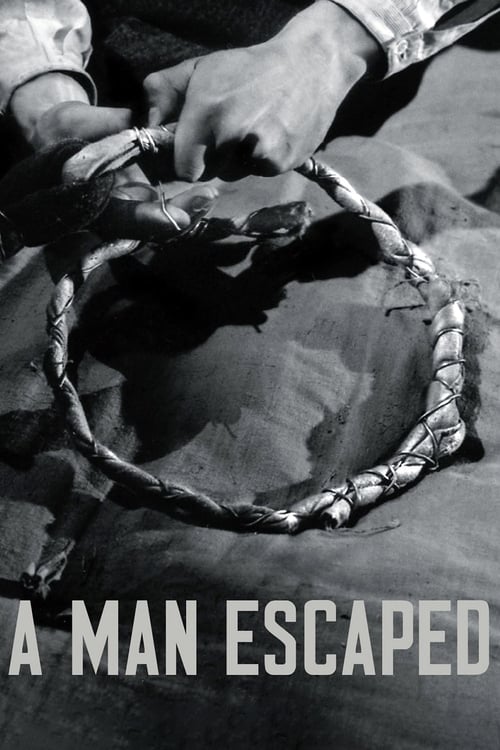
A Man Escaped
1956 · Robert Bresson
For when you want total absorption — a film that rewards silence, patience, and full attention, and repays them with an ending-stretch of almost unbearable tension. Not a background watch; a devotional one.
What it's about
A French Resistance fighter is captured by the Nazis, condemned to death, and locked in a cell in a Lyon prison — and the film is, almost minute by minute, the story of how he works his escape. A sharpened spoon against a wooden door, ropes braided from wire and blankets, coded taps through walls, and the constant arithmetic of when the guards pass. It's drawn from the real memoir of a man who did exactly this.
The experience
One of the most quietly suspenseful films ever made — the title tells you the destination, and somehow every scrape of the spoon still tightens your chest. It's spare, hushed, and hypnotic, closer to prayer than to a thriller, yet it grips like one.
The craft
Bresson strips out everything inessential — no melodrama, no flourishes, faces kept deliberately plain — and builds the film from hands, objects, and above all sound: footsteps, keys, distant trains, gunfire beyond the walls tell you everything the camera refuses to show. Good speakers or headphones transform it. Bursts of Mozart lift the routine into something like grace.
Why it matters
A pinnacle of minimalist filmmaking whose process-first suspense shaped the prison-escape story and every filmmaker drawn to doing more with less.
Snapshot
A Man Escaped — full French title Un condamné à mort s'est échappé ou Le vent souffle où il veut ("A Man Condemned to Death Has Escaped, or The Wind Blows Where It Will") — is Robert Bresson's fourth feature and the film in which his mature aesthetic crystallized into something irreducible. Drawn from the published memoir of André Devigny, a French Resistance lieutenant condemned to death who escaped Montluc prison in Lyon hours before his scheduled execution in 1943, the film reconstructs that escape with near-documentary fidelity to procedure and an almost liturgical attention to gesture, texture, and sound. Fontaine, the protagonist, methodically dismantles his cell door with a sharpened spoon, braids ropes from bedframe wire and torn blankets, and waits. The drama is almost entirely physical and almost entirely interior at once. Bresson strips the prison-break genre of suspense-as-spectacle and rebuilds it as a meditation on patience, attention, grace, and the cooperation of chance with will. It is widely regarded as one of the supreme achievements of postwar French cinema and the clearest single statement of Bresson's method.
Industry & production
The film was produced in France in the mid-1950s, a period when Bresson occupied a singular and somewhat solitary position in the industry: respected, awarded, but commercially marginal and dependent on producers willing to underwrite an uncompromising artist. A Man Escaped followed his 1951 Diary of a Country Priest, which had won the Louis Delluc Prize and established his reputation among critics. For A Man Escaped, Bresson worked from Devigny's account, which had appeared in the newspaper Le Figaro littéraire before book publication, and he consulted Devigny directly; Devigny is generally credited as a technical adviser, lending the production its insistence on authentic procedure. Bresson shot on location in Lyon, using Montluc prison itself for exteriors and reconstructions faithful to the real cells. The production was modest in scale by design — a small cast, confined settings, no stars — which suited both Bresson's economy of means and his refusal of conventional production values. Precise budget and box-office figures are not something I can responsibly cite here; the historical record I can vouch for concerns the film's making and reception rather than its ledger. The film was selected for the Cannes Film Festival, where Bresson received the Best Director prize in 1957, a recognition that helped consolidate his standing even as his work remained outside the commercial mainstream.
Technology
The film was made with the standard monochrome 35mm technology of its era, projected in the academy-derived 1.37:1 frame rather than the widescreen formats then sweeping the industry — a deliberate retention of a "classical," contained image at a moment when CinemaScope and its rivals were expanding the frame for spectacle. Bresson's commitment to the older aspect ratio is consistent with his aesthetic of concentration and exclusion: the frame is a window onto a narrow, chosen field, not a panorama. Synchronized optical sound recording is fundamental to the film's design, and Bresson exploited the technology not for fidelity to a realistic soundscape but for selection — isolating, amplifying, and foregrounding particular sounds while suppressing others. The film makes no use of the era's developing color or large-format processes; its technological choices are uniformly in the direction of restraint, using the medium's most basic resources with maximum deliberation. There is nothing technically novel in the apparatus; the innovation lies entirely in the discipline of its use.
Technique
Cinematography
The cinematography, by Léonce-Henri Burel — a veteran whose career stretched back to the silent era and who had shot Diary of a Country Priest — is built on close framing, restricted depth, and a gray, even tonality that refuses dramatic chiaroscuro. The camera stays close to Fontaine's hands and face and to the surfaces he works against: the wooden door, the stone wall, the iron of the bedframe, the rope. Bresson and Burel privilege the fragment — a hand, a tool, a lock — over the establishing view, so that the spectator comes to know the prison the way a prisoner does, by its parts and textures rather than its architecture. The lighting is functional and undramatic, avoiding expressionist shadow; the prison is lit to be seen clearly, not atmospherically. Camera movement is minimal and motivated, often a small reframing to follow a gesture. This is a cinematography of attention rather than display: the image is subordinated to the act of looking closely at material reality, which in Bresson becomes a form of spiritual attention.
Editing
Editing, credited to Raymond Lamy, is the film's secret engine. Bresson constructs the escape as a chain of discrete, precisely observed actions, cutting on gesture and often on sound. The rhythm is patient but never slack; each shot is held exactly long enough to register a step in the process and no longer. Crucially, Bresson frequently elides the expected "dramatic" image and shows instead its trace — we hear an event off-screen, or see the result of an action rather than its climax. The cutting refuses suspense-building in the Hitchcockian sense; rather than cross-cutting to manufacture tension, Bresson lets duration and repetition accumulate a different kind of pressure. The editing also governs the film's distinctive relation between image and the protagonist's retrospective voice-over, the two cut together so that narration and action comment on each other without redundancy.
Mise-en-scène / staging
Bresson's staging is austere to the point of asceticism. The settings are bare cells, corridors, and a courtyard; props are few and each is essential — the spoon, the lamp-hooks, the wire, the rope. Actors are positioned and moved with extreme economy, their gestures pared down and repeated until they acquire the quality of ritual. Bresson famously rehearsed his performers to drain expressivity from movement, seeking automatism rather than acting; the staging treats a man's hands working at a door with the gravity another director would reserve for a face in extremis. The confinement of the space is total and is the point: the mise-en-scène enacts imprisonment formally, and the few openings onto the world beyond — a glimpse of the courtyard, a sound from outside — carry enormous weight precisely because the visual field is so restricted.
Sound
Sound is arguably the film's most radical dimension. Bresson treats the soundtrack as an autonomous expressive layer, not an accompaniment to the image. The scrape of the spoon against wood, the chink of keys, the rattle of a passing train, the footsteps of guards, the distant sounds of the prison — these are isolated and foregrounded with such precision that the spectator learns the prison aurally. Off-screen sound continually extends the world beyond the frame and is used to convey events the camera does not show, making sound a narrative instrument equal to the image. Against this concrete sound-world Bresson sets brief passages of Mozart — the Kyrie from the Great Mass in C minor — whose sacred music recurs at intervals, most pointedly over scenes of the prisoners emptying their slop buckets in the yard. The juxtaposition of liturgical music with degraded routine is one of the film's central gestures, aligning the men's endurance with something transcendent. The full French title's subtitle, "the wind blows where it will," is from the Gospel of John, and the Mozart underscores that theological frame.
Performance
Bresson did not use professional actors; he used what he called "models" — untrained people directed to perform actions and speak lines without conventional interpretation. Fontaine is played by François Leterrier, a philosophy student at the time, with a flat affect and a quiet, even voice that refuses the heroics the material might invite. The performances are deliberately de-dramatized: faces register little, voices avoid inflection, and emotion is displaced onto gesture, sound, and the viewer's own engagement. This is not amateurishness but a rigorous anti-performance, designed to prevent the psychological identification that ordinary acting solicits and to keep attention on action and on a deeper, impersonal current Bresson associated with grace. The voice-over, spoken in the same neutral register, narrates from a position of retrospective survival without ever editorializing.
Narrative & dramatic mode
The narrative is linear, processual, and almost entirely confined to the prison. Its dramatic mode is the opposite of the suspense thriller's: the title itself announces the outcome — a man escaped — so the film generates no real question of whether but only of how, and even the "how" is presented less as a puzzle than as a discipline. The drama lies in process, patience, and the moral and spiritual stakes of perseverance. Bresson narrates through accumulation of detail and through the interplay of Fontaine's calm voice-over with the images of his labor. A subplot of consequence arrives late, when Fontaine is given a cellmate, Jost, a young man of uncertain loyalty, just as the escape is ready; Fontaine must decide whether to trust him or kill him, and chooses trust, folding a final moral test into the mechanics of the plot. The dramatic mode is thus contemplative and ethical rather than suspenseful: it asks the viewer to attend, to wait, and to consider what enables a man to act with hope under sentence of death.
Genre & cycle
Nominally A Man Escaped belongs to the prison-break film and, by way of its Resistance setting, to the body of postwar French cinema reckoning with the Occupation. But it stands at a deliberate angle to both. As a prison-break film it withholds nearly every genre pleasure — the gang, the suspense set-pieces, the violence, the cathartic climax — and substitutes process and interiority. As a Resistance film it largely brackets the politics and the war, never showing combat or the enemy as a dramatized force; the Germans are mostly off-screen sounds and procedures. Bresson takes the genre's bones — confinement, ingenuity, the will to freedom — and refunctions them toward a spiritual parable. The film thus belongs to its genres chiefly in order to transcend them, and it is best understood within the "cycle" of Bresson's own work, alongside Diary of a Country Priest before it and Pickpocket after, as part of a continuing investigation into grace, constraint, and the redemptive possibilities of disciplined action.
Authorship & method
A Man Escaped is the definitive demonstration of Bresson's theory of cinematography (his term for true cinema, as opposed to filmed theater, which he disdained as cinéma). His method, later codified in his aphoristic Notes on the Cinematograph, is everywhere visible: non-professional "models" rehearsed to automatism; the autonomy of sound; the privileging of fragment and gesture; the refusal of psychology and of acting; the search for an impersonal truth beneath expressive surface. The film is the product of Bresson's near-total authorial control over every element, but it depended on key collaborators whose contributions were essential to realizing his design. Cinematographer Léonce-Henri Burel translated Bresson's austerity into the film's gray, close, undramatic images, continuing their collaboration from Diary of a Country Priest. Editor Raymond Lamy cut the film's chain of gestures and managed the intricate counterpoint of image, voice-over, and sound. For music, Bresson used existing Mozart rather than a commissioned score, a choice consistent with his preference for found, autonomous sound over manipulative scoring. The screenplay is Bresson's own adaptation of Devigny's memoir, with Devigny advising on procedural authenticity. The film is signed, in every frame, by a single sensibility.
Movement / national cinema
Bresson is a French filmmaker, but he fits awkwardly into the standard movements of French cinema. He came to prominence before the New Wave and was not of it, yet the Cahiers du cinéma critics — Godard, Truffaut and their circle — revered him as a model of pure, personal auteur cinema, and A Man Escaped arrived in 1956, on the eve of the New Wave's eruption, as a touchstone of what rigorous authorship could achieve. He is neither a poetic-realist in the prewar mode nor a New Wave iconoclast; he stands apart as a category of one, often grouped loosely with a "transcendental" tendency in cinema. Within French national cinema he represents the highest claim for film as a serious, autonomous art, indifferent to commercial convention, and the Occupation setting roots the film firmly in France's postwar effort to narrate its own recent history — though Bresson treats that history with characteristic reticence.
Era / period
The film belongs to the mid-1950s, a transitional moment in world cinema. Hollywood and much of the international industry were turning to widescreen, color, and spectacle to counter television; the French New Wave was about to break. Against both currents Bresson made a small, black-and-white, academy-ratio film of extreme restraint, asserting a counter-modernity grounded in concentration rather than expansion. Its historical subject is the Occupation of 1943, reconstructed from a true event, but its sensibility is timeless by intent: Bresson abstracts the period almost entirely, giving few markers beyond uniforms and procedure, so that the film reads less as a portrait of 1943 than as a parable that happens to be set there. The film thus sits at the intersection of a specific wartime memory and a deliberately dehistoricized, contemplative present.
Themes
The film's governing themes are freedom and constraint, patience, attention, and grace. Its full title — borrowing from the Gospel of John, "the wind blows where it will" — announces a theological reading: Fontaine's meticulous, willed labor is necessary, but his escape finally depends on something beyond will, a grace that, like the wind, cannot be commanded. The film holds determinism and freedom, effort and gift, in tension and refuses to resolve them. Attention itself is a theme and a discipline: the act of looking and listening closely, which the film demands of its viewer, mirrors the prisoner's survival through vigilance. Solidarity and trust enter through the men's tapped messages and shared knowledge, and decisively through Fontaine's wager on Jost — community as a condition of liberation. Underlying all of it is a meditation on hope under sentence of death, the persistence of purposeful action in a situation defined by its apparent hopelessness. The body and material things — the spoon, the rope, the door — are treated as the very medium through which the spiritual is reached, a thoroughly Bressonian conviction.
Reception, canon & influence
A Man Escaped was received as a major work and has only grown in stature; it is consistently ranked among the greatest films ever made and among Bresson's two or three finest. It won Bresson the Best Director prize at Cannes in 1957 and was embraced by the Cahiers du cinéma critics as an exemplary work of auteur cinema, helping to define the standard of personal, formally rigorous filmmaking that the New Wave would champion. In the longer view it became a central text for critics of "transcendental" or spiritual cinema; Paul Schrader's influential study of Bresson, Ozu, and Dreyer treats Bresson's style as a paradigm, and A Man Escaped is frequently cited as its clearest instance.
Looking backward, the film's influences are less other films than Bresson's own prior work — especially Diary of a Country Priest, which established the voice-over, the spiritual reading of suffering, and the collaboration with Burel — and his deepening engagement with a Jansenist-inflected Catholic sensibility centered on grace. Its source in Devigny's lived memoir grounds it in fact rather than cinematic precedent.
Looking forward, its legacy is broad and deep. It is the model for a rigorous, anti-spectacular treatment of the prison-break and process film; later filmmakers drawn to procedure, duration, and confinement work in its shadow, and it is routinely invoked in discussions of films that find drama in patient physical labor. Bresson's own Pickpocket (1959) extends its method to a different milieu. More broadly, the film shaped the practice and theory of minimalist, contemplative cinema — its influence is felt across the international art-cinema tradition that prizes restraint, ascetic form, and the autonomy of sound — and it remains a foundational reference for filmmakers and critics arguing that cinema's deepest effects come not from showing more but from attending, with absolute concentration, to less.
A Deleuzian reading
A spoon, sharpened against the cell floor, worked into the seam of an oak door.
The full Deleuzian reading of A Man Escaped →
Reception
No reappraisal arc needed — it won Bresson Best Director at Cannes in 1957 and has spent seventy years being called the greatest escape film ever made; its stock has only climbed as 'process cinema' became a cinephile obsession.
How A Man Escaped was received, from release to now →
Influences: the films it descends from and the films it influenced
- Diary of a Country Priest (1951) — The immediate precursor in Bresson's own hand: it fixed the first-person voice-over-against-image counterpoint and the spiritual reading of suffering, and began the Burel collaboration whose gray, undramatic lighting A Man Escaped refines.
- The Passion of Joan of Arc (1928) — Source of the fragment-framing creed — faces, hands, and isolated objects shot in tight closeup divorced from establishing geography — and of the ascetic concentration on a captive subject that Schrader grouped with Bresson as 'transcendental style.'
- Grand Illusion (1937) — Distills the escape film to its procedural essence, carrying forward Renoir's faith that the patient observation of behavior and physical detail — not melodrama — generates the prison-break's meaning.
- Au Hasard Balthazar (1966) — Bresson pushes the nonprofessional 'model' rehearsed to automatism and the autonomous, off-screen soundtrack further, again pairing de-dramatized affect with an existing classical score (Schubert) used as found, non-illustrative sound.
- Pickpocket (1959) — Direct method-transfer: the patient choreography of hands at skilled work and cut-on-gesture editing migrate from the prison cell to the criminal's craft, with voice-over again narrating process rather than psychology.
- Mouchette (1967) — Extends the grace-under-constraint theme through a nonprofessional model whose blank, expressionless surface forces the spectator to read meaning into elided action rather than performed emotion.
- L'Argent (1983) — Late, severe distillation of the same syntax — fragmented inserts of hands and objects, elided violence (the axe murder withheld), and sound carrying what the image refuses to show.
- A Gentle Woman (1969) — Carries the de-dramatized model and elided-climax method into color, opening on the aftermath of a suicide so that the film reconstructs cause through fragments rather than staging the event.
- The Trial of Joan of Arc (1962) — Applies A Man Escaped's process-over-suspense procedural rigor to transcript material, the camera attending to the bureaucratic mechanics of confinement and interrogation with the same undramatic lighting.
- Le Trou (1960) — The other great anti-spectacular prison-break film: real-time attention to the physical labor of digging and tool-making, refusing music and suspense scoring in favor of the autonomous sound of metal on stone.
- A Prophet (2009) — Inherits the procedural-confinement lineage — drama located in the patient acquisition of craft and survival skills inside the cell — descending from Bresson via the process-over-suspense prison tradition.
- The Son (2002) — Builds an entire ethics on Bressonian means: nonprofessional-style blank faces, drama withheld and read through gesture and labor, and diegetic sound foregrounded in place of score.
- A Hidden Life (2019) — Explicitly Bressonian study of grace-and-constraint through imprisonment, using voice-over counterpoint and the spiritual valuation of suffering to make conscience, not escape, the dramatic action.
- First Reformed (2018) — Schrader directing his own theory: Academy-adjacent boxed framing, ascetic withholding, voice-over diary counterpoint, and an austere style consciously modeled on the Bresson he canonized.
- A Man Escaped's Jansenist precedent — Pickpocket aside, Hunger (2008) — Transposes the confinement procedural to the body: protracted attention to physical process and bodily endurance, withholding conventional drama so that duration and ascetic framing carry the spiritual weight.
- Ordet (1955) — Contemporary exemplar of transcendental style: stripped staging, withheld spectacle, and a miracle reached through restraint rather than dramatization — the spiritual reading of duration Schrader paired with Bresson.
- Tokyo Story (1953) — The third pillar of Schrader's transcendental-style triad: de-dramatized affect, elided emotional climaxes (a death occurs off-screen between scenes), and an austere fixed grammar that finds depth by showing less.
- Two Men in Manhattan / Army of Shadows (1969) — Shares the Resistance-confinement milieu rendered through behavioral minimalism and de-dramatized affect, with tension built from procedure, silence, and the mechanics of evasion rather than overt suspense.
- The Wrong Man (1956) — Sibling in the subtractive method released the same year — spectacle stripped to procedural fact and hands-on detail, with deliverance framed explicitly as Catholic grace ('the wind bloweth where it listeth').
Similar films
- Le Trou (1960) — influence & lineage · often watched together
- Pickpocket (1959) — influence & lineage
- L'Argent (1983) — influence & lineage
- Au Hasard Balthazar (1966) — influence & lineage
- Diary of a Country Priest (1951) — influence & lineage
- Mouchette (1967) — influence & lineage
- The Passion of Joan of Arc (1928) — influence & lineage · often watched together
- Tokyo Story (1953) — influence & lineage · often watched together
All the films related to A Man Escaped →
Watch it with: curated runs of related films
- The Futility of War — A run of films about ordinary men fed into war's machinery — from the trenches to the Casbah to the Warsaw sewers — where the futility and human cost rhyme across a century and a dozen conflicts.