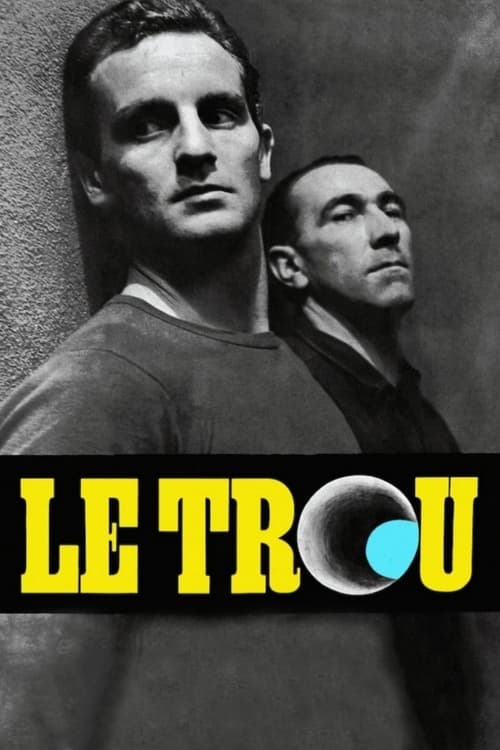
Le Trou
1960 · Jacques Becker
For a night when you want total absorption — a slow-burn procedural that rewards patience and silence. Turn your phone off; this one works because you commit to it.
What it's about
Four inmates in a shared cell at Paris's La Santé prison are quietly digging their way to freedom when a fifth man, Claude Gaspard, is transferred in — and they make the gamble of telling him everything. Over a few compressed days the film watches the escape as pure work: breaking concrete with a bed-post, navigating sub-basements and sewers, improvising tools, keeping watch, and above all deciding how far five men can trust each other.
The experience
Riveting in the most stripped-down way — no score to speak of, long unbroken takes of real labor, and a tension that accumulates until the sound of a chisel on concrete has your pulse up. It's austere and completely gripping, and the ending lands hard.
Performances
Becker cast largely non-professionals — including Jean Keraudy, a real veteran of the escape that inspired the story — and their unactorly, capable presence is exactly why the film feels so true.
The craft
Becker shoots the escape in near real-time stretches, refusing music and shortcuts so that every blow against the floor carries actual duration and effort — the sound of tools, breath, and stone does the work a score usually would. The black-and-white photography turns corridors and tunnels into a map you learn by heart. It's filmmaking of total economy: nothing wasted, everything felt.
Why it matters
Becker died just as the film was completed, and it's come to be seen as his testament — revered by filmmakers and regularly ranked among the greatest prison films ever made, a benchmark for the procedural thriller.
Snapshot
Le Trou — "The Hole" — is the last film Jacques Becker completed, a nearly two-and-a-quarter-hour prison-escape drama stripped to the essentials of labor, trust, and time. Four men in a shared cell at Paris's La Santé prison are tunneling toward freedom when a fifth inmate, Claude Gaspard, is transferred in; they gamble on telling him. What follows is one of the most concrete, procedurally exacting escape narratives in cinema: the picture watches men break through a concrete floor with a bed-post, descend into the prison's sub-basements and sewers, and measure their chances hour by hour. Becker died in February 1960, before or around the film's release, and Le Trou has come to be regarded as both a summation of his craft and one of the supreme achievements of the French cinema of manual work. Its reputation — Jean-Pierre Melville reportedly called it the greatest French film ever made, though such attributions circulate more as legend than documented citation, so I flag it as such — rests on austerity: minimal music, non-professional actors, real-time physical action, and an almost documentary attention to how difficult it is to dig your way out of anything.
Industry & production
Le Trou was produced in the French studio system of the late 1950s, at the exact moment the Nouvelle Vague was breaking, though Becker belonged to an older generation. It was adapted from José Giovanni's 1957 novel Le Trou, itself a fictionalized account of a genuine 1947 escape attempt from La Santé in which Giovanni had been imprisoned. Crucially, one of the actual participants in that historical attempt, Roland Barbat — credited on screen as Jean Keraudy — was cast, and the film opens with him addressing the camera directly, vouching that "this true story" is his own. That documentary warranty is a production fact as much as an aesthetic one: Becker built the film's authenticity on a surviving witness.
The screenplay was written by Becker with Giovanni and Jean Aurel. Becker cast largely unknown or non-professional performers, several of whom would go on to careers precisely because of this film. The shoot reconstructed the cell and the prison's underworld of corridors and tunnels; the production is celebrated for the tactile realism of these spaces. Precise budget and box-office figures I will not assert, as reliable period accounting for the film is not something I can confirm; contemporary commercial performance appears to have been modest, and the film's canonical stature was largely retrospective. There are longstanding accounts that the distributed version was cut down from Becker's preferred length and later restored, but I cannot verify the exact circumstances with confidence, so I note the claim without endorsing specific figures.
Technology
Le Trou was shot on 35mm black-and-white film in the standard Academy-ratio idiom of French studio production of the era, without recourse to widescreen anamorphic formats then fashionable. There is nothing technologically flashy here; the film's power comes from a deliberate refusal of spectacle. The most consequential "technology" is negative technology — the near-total absence of a non-diegetic musical score, which throws the entire soundtrack onto location and Foley-scale acoustic detail. The camera equipment permitted sustained handheld or fixed long takes in cramped sets, and the lighting is naturalistic, motivated by the harsh overhead sources of institutional space. In an era when many French productions leaned on lush orchestration and glossy sheen, Le Trou's technical signature is its withholding.
Technique
Cinematography
The cinematography is by Ghislain Cloquet, the Belgian-born cameraman who would later shoot Robert Bresson's Au hasard Balthazar and Mouchette and win an Academy Award for Polanski's Tess. His work here is disciplined and unshowy: high-contrast black-and-white, framings that respect the geometry of the cell and the claustrophobic verticality of the descent, and a refusal of expressive distortion. The camera tends to observe rather than editorialize — holding on hands, tools, faces at work — so that suspense accrues from duration and attention rather than from cutting or camera movement. Cloquet's images give the concrete, the metal, and the sweat a documentary weight; the surfaces of the film feel genuinely resistant, which is the point.
Editing
The editor was Marguerite Renoir (Marguerite Houllé-Renoir), a major figure who had cut films for Jean Renoir and had a long association with Becker. The editing of Le Trou is famous precisely for its patience: the film's most celebrated passage — the men smashing through the cell floor — unfolds in a long, sustained take (or near-real-time construction) that declines to compress the labor. Renoir's cutting elsewhere is functional and legible, building tension through the accumulation of small, verifiable actions rather than through montage acceleration. The decision to let physical processes play out at length is an editorial philosophy as much as a directorial one: the film trusts duration to generate dread and admiration in equal measure.
Mise-en-scène / staging
Becker's staging is a study in confinement and cooperation. The cell is organized so that the ensemble reads as a working unit; the men are frequently framed together, their bodies choreographed around the shared task. The descent into the prison's substructure turns the mise-en-scène vertical and labyrinthine, staging the escape as a physical excavation of the institution's hidden anatomy. Becker, who had been an assistant to Jean Renoir, inherited a certain democratic attention to the group — no single hero dominates the frame — and the staging consistently privileges collective labor and the small rituals of prison life (sharing food, keeping watch, improvising tools). Objects are given ceremonial importance: a cardboard periscope, a hollowed hourglass improvised to keep time.
Sound
Sound is arguably the film's defining technical achievement. With almost no musical score to cushion the action, the soundtrack is dominated by the concussive noise of digging — metal on concrete, the scrape and thud of demolition, the echo of footsteps in tunnels. This foregrounding of labor's acoustics makes the audience complicit in the risk, since every sound is also a potential betrayal audible to the guards. The silence between blows becomes unbearable. By denying itself the emotional shorthand of music, Le Trou forces the viewer to listen as the prisoners must listen — for danger, for progress, for time running out.
Performance
The performances are pitched toward understatement and physical credibility. Becker cast Jean Keraudy (Roland Barbat), an actual veteran of the historical escape, alongside Michel Constantin, Philippe Leroy, Raymond Meunier, and Marc Michel as the newcomer Claude Gaspard. Several were inexperienced or non-professional, and Becker used that rawness deliberately: the acting avoids theatrical projection in favor of watchfulness, fatigue, and the guarded body language of men who cannot afford to be read. Keraudy's presence, in particular, blurs the line between performance and testimony, since he is in some sense re-enacting his own history. The ensemble effect is of real men doing real work, and the drama's final emotional turn lands because the performances have earned our belief in the group's solidarity.
Narrative & dramatic mode
Le Trou operates in a realist, near-procedural dramatic mode, closer to reportage than to melodrama. Its narrative engine is process: the film is organized around the sequential, verifiable steps of an escape, and much of its suspense derives from watching competent people solve concrete problems under time pressure. The prologue's direct address establishes a documentary frame, and the film sustains a tone of sober observation throughout. Yet beneath the procedure runs a moral drama about trust — the decision to admit Gaspard into the conspiracy — that the film patiently develops and then detonates in its conclusion. The ending reframes everything that came before around the question of loyalty and its betrayal, converting a mechanics-of-escape film into a tragedy of misplaced faith. I will not spoil the specific mechanism here, but the dramatic architecture is built to make that final revelation devastating precisely because the preceding hours have made the men's fellowship so tangible.
Genre & cycle
The film belongs to the prison-escape genre and, more broadly, to a French tradition of realist crime cinema. It shares DNA with the "men on a job" film — the meticulous depiction of a difficult task executed by a small crew — that Jules Dassin's Rififi (1955) had recently made influential in France, and with which Becker's own earlier Touchez pas au grisbi (1954) is associated in the emergence of the French policier. Against the era's glossier gangster pictures, Le Trou strips the genre to its skeleton: no romance, no score, no star-driven bravado. It stands with A Man Escaped — Bresson's 1956 masterwork — as one of the two definitive French escape films, and the two are frequently discussed in tandem as parallel exercises in spiritual and physical rigor.
Authorship & method
Jacques Becker came up as an assistant and close collaborator of Jean Renoir in the 1930s, and his cinema carries Renoir's humanism and attentiveness to milieu while adding a more classical precision. Across Casque d'or (1952), Touchez pas au grisbi (1954), and Le Trou, Becker showed a recurring fascination with codes of loyalty among marginal communities. Le Trou is his most austere work and, poignantly, his last: he died in February 1960, and the film reached audiences essentially as a posthumous statement, with his son Jean Becker having assisted on the production.
The key collaborators reinforce the film's identity. Ghislain Cloquet (cinematographer) supplied the documentary-grade black-and-white images. Marguerite Renoir (editor) shaped the film's radical patience. José Giovanni (source novelist and co-writer) supplied lived authenticity, having been imprisoned and having known the real events. On music, the film is defined by near-absence rather than presence; I will not attribute a substantial score, because the film's method is precisely to forgo one, and I cannot confidently assign a composer credit for material that the finished film largely does without. The collective method — non-professionals, real locations of confinement, real-time action, and the withholding of music — constitutes one of the most coherent authorial signatures in postwar French cinema.
Movement / national cinema
Le Trou sits at a hinge in French national cinema. Becker was a product of the studio-based "quality" tradition and of the Renoir lineage, not of the Nouvelle Vague that was erupting in 1959–60; yet the young critics at Cahiers du cinéma admired Becker as a genuine auteur, and Le Trou embodies values — location authenticity, ensemble naturalism, formal rigor — that the New Wave itself prized. The film is thus best understood not as New Wave but as a peak of the older French realist-classical tradition, made with an integrity that the insurgents respected. It belongs to a distinctly French current of cinema about physical work and criminal fraternity, and it can be read alongside Bresson as evidence that French austerity cinema was pursuing its own ascetic path independent of the Nouvelle Vague's stylistic revolutions.
Era / period
Made in 1959–60, Le Trou arrives at the end of the Fourth Republic's cinematic order and the dawn of the New Wave, but its story reaches back to the immediate postwar years of the historical escape (the late 1940s). The film is thus doubly historical: a 1960 work looking back at a 1947 event, mediated through Giovanni's 1957 novel and through the surviving participant's testimony. Its sensibility feels almost outside its moment — neither nostalgic nor modish — which is part of why it has aged so well. Where much cinema of 1960 announces its period through fashion and technique, Le Trou pursues a near-timeless realism rooted in the unchanging facts of concrete, iron, and confinement.
Themes
The film's central theme is trust as both the precondition and the fatal vulnerability of collective action. The men can only escape together, and their solidarity — expressed through shared labor, food, watchfulness, and improvised ingenuity — is the film's moral core; but the same openness that makes the group possible also exposes it to betrayal. Related themes include the dignity and difficulty of manual work; time as an antagonist (embodied in improvised timekeeping and the relentless clock of the escape); the institution as a physical body to be penetrated and outwitted; and the tension between individual survival and group loyalty. The famous final turn crystallizes the film's tragic view: that human bonds, however genuine, remain hostage to a single person's choice. Becker refuses both cynicism and sentimentality, presenting solidarity as real and precious and as heartbreakingly fragile.
Reception, canon & influence
Contemporary commercial reception appears to have been muted, and I will not overstate figures I cannot verify; the film's towering reputation is substantially retrospective. Critically, it has ascended to canonical status as one of the greatest of all prison films and a peak of French realism. The frequently cited praise attributed to figures such as Jean-Pierre Melville should be treated as part of the film's critical legend unless documented; what is not in doubt is that generations of critics and filmmakers have championed its restoration and revival, and it is routinely ranked among the finest French films.
Influences on the film (backward): the Renoir tradition of humane ensemble realism that Becker absorbed as an assistant; the "men on a job" procedural rigor recently exemplified by Dassin's Rififi (1955); Becker's own Touchez pas au grisbi (1954) as a study of criminal loyalty; and, as a parallel rather than a strict influence, Bresson's A Man Escaped (1956), with which it shares an ascetic method. Above all, the film draws on the documentary authenticity of Giovanni's novel and the lived testimony of a real escapee.
Legacy (forward): Le Trou became a touchstone for realist crime and prison cinema and for the aesthetics of process and physical labor on screen. Its influence is frequently invoked in discussions of later French prison drama — Jacques Audiard's Un prophète (2009) is often placed in dialogue with it — and its rigorous, music-averse depiction of manual work has been admired by filmmakers drawn to procedural realism. Restored and reissued by art-house distributors, it now circulates as an acknowledged classic, its stature only growing with time. That a film so uninterested in conventional excitement should generate such durable suspense and emotion is the enduring lesson of Becker's final work: that patience, attention, and truthfulness to physical reality can be the most powerful tools a filmmaker possesses.
A Deleuzian reading
A man kneels on a cell floor with a length of iron torn off a bed frame and hits the concrete.
The full Deleuzian reading of Le Trou →
Reception
Becker died just weeks after finishing it, and the film was trimmed by distributors and somewhat lost amid the New Wave moment; decades later, restored and Criterion-canonised, it's routinely ranked among the greatest prison films ever made.
How Le Trou was received, from release to now →
How to watch Le Trou: what to notice on a first viewing
- Listen for the total absence of music, just digging. There is almost no score anywhere in the film. What you hear instead is metal on concrete, scraping, breathing, and the risk that any sound could reach a guard. You end up listening the way the prisoners have to, for danger as much as for progress.
- Notice how long the camera holds on the men breaking concrete. The floor-breaking scene runs in something close to real time, refusing to compress the labor into a highlight or a montage of quick, efficient blows. Watching the actual time work takes is the film's whole method, not a stylistic choice on top of it.
- Watch the plain, high-contrast black and white photography. Ghislain Cloquet shoots concrete, metal, and sweat with a documentary weight, refusing any expressive distortion or stylized shadow that would prettify the labor. The unglamorous image makes the surfaces themselves feel genuinely difficult to break through.
- Notice how the men's bodies work as a single unit. No one man dominates the frame. The five prisoners are choreographed around the shared task, sharing food, keeping watch, and improvising tools together. The staging treats the group itself as the film's real subject, not any one member of it.
- Watch the man who opens the film speaking straight to camera. Jean Keraudy addresses you directly at the start, vouching that this really happened, and he is, in fact, a veteran of the real 1947 escape. The line between someone performing an escape and someone remembering their own escape mostly disappears.
The whole guide to watching Le Trou, with the keys for a rewatch →
Influences: the films it descends from and the films it influenced
- The Wages of Fear (1953) — Clouzot generates near-unbearable suspense purely from the real-time physical execution of a dangerous manual task, the score-averse procedural-tension method Le Trou applies to digging through concrete.
- Rififi (1955) — The extended, near-wordless, diegetic-sound-only heist sequence that renders craft-labor in real time is the immediate 'men-on-a-job' procedural template Le Trou extends across a whole escape.
- A Man Escaped (1956) — A parallel ascetic prison escape built from close-ups of hands, tools and improvised implements with diegetic sound and no dramatizing score, sharing Le Trou's fetishization of process and material texture.
- The Great Escape (1963) — Descends via the same men-on-a-job mechanics of tunnel-digging, spoil-disposal and division of specialist tasks presented as an engineering problem to be solved collectively.
- Escape from Alcatraz (1979) — A minimalist, near-scoreless prison break dramatized as patient nightly labor—loosening grilles, fashioning tools, concealing progress—reproducing Le Trou's process-over-thrills procedural rigor.
- Un prophète (2009) — Explicitly placed in dialogue with Le Trou, Audiard grounds the French prison drama in granular procedural realism—the learned mechanics of survival and confinement rendered with tactile, non-sensational detail.
- The Mastermind (2025) — Near-real-time, ambient-sound, scoreless attention to the mechanics of an illicit operation — the patient, tool-by-tool process-observational mode that Reichardt's elliptical procedure descends from.
- Papillon (1973) — Its patient, near-real-time attention to the physical mechanics of an escape — tunneling, timing, improvised tools shot in unbroken duration — models Papillon's editing that trusts process and endurance over montage compression.
- Mathilukal (1990) — The prison procedural built from real-time tactility and ambient sound — bodies against stone, patient labor, no score — the durational, materially attentive treatment of incarceration Mathilukal shares.
- A Twelve-Year Night (2018) — Pioneers near-real-time confinement built from the tactile diegetic soundscape of bodies laboring in silence, using non-actors' physical exertion rather than score to generate tension — a direct precedent for the film's texture of scraping, breathing and withheld music.
- Le Havre (2011) — Becker's scoreless, gestural procedural — the escape filmed as manual craft in unhurried shots of hands on objects, faces held in silent reaction — underwrites the smuggling logistics and the held reaction shots; Étaix's character is named Dr. Becker.
- Scum (1979) — Films custodial time as unbroken procedural labor (the near-real-time floor-breaking sequence) with non-professional casting and no music, modeling the patience with which Clarke records institutional process instead of plot beats.
- Memories of Prison (1984) — Becker's real-time labor in a confined cell — deep-focus staging of five bodies in a space too small for conventional coverage, cast to include an actual participant in the events — is the model for treating incarcerated duration as the unit of construction rather than something to elide.
- Tuner (2026) — Refuses to compress manual labor: concrete is chipped in real duration by a cast including the actual escapee, so the cut respects the work rather than summarizing it — the editing ethic behind Tuner's uncut procedure scenes.
- Toni (1935) — Renoir's on-location shooting with non-professional and regionally-cast players established the milieu-authentic realism Becker later applied by casting near-unknowns and a real ex-convict in confinement-accurate spaces.
- La Grande Illusion (1937) — The prototype for the tunnel-digging escape ensemble bound by cross-class camaraderie, whose humane group choreography and escape-as-collective-labor Becker distilled after apprenticing under Renoir.
- Le Crime de Monsieur Lange (1936) — Renoir's staging of a collective working as a self-organizing unit, with the camera attending to shared labor over an individual hero, feeds Le Trou's ensemble-collective-labor blocking.
- Touchez pas au grisbi (1954) — Becker's own earlier study of criminal loyalty codes and understated milieu among aging gangsters is the direct authorial precedent for Le Trou's trust-and-betrayal ethics.
- Casque d'or (1952) — Establishes Becker's classical precision and attentive rendering of a marginal community's codes, the controlled formal discipline he pushed to austerity in his final film.
- Pickpocket (1959) — Bresson's reduction of drama to the precise gestures of trained hands and flatly-cast non-professional 'models' is a sibling of Le Trou's insistence on physical action over psychology.
- Army of Shadows (1969) — Melville's austere, procedurally-detailed Resistance operations, where survival hinges on trust and a single betrayal is catastrophic, carry forward Le Trou's ethics-of-loyalty realism stripped of melodrama.
- Le Cercle rouge (1970) — The prolonged, dialogue-free heist executed in real time with only diegetic sound directly inherits the Rififi/Le Trou lineage of suspense built from meticulous manual process.
- Thief (1981) — Mann's documentary-grade depiction of real safecracking with actual tools and expert consultants, treating criminal work as skilled physical craft, extends Le Trou's fidelity to the texture of manual labor.
- Hunger (2008) — McQueen's prison film built from long takes, bodily process and a near-total absence of score, letting physical reality and duration generate meaning, is a modern heir to Becker's patient, music-averse method.
Similar films
- Pickpocket (1959) — influence & lineage · same viewing thread
- Le Cercle Rouge (1970) — influence & lineage · same viewing thread
- Rififi (1955) — influence & lineage · same viewing thread
- Escape from Alcatraz (1979) — influence & lineage · same viewing thread
- Thief (1981) — influence & lineage · same viewing thread
- A Man Escaped (1956) — influence & lineage · often watched together
- The Wages of Fear (1953) — influence & lineage · often watched together
- Army of Shadows (1969) — influence & lineage · same viewing thread · often watched together
All the films related to Le Trou →
Watch it with: curated runs of related films
- Cells, Vaults, and Codes of Honor — A run of methodical men — safecrackers, escapees, informers, resistants — filmed as pure process, where the suspense is less whether the job or the escape works than who honors the code and who breaks it first.