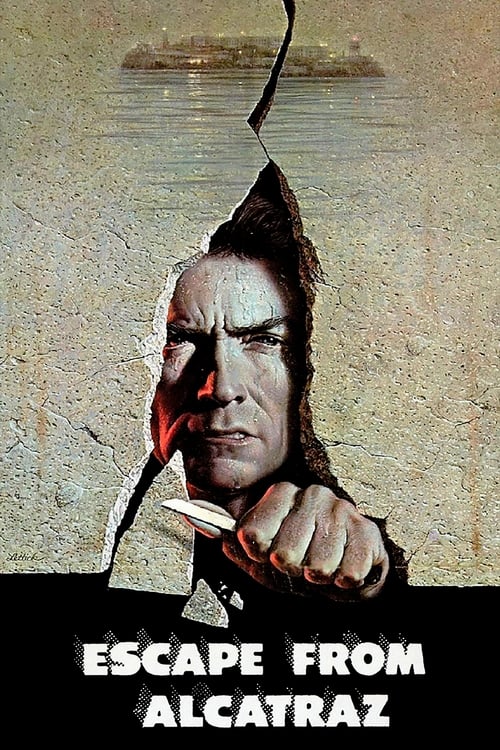
Escape from Alcatraz
1979 · Don Siegel
For when you want tension without noise — a focused, gripping night where you lean in rather than get blasted back. Ideal if you're in the mood for a true story told with total confidence and zero flab.
What it's about
January 1960: career criminal Frank Morris is transferred to Alcatraz, the island fortress in San Francisco Bay that no inmate has ever escaped. Sizing up the guards, the routines, and the crumbling concrete, he and a handful of fellow prisoners begin the slow, secret work of planning a way out. It reconstructs the real 1962 attempt — the one case the authorities could never definitively close.
The experience
Lean, quiet, and methodically tense — almost no wasted dialogue, just the patient accumulation of tools, risks, and near-misses. The suspense comes from process: every scrape of a spoon against concrete feels like it could be the sound that ends everything.
Performances
Clint Eastwood at his most contained, doing more with a watchful stare and a few dry lines than most actors manage with pages of dialogue — a masterclass in minimalist screen presence.
The craft
Don Siegel directs with deliberate austerity: underlit cells, sparse music, and an almost documentary attention to the mechanics of confinement. The sound design does heavy lifting — footsteps, drips, and silence — so good speakers and a dark room pay off.
Why it matters
The final and finest of the five Eastwood–Siegel collaborations, it set the template for the stripped-down procedural prison-break film and kept the real Alcatraz mystery alive in popular imagination.
Snapshot
Escape from Alcatraz is a lean, procedural prison drama that reconstructs the June 1962 escape of Frank Morris and brothers John and Clarence Anglin from the federal penitentiary on Alcatraz Island — the only escape from "the Rock" that was never definitively disproven, its participants presumed drowned but never found. Directed by Don Siegel from a first screenplay by Richard Tuggle, adapted from J. Campbell Bruce's 1963 non-fiction account, the film stars Clint Eastwood as Morris in what would be the fifth and final collaboration between actor and director. It is a work of deliberate austerity: sparse dialogue, underlit interiors, minimal music, and an almost documentary attention to the mechanics of confinement and the patient labor of breaking out. Where a film like The Great Escape is an ensemble adventure, Escape from Alcatraz is closer to the monastic rigor of Robert Bresson or Jacques Becker — a study of intelligence, routine, and will pressed against a system designed to extinguish all three. It stands as one of the most controlled genre films of the late-classical American cinema, and as the coda to one of the defining director–star partnerships of the era.
Industry & production
The film was produced by Don Siegel through his own production arrangement and released by Paramount Pictures in June 1979. It marked a significant point in the Siegel–Eastwood relationship, which had begun in 1968 with Coogan's Bluff and continued through Two Mules for Sister Sara (1970), The Beguiled (1971), and Dirty Harry (1971). By 1979 Eastwood was among the largest box-office draws in the world and had established himself as a director in his own right through his company Malpaso, while Siegel remained a respected veteran craftsman of studio genre cinema. Their partnership on Alcatraz was, by most accounts, more strained than their earlier work together, with reported friction over producing credit and creative control; the two never made another film, though the professional rupture did not preclude a later personal reconciliation. Eastwood's public tribute — dedicating Unforgiven (1992) "to Sergio and Don," Leone and Siegel, the two directors he considered his mentors — is the clearest testimony to what the relationship meant.
The screenplay's origin is unusual and well documented: Richard Tuggle, who had no prior produced credits, wrote the script on spec after reading Bruce's book, and it eventually reached Siegel and Eastwood. Tuggle would go on to write and direct Tightrope (1984), again with Eastwood. Much of the film was shot on location on Alcatraz Island itself, which had ceased to operate as a federal prison in 1963 and had become part of the Golden Gate National Recreation Area in 1972 — making the production one of comparatively few features permitted to film in the actual cellblocks, corridors, and yard, with additional sets used where the decayed structure could not accommodate a crew. The specific budget and detailed box-office figures are not something I will assert with precision here; the film was, by general contemporary account, a commercial success, but exact numbers should be checked against studio records rather than trusted from summary.
Technology
Escape from Alcatraz is not a technologically innovative film in the sense of introducing new apparatus; its accomplishment is one of restraint using conventional late-1970s tools. It was shot photochemically on 35mm color stock, and its notable technical signature is exposure discipline rather than any novel device. Cinematographer Bruce Surtees worked at the low end of the exposure latitude available to color negative of the period, allowing large areas of the frame to fall to near-blackness — a strategy that depended on precise control of practical and motivated light sources and confidence that the lab would hold shadow detail. The location shooting on Alcatraz imposed its own constraints of cramped, hard-surfaced interiors and the island's fog-filtered natural light, which the production used as an asset rather than fighting. The film's realism derives less from technology than from an aesthetic decision to let period-accurate materials — concrete, iron, incandescent fixtures — read as themselves.
Technique
Cinematography
Bruce Surtees, nicknamed the "Prince of Darkness" for his willingness to underexpose, is central to the film's identity. His photography renders Alcatraz as a world of encroaching shadow: cells lit by a single source, corridors receding into black, faces half-swallowed by darkness. This is not stylized noir chiaroscuro so much as a naturalist's argument that a maximum-security prison is genuinely a dim, oppressive space. The compositions favor confinement — bars, grilles, and rectangles of hard architecture that frame and subdivide the figures. The camera is largely unshowy and observational, holding on process and on Eastwood's economical performance, and reserving movement for moments of consequence.
Editing
Ferris Webster, a longtime Eastwood-associated editor, cuts the film for patience and clarity. The escape narrative is fundamentally procedural, and the editing honors that: it lays out the geography of the cellblock, the routines of the guards, and the incremental progress of the tunneling with a legibility that lets suspense accrue from understanding rather than confusion. The rhythm is measured, sometimes near-silent, allowing scenes to breathe and tension to build through duration. The famous opening — Morris's nighttime arrival, processing, strip search, and walk to his cell — is a sustained, near-wordless sequence that establishes the film's grammar before a line of expository dialogue is spoken.
Mise-en-scène / staging
The film's mise-en-scène is grounded in the authenticity of the location and in a rigorous depiction of institutional routine. Staging emphasizes the vertical and horizontal lines of the cellblock, the ritualized movements of count and mealtime, and the small human transactions — a shared painting, a chessboard, a hidden spoon — that constitute life inside. Props carry enormous narrative weight: the sharpened spoons and improvised drills, the vent grilles loosened over weeks, the papier-mâché dummy heads finished with real hair to fool the night guards, the raincoats repurposed into a raft. Siegel stages the mechanics with a craftsman's fascination, so that the tools of escape become the film's true supporting characters.
Sound
Sound is arguably the film's boldest technical choice. It leans heavily on ambient, diegetic sound — footsteps on concrete, the clang of gates, the scrape of metal, the wind and water surrounding the island — and uses Jerry Fielding's score sparingly, withholding music through long stretches so that silence itself becomes an instrument of dread and concentration. When scoring does appear it is restrained and functional. The effect is to make the prison's acoustic environment oppressively present and to keep the audience attentive to the small sounds that could betray the escapees.
Performance
Eastwood's Frank Morris is a masterclass in minimalist star performance: watchful, contained, communicating intelligence and resolve through economy rather than display. The film explicitly frames Morris as exceptionally intelligent, and Eastwood plays him as a man whose stillness is a form of calculation. Patrick McGoohan, as the unnamed Warden, provides the film's principal antagonist — a cold, self-satisfied embodiment of institutional cruelty whose petty vindictiveness (revoking privileges, crushing small dignities) supplies much of the drama's moral charge. The supporting inmates — including the older "Doc," whose loss of his painting privilege leads to an act of self-mutilation, and the fellow escapees and the man who fails to get out in time — are drawn economically but vividly, each embodying a different response to confinement.
Narrative & dramatic mode
The film operates in a realist, procedural mode with strong affinities to the "process" genre — the careful, step-by-step depiction of a difficult task executed under pressure. Its dramatic engine is not psychological revelation or elaborate backstory but the accumulation of small actions toward a goal, and the suspense generated by the constant threat of discovery. Morris is given almost no interior monologue and little exposition; we know him through what he does. The mode is deterministic and observational, closer to naturalism than melodrama, and the film's refusal to sentimentalize or over-explain is essential to its power. The famously ambiguous ending — the men vanish, their fate officially unknown, a chrysanthemum left as a possible clue — converts the procedural into something quietly mythic, honoring the historical uncertainty rather than inventing a resolution.
Genre & cycle
Escape from Alcatraz belongs to the prison-escape film, a durable subgenre with a distinguished lineage: Jules Dassin's Brute Force (1947), Robert Bresson's A Man Escaped (1956), Jacques Becker's Le Trou (1960), John Sturges's The Great Escape (1963), Stuart Rosenberg's Cool Hand Luke (1967), and Franklin Schaffner's Papillon (1973). Within that cycle, Siegel's film aligns most closely with the European austerity of Bresson and Becker — the patient, near-liturgical attention to tools, walls, and time — rather than the star-ensemble adventure of Sturges. It is also legible as a late entry in the broader tradition of institutional dramas that treat the prison as a metaphor for systems of control, and as a variant of the "one impossible task" structure shared with the heist film.
Authorship & method
Don Siegel (1912–1991) was a consummate genre professional whose economical, muscular style influenced a generation — Sam Peckinpah worked under him early, and Eastwood repeatedly cited him as a formative teacher of directing. Siegel's method favored efficiency, clarity, and momentum; his best films (Invasion of the Body Snatchers, The Killers, Dirty Harry) are models of unpretentious craft, and Alcatraz is among the purest expressions of that sensibility, stripped even of the pulpy energy of his thrillers. His key collaborators here form a coherent authorial unit: cinematographer Bruce Surtees, whose underexposed naturalism defines the look; editor Ferris Webster, who supplies the measured rhythm; composer Jerry Fielding, deployed with unusual restraint; and screenwriter Richard Tuggle, whose spare adaptation of Bruce's book resists embellishment. Eastwood, though credited only as star, was by this point a director himself, and the film's minimalism is consistent with the aesthetic he would carry into his own work.
Movement / national cinema
The film is a product of American commercial cinema, but it sits at a revealing hinge. Siegel was a classical Hollywood craftsman whose lean genre pictures were embraced by the New Hollywood generation as models of authorial efficiency; through Eastwood and Peckinpah his influence flowed directly into the era's most important American filmmakers. Escape from Alcatraz thus reads as classical Hollywood method surviving into, and quietly enriched by, the post-1967 sensibility — European art-cinema austerity absorbed into a studio genre picture. It is not part of any organized movement, but it is a significant node in the transmission of craft between generations of American directors.
Era / period
Released in 1979, the film arrived at the tail end of the New Hollywood period, in a year dominated by more expansive spectacles — Apocalypse Now, Alien, Kramer vs. Kramer. Against that backdrop its modesty and control feel almost defiant. It also captures a specific historical texture in its depiction of Alcatraz circa 1960–62, and it carries the added resonance of being filmed on the decommissioned island itself, a place that had passed from operating prison to public monument in the intervening decades. The film is both a period reconstruction of the early 1960s and, in its production circumstances, a late-1970s meditation on a vanished institution.
Themes
The film's dominant themes are freedom and confinement, intelligence versus brute authority, and the preservation of human dignity under a dehumanizing system. The Warden's petty cruelties — most pointedly the confiscation of Doc's painting privilege, which drives an old man to self-harm — establish that Alcatraz seeks to extinguish not just liberty but selfhood, and the escape becomes an assertion of the self against that erasure. The film honors patience, craft, and cooperation as moral values: the escape is a triumph of ingenuity and quiet solidarity. Its ambiguous ending refuses catharsis and instead sustains a theme of the unknowable — the men become a rumor, a possibility, an open question that the institution cannot close.
Reception, canon & influence
Escape from Alcatraz was generally well received on release and is now widely regarded as one of the finest late works of both Siegel and Eastwood, praised for its discipline, atmosphere, and refusal of genre cliché; several prominent American critics singled out its austerity as a strength. (Specific individual reviews and any awards recognition should be verified against the record rather than paraphrased from memory.) Looking backward, the film draws on the procedural escape tradition of Bresson's A Man Escaped and Becker's Le Trou, on the institutional dramas of the 1940s–60s, and directly on J. Campbell Bruce's documentary source; Siegel's own economical style is the through-line. Looking forward, its influence is felt in the enduring appeal of the patient, process-driven prison film — its DNA is visible in the deliberate craftsmanship and institutional critique of The Shawshank Redemption (1994) — and in the continued fascination, cinematic and popular, with the historical mystery of the Anglin brothers and Frank Morris. Within Eastwood's and Siegel's filmographies it holds a place of particular esteem: the elegant, understated capstone to a partnership that helped define American genre cinema of the 1970s.
A Deleuzian reading
A face on a pillow.
The full Deleuzian reading of Escape from Alcatraz →
Reception
A solid hit in 1979 and warmly reviewed, it's since hardened into something more: the lean, wordless craft that once read as 'good genre picture' now gets cited as a masterclass in minimalist filmmaking and one of the great prison movies.
How Escape from Alcatraz was received, from release to now →
Influences: the films it descends from and the films it influenced
- A Man Escaped (1956) — The template for the process-genre: escape built almost entirely from tactile close-ups of hands working spoons, wire, and rope, with scraping and footfall sound carrying the suspense in place of a score.
- Le Trou (1960) — Near-real-time depiction of prisoners chiseling through concrete, shot with documentary patience and non-actors so that tools and physical labor become the drama itself.
- Riot in Cell Block 11 (1954) — Siegel's own semi-documentary prison film, shot inside Folsom with newsreel naturalism and institutional routine (roll calls, mess, lockdown) used as narrative structure.
- Brute Force (1947) — Establishes the prison-as-institution drama and the coldly sadistic authority figure (Captain Munsey) that Alcatraz distills into its impassive warden.
- The Beguiled (1971) — First deployment of the Siegel–Surtees–Eastwood unit; Bruce Surtees's underexposed, single-source (candlelight) naturalism that would define the Alcatraz look originates here.
- The Killers (1964) — Siegel's stripped, momentum-driven economy and the cold professional detachment of its antagonists, a directorial grammar carried directly into Alcatraz.
- Dirty Harry (1971) — Codifies the Siegel/Eastwood minimalist-star method — laconic, near-expressionless performance driving procedural, clarity-first editing.
- The Great Escape (1963) — Codified the procedural-escape genre's step-by-step ingenuity, making forged props, tunnels, and improvised tools the engine of the plot.
- Cool Hand Luke (1967) — Pairs granular institutional routine with a coldly bureaucratic antagonist and a minimalist antihero whose defiance is expressed through withholding rather than speech.
- Papillon (1973) — A contemporaneous escape film built on endurance and the physical mechanics of confinement — solitary cells, tides, hidden tools — rendered as procedural ordeal.
- The Shawshank Redemption (1994) — Extends the patient process-escape into a decades-long slow reveal, with props-as-characters (rock hammer, Rita Hayworth poster) concealing the tunnel exactly in Alcatraz's tradition.
- A Prophet (2009) — Renders prison as a total institution through granular procedural realism — the daily mechanics of survival and hierarchy observed with near-anthropological patience.
- Starred Up (2013) — Immerses in institutional routine with near-wordless, handheld naturalism, trusting behavior and process over exposition in the Bresson–Siegel line.
- Escape from Pretoria (2020) — A direct revival of the tactile process-escape: whittling wooden keys through trial and error, filmed in tense close-up on hands and mechanisms.
- Unforgiven (1992) — Eastwood carries the Surtees underexposed, single-source naturalism and the withholding, austere minimalism learned under Siegel into his own authorship.
- The Rock (1996) — Maps the island's real architecture as a continuously traversable route (utility corridor, ventilation shaft, shower block, waterline), and The Rock simply reverses the vector, running the same infiltration path inward through the cistern and incinerator.
- Birdman of Alcatraz (1962) — An austere black-and-white study of the same institution, structured around patient confinement routine and the slow accretion of cell-bound time.
- No Country for Old Men (2007) — Builds suspense from a withheld score and diegetic-ambient sound design, letting procedural clarity of physical action replace musical cueing.
Similar films
- Le Trou (1960) — influence & lineage · same viewing thread
- Papillon (1973) — influence & lineage · same viewing thread
- The Great Escape (1963) — influence & lineage
- A Man Escaped (1956) — influence & lineage
- Dirty Harry (1971) — influence & lineage
- The Shawshank Redemption (1994) — influence & lineage
- A Prophet (2009) — influence & lineage · same viewing thread
- The Asphalt Jungle (1950) — same viewing thread
All the films related to Escape from Alcatraz →
Watch it with: curated runs of related films
- Cells, Vaults, and Codes of Honor — A run of methodical men — safecrackers, escapees, informers, resistants — filmed as pure process, where the suspense is less whether the job or the escape works than who honors the code and who breaks it first.