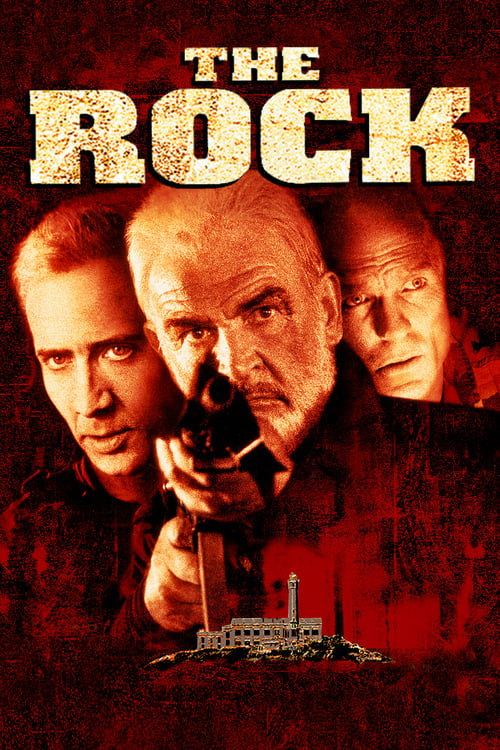
The Rock
1996 · Michael Bay
For when you want a big, dumb-smart action night done absolutely right — pizza, good speakers, no guilt. The gold standard of '90s testosterone cinema, best enjoyed at full volume.
What it's about
A decorated, embittered Marine general seizes Alcatraz with a mercenary force, takes eighty-one hostages, and points rockets loaded with nerve gas at San Francisco — not for money, but to force the government to honor soldiers it left behind. The mismatched team sent in underneath the island: a lab-bound FBI chemist who's never fired a gun in anger, and an elderly British prisoner the government pretends doesn't exist — the only man ever to escape the Rock.
The experience
Relentless, loud, and gleefully entertaining — a machine built from chases, shootouts, ticking clocks, and two stars trading barbs while everything explodes. It moves like a freight train but keeps its swagger and sense of humor the whole way.
Performances
Sean Connery, silver-ponytailed and lethal, essentially plays an aged James Bond gone to prison and steals the film with pure contemptuous charisma. Nicolas Cage makes the nerdy chemist genuinely funny and strange, and Ed Harris gives the villain real gravity — a principled soldier you halfway root for.
The craft
This is Michael Bay's visual style at its most effective — burnished light, roaming cameras, cutting like a strobe — welded to a genuinely sharp script of quotable banter, produced by the Simpson/Bruckheimer hit factory at its peak. The San Francisco car chase and the island assault are showcase set pieces that demand a big screen and loud sound.
Why it matters
The film that made Michael Bay a brand and Nicolas Cage an action star, it's widely held up as the high-water mark of the '90s Bruckheimer action machine — the one even skeptics of the style concede is great.
Snapshot
The Rock is the point at which the Simpson/Bruckheimer high-concept machine, the post-Die Hard siege thriller, and Michael Bay's commercial-bred visual grammar fused into a single, unusually durable object. A decorated Marine general seizes Alcatraz, holds eighty-one hostages, and aims rockets tipped with nerve gas at San Francisco — not for money, but to force the government to acknowledge covert operatives who died unrecognized. The counter-force is a mismatched pair: a bench chemist with no field experience and a British prisoner of the state who is the only man ever to have escaped the island. Released in June 1996 by Hollywood Pictures, it was the last film produced by Don Simpson, who died in January 1996 during post-production and to whom the finished picture is dedicated. It was a major commercial success — figures commonly reported place its worldwide gross above $300 million against a budget in the mid-seventies of millions — and it received a single Academy Award nomination, for sound. Thirty years on, it remains the film most often cited by Bay's detractors as evidence that he could once stage action legibly, and by his defenders as the fullest statement of a style.
Industry & production
The film belongs to the terminal phase of Don Simpson and Jerry Bruckheimer's partnership, the producing team whose 1980s output (Flashdance, Beverly Hills Cop, Top Gun) had codified the high-concept blockbuster: a premise expressible in a sentence, a soundtrack, a hero shot, and a house visual style largely inherited from Tony Scott. By the mid-1990s the partnership had returned to form with Bad Boys (1995) and Crimson Tide (1995), the latter sharing with The Rock a plot engine of military men divided over whether a launch order is legitimate. Simpson's death at forty-eight, with the film in cutting, ended the company; Bruckheimer continued alone into Con Air and Armageddon.
The screenplay's authorship is genuinely tangled, and the record supports only partial resolution. Credit went to David Weisberg and Douglas S. Cook for story and, with Mark Rosner, for screenplay. Multiple uncredited passes have been widely reported — Jonathan Hensleigh, Quentin Tarantino, Aaron Sorkin, and the British team of Dick Clement and Ian La Frenais among them — with Sorkin generally associated with Hummel's rhetoric and Tarantino with Mason's dialogue. The precise apportionment is not documented in any authoritative form, and accounts derive largely from interviews and trade reporting rather than from Writers Guild arbitration records; it should be treated as informed consensus, not established fact.
Production was distinguished by access. Alcatraz had closed as a federal penitentiary in 1963 and become part of the Golden Gate National Recreation Area; The Rock was among the few features permitted to shoot extensively on the island itself, and the location's real corrosion — flaking paint, salt-eaten steel, the cellhouse's cathedral proportions — is doing enormous work that no set could counterfeit. Interiors requiring destruction, water, or fire were built on stages. The San Francisco street chase, in which a Hummer and a Ferrari demolish a stretch of the city, was shot practically on location with a mock cable car among the casualties.
Technology
The Rock sits on a hinge. It is a fully photochemical film: no digital intermediate existed in 1996, so its color and contrast were achieved in-camera and at the lab, which partly explains why its blacks are dense and its highlights blown rather than graded into the uniform teal-and-orange that Bay's own later work helped normalize. Its spectacle is overwhelmingly physical — pyrotechnics, full-scale vehicle destruction, squibs, live fire in confined tunnels, stunt performers rather than digital doubles. Optical and early digital compositing carry the aerial and missile material and the poison-gas effects, but the film predates the moment, roughly two years later, when a Bay production would reach for computer-generated destruction as a first resort.
On the exhibition side it arrived at the crest of theatrical digital sound. The mid-1990s competition between Dolby Digital, DTS, and SDDS gave big-format action films discrete multichannel low-frequency capability, and The Rock was engineered for it; the sole Oscar nomination, for sound, recognizes a mix built for rooms that could reproduce it. Its home-video afterlife is equally period-marked: the film appeared on LaserDisc and then on early DVD through the Criterion Collection, an artifact of Criterion's mid-1990s licensing relationship with Disney that produced one of the stranger juxtapositions in the label's history.
Technique
Cinematography
John Schwartzman, shooting anamorphic Panavision at 2.39:1, established here the look he would carry into Armageddon and Pearl Harbor: hard backlight, atmosphere thick enough to render every beam visible, deep shadow with faces lit to a burnished gold, and a camera that circles. The signature figure — a low, wide, orbiting move around a standing hero with sky or flare behind him — is not Bay's invention (Tony Scott had been doing versions of it for a decade), but The Rock deploys it with a frequency and a rhetorical seriousness that turned it into a template. Interiors on Alcatraz exploit the location's God-light: shafts through broken windows and skylights into the cellblock, cut with handheld coverage in the tunnels and cisterns where the geography is deliberately claustrophobic. The film keeps the camera low and moving even in dialogue scenes, so that exposition acquires the pulse of action; it is a commercial director's instinct — never let a frame be inert — applied at feature length.
Editing
Richard Francis-Bruce, who had cut The Shawshank Redemption and Se7en, is the crucial and least-discussed contributor. The average shot length is very short by 1996 standards, and the film is aggressively fragmented, yet its major set pieces remain spatially readable: the shower-room ambush, the mine-cart and tunnel sequences, the final rooftop pursuit all preserve screen direction and a comprehensible map of who is where. That legibility is what separates The Rock from Bay's later films, where a comparable cutting rate produces incoherence. The editing also carries the film's tonal management, cross-cutting between three command centers — Hummel's men, the FBI/Pentagon war room, the two infiltrators — so that the ticking clock is dramatized structurally rather than merely announced.
Mise-en-scène / staging
Alcatraz functions as a labyrinth with vertical logic: cellblock above, tunnels and flooded cisterns below, roof and lighthouse at the summit. The script rations the space, moving the pair steadily downward and then upward, so that the location itself provides the escalation. Staging favors the tableau — figures arranged in depth against fire, water, or sky, often in slow motion at the moment of a decision. Bay's costume and prop rhetoric is unembarrassed: Mason in a stolen suit and a barber's haircut mid-siege; the nerve agent rendered as green glass spheres of a beauty entirely unrelated to the chemistry of real VX, which is a liquid. The film's most famous image, marines with a rocket on a battlement above a postcard city, is a piece of pure iconographic invention.
Sound
Nick Glennie-Smith, Hans Zimmer, and Harry Gregson-Williams — all working out of Zimmer's Media Ventures — produced a score that became one of the most consequential of the decade, not for its complexity but for its portability: a marching ostinato, a sustained brass anthem, synthesized low end fused with orchestra, structured in eight-bar blocks that can be excerpted indefinitely. It colonized film trailers for the next fifteen years and effectively established the grammar of the modern trailer-music industry. The mix itself, nominated for the Academy Award, is notable for its dynamic brutality — the flat crack of small-arms fire in stone corridors, the sub-bass of the rocket ignition — and for a willingness to drop to near-silence before impact.
Performance
Sean Connery plays John Patrick Mason as a man of the early 1960s released into 1996, and the film knowingly leverages what the audience brings: an SAS-trained British operative imprisoned since 1962 for stealing state secrets is a Bond who was caught, and Connery's authority, contempt, and physical ease all read as a commentary on his own iconography. Nicolas Cage, arriving from a Best Actor Oscar for Leaving Las Vegas three months before release, chose this as his pivot into action, and plays Stanley Goodspeed as a neurotic comic — high-pitched, sardonic, visibly terrified — which is a genuinely strange choice for a blockbuster lead and is much of why the film still works. Ed Harris gives Hummel a quiet, wounded rectitude that refuses villainy; the performance is the film's ballast. Around them, Michael Biehn, William Forsythe, David Morse, John C. McGinley, Tony Todd, John Spencer, and Bokeem Woodbine supply a density of character actors that mid-budget action films of the period could still afford.
Narrative & dramatic mode
The structure is a graft: a heist/caper first act (recruit the specialist, break the prisoner out of custody, plan the entry) welded to a Die Hard-descended siege, with a mutiny drama running underneath. Its most interesting formal decision is the destruction of the SEAL team roughly at the midpoint. The film assembles a squad of competent professionals, gives them a tense, expert approach through the tunnels, and then annihilates them in a single ambush — a shock that converts the picture from a mission film into a two-man survival story and retroactively justifies its odd pairing.
The dramatic mode is operatic melodrama played at action tempo. Hummel is not deluded; his grievance is legible and the film substantially endorses it, forcing the climax to turn on his own refusal to fire rather than on his defeat. That decision moves the antagonism onto his subordinates, who want the money, and produces the film's real argument: honor is not a defense against the machinery it sets in motion. Around this sits a comic register — Cage's exasperation, Connery's needling — that would be tonally incoherent in a lesser-managed film and here functions as pressure release.
Genre & cycle
The Rock is a late, self-aware entry in the "Die Hard in a —" cycle that dominated 1988–1997, and it distinguishes itself by inverting the prison movie: the escape artist must break in. It joins a small Alcatraz filmography — Birdman of Alcatraz (1962), the island prologue of Point Blank (1967), Don Siegel's Escape from Alcatraz (1979) — and is the only one to treat the rock as a fortress to be assaulted rather than fled. It also belongs to the mid-1990s cycle of post-Cold War thrillers in which the antagonist is American and institutional: Under Siege (1992), Clear and Present Danger (1994), Crimson Tide (1995), Broken Arrow (1996), all circling the same anxiety about who controls the weapons and on whose authority.
Authorship & method
Bay was about thirty-one, making his second feature after Bad Boys, having come up through Propaganda Films — the commercial and music-video house that also incubated David Fincher, Alex Proyas, Antoine Fuqua, and Spike Jonze — and through advertising work including the celebrated "Got Milk?" campaign. His method is legible throughout: shoot enormous coverage, favor the striking image over the connective one, cut for propulsion, and treat every frame as a potential poster. What makes The Rock the strongest expression of that method is the counterweight supplied by his collaborators. Schwartzman's photography gives the location gravity; Francis-Bruce, trained on Frank Darabont and David Fincher, imposes spatial discipline on the fragmentation; the Media Ventures team supplies emotional continuity across cuts that would otherwise fly apart; and a screenplay passed through several of the best dialogue writers then working in Hollywood gives Connery and Cage lines worth speaking. Bay's later films retain the method and shed most of the counterweights.
Movement / national cinema
This is American studio cinema at its most confidently commercial, and specifically the product of the advertising-to-features pipeline that reshaped Hollywood's visual language between roughly 1983 and 2000. Its lineage runs from Adrian Lyne and the Scott brothers through Simpson/Bruckheimer to Bay: a cinema of surface finish, montage-driven emotion, and rhetorical rather than observational images. It is also a San Francisco film in a specific tradition — Bullitt, Dirty Harry, Point Blank — using the city's topography as an action instrument, though The Rock treats the location as spectacle rather than as social fact.
Era / period
June 1996 sat inside one of the densest blockbuster summers on record, weeks after Twister and Mission: Impossible and immediately before Independence Day. The context matters: the mid-1990s were the last years in which a $70–80 million action film could be built primarily out of physical production, adult movie stars, and character actors rather than franchise IP and digital armies. Politically, the film is post–Cold War and pre-9/11 — its terrorist is a domestic patriot, its chemical weapon is an object of aesthetic fascination rather than dread, and its threatened American city is a spectacle rather than a wound. That temporal position is inseparable from how the film plays now.
Themes
Three preoccupations organize the picture. The first is institutional betrayal: Hummel's men died off the books and their families received nothing, and the film's authority figures — an FBI director, a Pentagon staff — are shown lying, disowning, and disposing of people as policy. Mason is the same grievance in a different register, a man erased by a state that never charged him. The second is fatherhood, distributed across all three leads: Goodspeed learns he will be a father in the opening act, Mason meets an estranged adult daughter, Hummel acts in the name of dead men and a dead wife. Competence and lineage pass between generations rather than through institutions. The third is the amateur-versus-professional dialectic that makes the casting legible: the chemist who has never fired a weapon and the operative who has never held a legal identity are both, in different senses, unofficial — and the film's proposition is that only the unofficial can be trusted.
Reception, canon & influence
Contemporary reviews were notably warmer than for Bad Boys, with critics repeatedly isolating the same things: Connery's charisma, Cage's unexpected comic strategy, Harris's dignity, the sound and momentum — set against complaints about implausibility, length, and a body count treated as decoration. The film's canonical position is genuinely odd. Its inclusion in the Criterion Collection, on LaserDisc and then as an early DVD (spine #108, with a director-and-cast commentary), was a byproduct of Criterion's Disney licensing rather than a curatorial argument, but it has left The Rock permanently shelved alongside the art-cinema canon — a joke that has slowly acquired the shape of a real critical claim.
Looking backward, the film draws on Die Hard for structure, on the men-on-a-mission tradition of The Guns of Navarone and The Dirty Dozen for its squad, on Escape from Alcatraz and Point Blank for its location, on the Bond cycle for its leading man, and on Tony Scott's Simpson/Bruckheimer work for its entire visual and musical rhetoric. The casting of Michael Biehn as a doomed squad leader carries an unmistakable echo of Aliens.
Looking forward, its consequences are broad. It made Nicolas Cage an action star, directly enabling Con Air and Face/Off the following year. It made Michael Bay a brand and set the grammar — orbiting low-angle hero shots, sunset backlight, ground-level camera, escalating cross-cut climaxes — that the video essayist Tony Zhou later named "Bayhem" and that became close to default for 2000s action and superhero filmmaking. Its score established the Media Ventures/Remote Control template and, through trailer licensing, reshaped how films are sold. Hideo Kojima has cited it as an influence on Metal Gear Solid (1998), whose renegade special-forces unit seizing a remote island weapons facility to demand recognition for the state's disposable soldiers is a near-direct transposition. And in the strangest coda of any 1990s blockbuster, the 2016 Chilcot Inquiry into the Iraq War noted that British intelligence reporting on Iraqi chemical agents stored in glass containers bore a striking resemblance to material in The Rock — an action film's most fanciful invention leaking back into the documentary record of a war.
A Deleuzian reading
Marines on a battlement, a rocket up on a shoulder, San Francisco spread out behind them like a postcard.
The full Deleuzian reading of The Rock →
Reception
A big summer hit in '96 that critics treated as slick Bruckheimer product — and thirty years on it's been fully canonized as Michael Bay's best film, the one even Bay skeptics have to concede.
How The Rock was received, from release to now →
How to watch The Rock: what to notice on a first viewing
- Count how often the camera circles a man standing still. John Schwartzman drops the anamorphic camera low and orbits while flare, smoke and sky wheel behind the figure. Bay saves the move for decisions and usually runs it in slow motion. A very fast film keeps stopping to build statues, which is why it feels monumental instead of merely busy.
- Track who is where during the tunnel sequences. Richard Francis-Bruce cuts very short shots for 1996 and still holds screen direction, so the map stays in your head. He also crosscuts three command posts: the marines on the island, the Pentagon room, the two men underground. The clock gets dramatized by structure rather than announced, and the speed never costs you the geography.
- Notice how the film keeps moving down and then up. Cellhouse above, tunnels and flooded cisterns below, roof and lighthouse at the summit. They shot on Alcatraz itself, so flaking paint, salt-eaten steel and cathedral proportions come free with the location. The escalation is architectural. The story rises and falls by where people are standing in a building.
- Watch how frightened Cage lets Goodspeed look. Three months after winning an Oscar for Leaving Las Vegas, Cage plays a summer action lead high-pitched, sardonic and openly scared. Connery plays contempt and physical ease straight across from it. The hero is an amateur who never stops being one, which keeps the danger feeling real.
- Look at the green glass spheres holding the nerve agent. Real VX is a liquid. The film turns the poison into beautiful glass marbles and lights them like jewelry, then builds every handling scene around not dropping one. Lethal things are gorgeous here, and the gorgeousness is part of what the film is arguing.
The whole guide to watching The Rock, with the keys for a rewatch →
Influences: the films it descends from and the films it influenced
- Goldfinger (1964) — Supplies the Connery performance-text the film treats as literal costume — the bespoke tailoring, the barbershop restoration, the quip timed to the moment of maximum threat — staged in the hotel escape sequence as a deliberate reactivation of a 1962-vintage Bond persona.
- The Guns of Navarone (1961) — Provides the briefing ritual: a scale model of an impregnable rock fortress, specialists assigned by discrete function, and the assault plotted as a vertical climb from waterline to gun emplacement — a beat The Rock reproduces almost function-for-function in the SEAL briefing.
- The Dirty Dozen (1967) — Establishes the convict-as-indispensable-asset recruitment and the roll-call structure in which named specialists are individuated only so they can be eliminated in sequence, which is exactly the arithmetic of the shower-room massacre.
- Point Blank (1967) — Shot Alcatraz as abstract geometry rather than documentary — hard horizontal bar-shadows, receding cell tiers as vanishing-point corridors, footsteps used as percussive rhythm — and Bay lifts that corridor-as-composition logic for the cell-block and tunnel staging.
- Escape from Alcatraz (1979) — Maps the island's real architecture as a continuously traversable route (utility corridor, ventilation shaft, shower block, waterline), and The Rock simply reverses the vector, running the same infiltration path inward through the cistern and incinerator.
- Aliens (1986) — Donates the midpoint squad annihilation — an over-equipped elite unit walking into a prepared ambush in a confined industrial space and being wiped out in under two minutes — down to recasting Michael Biehn as the competent squad leader, plus the gear-up-and-insertion montage cadence.
- Die Hard (1988) — Supplies the siege architecture wholesale: a sealed vertical structure with hostages held in one zone, an unarmed lone infiltrator moving through service spaces, and relentless cross-cutting to an incompetent outside command post — which The Rock grafts onto a heist-crew infiltration.
- Top Gun (1986) — Codifies the Simpson/Bruckheimer image bank Bay inherits intact — hard low-sun backlight raking through smoke and doorways, silhouetted figures walking toward a wide-angle lens, anamorphic flare, and an anthemic cue laid over hardware inserts.
- Crimson Tide (1995) — The immediate template: Zimmer's Media Ventures brass-and-choir ostinato scoring a moral standoff inside a military machine, plus the uncredited star-dialogue polish (Tarantino there, Quinn/Sorkin/Reynolds here) that gives two leads ornamental set-piece exchanges inside a procedural.
- Blade Runner (1982) — Cronenweth's smoke-and-shaft interiors — heavy atmospheric haze punctured by hard parallel beams from unmotivated off-screen sources — become the default lighting grammar Schwartzman applies to Alcatraz's cell blocks and flooded cistern.
- Bad Boys (1995) — Bay's own prototype for the 360-degree orbiting low-angle hero shot, the ground-level wide-angle camera, and cutting on motion rather than on information — techniques The Rock retains but disciplines via Francis-Bruce's spatial continuity.
- The Wild Bunch (1969) — Originates the multi-camera slow-motion violence tableau intercut with normal-speed coverage, which Bay converts from elegy into poster-making — the hero-walk and the ramped deaths in the shower room use the same speed-change grammar stripped of its moral weight.
- Con Air (1997) — Bruckheimer hands the Cage-as-action-lead formula to another commercials director and retains the full package: sunset key light, the hero walking out of an explosion in slow motion, and a Mancina/Media Ventures score built on the same brass-and-guitar hybrid.
- Face/Off (1997) — Directly enabled by The Rock's proof that Cage's mannerist, neurotic-comic register could headline an action film — Woo then makes that performance style the movie's formal subject by having two actors trade it.
- Armageddon (1998) — Extends the escalating parallel cross-cut climax — countdown clock plus multiple geographically separated crises resolved in alternation — and repeats the midpoint squad attrition, while abandoning the single-location discipline that held The Rock together.
- Transformers (2007) — The codified 'Bayhem' grammar at scale: orbiting low-angle hero shot, ground-level dolly under moving objects, magic-hour backlight, and coverage cut for propulsion rather than spatial legibility — the method with every counterweight removed.
- Man of Steel (2013) — Shows superhero cinema absorbing the Bay/Zimmer package as default — handheld ground-level orbit around the standing hero, hard atmospheric backlight, and a Remote Control ostinato-and-percussion score carrying emotional continuity across fragmented cutting.
- Pearl Harbor (2001) — Crystallized Bay's own grammar — 360-degree hero low-angles, orange-teal golden sheen, and hyperkinetic multi-camera coverage — that Pearl Harbor applies at epic scale.
- Broken Arrow (1996) — Same-year twin structure: a decorated officer seizes US strategic ordnance and negotiates by phone with a Pentagon crisis room, cross-cut against a two-man improvised counter-team, with Woo's frozen standoff tableau running parallel to Bay's slow-motion one.
- Enemy of the State (1998) — Bruckheimer and Scott port The Rock's command-post cross-cutting — the room of monitors and satellite feeds intercut with a body moving through real geography — into surveillance thriller form, over the same Media Ventures ostinato scoring.
- Ambulance (2022) — Bay's own foundational text — circling hero cameras, low golden-hour angles, and operatic-pitch performance that Ambulance purifies into undiluted 'Bayhem.'
- Days of Thunder (1990) — Bruckheimer's high-concept spectacle and Hans Zimmer's driving synth-orchestral idiom, first paired in Scott's films, reach their fullest 1990s expression here.
Similar films
- Face/Off (1997) — influence & lineage
- The Dirty Dozen (1967) — influence & lineage
- Escape from Alcatraz (1979) — influence & lineage
- Die Hard (1988) — influence & lineage
- The Guns of Navarone (1961) — influence & lineage
- Goldfinger (1964) — influence & lineage
- Point Blank (1967) — influence & lineage
- 13 Hours: The Secret Soldiers of Benghazi (2016) — shared sensibility