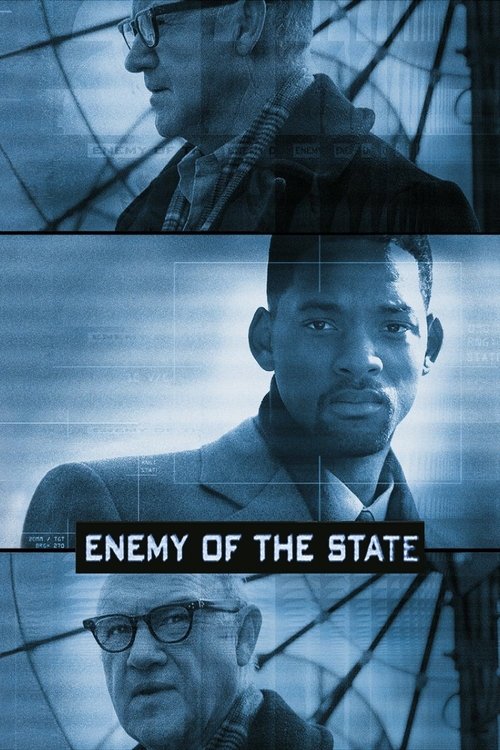
Enemy of the State
1998 · Tony Scott
For a Friday-night thriller that grips from the first act and never lets go — and quietly makes you glance at your phone differently afterward. Pure propulsive comfort-zone tension, no homework required.
What it's about
Robert Clayton Dean is a Washington labor lawyer with a good marriage and a comfortable life until a videotape documenting a congressman's murder lands in his possession without his knowledge. Suddenly the National Security Agency's full toolkit — satellites, wiretaps, planted bugs, fabricated scandals — is turned on one ordinary man, and his only ally is a paranoid ex-intelligence ghost named Brill who's spent decades staying off the grid.
The experience
Relentless and jittery in the best way: a wrong-man chase movie cut at full sprint, where the thrill comes less from gunfights than from the creeping realization that every phone, camera, and credit card is a tripwire. It's paranoia as pure entertainment.
Performances
Will Smith, at the height of his charm, makes the panic feel human, while Gene Hackman brings decades of accumulated wariness to Brill — a prickly, haunted turn that gives the movie its soul.
The craft
Tony Scott's hyperkinetic style — restless cameras, satellite zooms, surveillance-feed inserts, machine-gun editing — is perfectly matched to a story about being watched from every angle. The constant switching between film grain and grainy monitor imagery makes the surveillance itself the visual texture of the movie.
Why it matters
Released in 1998, it played as glossy paranoid fantasy — then the Snowden revelations fifteen years later made it look uncomfortably like reporting, and it's now the go-to reference point for pre-9/11 pop culture's surveillance anxieties.
Snapshot
Enemy of the State arrives at the seam between two eras of American paranoia: the waning Cold War surveillance state and the emerging networked world of ubiquitous tracking. Tony Scott's kinetically edited, Bruckheimer-produced thriller grafts a Hitchcockian wrong-man plot onto the post-Vietnam paranoia cycle of the 1970s, updating its anxieties for the age of GPS, fiber-optic intercepts, and satellite imagery. Will Smith plays Robert Clayton Dean, a Washington labor attorney whose accidental possession of footage documenting a congressman's murder turns the full apparatus of the National Security Agency against him. The film is less interested in pure action-movie thrills than in the phenomenology of being watched—a preoccupation that the Snowden revelations of 2013 would retroactively transform from hyperbole into reportage. Enemy of the State is the rare blockbuster that functions simultaneously as genre entertainment and political provocation, and its afterlife is inseparable from the history it inadvertently anticipated.
Industry & production
Jerry Bruckheimer produced Enemy of the State as one of his first major solo projects following the death of producing partner Don Simpson in January 1996. His collaborative history with Tony Scott—Top Gun (1986), Beverly Hills Cop II (1987), Days of Thunder (1990), The Last Boy Scout (1991), Crimson Tide (1995)—had produced one of the most commercially consistent producer-director partnerships in the industry, and their creative shorthand was thoroughly established by 1998. Bruckheimer's production apparatus brought considerable resources to the surveillance sequences; the production design team undertook research into the visual and procedural textures of intelligence-community facilities, though the specifics of that research process remain poorly documented in the public record.
The screenplay was written by David Marconi, whose script distinguished itself through procedural density—an apparent working knowledge of signals intelligence, satellite tasking, and interagency dynamics that gave the film's scenario its texture of plausibility. Marconi was not a prominent Hollywood figure before or after this project; the history of how Bruckheimer acquired and developed the script is not well documented publicly.
Will Smith, coming off Independence Day (1996) and Men in Black (1997), was at the apex of his commercial power. His casting as Dean works against the grain of the character's vulnerability: a star of that wattage projects confidence and agency even when scripted as a victim, and Scott and Marconi leverage the tension between Smith's charisma and Dean's helplessness for consistent comic and dramatic effect. Gene Hackman, as the reclusive former intelligence operative Edward Lyle—known only as "Brill"—grounds the film in a different register entirely: wary, technically precise, bitter with institutional experience. Jon Voight plays antagonist Thomas Brian Reynolds with cold bureaucratic certainty, making the NSA's menace procedural rather than demonic.
The film was distributed by Touchstone Pictures, Disney's adult-fare label, released in November 1998.
Technology
Enemy of the State's central argument—that an intelligence agency with sufficient budget and political cover can destroy an ordinary citizen's life from orbit—depends on the audience accepting its depicted capabilities as plausible rather than fantastical. In 1998, the specific technologies shown (satellite tasking of civilian targets, real-time traffic-camera tracking, the rapid aggregation of financial, telephonic, and biometric data) occupied a productive uncertainty: advanced enough to be alarming, unconfirmed enough to be dismissed as science fiction.
The production visualized this apparatus through a deliberate grammar of image degradation: satellite feeds rendered with the characteristic grain and lens distortion of reconnaissance optics, CCTV footage with the flickering compression artifacts of low-bandwidth video, thermal imaging with its ghostly, washed-out palette. These were not purely aesthetic choices—they created an epistemological hierarchy within the film's visual field, distinguishing the NSA's claimed omniscient vantage from the civilian world's embodied, partial perspective.
The film's surveillance imaginary proved historically prescient in ways its makers could not have fully anticipated. When Edward Snowden disclosed the scope of NSA programs including PRISM in June 2013, journalists and commentators repeatedly cited Enemy of the State as the nearest popular-cultural approximation of what the agency actually did. The film's fictional surveillance capabilities—mass interception of communications, satellite tracking of individuals, the weaponization of aggregated personal data—mapped uncomfortably closely onto disclosed operational realities. Scott and Marconi had produced, in the form of a thriller, something approaching a speculative technical document.
Technique
Cinematography
Dan Mindel served as director of photography, beginning what would become a significant career in large-format, high-impact studio filmmaking—his subsequent credits would include Star Trek (2009) and Star Wars: The Force Awakens (2015). Scott's visual strategy called for the syntactic mixing of image formats: 35mm principal photography intercut with footage shot on video, digital sensors, and lower-gauge stocks to simulate the heterogeneous feeds of a surveillance operation. This produces the characteristic texture of Enemy of the State's visual field—clean, saturated, kinetic cinematography interrupted by the grainy, compressed imagery of institutional watching.
Mindel's work deploys crash zooms, floating handheld moves, and a consistent preference for telephoto compression that keeps the frame restless even in dialogue sequences. The film rarely settles into the stable, composed frames of classical Hollywood construction; instead, it renders even domestic space as if already observed from without, the camera's mobility a formal correlate of Dean's encroaching paranoia.
Editing
The editing—credited to Chris Lebenzon along with other editorial collaborators—is characteristically Scottian in its density. Scenes are constructed from many short takes, cutting on movement and audio overlap, maintaining rhythmic pressure that prevents the audience from settling into any stable relationship with the action. The surveillance montages in particular, interweaving feeds from multiple cameras with map overlays and reaction shots of NSA operators, required complex editorial architecture to remain legible at speed.
This style was sometimes criticized as exhausting—the formal restlessness working against the film's more intimate dramatic sequences—but it is inseparable from the film's argument: to inhabit Dean's perspective is to experience an overwhelming informational flood, and the editing is designed to produce that disorientation in the viewer.
Mise-en-scène / staging
Scott stages the surveillance sequences with a specific theatrical logic: the NSA operations center functions as a kind of panopticon proscenium, its operators arrayed before banks of monitors like an audience watching Dean's performance of ordinary life. This mise-en-scène—watched and watchers in perpetual theatrical relation—draws on a tradition of institutional space in Hollywood cinema, from the control rooms of Cold War thrillers to the wire rooms of police procedurals.
The film's action sequences prioritize the sensation of velocity over spatial clarity, a consistent Scott preference. The chase sequences through Washington, D.C. deploy the city's neoclassical, monumental architecture as ironic backdrop—the temples of democratic government as the setting for their own subversion.
Sound
The film's score was composed by Trevor Rabin, who had become associated with the Bruckheimer production aesthetic, with additional contributions from Harry Gregson-Williams—though the specific division of compositional labor between them is not clearly documented in public sources. The score maintains the film's tonal instability, shifting between electronic textures evoking surveillance technology and more conventional thriller orchestration during action sequences. Sound design carries significant expressive weight: the hiss of intercepted transmissions, the click of satellite relay equipment, the ambient noise of multiple simultaneous audio feeds. These sounds construct the acoustic world of the surveillance state as a form of intimate, unearned familiarity—the state inside the private moment.
Performance
Smith and Hackman operate on different dramatic frequencies that Scott and Marconi deliberately exploit. Smith's Dean is reactive, improvisational, socially skilled—a man whose professional life has trained him to read people and negotiate, now confronted by an institutional apparatus against which interpersonal skill is useless. Hackman's Brill is the inverse: socially atrophied, technically masterful, his decades of intelligence work having stripped away every ordinary human accommodation to institutional authority. Their scenes together function as a kind of generational dialogue about what the surveillance state does to those who serve it and those it targets.
Voight's Reynolds is one of the film's more undervalued achievements: a villain motivated not by ideology or personal animus but by institutional momentum and the bureaucratic logic of self-protection. He is dangerous precisely because he is ordinary—a functionary who has simply stopped noticing what his function requires him to do.
Narrative & dramatic mode
The film's narrative engine is the Hitchcockian wrong-man plot, one of Hollywood's most durable mechanisms: an innocent person, through no fault of their own, becomes entangled in a conspiracy and must prove their innocence while evading the forces pursuing them. Scott and Marconi update this template for the networked age by foreclosing the possibility of flight. Where Roger Thornhill in North by Northwest (1959) can effectively vanish into the American landscape for long stretches, Dean cannot: the NSA's ability to track credit cards, cellular signals, and physical location means that every attempt to escape the grid requires shedding the entire infrastructure of modern life. The film thus stages the wrong-man plot as a critique of the networked self—the revelation that what we take for convenience is simultaneously a targeting system.
The film's dramatic irony operates through the gap between what the audience can see (the surveillance feeds, the operators' running commentary) and what Dean experiences (fragments, confusion, the sudden collapse of his ordinary life). This dual perspective—intimate with both the hunted and the hunters—sustains suspense across a long runtime and positions the viewer as something uncomfortably close to a surveillance operator themselves.
Genre & cycle
Enemy of the State belongs to the surveillance-paranoia thriller, a cycle that peaked in the early-to-mid 1970s with Francis Ford Coppola's The Conversation (1974), Alan J. Pakula's The Parallax View (1974) and All the President's Men (1976), and Sydney Pollack's Three Days of the Condor (1975). Those films emerged from the specific traumata of Watergate, Vietnam, and the Church Committee revelations about domestic intelligence operations. Scott and Marconi consciously invoke this cycle while transposing its anxieties into a digital register: the enemy is no longer a specific criminal conspiracy but an institutional apparatus that functions autonomously, self-perpetuating, effectively beyond accountability.
The film simultaneously participates in the high-concept action-thriller cycle of the Bruckheimer era, sharing formal DNA with The Rock (1996) and Con Air (1997), though Enemy of the State is meaningfully more invested in politics and procedure than either of those. Scott holds the action thriller and the paranoia film in sustained and productive tension throughout—a balancing act that accounts for both the film's genre satisfactions and its more serious ambitions.
Authorship & method
Tony Scott's authorial signature is kinesis as epistemology: the conviction that velocity—of cutting, camera movement, narrative information—is itself an argument about how contemporary institutional life feels. His most significant films of the 1990s (Crimson Tide, Enemy of the State, and later Man on Fire in 2004) share a preoccupation with American institutions—military, intelligence, governmental—and individuals destroyed or transformed by contact with them. Scott was not an auteur in the romantic European sense; he was a craftsman of large-scale genre cinema who used craft to serve argument, and whose most interesting work channels commercial energy toward political content.
The Bruckheimer-Scott collaboration was among the most commercially consistent producer-director partnerships of the era. Enemy of the State represents perhaps its most politically serious product—the moment when their shared interest in American institutional power extended from military heroism (Top Gun) to institutional menace. That this shift occurred within the same formal vocabulary—kinetic, immersive, unambiguously entertaining—is itself a significant achievement of the collaboration.
Movement / national cinema
Enemy of the State is squarely within mainstream American commercial cinema and does not affiliate with any alternative or national movement. It is, however, notably Washington-centered rather than New York or Los Angeles-centered in its geography and political imagination, placing it within a tradition of D.C. thrillers—All the President's Men, Three Days of the Condor, JFK—concerned with the gap between democratic representation and actual power. This setting is not incidental: the film's argument depends on locating its antagonists within structures that are constitutionally accountable and institutionally unaccountable simultaneously.
Era / period
1998 marks a peculiar interregnum in American political history: the post-Cold War, pre-9/11 interval during which the national security apparatus remained vast but had lost its organizing justification. The NSA, facing institutional pressure to justify its budget in the absence of a Soviet adversary, was expanding its signals intelligence mandate toward domestic and commercial targets—a development known to researchers and journalists at the time but not to most of the general public. The film arrives in this interval as an inadvertent document of a transformation in progress; its anxiety about state surveillance was not paranoid projection but informed extrapolation.
The film also belongs to the moment just before broadband internet transformed mass communication and commerce. The surveillance Dean suffers is already recognizable as the logical extension of the networked world then taking shape—an early vision of what aggregated data could become as an instrument of social control. The anxieties the film dramatizes about data concentration, location tracking, and the weaponization of ordinary digital activity would become normalized features of everyday life within a decade.
Themes
The film's central preoccupation is the asymmetry of institutional power over individual life: what it means to be comprehensively known by an apparatus that you cannot see, appeal, or resist. Dean's predicament is less dramatic exaggeration than structural extrapolation—the logical endpoint of information concentration in state hands, extrapolated to its individual human consequence. The film never depicts the NSA as uniquely evil; it depicts it as structurally constituted to operate this way, which is the more disturbing argument.
Secondarily, Enemy of the State meditates on complicity and its costs. Brill's arc—a former intelligence operative who has spent decades in hiding after refusing to participate in an assassination—frames the moral stakes of institutional loyalty. The system destroys those who resist it and corrupts those who serve it; the film offers no position entirely outside this structure, only the precarious margin of individual refusal and its price.
The film also engages, with prescient discomfort, questions of technological mediation and authentic identity. Dean's existence is increasingly constituted by his data profile rather than his actual self; the NSA's power resides precisely in their ability to manipulate that profile to produce social and legal consequences in the world. This insight—that the data-double can be more socially real than the person it represents—would become a central concern of surveillance studies and digital criticism in subsequent decades, though Enemy of the State arrived at it through thriller mechanics rather than theoretical argument.
Reception, canon & influence
Backward influences: The debt to Coppola's The Conversation is explicit to the point of meta-textual commentary. Hackman's character Brill is linked—through a photograph of a younger man briefly displayed during the film—to Harry Caul, his surveillance specialist protagonist from 1974. Tony Scott acknowledged this homage in interviews, though he did not insist on a strict continuity reading between the two films; the connection functions more as a meditation on what has happened to the surveillance-industrial complex in the quarter century between Coppola's film and Scott's. The broader 1970s paranoia cycle—Pakula especially—is the film's primary generic inheritance, and it inherits not only conventions but the moral seriousness those films brought to conspiracy material.
Critical reception: Reviews on release were generally positive, with particular praise directed at Hackman's performance and the film's procedural texture. Critics noted its ambition to be taken seriously as political thriller rather than pure action product, though some found the action sequences and the political argument pulling against each other in ways the film could not fully resolve. The film performed well commercially; specific figures are not cited here as box-office numbers from this period vary significantly across sources.
Forward influence: Enemy of the State's lasting significance is primarily documentary and cultural rather than narrowly formal. It became the central reference point, post-Snowden, for popular understanding of NSA capabilities—when Glenn Greenwald, Laura Poitras, and Barton Gellman began reporting on PRISM and related programs in 2013, they found a public that had been culturally prepared by Enemy of the State to understand what mass surveillance looked like in practice. The film's surveillance aesthetic—mixing image formats, overlaying data visualizations, deploying the operator's-eye view as a counterpoint to the protagonist's ground-level confusion—became a visual convention of subsequent surveillance drama, visible in the television series Person of Interest (2011–2016) and Mr. Robot (2015–2019), both of which engage with comparable anxieties at greater length and depth.
The film also contributed to a late-1990s cycle of meditations on institutional watching that included The Truman Show (1998) and, at greater remove, Minority Report (2002). Among these, Enemy of the State is the most explicitly political and the most grounded in actual intelligence-community practice. Its achievement—a film that wanted the audience to enjoy itself and to be alarmed, and that largely managed both—remains unusual in the genre and in the Bruckheimer filmography alike.
A Deleuzian reading
Start with the shot you remember: an overhead view of a city block, Will Smith reduced to a dot crossing a crosswalk, the image stamped with crosshairs and coordinates, slightly grained, slightly wrong.
The full Deleuzian reading of Enemy of the State →
Reception
In 1998 it played as a slick Bruckheimer paranoia ride — fun, loud, disposable. Post-Snowden it got fully reappraised as eerily prophetic about NSA mass surveillance, and the Tony Scott revival after his death sealed its climb from popcorn to prescient.
How Enemy of the State was received, from release to now →
Influences: the films it descends from and the films it influenced
- Blow-Up (1966) — Antonioni's photographic-enlargement sequence establishes image-degradation as the primary epistemological device—surveillance media that contains truth only until it dissolves into grain—the formal ancestor of Enemy of the State's visual hierarchy of degraded CCTV and satellite feeds.
- The Parallax View (1974) — Pakula's extreme wide-angle compositions that dwarf the protagonist within governmental architecture—Senate hearing rooms, stadium concourses, institutional lobbies—establish the panopticon-proscenium staging grammar that Scott's production design inherits for its NSA operations centers and DC interiors.
- The Conversation (1974) — Coppola's construction of surveillance audio as the primary forensic medium—ambiguous tape recordings replayed to reveal and conceal a murder simultaneously—establishes the epistemological grammar of institutional watching that Scott inverts into visual form; Hackman's casting as Brill directly evokes Harry Caul, completing the intertextual loop.
- Three Days of the Condor (1975) — Pollack's narrative structure—a civilian analyst targeted by the very apparatus he serves, navigating with a burned operative who no longer trusts the institution—is the precise relational template Enemy of the State inherits for the Dean/Brill pairing and its two-man survival logic.
- Blow Out (1981) — De Palma's construction of recorded media as simultaneously forensic evidence and epistemological trap—audio and photographic material that cannot survive the institutional pressure to suppress it—directly prefigures Enemy of the State's treatment of the incriminating video footage and its mixed-format grammar of surveillance capture.
- No Way Out (1987) — Donaldson's Pentagon-set wrong-man thriller introduced the Washington security apparatus—composite digital identity searches, interagency dynamics, betrayal at departmental hierarchy's apex—as the procedural machinery that Enemy of the State updates with GPS satellite tasking, fiber-optic intercepts, and real-time biometric aggregation.
- JFK (1991) — Stone and Robert Richardson's grammar of mixed-gauge stocks—16mm archival footage, Super-8, video surveillance, and 35mm principal photography intercut to construct a paranoid institutional epistemology—is the immediate formal model for Dan Mindel and Tony Scott's syntactic mixing of surveillance image formats as truth-claim markers.
- Natural Born Killers (1994) — Stone and Richardson's aggressive mixing of film stocks, video formats, and image textures—formats chosen specifically for their degradation properties—is the direct formal precedent for Enemy of the State's use of image quality as epistemological register, distinguishing institutional vantage from embodied civilian perspective.
- Crimson Tide (1995) — Scott and Bruckheimer's preceding collaboration established the specific telephoto-compression grammar, rapid-fire cutting rhythm, and institutional-pressure performance register—professionals under operational duress in enclosed command spaces—that Enemy of the State inherits and scales from submarine confinement to city-wide surveillance architecture.
- The End of Violence (1997) — Translates the same NSA/satellite-grid surveillance anxiety into propulsive genre mechanics, dramatizing the camera-and-database network Wenders only sketched as concept.
- The Fugitive (1993) — Surveillance-era update of the wronged-everyman-on-the-run thriller, an ordinary man improvising evasion against institutional state power.
- The Bourne Supremacy (2004) — Greengrass's dual-perspective surveillance architecture—institutional overhead shots of operations centers tracking the protagonist via satellite and CCTV feeds, intercut with the protagonist's ground-level embodied perspective—directly inherits Enemy of the State's structural grammar of the watcher and the watched as competing editorial registers.
- Caché (2005) — Haneke radicalizes Enemy of the State's image-degradation epistemology by rendering anonymous surveillance footage in a visual register indistinguishable from the film's principal photography—the impossibility of determining the watcher's identity becomes the formal and psychological crisis, extending Scott's surveillance grammar into pure aesthetic dread.
- Déjà Vu (2006) — Scott's own evolution of Enemy of the State's surveillance architecture—the multi-camera 'Snow White' monitoring window as both narrative engine and epistemological trap—transmutes the institutional panopticon into a temporal surveillance apparatus, applying the same mixed-format, multi-angle monitoring grammar to the problem of past-image legibility.
- The Dark Knight (2008) — Nolan's city-wide sonar surveillance sequence—aggregated mobile microphones rendered as a panopticon montage of urban space—directly inherits Enemy of the State's grammar of mass-data-collection as editing spectacle, while Lucius Fox's ethical objection enacts precisely the institutional-atrophy performance register that Jon Voight's Reynolds had foreclosed.
- Zero Dark Thirty (2012) — Bigelow's procedural integration of drone feeds, surveillance video, and degraded imagery alongside principal photography extends Enemy of the State's image-quality epistemology—the visual hierarchy distinguishing institutional vantage from human-scale embodied vision—now applied to documented rather than speculative intelligence operations.
- Snowden (2016) — Stone's return to mixed-format paranoid grammar for the Snowden disclosures—and the film's explicit in-dialogue citation of Enemy of the State as the nearest public-cultural model for NSA capability—completes the lineage loop, with Stone applying to documented reality the visual vocabulary Scott had applied to speculation eighteen years earlier.
- Shooter (2007) — Updates the surveillance-state government-framing conspiracy for the digital era: a protagonist targeted by his own government's institutional machinery using real-time intelligence tools, establishing the post-Cold War paranoid thriller visual and narrative grammar that Shooter directly continues.
- Spy Game (2001) — Dan Mindel's cinematography and the satellite/intercept-screen surveillance apparatus carry directly into Spy Game's information-dense, geographically coded frame.
- The Truman Show (1998) — Released the same year, Weir constructs total surveillance as spatial and editorial architecture—the panopticon rendered as a diegetic world whose geography is determined entirely by camera placement and broadcast-control montage—developing the panopticon-proscenium staging as pure ontological condition rather than political threat, the thematic mirror image to Scott's institutional critique.
- Minority Report (2002) — Spielberg and Kaminski's construction of pre-crime surveillance as gesture-driven editorial interface—the protagonist's hands sorting video streams through a spatially choreographed montage system—extends Enemy of the State's surveillance-montage editing into speculative procedural form, literalizing the networked-self-as-targeting-system thesis as operational workflow.
- Runaway Jury (2003) — Has Hackman reprise his Harry Caul surveillance-expert role in a control room of monitors and data-tracking, the same post-Conversation iconography Runaway Jury maps onto jury consulting.
- The Rock (1996) — Bruckheimer and Scott port The Rock's command-post cross-cutting — the room of monitors and satellite feeds intercut with a body moving through real geography — into surveillance thriller form, over the same Media Ventures ostinato scoring.
Similar films
- Crimson Tide (1995) — influence & lineage · same viewing thread
- Déjà Vu (2006) — influence & lineage · same viewing thread
- The Conversation (1974) — influence & lineage
- JFK (1991) — influence & lineage
- The Parallax View (1974) — influence & lineage
- The Truman Show (1998) — influence & lineage
- Blow Out (1981) — influence & lineage
- The Bourne Supremacy (2004) — influence & lineage
All the films related to Enemy of the State →
Watch it with: curated runs of related films
- Inside the Security State — A run of modern espionage and national-security thrillers — globe-trotting spycraft, submarine brinkmanship, and the paper trail behind the black sites — where operatives and investigators race secretive institutions and catastrophic clocks.