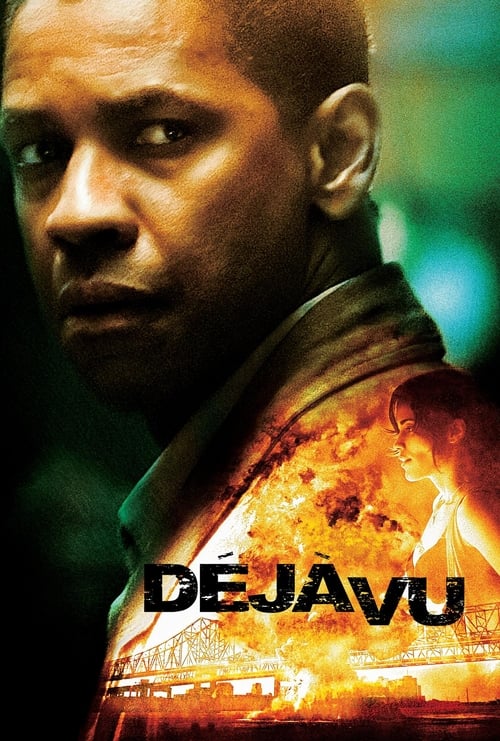
Déjà Vu
2006 · Tony Scott
For a Friday night when you want a big, loud, satisfying thriller that's also a little smarter and a little sadder than it needs to be — comfort viewing with a time-travel brain-teaser inside.
What it's about
A ferry packed with sailors and their families explodes in New Orleans, and ATF agent Doug Carlin is brought in to work the wreckage. His instincts are so sharp that a covert federal unit recruits him to use their secret surveillance system — a device that lets investigators watch events from four days in the past, but only once, in real time, with no rewind. As he hunts the bomber, Carlin becomes fixated on one victim, a young woman whose murder seems tangled up with the attack, and starts wondering whether watching the past is really all the machine can do.
The experience
It moves like a muscle car — propulsive, saturated, restlessly edited — but there's an undertow of grief and longing that sneaks up on you. Half forensic thriller, half impossible love story, it keeps accelerating until the two halves collide.
Performances
Denzel Washington grounds all the sci-fi machinery with easy charm and real ache — his fixation on a woman he's only ever seen on a screen becomes strangely moving. Paula Patton makes the victim a full person rather than a plot device.
The craft
Tony Scott's signature style — swirling cameras, jagged cuts, colors pushed to the edge of bleeding — turns surveillance footage into something almost romantic. The film's centerpiece is a car chase run simultaneously in two timelines, a genuinely original piece of action staging, and shooting in post-Katrina New Orleans gives the whole thing a haunted, waterlogged weight. Loud, kinetic, and built for a big screen and good speakers.
Why it matters
One of the first major Hollywood productions to film in New Orleans after Katrina, and a high-water mark of the Tony Scott–Denzel Washington partnership; its two-timeline chase and watching-the-past premise have echoed through time-bending thrillers since.
Snapshot
Déjà Vu is Tony Scott's surveillance-thriller-meets-time-travel hybrid, a film that begins as a forensic procedural about a New Orleans ferry bombing and gradually reveals itself as a metaphysical love story conducted across a four-day rift in time. ATF agent Doug Carlin (Denzel Washington), sifting the wreckage, is recruited into a covert federal unit operating a device that can surveil the recent past — and becomes fixated on a murdered woman, Claire Kuchever (Paula Patton), whose death is bound up with the attack. The picture marks the third collaboration between Scott and Washington, sits squarely within producer Jerry Bruckheimer's brand of high-gloss studio spectacle, and carries a specific historical charge as one of the first major Hollywood productions to shoot in New Orleans after Hurricane Katrina. It is at once a slick commercial machine and a surprisingly mournful meditation on watching, grief, and the wish to undo catastrophe.
Industry & production
Déjà Vu was produced by Jerry Bruckheimer and released through Touchstone Pictures, then a Disney label, in November 2006. It belongs to the long-running Bruckheimer–Scott partnership that stretches back to Top Gun (1986) and Beverly Hills Cop II (1987), and it reunites the producer and director with Denzel Washington after Crimson Tide (1995) and Man on Fire (2004); the two would go on to make The Taking of Pelham 123 (2009) and Unstoppable (2010). The screenplay originated as a spec script by Bill Marsilii, with Terry Rossio — the Pirates of the Caribbean and Shrek co-writer — brought on for development; the project was a high-profile spec sale of its era, though I would avoid attaching a precise figure to it without firm sourcing.
The most consequential production fact is geographic. The film was shot largely on location in New Orleans in 2006, less than a year after Katrina, and it is frequently cited as one of the first major studio features to return production to the city. Scott and Bruckheimer chose to acknowledge the disaster within the fiction rather than erase it: dialogue references the storm and the city's wounded condition, and the choice carried both an economic dimension (production dollars and visible solidarity for a devastated film community) and a thematic one — a story about reversing an unbearable loss, made in a place defined by an unbearable, irreversible one. The climactic set pieces exploit recognizable local geography: the Algiers ferry, the Crescent City Connection bridge, and a Mardi Gras–adjacent staging of the bombing aboard a vessel carrying Navy sailors and their families.
Technology
The film is organized around a fictional surveillance apparatus the unit nicknames "Snow White": a system that, the team claims, can reconstruct and display events from exactly four days and six hours in the past, presenting them as a navigable, camera-like window rather than recorded footage. The conceit is explained first as triangulated satellite surveillance and only later as something closer to a folded wormhole — a deliberate bait-and-switch that lets the film function as a tech-procedural before committing to literal time travel. Two devices drive the plot's escalation: a portable "goggle" rig that lets Carlin drive through present-day streets while watching the same route four days earlier, and the larger apparatus that can ultimately send physical matter — a note, and then a person — backward.
Behind the camera, Déjà Vu sits at the front edge of digital-era studio filmmaking without being a fully digital production; Scott's house style of the period leaned on aggressive post-production color and compositing to integrate the multi-screen surveillance interfaces, layered "past" imagery, and the doubled-timeframe chase. The film's imagined technology is also a self-portrait of its own apparatus: a roomful of screens reconstructing the past from many angles is, transparently, a metaphor for cinema and the editing bay.
Technique
Cinematography
The cinematographer is Paul Cameron, who had shot Man on Fire for Scott. The film is photographed in Scott's saturated, high-contrast late manner — warm New Orleans light, smeared neon, telephoto compression, and a restless handheld energy — though Déjà Vu is somewhat more disciplined than the near-experimental visual overload of Man on Fire or Domino (2005). Cameron and Scott exploit a useful formal problem: how to render two moments in time within a single frame. The surveillance sequences are graded and textured to read as subtly "other" — a half-step cooler or more diffuse than the present — so the audience can hold both timeframes simultaneously, which pays off in the bravura car chase intercut and overlaid across the four-day gap.
Editing
Chris Lebenzon, Scott's longtime editor, cut the film, and the picture is in many ways an editor's showcase precisely because its subject is the manipulation of recorded time. Lebenzon manages an unusually demanding spatial-temporal logic: the surveillance scenes require the audience to track Carlin watching events, the events themselves, and the lag between them. The cross-time car chase — Carlin pursuing in the present a vehicle that existed four days earlier — is the film's signature edit, a sustained exercise in keeping two non-contemporaneous spaces legible and tense at once. Elsewhere the cutting carries Scott's familiar staccato rhythms, but the central premise disciplines the montage toward clarity rather than pure kinesis.
Mise-en-scène / staging
The production design splits between two registers: the grain and humidity of post-Katrina New Orleans — docks, working-class apartments, the ferry, the bridge — and the cold, screen-saturated interior of the surveillance lab. Scott stages the investigation as a kind of haunting: Carlin moves through Claire's apartment and life as a voyeur of a woman already dead, the domestic space rendered both intimate and forensic. The recurring motif of looking — through goggles, monitors, windshields, evidence — is built into the staging at every level.
Sound
Harry Gregson-Williams composed the score, continuing his collaboration with Scott (Man on Fire) and his broader association with Bruckheimer productions. The music balances propulsive thriller cues against a more elegiac, romantic theme tied to Claire, underscoring the film's double identity as action machine and love story. The sound design leans heavily on the texture of surveillance — the hum and click of the apparatus, the eerie ambient "presence" of a past being watched — and on the visceral concussion of the ferry explosion, which the film returns to repeatedly as both crime scene and trauma.
Performance
Washington anchors the film with the grounded, watchful authority that defines his work for Scott: Carlin is intelligent, wry, and increasingly haunted, and Washington plays the dawning emotional absurdity of falling in love with a dead woman on a screen without tipping into either camp or sentimentality. Paula Patton, in an early major role, gives Claire enough warmth and specificity to make the conceit land — she must function as both murder victim and living romantic lead. Val Kilmer plays the FBI handler Andrew Pryzwarra with low-key gravity; Jim Caviezel is the domestic-terrorist antagonist Carroll Oerstadt, a chilly, ideologically inscrutable bomber; Adam Goldberg and Bruce Greenwood round out the technical and bureaucratic worlds.
Narrative & dramatic mode
The screenplay executes a deliberate genre migration. Act one is a competent forensic procedural — a bombing, an investigator, a body that doesn't fit the timeline. Act two reframes the mystery as a science-fiction surveillance drama, with the "window into the past" supplying a fresh engine for detection: Carlin solves the present by watching the past. Act three converts the premise into active time travel and a race to prevent the atrocity, collapsing investigation, romance, and rescue into one. The film flirts with the classic paradoxes of the form — can the past be changed, and at what cost — and ultimately opts for an emotionally satisfying, logically permissive resolution rather than a rigorously closed loop. Its dramatic mode is fundamentally romantic-tragic dressed as action spectacle: the deja vu of the title is the ache of having already lived, or watched, a loss one is powerless to stop — until, in fantasy, one is not.
Genre & cycle
Déjà Vu belongs to two overlapping cycles. The first is the post-9/11 surveillance-and-terrorism thriller, a strain Scott himself had helped define with Enemy of the State (1998); the film's premise of a secret federal unit deploying near-magical total surveillance against domestic terror is unmistakably a product of the mid-2000s security state and its anxieties. The second is the time-loop / change-the-past science-fiction romance, a tradition running through Vertigo, La Jetée, The Terminator, 12 Monkeys, Frequency, and The Butterfly Effect. The film's distinctiveness lies in fusing the two: it treats mass surveillance not merely as a tool of control but as a technology of grief and second chances.
Authorship & method
Tony Scott is the organizing authorial intelligence. By 2006 he had developed an instantly recognizable late style — chromatic excess, layered exposures, telephoto restlessness, kinetic cutting — that some critics read as empty flash and others as a genuine, near-avant-garde reinvention of studio action grammar. Déjà Vu is a useful test case because its premise forces that style toward coherence: the very subject of watching and re-watching rewards Scott's obsession with the image-of-an-image. His key collaborators form a stable repertory: cinematographer Paul Cameron, editor Chris Lebenzon, and composer Harry Gregson-Williams, each carried over from Man on Fire, plus star Denzel Washington and producer Jerry Bruckheimer. The screenplay by Bill Marsilii and Terry Rossio supplies the high-concept architecture; the romantic-melancholic undertow is as much Scott's contribution as the writers', evident in how much weight the film places on Carlin's solitary, voyeuristic longing.
Movement / national cinema
This is mainstream American studio cinema at its most industrially refined — Hollywood high-concept spectacle in the Bruckheimer mold, conceived for global theatrical release. It does not belong to any art-cinema movement, but it can be situated within a recognizable strand of 2000s Hollywood: the technologically anxious, post-9/11 blockbuster that processes contemporary security politics through genre. Its New Orleans setting and timing give it a more specific national-cultural inflection than most films of its type, binding a piece of escapist entertainment to a real and recent American disaster.
Era / period
The film is profoundly of 2006. It arrives amid the War on Terror's surveillance debates, the political aftershocks of Katrina, and a Hollywood moment increasingly preoccupied with watching and being watched. Its imagined apparatus — total retrospective surveillance justified by counterterrorism — reads as a fantasy and a warning simultaneously, and its choice to dramatize a domestic terrorist bombing aboard a vessel of Navy families locates its fears firmly in the American mid-decade. Aesthetically it captures Scott's style at its mature peak, just before The Taking of Pelham 123 and the comparatively classical Unstoppable that would close out his career before his death in 2012.
Themes
The governing theme is the desire to reverse the irreversible — to re-enter the past and undo a death, a wish given literal machinery and unmistakable resonance in a city still grieving Katrina. Surrounding it are surveillance and voyeurism (the investigator who falls in love through a screen), the ethics of total observation, fate versus agency (whether watching the past obligates or enables one to change it), and grief as a kind of haunting. The title names the film's deepest idea: the uncanny sense of having already experienced a moment, recast here as the structural condition of a man who has watched a future that is also a past. Love, in this scheme, is the force that justifies tearing the fabric of time.
Reception, canon & influence
Critical reception was mixed-to-positive. Reviewers frequently praised the taut, intriguing first act and Washington's grounded performance, while a recurring criticism held that the time-travel logic grows muddled or convenient in the final act, asking the audience to feel rather than scrutinize the paradoxes. The film performed respectably as a commercial release, though I would not assign it specific box-office figures without verification.
The influences on the film are legible and deep. Vertigo is the essential ancestor: a man obsessively watching, reconstructing, and trying to save a woman who is, in some sense, already lost. Chris Marker's La Jetée and its descendant 12 Monkeys supply the structure of a consciousness sent through time toward a remembered catastrophe; The Terminator and Frequency supply the change-the-past mechanics; and Scott's own Enemy of the State supplies the surveillance-state architecture and the visual vocabulary of the watch-room. The procedural-investigator-meets-impossible-technology shape also echoes the pre-crime surveillance cinema of the moment, of which Spielberg's Minority Report (2002) is the dominant contemporary.
The film's forward legacy is real but modest. It stands as a notable entry in the 2000s cycle of surveillance-and-time science fiction that runs forward to films like Duncan Jones's Source Code (2011), which shares the premise of an agent repeatedly re-entering a recent past to prevent a transit bombing and to save a woman. Within Scott's own filmography it occupies an important late-period position, demonstrating that his maximalist style could serve emotion and complex temporal storytelling, not just velocity. Its most durable cultural footnote may be extra-textual: as a marker of Hollywood's return to New Orleans after Katrina, Déjà Vu carries a documentary weight its fantastical premise never quite anticipated — a film about undoing disaster, made in the ruins of one that could not be undone.
A Deleuzian reading
Picture Carlin in the goggle rig, tearing down a New Orleans overpass with the windshield full of the same road four days ago.
The full Deleuzian reading of Déjà Vu →
Reception
Shrugged off in 2006 as a slick Bruckheimer sci-fi thriller with a silly premise, it's since become a centerpiece of the Tony Scott reappraisal — after his death in 2012, cinephiles recast his hyperactive late-digital style as genuine auteurism, and Déjà Vu is now regularly called one of his best.
How Déjà Vu was received, from release to now →
Influences: the films it descends from and the films it influenced
- Vertigo (1958) — Supplies the voyeuristic-haunting template — a man who surveils, reconstructs, and tries to recover a woman already lost — making the watcher's obsessive gaze the film's true subject, the structuring ancestor the dossier names.
- La Jetée (1962) — Donates the architecture of a consciousness sent backward toward a remembered catastrophe, the protagonist circling his own death in a closed loop he cannot see he is completing.
- 12 Monkeys (1995) — La Jetée's feature-length descendant that hands Déjà Vu its doomed-investigator-inside-a-predestined-loop shape, with time-displaced perception bleeding into the present.
- The Terminator (1984) — Provides the change-the-past mechanics: an agent physically dispatched through time to intervene in a fixed disaster, and the bootstrap causality that the third act leans on.
- Frequency (2000) — Models the emotional cross-time procedural — communication sent into the recent past to rewrite events and rescue a doomed person — privileging feeling over paradox-scrutiny exactly as Déjà Vu does.
- Minority Report (2002) — The dominant contemporary pre-crime surveillance procedural: future evidence rendered as a navigable, scrubbable interface that the investigator physically manipulates to read a crime before it happens.
- Enemy of the State (1998) — Scott's own surveillance-state watch-room and multi-feed monitoring grammar, recycled almost wholesale into the 'Snow White' apparatus and its god's-eye reconstruction of a place and time.
- Man on Fire (2004) — The immediate stylistic parent: the same Paul Cameron / Chris Lebenzon / Harry Gregson-Williams repertory plus Denzel, carrying over the chromatic-excess, layered-exposure, subtitle-as-graphic late style.
- Spy Game (2001) — Builds narrative out of surveillance footage and intercut timeframes, rehearsing the watch-room procedural rhythm and the cross-time editing logic Déjà Vu formalizes.
- Source Code (2011) — Near-direct heir: an agent repeatedly re-enters a recent past to prevent a transit bombing and save a woman, inheriting Déjà Vu's loop-procedural premise and its emotional override of temporal logic.
- Looper (2012) — Extends the change-the-past, reverse-the-irreversible mechanics into time-travel noir, where the protagonist's intervention closes a causal loop he is implicated in.
- Predestination (2014) — Intensifies the La Jetée/Déjà Vu closed-loop paradox into a bomb-prevention procedural where the agent is revealed to be the very catastrophe he chases.
- Tenet (2020) — Builds a surveillance-thriller on literally reversing the irreversible — inverted timeframes intercut and composited within the frame — the maximalist endpoint of Déjà Vu's dual-timeframe, watch-the-past device.
- Domino (2005) — The formal bracket immediately preceding Déjà Vu — peak late-style chromatic saturation, multi-layered superimposition, and staccato cutting pushed toward near-abstraction.
- Unstoppable (2010) — Applies the same telephoto-compression restlessness and kinetic staccato assembly to a real-time disaster-prevention procedural, the terminal extension of Scott's watch-and-intervene grammar.
Similar films
- Source Code (2011) — influence & lineage · same viewing thread
- Enemy of the State (1998) — influence & lineage · same viewing thread
- Man on Fire (2004) — influence & lineage
- Tenet (2020) — influence & lineage
- Predestination (2014) — influence & lineage
- Looper (2012) — influence & lineage
- Minority Report (2002) — influence & lineage
- Spy Game (2001) — influence & lineage · same viewing thread
All the films related to Déjà Vu →
Watch it with: curated runs of related films
- Inside the Security State — A run of modern espionage and national-security thrillers — globe-trotting spycraft, submarine brinkmanship, and the paper trail behind the black sites — where operatives and investigators race secretive institutions and catastrophic clocks.