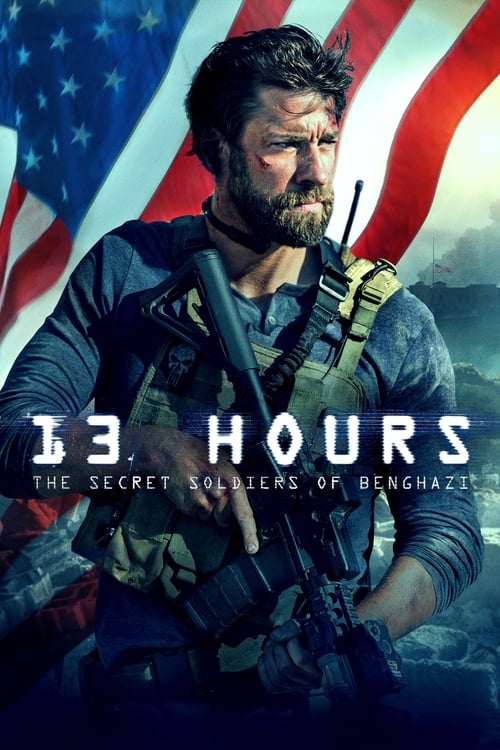
13 Hours: The Secret Soldiers of Benghazi
2016 · Michael Bay
For when you want pure, sustained combat intensity — a long, adrenaline-heavy night rather than a thoughtful one. Reach for it when you're in the mood for a siege you can feel in your chest; skip it if you want subtlety or comfort.
What it's about
On the night of September 11, 2012, militias attack the U.S. diplomatic compound in Benghazi, Libya, and a small team of ex-military security contractors at a nearby covert CIA annex becomes the only force able to respond. Drawn from the surviving team members' own account, the film compresses one long night of confusion, waiting, and repeated assaults into a ground-level siege — no big picture, no Washington, just the men holding the walls.
The experience
Loud, punishing, and claustrophobic — hours of dread between waves of chaotic close-quarters combat, where you're never sure which direction the next attack is coming from. It's exhausting by design, and the fog-of-war confusion is the point.
Performances
John Krasinski, cast against his comedic image, brings a grounded weariness to the team, and James Badge Dale gives the standout turn as the unit's blunt, magnetic leader.
The craft
This is Michael Bay at his most restrained: the trademark spectacle is swapped for sweaty, tactile realism — night-vision green, tracer fire, mortars you hear before you see. The sound design and battlefield geography are genuinely impressive, and it hits hardest with good speakers and the lights off.
Why it matters
Landing in the middle of an American political firestorm over Benghazi, the film became a flashpoint itself — and it stands as the case that Bay could make a serious, stripped-down war picture when he chose to.
Snapshot
On the night of September 11, 2012, a coordinated militia assault on the U.S. Special Mission Compound and CIA Annex in Benghazi, Libya, killed U.S. Ambassador J. Christopher Stevens, Foreign Service Information Officer Sean Smith, and two CIA Global Response Staff contractors, Tyrone "Rone" Woods and Glen "Bub" Doherty. Michael Bay's dramatization, based on Mitchell Zuckoff's 2014 oral history written with the surviving members of the Annex Security Team, compresses those thirteen hours into a siege film of deliberate, almost procedural intensity. It is the most restrained and arguably the most serious film Bay has made — a work that subordinates spectacle to ground-level claustrophobia, forgoing his signature CGI baroque in favor of sweated, tactile combat realism. The result occupies an uneasy but historically significant position: a megabudget mainstream director applying his craft to an event whose political aftershocks were still reverberating through American public life at the time of the film's release.
Industry & production
Paramount Pictures produced the film with 3 Arts Entertainment and Bay's production company, Don Simpson/Jerry Bruckheimer Films having long since dissolved as a partnership. The screenplay was written by Chuck Hodes, adapting Zuckoff's book, which drew on extended interviews with the six surviving GRS contractors: Kris "Tanto" Paronto, Dave "Boon" Benton, John "Tig" Tiegen, Mark "Oz" Geist, and the two composite-adjacent figures whose accounts anchor the narrative. The film was shot primarily in Malta — the island's architecture, light, and production infrastructure having served as a proxy for North African and Middle Eastern locations in numerous productions — as well as in Morocco. Principal photography began in 2014.
Bay made a deliberate decision, reinforced in press materials and verified by the film itself, to excise any explicit political commentary: no sitting U.S. officials are named, the "stand down order" controversy is gestured at through dramatic ambiguity rather than indictment, and Hillary Clinton's name does not appear. This choice drew both praise (for keeping the film focused on the men rather than the political circus) and criticism (for depoliticizing an event whose political dimensions were inseparable from its human cost). Commercially, the film's January 2016 release — timed away from the holiday awards season — positioned it as counter-programming; it performed respectably but without the enormous grosses of Bay's Transformers franchise, reflecting both the more modest genre expectations and the polarized public associations with "Benghazi" as a culture-war flashpoint.
Technology
Bay and his collaborators elected a hybrid acquisition strategy, shooting on digital cinematography rigs that permitted the handheld immediacy the material demanded while retaining the resolution and dynamic range required for large theatrical exhibition. The production made extensive use of practical locations and large-scale physical sets in Malta — the Annex compound was built as a working practical set rather than a predominantly digital environment — which gave actors genuine spatial and geographic relationships to perform within, a significant departure from the greenscreen-heavy Transformers productions. Night photography presented acute challenges given the siege's nocturnal duration; the production employed high-ISO digital capture and practical lighting sources embedded in the set to approximate the degraded, partially illuminated visual field of actual combat.
Technique
Cinematography
The director of photography on 13 Hours was Dion Beebe, an Australian cinematographer who had previously collaborated with Bay on Pain & Gain (2013) and who carries a distinct body of work that includes Michael Mann's Collateral (2004) and Miami Vice (2006) — films renowned for their experiments in digital texture and naturalistic night photography. Beebe's approach here draws on that Mann lineage: the image is desaturated toward khaki and ash, the frame is frequently handheld and tight on bodies, and compositional depth is often sacrificed for kinetic proximity. This represents a conscious rebuke of the sun-drenched, lens-flared, low-angle triumphalism of the Transformers cycle. The decision to photograph the compound at ground level, without the crane and helicopter grandeur Bay typically deploys, functions as a formal argument: these men are small against the darkness, not larger than life.
Editing
The editing, handled by Pietro Scalia, reflects Scalia's background on films demanding compressed, spatially coherent action — most notably his work with Ridley Scott on Black Hawk Down (2001), a film that is the most obvious formal ancestor of 13 Hours and with which it shares both a thematic DNA and an editorial sensibility. Scalia cuts between the compound and Annex with disciplined geography, resisting the temptation to fracture chronology for emotional amplification. The thirteen-hour real-time compression is rendered through a fairly linear structure, punctuated by brief quieter intervals — phone calls home, team-building exchanges — that render the siege's duration palpable rather than abstractly spectacular. The intercutting of mortar impacts with the helpless vigil at the Annex achieves genuine formal tension because Scalia has carefully established the spatial logic of the two locations.
Mise-en-scène / staging
Bay's staging in 13 Hours operates at a distance from his usual choreography of superhuman figures against apocalyptic scale. The compound and Annex sets are cramped, rooftop-bound environments where tactical positions are limited and the geography of threat is never fully legible — a faithful formal representation of combat in built environments where adversaries and civilians may be indistinguishable. Bay stages the early attack on the Ambassador's compound with deliberately disorienting rapid cuts and obscured sightlines, denying the audience the orienting omniscience of the conventional action film. Later rooftop sequences achieve a stillness unusual for Bay — men lying prone in darkness, listening, waiting — that draws on the register of the combat documentary rather than the set-piece spectacular. The film does not entirely abandon Bay's instinct for scale: the mortar sequence in the film's final act deploys the kind of choreographed kinetic destruction Bay is known for, but its effect here reads as catastrophe rather than exhilaration.
Sound
The sound design is among the film's most accomplished contributions. The film makes deliberate use of acoustic confusion — overlapping Arabic voices, the direction of fire unclear, radio communications fragmentary — to reproduce the cognitive overload of sustained combat. The score by Lorne Balfe, a composer associated with Hans Zimmer's Remote Control Productions collective who had worked on Mission: Impossible – Rogue Nation (2015), is largely textural and ambient, avoiding the triumphalist brass idiom that typically accompanies the American military film. Balfe allows silence and atmospheric ambience to do substantial work in sequences where dialogue confirms the strategic situation; the restraint serves the film's documentary pretensions more effectively than a conventionally scored treatment would.
Performance
John Krasinski's casting as Jack Silva was widely noted as a statement of intent: best known at the time for his comedic television work on the American adaptation of The Office, Krasinski physically transformed for the role (a preparation that prefigured his later action casting as Jack Ryan) and delivers a performance calibrated to interiority rather than the explosive masculine display the genre often demands. James Badge Dale as Tyrone "Rone" Woods — the veteran GRS contractor who would die in the attack — grounds the film's emotional core with a weariness and professional competence that Dale has deployed across a career in similar material (The Grey, The Pacific). Toby Stephens plays Glen Doherty with appropriate tonal weight. Pablo Schreiber, David Denman, and Max Martini round out the contractor team with an ensemble credibility that depends on the actors' visible physical coordination. The film largely avoids the Hollywood impulse to sentimentalize its subjects in real time; sentiment is reserved for framing, for the title cards that follow.
Narrative & dramatic mode
13 Hours belongs to the tradition of the siege narrative — the Alamo structure — in which a small defending force, geographically isolated and institutionally abandoned, holds out against overwhelming opposition. This structure has deep roots in American cultural mythology and its military film manifestations, from John Ford's cavalry pictures through Beau Geste (1939) to Zulu (1964) and into the post-Vietnam survival films. Bay amplifies the Alamo reading through the film's insistent attention to the moment at which the GRS team, ordered to stand by, independently chooses to move toward the compound — a disobedience framed not as insubordination but as professional conscience. The narrative mode is broadly docudramatic: title cards punctuate the action with approximate timestamps; the film does not employ fictional composite characters beyond what the source material provides; and a closing sequence of photographs and biographical notes re-anchors the events in the documentary record. The effect is to claim the genre authority of the combat film while asserting the moral weight of testimony.
Genre & cycle
13 Hours arrives within a specific cycle of early-21st-century American war films defined by operational realism, first-person ground perspective, and the experience of the Global War on Terror: Black Hawk Down (Scott, 2001), The Hurt Locker (Bigelow, 2008), Zero Dark Thirty (Bigelow, 2012), and Lone Survivor (Berg, 2013) constitute its most immediate generic precursors and points of formal comparison. Each of these films shares a set of formal commitments — handheld cinematography, desaturated palettes, emphasis on small-unit cohesion over national narrative, skepticism of institutional command structures — that distinguish them from the triumphalist Cold War military films they implicitly critique. 13 Hours extends this cycle while representing its first major instance directed by a filmmaker whose previous output was associated with a diametrically opposed aesthetic register, lending the film a peculiar generic tension.
Authorship & method
Michael Bay emerged from music video and advertising production in the early 1990s and established himself with Bad Boys (1995) and The Rock (1996) as a director of kineticism and percussive montage. His collaboration with producer Jerry Bruckheimer defined a recognizable commercial aesthetic — golden-hour cinematography, rapid cutting, nationalistic iconography — that culminated in the Transformers franchise and its sequels, which made Bay one of the highest-grossing directors in cinema history while consolidating his critical reputation as an avatar of sensation over sense. Pain & Gain (2013) represented one prior attempt at a mode-shift, applying Bay's technique to dark comedy with mixed results. 13 Hours is a more sustained departure: Bay's characteristic impulses — the golden light, the low angle, the moving camera — are here disciplined by subject matter that resists their usual deployment. The film reveals, perhaps unexpectedly, that Bay's technical command is genuine, and that his defaults are choices that can be revised rather than compulsions.
Dion Beebe's cinematography, Pietro Scalia's editing, and Lorne Balfe's score together constitute a team assembled with the genre register explicitly in mind, rather than the continuing collaborators from Bay's franchise work. The screenplay by Chuck Hodes stays closely tethered to Zuckoff's sourcing and resists the impulse to impose dramatic structure through invented dialogue or fictionalized incident — a constraint that produces, paradoxically, more dramatically credible results than many of the genre's more freely invented exercises.
Movement / national cinema
13 Hours is unambiguously a film of American cinema, and specifically of the post-9/11 tradition of military-patriotic filmmaking that found its defining mode in the first decade of the 21st century. Its production ecology — Paramount financing, Hollywood labor, Malta locations, digital post-production infrastructure — is entirely mainstream American commercial cinema. It engages, however, with political and international material that implicates American foreign policy, intelligence operations, and the use of private contractors in combat zones, subjects that place it at the edge of what the mainstream American film is conventionally permitted to address without forfeiting its audience. The deliberate bracketing of explicit political commentary is itself a feature of the American mainstream's uneasy relationship with the recent past.
Era / period
The film is simultaneously a historical drama set in 2012 and a cultural artifact of 2016 — a moment in which the Benghazi attack had become a deeply partisan political object, the subject of multiple Congressional investigations and a persistent motif in the presidential campaign context in which the film was released. Bay's decision to release the film in January 2016 placed it squarely in the middle of the primary season. The film's refusal to assign institutional blame reads differently depending on the political commitments of its viewer — as responsible artistic restraint or as de facto exculpation — which is itself a condition of the era in which it was made. The film is period in another sense as well: it depicts the specific form of American power projection — contractor-augmented, institutionally fragmented, asymmetrically resourced — that characterized the post-Iraq phase of U.S. military and intelligence operations.
Themes
The film's dominant thematic register is the gap between those who act and those who command — between ground-level human judgment and institutional risk-calculus. The GRS contractors are former military professionals operating as private security: men with full military training but without the institutional standing, chain of command, or political cover that military deployment would entail. Their ambiguous status — neither fully civilian nor fully military, neither fully sanctioned nor fully abandoned — gives the film much of its dramatic tension. Brotherhood under fire, the compact of trust within the small unit, is the film's warmest and most insistently developed theme; the relationships between the men are rendered through the shorthand of professional respect rather than explicit sentiment. Bureaucratic failure — the repeated inability of institutional actors to authorize or support the team — functions as a structural theme that the film presents as tragedy of organization rather than individual culpability, a framing that permits emotional catharsis without political indictment.
Reception, canon & influence
Influences on the film (backward): Black Hawk Down is the most direct formal predecessor, sharing operational setting, ensemble structure, editorial approach, and the docudramatic framing of American military actors in African terrain. Zero Dark Thirty and Lone Survivor established the cycle within which the film positions itself. Paul Greengrass's United 93 (2006) and Captain Phillips (2013) contributed a real-time procedural mode and a commitment to non-glamorized realism. Saving Private Ryan (Spielberg, 1998) and its influential opening sequence cast a long shadow over the aesthetic of sustained, de-romanticized combat photography to which 13 Hours aspires.
Critical reception: The film received broadly positive reviews, with particular praise for its action sequences, its ensemble performances, and the evidence it provided of Bay's ability to operate in a register other than franchise spectacle. Critics noted the deliberate restraint and the formal intelligence of the siege staging. Some criticism focused on the film's avoidance of political context and on what reviewers argued was its implicit participation in a particular partisan narrative through the act of omission alone. The performance discourse around Krasinski was notably prominent; the film is frequently cited as the inflection point in his transition from comic to action lead.
Legacy and influence (forward): The film's most legible forward influence is on Krasinski's subsequent career — it directly enabled his casting as Jack Ryan in Amazon's streaming adaptation (2018–2023), a franchise role that would not have been plausible without the physical and tonal work of 13 Hours. More broadly, the film consolidated the War on Terror cycle's aesthetic norms at a point of maturation, demonstrating that the handheld-realist combat mode had become sufficiently established to accommodate even a director whose prior work had been its formal antithesis. Whether 13 Hours contributed to or merely represented the end-point of that cycle is a question the subsequent years — in which the cycle has largely dissipated in favor of more explicitly political or superhero-adjacent military content — leave somewhat open. It occupies a secure if minor position in the history of American war film as a technically accomplished, morally earnest, and politically circumspect treatment of a contested historical moment.
A Deleuzian reading
A rooftop after midnight.
The full Deleuzian reading of 13 Hours: The Secret Soldiers of Benghazi →
Reception
Landed in January 2016 as an election-year lightning rod — critics were lukewarm and many dismissed it as agitprop — but it's since become the go-to exhibit for the 'Michael Bay is secretly a great filmmaker' argument, with a vocal contingent calling it his most disciplined, purposeful work.
How 13 Hours: The Secret Soldiers of Benghazi was received, from release to now →
Influences: the films it descends from and the films it influenced
- Black Hawk Down (2001) — Pietro Scalia edited both films; the ensemble operational structure, spatial coherence in multi-vector chaos, and docudramatic framing of American soldiers in African terrain are the direct template 13 Hours inherits.
- Saving Private Ryan (1998) — The Omaha Beach sequence established desaturated handheld combat photography and the de-romanticized chaos aesthetic that 13 Hours explicitly descends from — Bay's restraint is calibrated against Spielberg's benchmark.
- Collateral (2004) — Dion Beebe developed high-ISO digital night photography on this film; Bay hired Beebe specifically to bring that nocturnal visual language — grain, ambient-light sourcing, texture over clarity — to the Benghazi sequences.
- The Hurt Locker (2008) — Codified ground-level, ambient-scored operational realism as the aesthetic norm for post-9/11 war cinema; 13 Hours inherits its de-heroicized staging, tactical patience, and the refusal to underscores kills with triumphalism.
- United 93 (2006) — Established real-time siege structure and acoustic confusion — overlapping radio traffic, disorienting ambient sound — as legitimate docudramatic devices; the aircraft cabin as cramped tactical space prefigures the Annex compound.
- Zero Dark Thirty (2012) — Positioned the docudramatic procedural — operational detail foregrounded, political causation bracketed — as the dominant mode for War on Terror narratives; 13 Hours inherits the cycle's desaturated palette and moral-circumspect framing.
- Lone Survivor (2013) — Physical transformation of actors for special operations roles and sustained handheld combat in constricted natural terrain directly precede 13 Hours's production choices; Berg's film established the body-as-credential logic Krasinski follows.
- Captain Phillips (2013) — Real-time procedural tension in a cramped, inescapable space — the lifeboat as siege location — and the acoustic design of claustrophobic siege (radio chatter, engine noise, breathing) carry directly into 13 Hours's compound sequences.
- The Wall (2017) — Takes 13 Hours's acoustic confusion and single-location siege to extreme minimalism — two characters, one wall, a sniper's disembodied radio voice as tactical weapon — inheriting the ambient-scored, cramped-space procedural at its logical reduction.
- 12 Strong (2018) — Directly inherits the special operations docudrama formula Bay consolidated — physical transformation of actors, handheld combat in non-Western terrain, linear compression of a multi-day operation — and reproduces it with diminishing formal invention.
- Mosul (2019) — Urban cramped tactical space, non-glamorized ensemble without a surrogate American protagonist, and stripped operational realism inherit 13 Hours's staging grammar while displacing its political circumspection through a non-American point of view.
- Extraction (2020) — Extends 13 Hours's ground-level spatial coherence in tactical action into choreographed continuous takes — the oner sequences apply linear-compression logic to physical space rather than editorial time, inheriting the staging vocabulary in kinetic form.
- Act of Valor (2012) — Pushed operational realism to documentary extreme by casting active-duty Navy SEALs, using live-fire photography, and treating tactical procedure as intrinsic narrative content — a parallel radicalization of the genre's non-fiction grounding.
- Sicario (2015) — Roger Deakins and Dion Beebe pursued parallel solutions to the same aesthetic problem — desaturated tactical palette, ground-level staging of operations, ambient score over heroic underscore — arriving at the same visual register from different production traditions.
- Eye in the Sky (2015) — Simultaneous War on Terror siege structure using real-time procedural tension and linear compression; where 13 Hours grounds the siege in the compound, Hood disperses it across multiple control rooms — parallel formal solutions to the same dramatic material.
- Escape from Mogadishu (2021) — The closest Western formal parallel for EfM's specific problem — a diplomatic compound besieged in a collapsed-state African city — including the staging of small-team convoy extraction through sonic saturation and the use of ambient urban deterioration to mark the absence of governing authority.
Similar films
- Lone Survivor (2013) — influence & lineage
- The Hurt Locker (2008) — influence & lineage
- Zero Dark Thirty (2012) — influence & lineage
- Black Hawk Down (2001) — influence & lineage
- Captain Phillips (2013) — influence & lineage
- United 93 (2006) — influence & lineage
- Sicario (2015) — influence & lineage
- Warfare (2025) — same viewing thread
All the films related to 13 Hours: The Secret Soldiers of Benghazi →
Watch it with: curated runs of related films
- The Set-Piece Machine — A run of hard-charging, forward-driving action cinema — watch these back-to-back when you want mission-structured, physical-stakes spectacle built by people who know exactly how to escalate.