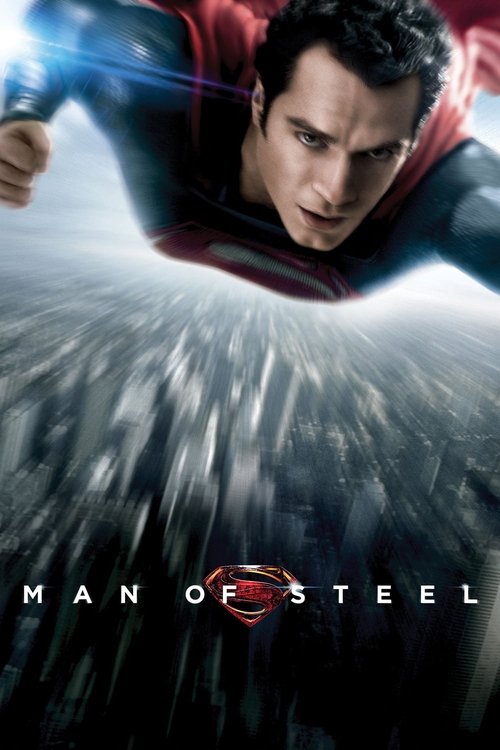
Man of Steel
2013 · Zack Snyder
Less a director than a fandom phenomenon: the #ReleaseTheSnyderCut campaign's success changed studio-fan power dynamics forever, and Rebel Moon's critical drubbing versus loyalist defense is a permanent internet fault line. Naming him takes a side.
When you want spectacle at maximum volume — a big, brooding blockbuster for a night when you'd rather feel the room shake than be charmed. Comfort food for action fans, though its grave tone divides people.
What it's about
A Kansas farm kid grows up hiding impossible abilities and not knowing why he has them. As an adult drifting between jobs and identities, Clark pieces together his origin — a dying alien world, a father's desperate gamble — just as survivors of that world arrive with plans that put all of humanity on the line. It's the Superman origin retold as a search for identity that ends in a planet-scale invasion.
The experience
Solemn, thunderous, and huge — the quiet flashbacks of a boy afraid of his own strength alternate with some of the most colossal action ever staged in a superhero film. It aims for awe rather than laughs, and by the final hour it's pure sensory overload.
Performances
Michael Shannon plays General Zod with frightening conviction — not a smirking villain but a fanatic who believes every word — and Kevin Costner and Diane Lane give the Kansas scenes an emotional anchor the spectacle needs.
The craft
Zack Snyder shoots the cosmic like a documentary — handheld cameras chasing beings who move faster than the eye — and the Krypton prologue is a full science-fiction epic in miniature. Hans Zimmer's percussion-heavy score builds a new musical identity for the character from the ground up. This one genuinely demands the biggest screen and loudest speakers you can find.
Why it matters
The film that launched the DC Extended Universe and ignited a years-long argument about how dark a superhero movie should be — its grounded, weighty take on Superman reshaped (and polarized) the genre's direction for a decade.
Snapshot
Man of Steel is the film with which Warner Bros. and DC Comics attempted to do for Superman what Christopher Nolan's Batman trilogy had done for the Caped Crusader: reground a mythic, somewhat unfashionable hero in a register of solemn realism, contemporary anxiety, and operatic scale. Directed by Zack Snyder, produced by Nolan, and written by David S. Goyer from a story Goyer developed with Nolan, it is a deliberate reboot — the first Superman feature since Bryan Singer's Superman Returns (2006), and a clean break from the Donner-Reeve lineage that film had reverently extended. The narrative recasts the familiar origin as a fractured, time-shuffled bildungsroman: the destruction of Krypton and the infant Kal-El's rocket-borne escape; the boy Clark's anxious, itinerant childhood in Kansas, told in flashback rather than straight chronology; his adult wandering in search of identity; and his eventual confrontation with General Zod, a fellow Kryptonian survivor who arrives not as a conqueror of vanity but as a genocidal patriot seeking to terraform Earth into a new Krypton. Where earlier Supermen radiated effortless benevolence, Snyder's Kal-El (Henry Cavill) is a figure of doubt, restraint, and reluctant power — a god learning whether to trust humanity and whether humanity will trust him. The film is also, decisively, the cornerstone of what became the DC Extended Universe, and its choices — tonal, visual, and above all the brutal, city-leveling climax — would shape and haunt that franchise for a decade. It remains one of the most polarizing major-studio superhero films of its era.
Industry & production
Man of Steel was born from a strategic problem. Superman Returns had performed respectably but failed to launch a franchise or satisfy the studio's ambitions, and Warner Bros. shelved a planned sequel. By the late 2000s, with Marvel Studios assembling its interconnected universe and Nolan's Batman films delivering both prestige and enormous returns, Warner needed a viable Superman to anchor a competing DC slate. Crucially, the studio's rights situation created pressure of its own: longstanding litigation between Warner and the heirs of Superman's creators, Jerry Siegel and Joe Shuster, gave the studio a contractual incentive to put a new Superman film into active production by a deadline. This commercial and legal urgency framed the project's development.
The creative solution was to attach Christopher Nolan and David S. Goyer, the architects of the Dark Knight trilogy. Goyer reportedly pitched a fresh approach to the origin, Nolan came aboard as producer and co-story author, and the directing job went to Zack Snyder, then known for the stylized comic-book adaptations 300 (2006) and Watchmen (2009) and the visually maximalist Sucker Punch (2011). The pairing is significant: Nolan's grounded, consequence-minded sensibility as producer met Snyder's frankly operatic, image-first visual temperament as director, and the tension between those instincts is legible throughout the finished film. Charles Roven, Emma Thomas, and Deborah Snyder produced alongside Nolan.
Casting placed the British actor Henry Cavill in the title role — the first non-American to play the character on the big screen — after he had been considered for earlier, abandoned Superman projects. Amy Adams played Lois Lane, conceived here as a Pulitzer-winning investigative reporter who discovers Clark's secret early rather than being kept in the dark; Michael Shannon brought a coiled intensity to General Zod; and the parental figures were cast with gravitas, Russell Crowe and Ayelet Zurer as Jor-El and Lara on Krypton, Kevin Costner and Diane Lane as Jonathan and Martha Kent. The film was a substantial commercial success worldwide — enough to confirm the studio's franchise plans — though I will not assign specific box-office figures I cannot verify here. Its performance directly green-lit the expanded DC universe that followed.
Technology
The film's most discussed technological dimension is its world-building of Krypton, realized through dense, fully imagined production design and visual effects: a biotech-organic civilization of liquid-metal command consoles, genetically engineered citizens, flying creatures, and a "Codex" containing the planet's genetic future. Weta Digital and other houses contributed to the extensive effects work, and the Kryptonian sequences represent a comprehensive digital environment rather than a few showcase shots.
More consequential to the film's texture is its approach to depicting super-powered movement and flight. Snyder and his team pursued a quasi-documentary aesthetic for the action — flight rendered with sudden sonic-boom acceleration, the camera struggling to "find" and hold Superman as if caught off guard, lens flares and rack-focus hunting mimicking the limitations of a real camera operator confronted with an impossible subject. This deliberately imperfect, reactive visual strategy was a notable stylistic-technological choice, distinguishing the film's flight and combat from the smoother, more balletic conventions of earlier superhero cinema. The climactic battles, in which two invulnerable beings hurl each other through skyscrapers, pushed large-scale digital destruction to an extreme that became central to the film's reception. As with much of the era's blockbuster spectacle, the picture's technical interest lies less in a single invention than in the marshaling of mature CGI, motion capture, and digital environments toward a particular, weighty realism.
Technique
Cinematography
Shot by Amir Mokri, Man of Steel adopts a desaturated, naturalistic palette far removed from Superman's traditional primary-color brightness — muted blues and steels, overcast Kansas light, a deliberate drabness meant to signal seriousness and weight. The handheld, reactive camera is the film's defining visual signature: even in dialogue scenes the frame breathes and drifts, and in action it lurches, whip-pans, and refocuses, as though the apparatus itself were overwhelmed by its subject. This vérité-inflected grammar, borrowed loosely from war reportage and prestige television, was a conscious rejection of the stately compositions of the Donner films. The Krypton and flashback sequences carry their own tonal coloring, and the film reserves its few moments of golden, lyrical light — Clark as a boy, the Kent farm — for emotional punctuation. The look is consistent and purposeful, if controversial: admirers found it grave and immersive, detractors found it murky and joyless for a character defined by hope.
Editing
Edited by David Brenner, the film's most consequential structural decision is its fragmentation of the origin story. Rather than the linear birth-to-flight arc of Superman: The Movie (1978), Man of Steel opens on Krypton's fall, then follows an already-adult, drifting Clark, threading his Kansas childhood through the present as a series of memory-flashbacks triggered by his search for identity. This mosaic construction lets the film treat the origin as known mythology and concentrate on psychology and theme, though it also produces an uneven rhythm — a contemplative, elliptical first half giving way to an extended, near-relentless final act of destruction. The climactic battles are cut for overwhelming kinetic impact, a sustained crescendo that some viewers found exhausting and others thrilling. The editing's ambition is clear; its tonal balance between the introspective and the apocalyptic is among the film's most debated features.
Mise-en-scène / staging
Alex McDowell's production design anchors the film's two worlds — the alien biomechanical grandeur of Krypton and the worn, dust-and-grain Americana of Smallville — and the costume design notably reconceived the Superman suit as an armored, textured Kryptonian garment, abandoning the trunks and the flat primary red and blue for a darker, scaled, almost chainmail surface. Staging throughout favors scale and verticality: figures dwarfed by Kryptonian architecture, by the World Engine's terraforming machinery, by collapsing skyscrapers. The intimate scenes — Jonathan Kent counseling restraint, the boy Clark overwhelmed by his senses in a schoolroom — are staged with quiet naturalism that deliberately contrasts the cosmic spectacle. The film's most discussed staging choices are in its climax, where the wholesale demolition of Metropolis is rendered with a deliberate, 9/11-adjacent imagery of falling buildings and dust-choked streets that proved one of the picture's flashpoints.
Sound
Hans Zimmer's score is one of the film's signal achievements and a clean break from John Williams's beloved, fanfare-driven 1978 theme — a sound so iconic that replacing it was itself a statement. Zimmer built a new identity around a soaring, deceptively simple ascending motif, often carried by strings and a wall of percussion (famously recorded with a large ensemble of drummers), pairing anthemic uplift with a brooding, ambient weight appropriate to the film's tone. The score refuses nostalgic quotation, insisting on a Superman defined anew. The sound design is equally aggressive: the cracking sonic booms of flight, the subsonic rumble of Kryptonian technology and the World Engine, and the sheer concussive density of the final battles, where invulnerable bodies collide with architecture. Sound is used to convey mass and force — to make a being who cannot be hurt feel physically consequential.
Performance
Henry Cavill plays Superman as a watchful, contained, often pained figure — physically immense but emotionally guarded, a man suppressing his power and his loneliness. It is a performance of restraint rather than charm, in keeping with the film's conception, and it divided viewers who missed the warmth and wit of Christopher Reeve's definitive interpretation. Amy Adams gives Lois intelligence and drive, recast as a capable professional rather than an imperiled love interest. Michael Shannon's General Zod is the performance many critics singled out: not a preening megalomaniac but a fanatic bound by duty, a soldier engineered to protect Krypton at any cost, whose villainy is rendered as tragic conviction — "I was bred to be a warrior" is the logic the performance embodies. Russell Crowe lends Jor-El an active, heroic presence well beyond a cameo, and Kevin Costner and Diane Lane ground the Kent scenes; Costner's Jonathan, in particular, anchors the film's most contested idea — a father who counsels his son toward caution and self-protection even at great moral cost.
Narrative & dramatic mode
The film's dramatic mode is the mythic origin-as-identity-quest, told in a register of earnest, semi-tragic seriousness. Its governing question is not what Superman does but whether he should exist openly at all — whether humanity can accept a being of his power, and whether he can trust them with it. This frames the picture as a drama of belonging and choice: a foundling negotiating two fathers (the Kryptonian Jor-El, who entrusts him with hope, and the human Jonathan, who counsels concealment) and two heritages. The structure withholds the fully realized hero until late, treating the donning of the cape and the first flight as hard-won emotional thresholds rather than foregone conclusions. The Zod conflict externalizes the theme: Zod offers Kal-El a restored Krypton at the price of Earth, forcing a choice of allegiance that is also a choice of self. The climactic killing of Zod — Superman snapping his neck to stop a massacre — is the film's most radical narrative departure, deliberately violating the character's traditional code against killing to dramatize the agonizing cost of his choice and to mark this Superman as a being still becoming himself.
Genre & cycle
Man of Steel belongs to the modern superhero blockbuster, and specifically to the post-Dark Knight cycle of "grounded," tonally serious comic-book films that sought prestige and weight by importing the textures of drama, war film, and science fiction. Within that cycle it represents the deliberate darkening and reinvention of a character long associated with optimism — an attempt to make Superman viable for an age that had embraced the troubled Batman. It is also a foundation film, engineered (increasingly so in hindsight) to launch a shared universe in answer to Marvel's, and thus belongs to the franchise-architecture logic that dominated 2010s studio production. Generically it blends origin myth, alien-invasion science fiction (the Krypton sequences and the terraforming threat owe as much to SF as to comics), and disaster-spectacle. Its place in the cycle is pivotal and contested: it set the somber, conflicted tone that would define the early DCEU and provoked an industry-wide conversation about whether Superman, of all heroes, should be reimagined in so grave a key.
Authorship & method
Man of Steel is best understood as the product of a distinctive, sometimes contradictory collaboration. Zack Snyder is its director and dominant visual author: his sensibility — the maximalist imagery, the slow-motion-and-speed-ramp instincts (here largely restrained), the mythic-operatic seriousness, the painterly compositions and willingness toward darkness — pervades the film, and his subsequent stewardship of the DCEU (Batman v Superman, Justice League) would extend its preoccupations with gods, fathers, sacrifice, and the burden of power. Snyder is an unmistakable stylist whose work polarizes precisely because of its conviction. Christopher Nolan, as producer and co-story author, supplied the grounding logic and prestige framework, and David S. Goyer, as screenwriter and co-story author, executed the structural reconception of the origin; the film's tension between Nolan-Goyer plausibility and Snyder spectacle is its central authorial dynamic. Among key collaborators, composer Hans Zimmer redefined the character's sonic identity; cinematographer Amir Mokri built its desaturated, handheld look; editor David Brenner shaped its fragmented chronology; production designer Alex McDowell realized its two worlds. The result is a film of strong but divided authorship — a Snyder picture operating within a Nolan-Goyer scaffold.
Movement / national cinema
The film is a mainstream American studio production (Warner Bros./DC, with Legendary and Syncopy) and belongs to no national-cinema school or aesthetic movement in the art-historical sense. Its true "movement" is industrial: the 2010s shared-cinematic-universe paradigm, in which individual films function as installments in a branded, interconnected franchise architecture. Man of Steel is a charter document of that paradigm on the DC side — conceived not only as a standalone reboot but as the keystone of a universe meant to rival Marvel's. If it expresses any broader tendency, it is the convergence of prestige-drama gravity with tentpole spectacle that characterized post-Dark Knight Hollywood, and the global, effects-driven, IP-anchored blockbuster economy of its decade.
Era / period
Man of Steel is firmly a film of the early-to-mid 2010s, the high-water moment of the shared-universe blockbuster and of a broader cultural appetite for "darker," morally complicated reimaginings of inherited heroes. Released in 2013, in the wake of The Dark Knight Rises (2012) and The Avengers (2012), it reflects an industry racing to build interconnected franchises and a critical-popular climate that had, for a decade, rewarded grit and ambivalence over four-color sincerity. Its post-9/11 imagery of urban devastation — collapsing towers, dust-shrouded survivors — locates it precisely in the anxieties of its period, and its debate over whether a near-omnipotent figure can be trusted echoes contemporary unease about power, surveillance, and security. The film's very project — to make Superman somber — is itself a period symptom, the application of a prevailing tonal fashion to the most sunlit of American myths.
Themes
The film's central theme is identity and belonging: a being of two worlds, raised in secrecy, who must decide what he is and to whom he owes allegiance. This is structured through the dual-father motif — Jor-El's gift of hope and destiny against Jonathan Kent's protective counsel of concealment — and the question of nature versus nurture, Kryptonian inheritance against human upbringing. Hope is explicitly thematized: the Kryptonian glyph on Superman's chest is reframed within the film as the symbol for hope, and Jor-El's vision of his son as a bridge between peoples is the film's stated ideal. Against this runs a darker meditation on fear and trust — humanity's instinctive dread of overwhelming power, dramatized in the military's wariness and in the film's insistence that Superman's acceptance is uncertain and provisional. The Zod conflict raises questions of determinism and choice (Zod, "bred" for one purpose, against a Kal-El free to choose his own), and the climax's neck-snap forces a stark theme of sacrifice and moral cost — the impossible burden of a savior who must do terrible things to save the innocent. There are recurrent religious overtones, with Kal-El framed in messianic terms (a thirty-three-year-old who chooses to surrender himself for humanity), which the film foregrounds with some insistence.
Reception, canon & influence
Critically, Man of Steel was sharply divided on release, and that division has proved durable. Admirers praised its ambition, its visual grandeur, Zimmer's score, Shannon's Zod, and the seriousness with which it took the character's psychology; detractors faulted its grimness, its joylessness, the relentlessness and scale of its destruction, and above all two narrative choices — the mass civilian carnage of the Metropolis climax and Superman's killing of Zod — as betrayals of the character's essential optimism and moral code. The debate over whether Superman should kill, and whether a Superman film should level a city, became one of the defining critical conversations in 2010s superhero discourse and has never fully settled. Audience opinion was likewise split, with a substantial, lasting partisanship both for and against Snyder's interpretation.
Looking backward, the film draws on a deep well of sources: the foundational Superman comics of Siegel and Shuster and the character's eight decades of mythology; the modernizing comic reinventions of the character (notably John Byrne's 1980s reboot and Mark Waid and Leinil Yu's Birthright, which reconceived the origin and Krypton in ways the film echoes); the Donner-Reeve Superman (1978) as the touchstone it consciously rejects; and the grounded, prestige template of Nolan's Batman trilogy. Its alien-invasion and terraforming machinery owes to science fiction beyond comics, and its visual war-reportage grammar to contemporary action and drama. Looking forward, its legacy is large and double-edged. It launched the DC Extended Universe, establishing the tone, the casting (Cavill, Adams), and the thematic preoccupations that Snyder would carry into Batman v Superman: Dawn of Justice (2016) and Justice League; its destruction-heavy climax directly informed the premise of Batman v Superman, which made Metropolis's collateral damage a plot engine. More broadly, the controversy it generated helped catalyze a corrective turn in the DCEU and beyond toward lighter, more hopeful superhero filmmaking. Within film history Man of Steel stands as a pivotal and divisive work — the most serious modern attempt to reimagine an icon of innocence in a tragic key, a foundation stone of a major franchise, and an enduring case study in the risks and rewards of taking the brightest of heroes into the dark.
A Deleuzian reading
A boy sits in a Kansas schoolroom and the world floods in.
The full Deleuzian reading of Man of Steel →
Reception
Landed in 2013 to a genuinely split reception — critics lukewarm, audiences divided — and it's never stopped being contested; a decade on it's been reclaimed by a passionate fanbase as the founding text of the SnyderVerse, while the Hans Zimmer score has been near-universally rehabilitated as one of the great modern blockbuster scores.
How Man of Steel was received, from release to now →
Influences: the films it descends from and the films it influenced
- Superman (1978) — The ancestral origin template — Krypton prologue, Smallville coming-of-age, and 'you will make my strength your own' father-message structure — which Man of Steel consciously inverts by replacing Donner's bright sincerity with a desaturated, tragic register while keeping the three-act mythic origin scaffold.
- Batman Begins (2005) — Supplies the Nolan-Goyer 'grounded prestige reboot' method co-authored here — fragmented non-linear origin intercut with the present, psychological realism applied to a comic icon, and a mentor/ideology villain — the plausibility scaffolding inside which Snyder stages spectacle.
- Transformers (2007) — Establishes the modern 'digital destruction' idiom of skyscrapers shearing apart in dust-and-debris CG, the collapsing-urban-canyon spectacle that the Metropolis climax scales up and is criticized for.
- 2012 (2009) — Inherits 2012's procedural city-collapse and digital-double crowd work — much of it via the same effects houses — to stage the Metropolis devastation as sustained, physics-driven mass destruction.
- The Rock (1996) — Shows superhero cinema absorbing the Bay/Zimmer package as default — handheld ground-level orbit around the standing hero, hard atmospheric backlight, and a Remote Control ostinato-and-percussion score carrying emotional continuity across fragmented cutting.
- Zack Snyder's Justice League (2021) — Extends the DCEU foundation — the godlike-hero-as-sacrifice theme, terraforming-invasion threat (Steppenwolf/Darkseid echoing the World Engine), and Snyder's slow-motion mythic tableau as franchise house style.
- Superman (2025) — The desaturated, collateral-heavy, brooding Superman that Gunn's bright, tactile, low-body-count 'anti-Snyder' staging is explicitly built in negative against.
- The Dark Knight (2008) — Model for the IMAX-scale, morally agonized blockbuster and Zimmer's minimalist motif-over-melody scoring approach (sustained drones, ostinato dread) that Zimmer carries directly into the Krypton and 'Flight' cues.
- Watchmen (2009) — Snyder's prior deconstruction of the superhero as burdened demigod — painterly tableau compositions, operatic seriousness, and the willingness to render heroism as morally compromised — the authorial sensibility he ports onto Superman.
- 300 (2006) — Establishes Snyder's maximalist mythic-spectacle grammar and his speed-ramping combat aesthetic, here largely restrained but visible in the bronze, sculptural framing of Krypton and Zod's hand-to-hand finale.
- Saving Private Ryan (1998) — Source of the handheld, desaturated war-reportage camera grammar — Amir Mokri's shaky long-lens 'embedded combat' coverage of the Smallville and Metropolis battles borrows Spielberg's vérité documentary-of-chaos approach to action.
- Children of Men (2006) — Pioneers the handheld, lens-spattered, you-are-there immersion in catastrophe that Mokri emulates — camera as panicked witness at ground level amid collapsing scale rather than clean god's-eye spectacle.
- The Tree of Life (2011) — Direct visual debt in the elliptical, sun-flared Kansas memory passages — Malick's lyrical handheld grazing of fields, golden-hour naturalism, and father-son interiority — which Snyder cites for Clark's pastoral upbringing.
- Man of Steel's Krypton / Avatar (2009) — Template for fully CG alien-world worldbuilding and the terraforming/'world engine' ecological-conquest device, realized via Alex McDowell's design and photoreal digital environments.
- Independence Day (1996) — Ancestor of the alien-invasion-of-Earth blockbuster grammar — orbital armada, mothership over the city, mass civilian evacuation imagery — which Man of Steel recasts in a grimmer, 9/11-inflected key.
- Superman: Birthright (comic) (2004) — The literary ancestor whose reconception of Krypton's design, Clark's alienated identity-quest, and a more science-fictional origin the film adapts structurally into its 'origin as identity quest.'
- Batman v Superman: Dawn of Justice (2016) — Direct descendant that converts Man of Steel's Metropolis collateral damage into its founding plot engine, continues the desaturated palette, Cavill casting, and Zimmer/Junkie XL sonic identity established here.
- Logan (2017) — Sibling in the 'tragic, grounded prestige superhero' turn Man of Steel helped license — desaturated realism, restrained lead performance, and treating the costumed icon as a vehicle for mortal grief and moral cost.
- The Batman (2022) — Descendant of the desaturated, vérité-grounded, somber-scored superhero mode — handheld realism and oppressive low-key cinematography extending the tonal template Snyder/Nolan set for the DC screen icon.
Similar films
- Batman Begins (2005) — influence & lineage · same viewing thread
- The Dark Knight (2008) — influence & lineage · same viewing thread
- The Batman (2022) — influence & lineage · same viewing thread
- Logan (2017) — influence & lineage · same viewing thread
- Superman (1978) — influence & lineage
- Zack Snyder's Justice League (2021) — influence & lineage
- Superman (2025) — same viewing thread
- The Dark Knight Rises (2012) — same viewing thread
All the films related to Man of Steel →
Watch it with: curated runs of related films
- The Superhero Movie Grows Up — Watch these as one arc — Raimi's warmth into Nolan's gravity into Logan's elegy and The Batman's rain-soaked noir — the two decades the comic-book film reached for real weight.