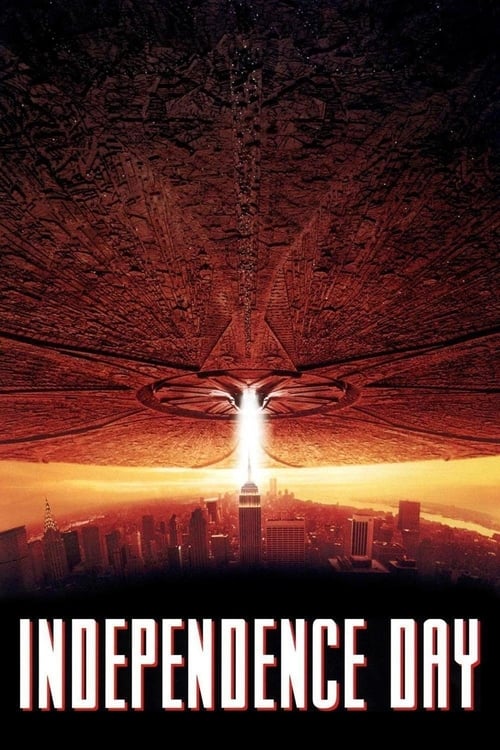
Independence Day
1996 · Roland Emmerich
For a popcorn night when you want maximum spectacle and zero homework — perfect with friends, pizza, and a willingness to cheer at a speech.
What it's about
Over the Fourth of July weekend, city-sized alien ships park themselves over the world's capitals — and it quickly becomes clear they haven't come to talk. A scrappy coalition forms across the wreckage: a hotshot fighter pilot, a cable-repair genius who saw the pattern first, and a young American president, all converging on one desperate plan to hit back.
The experience
Big, loud, unapologetically crowd-pleasing spectacle — two-plus hours of dread, destruction, one-liners, and fist-pump speeches, paced like a fireworks show. It's the movie equivalent of a summer blockbuster's platonic ideal, corn and all.
Performances
Will Smith's cocky, wisecracking pilot turned him into a global movie star overnight, and Jeff Goldblum's twitchy, fast-talking scientist is the film's comic engine.
The craft
The famous destruction sequences were achieved largely with enormous practical miniatures blown up for real — which is why they still look weighty where early CGI has aged. It's engineered for the biggest screen and loudest speakers you can find; the White House shot alone became one of the most replayed images of the decade.
Why it matters
The top-grossing film of 1996 and one of the biggest hits ever at that point, it single-handedly revived the alien-invasion movie and set the template for the modern event blockbuster and its marketing.
Wrote the dossier to `dossiers/602.md` (TMDB id 602 = Independence Day), matching the house style and header structure of the existing corpus. ~2,400 words, grounded throughout — I kept box-office to "top worldwide earner of 1996 / among the highest-grossing to that point" rather than inventing exact figures, and flagged the practical-vs-CGI effects record explicitly since that's the film's most-misremembered technical fact.
A Deleuzian reading
The first thing the aliens do is throw shade.
The full Deleuzian reading of Independence Day →
Reception
Critics in 1996 rolled their eyes even as it became the year's biggest hit worldwide — the spectacle praised, the script mocked. Thirty years on it's been re-embraced without irony as the peak of the '90s blockbuster, the film every later alien-invasion movie gets measured against.
How Independence Day was received, from release to now →
Influences: the films it descends from and the films it influenced
- Earth vs. the Flying Saucers (1956) — Ray Harryhausen's stop-motion saucers toppling Washington monuments are the literal storyboard template for ID4's destruction of the White House and Capitol.
- The War of the Worlds (1953) — Established the alien death-ray annihilation of cities via Gordon Jennings's miniature effects, plus the unbeatable-shield-then-hidden-vulnerability ending that ID4 recasts as the computer virus.
- The Day the Earth Stood Still (1951) — Staged the saucer's arrival as a Washington-centered national-emergency media event — the reverent iconography ID4 deliberately inverts into hostility.
- Star Wars (1977) — ILM motion-control dogfighting and the climactic trench-run strike on one vulnerable port, reborn as the fighter assault on the city-destroyer's primary weapon.
- Close Encounters of the Third Kind (1977) — Douglas Trumbull's vast luminous mothership hovering over a landscape and the awe-by-shadow scale reveal that Emmerich quotes when the city-destroyers eclipse Los Angeles.
- Alien (1979) — H.R. Giger's wet biomechanical creature design drives ID4's autopsy-lab reveal of the alien pilot writhing inside its bio-mechanical suit.
- The Towering Inferno (1974) — Irwin Allen's all-star disaster-ensemble structure — separate intercut character strands converging on a single catastrophe — is ID4's narrative scaffold.
- Top Gun (1986) — The hotshot-fighter-pilot grammar and recruitment-poster jet photography adopted wholesale for ID4's aerial dogfights and Will Smith's cocky aviator.
- Stargate (1994) — Emmerich and Dean Devlin's prior collaboration that fused David Arnold's bombastic Americana scoring with the lone-everyman-versus-alien-god structure ID4 expands.
- Godzilla (1998) — Emmerich/Devlin recycle their own urban-landmark-destruction setpiece craft and military-procedural response into kaiju form.
- Armageddon (1998) — The post-ID4 high-concept disaster blockbuster built on countdown structure, blue-collar heroics, and overt patriotic sacrifice scored to swelling brass.
- The Day After Tomorrow (2004) — Scales ID4's CG mass-destruction of recognizable monuments from alien beams to weather, keeping the landmark-money-shot economy intact.
- Transformers (2007) — Extends ID4's military-hardware-versus-alien spectacle and Pentagon-cooperation aesthetic, with fighter jets and tanks fetishized against towering CG threats.
- The Avengers (2012) — The third-act alien armada pouring through a portal to devastate a metropolis is ID4's invasion-spectacle template absorbed into the superhero blockbuster.
- 2012 (2009) — Emmerich's own codification of landmark-destruction iconography — recognizable monuments obliterated in wide master shots as the spectacle's money image — is the authorial signature 2012 escalates to whole-continent scale.
- The Darkest Hour (2011) — Codifies the large-scale invasion-spectacle grammar — synchronized global strike, emptied and destroyed urban landmarks — that the film inherits but reduces to a single depopulated city.
- Pacific Rim: Uprising (2018) — The blueprint for the globally-financed destruction tentpole — multi-city set-pieces and an internationally legible cast engineered for the world market, the commercial logic shaping Uprising's US–China co-production design.
- Mars Attacks! (1996) — Same-year saucers-over-Washington invasion staged as an explicit Harryhausen-homage parody of the very destruction-spectacle ID4 plays straight.
- War of the Worlds (2005) — Returns the alien-invasion film to ground-level civilian POV but inherits ID4's scale of urban annihilation and tripod-disintegration set pieces.
- Man of Steel (2013) — Ancestor of the alien-invasion-of-Earth blockbuster grammar — orbital armada, mothership over the city, mass civilian evacuation imagery — which Man of Steel recasts in a grimmer, 9/11-inflected key.
Similar films
- War of the Worlds (2005) — influence & lineage
- Transformers (2007) — influence & lineage
- The War of the Worlds (1953) — influence & lineage
- Godzilla (1998) — influence & lineage
- Star Wars (1977) — influence & lineage
- Close Encounters of the Third Kind (1977) — influence & lineage
- The Avengers (2012) — influence & lineage
- Alien (1979) — influence & lineage