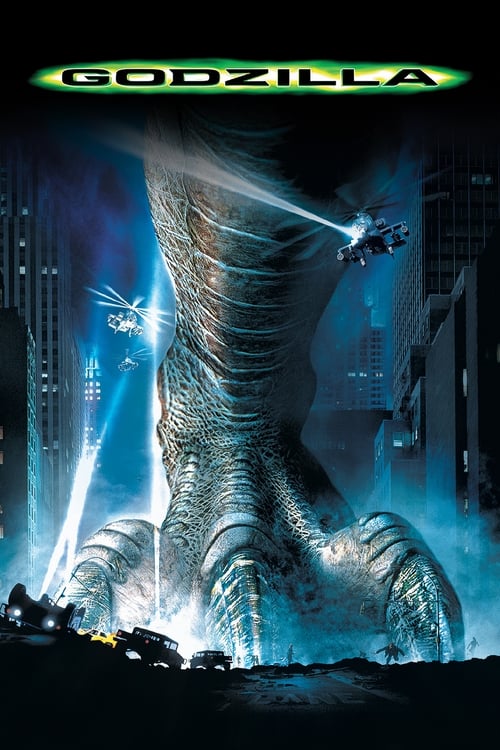
Godzilla
1998 · Roland Emmerich
For a popcorn night when you want big dumb destruction and don't need it to be good so much as loud — comfort food with a demolition budget. Also a great pick if you enjoy watching a famously divisive blockbuster and judging for yourself.
What it's about
French nuclear tests in the Pacific mutate an iguana into something enormous, and after a string of shredded freighters the creature comes ashore in Manhattan. A soft-spoken scientist who studies radiation's effects on animals gets pulled into the hunt, alongside the US military and a shadowy French intelligence team, as the city is evacuated and the chase moves through rain-soaked streets and subway tunnels. The clock is ticking for a second reason: this thing may be about to reproduce.
The experience
A fast, noisy, rain-drenched chase movie — less about awe than about running. It plays like a creature-feature crossed with a disaster picture, with a streak of goofy humor, and it moves quickly enough that you rarely stop to ask questions.
The craft
The spectacle is the point: a redesigned, sprinting reptile weaving through skyscrapers, practical destruction mixed with late-90s digital effects, and near-constant rain that hides seams and adds atmosphere. It was sold on months of creature secrecy, and the reveal-and-chase staging still plays best loud and large.
Why it matters
The notorious first Hollywood attempt to remake Japan's most famous monster, it landed with a thud among fans and became the cautionary tale that shaped how later American monster movies approached the character. Its infamy is now part of its appeal.
Snapshot
Roland Emmerich's Godzilla is the American studio system's first attempt to absorb Toho's most durable export into the Hollywood blockbuster grammar — and it remains a textbook case of what is gained and lost in that translation. Released in the wake of Emmerich and producer Dean Devlin's Independence Day (1996), it arrived as a TriStar/Sony tentpole engineered for maximum summer saturation, complete with a months-long campaign of creature secrecy and the now-notorious tagline "Size Does Matter." What the film delivered was less a kaiju picture than a monster-on-the-loose chase thriller, relocating the beast from Tokyo to a rain-soaked Manhattan and reconceiving Godzilla as a lean, fast, burrowing reptile closer to the raptors of Jurassic Park than to Toho's lumbering, atomic-breathed icon. The mismatch between the brand and the execution defined both its reception and its legacy: a film fans nicknamed "GINO" (Godzilla In Name Only) and which Toho would later quarantine under the separate name "Zilla." It is a revealing artifact of late-1990s blockbuster manufacture — technically ambitious, commercially aggressive, and creatively timid about the very property it was built to exploit.
Industry & production
Godzilla was the product of a licensing arrangement between Sony's TriStar Pictures and Toho, which had held the character since 1954. TriStar had optioned the rights years earlier; an unrealized mid-1990s version developed with director Jan de Bont and writer Ted Elliott and Terry Rossio fell apart over budget and creative differences before Emmerich and Devlin's Centropolis Entertainment took the project on, fresh off the runaway success of Independence Day. Their participation was conditional and self-aware: by their own later accounts, neither was a fervent Godzilla devotee, and they negotiated latitude to remake the creature wholesale rather than replicate Toho's suitmation icon.
The production was a large-scale studio undertaking shot substantially in and around New York and on stages, with the creature realized through a combination of digital animation and practical elements. The marketing apparatus is, in retrospect, as significant as the film itself. Sony mounted one of the era's most disciplined secrecy campaigns, withholding full views of the monster from trailers and posters, teasing scale through fragments — a foot crushing a display, a museum skeleton dwarfed — under the "Size Does Matter" banner. Extensive merchandising and fast-food tie-ins accompanied release. The film opened over the Memorial Day frame in May 1998 to enormous front-loaded attendance that fell off sharply as word of mouth soured. It earned a large worldwide gross but is generally remembered as a commercial disappointment relative to its budget and to the expectations Independence Day had set; precise figures vary by source, so they are best treated qualitatively here.
Technology
The film sits at a pivotal moment in effects history, between the practical-suit tradition it was abandoning and the fully digital monster cinema that Jurassic Park (1993) had inaugurated. Emmerich's Godzilla is principally a computer-generated character, animated rather than puppeteered, supplemented by large-scale miniatures, practical destruction, and limited animatronic and maquette work for close interaction. Centropolis Effects, the in-house unit Emmerich and Devlin had built, supervised the work, with creature design led by Patrick Tatopoulos — closely enough identified with the project that the protagonist, Niko Tatopoulos, carries his surname.
The technical strategy was shaped by a creative constraint: the new Godzilla was conceived as fast and agile, which meant the digital model had to perform sprints, leaps, and tight urban maneuvers rather than the stately stomp of suitmation. The production leaned heavily on rain, darkness, and water to integrate the creature, partly an aesthetic choice and partly a practical one, since wet, low-light environments eased the compositing of a digital animal into live plates and helped mask the limits of late-1990s rendering. The baby-Godzilla sequence in a flooded Madison Square Garden similarly exploited dim, enclosed staging. The film is thus a useful marker of where photoreal creature animation stood just before the turn of the millennium: capable of sustained, dynamic performance, but most convincing when shrouded.
Technique
Cinematography
Ueli Steiger photographed the film in a dark, rain-drenched register that became its most recognizable visual signature. The palette is deliberately desaturated and nocturnal, with neon and sodium light bleeding across wet asphalt. This serves the genre's suspense beats — the monster glimpsed in fragments, looming out of downpour — but it also flattens the spectacle the brand implicitly promised, trading the daylit, full-figure clarity of Toho's kaiju for concealment. The framing favors human-scale, ground-level vantage to sell magnitude through low angles and foreground destruction, a logic inherited from Independence Day's monumentalism but applied here to a single animal rather than a fleet.
Editing
The picture is cut for momentum, structured around a series of pursuits — the creature through Manhattan, the military after the creature, and the climactic chase involving New York's bridges and tunnels. The editing prioritizes propulsion and set-piece rhythm over the dread-building stillness that the best monster films use to husband their reveals. The Madison Square Garden act, with its nest of hatchlings, is built as a Jurassic Park-style stalking sequence, and the cutting there is its most controlled.
Mise-en-scène / staging
Emmerich stages catastrophe at metropolitan scale, his consistent authorial mode: recognizable landmarks as stress points, crowds in flight, infrastructure as battleground. Manhattan is rendered as a maze the creature can vanish into, which motivates the persistent rain and the choice to have Godzilla burrow and tunnel rather than simply rampage. The staging is competent and legible but conventional; the monster's habit of disappearing, narratively useful for suspense, repeatedly removes the title attraction from view.
Sound
David Arnold, Emmerich's regular composer of the period, supplies a brass-forward orchestral score in the heroic-disaster idiom he had honed on Independence Down and Stargate. The sound design works hard on the creature's vocalizations and the low-end impact of its movement — footfalls, structural collapse, the roar — which carry much of the monster's presence in scenes where it is barely seen. The soundtrack album leaned on contemporary pop tie-ins, most prominently Puff Daddy's "Come With Me," which interpolates Led Zeppelin's "Kashmir" with Jimmy Page's participation, and a Jamiroquai track — a marketing-driven layer typical of late-'90s blockbuster releases and largely separate from Arnold's score.
Performance
The casting tilts toward comic and character actors, signaling the film's lighter register. Matthew Broderick plays Niko Tatopoulos, the earthworm-studying scientist pressed into monster expertise, in an affable, deflationary key. Jean Reno brings the film's most enjoyed performance as the French operative Philippe Roaché, his running jokes about American coffee and culture functioning as the picture's wit. Hank Azaria's cameraman "Animal," Maria Pitillo's aspiring reporter Audrey, Kevin Dunn's military man, Michael Lerner's Mayor Ebert and Harry Shearer's anchor round out an ensemble pitched between disaster-movie types and broad comedy. The performances are serviceable to the tone but were widely faulted for thinness, particularly the romantic subplot.
Narrative & dramatic mode
The screenplay, credited to Devlin and Emmerich from a story they developed with Elliott and Rossio, runs on the monster-on-the-loose template rather than the tragic-elemental mode of Toho's original. Its dramatic engine is procedural and comic: a team of mismatched experts and operatives races to identify, contain, and finally outwit a creature whose true threat is reproduction. The reveal that Godzilla is nesting — that the danger is not one monster but a brood — is the film's structural pivot, importing the dread-of-multiplication that Aliens and Jurassic Park had made a blockbuster staple. The human plot braids career ambition, a strained romance, and authority-vs-expert friction in the familiar disaster-ensemble manner. Notably, the film includes a satirical thread: the bumbling Mayor Ebert and his aide Gene are transparent caricatures of critics Roger Ebert and Gene Siskel, a swipe at the duo's prior pans of Emmerich and Devlin's work folded into the text itself.
Genre & cycle
The film belongs to two cycles at once and fully commits to neither. As a Godzilla picture it inherits a forty-four-year kaiju tradition; as a 1998 Hollywood release it is squarely a disaster/creature-feature blockbuster in the post-Jurassic Park, post-Independence Day mold. Its redesign of the monster — fast, lean, animalistic, fertile — pulls it decisively into the Jurassic Park lineage of plausible-biology super-predators and away from the rubber-suited, symbolically charged kaiju. The result reads less as kaiju cinema than as a giant-animal thriller wearing a famous name, which is precisely the friction that defined its reception. It is also a representative specimen of the late-1990s "event movie," organized as much around release-date dominance and merchandising as around the film on screen.
Authorship & method
Godzilla is unmistakably an Emmerich–Devlin production, the third in the run that began with Stargate (1994) and peaked with Independence Day. Their method is consistent: spectacle-first blockbusters that stage global or metropolitan catastrophe with broad-stroke characters, comic relief, and a fascination with monuments under assault. Emmerich directs and co-writes; Devlin produces and co-writes; their Centropolis operation kept effects, production, and creative control largely in-house, which is part of why the film bears so uniform an authorial stamp.
The key collaborators reflect that continuity. Cinematographer Ueli Steiger, composer David Arnold, and the Centropolis Effects team carried over the house style. Creature designer Patrick Tatopoulos is arguably the film's defining authorial voice on the monster itself, having been given license to discard the Toho silhouette entirely — a decision that is the single most consequential creative choice in the picture and the one most responsible for its rejection by the property's existing audience. Production designer Oliver Scholl shaped the rain-slicked Manhattan. The authorship question here is less about a personal vision than about a producing-directing partnership's reliable, formula-driven approach colliding with a property whose meaning resisted that formula.
Movement / national cinema
The film is a Hollywood studio blockbuster, but it is inescapably a transnational object — an American remake of a Japanese national icon, made under license from Toho. That cross-cultural transfer is the film's deep subject whether it intends it or not. Toho's Godzilla emerged from a specifically Japanese postwar trauma; Emmerich's recasts the creature's origin as a product of French nuclear testing in the Pacific (a detail that lets the film route its anxieties through a non-American culpability while keeping its hero an American everyman). The German-born Emmerich's career as a European émigré director specializing in American disaster spectacle adds another layer: this is American mass cinema produced by international talent for a global market, with the source culture's authorship reduced to a licensing credit. Toho's eventual decision to rename this version "Zilla" is itself a statement of national-cinema ownership, reclaiming the "God" from a creature it judged unrepresentative.
Era / period
Godzilla is a quintessential 1998 artifact, situated at the crest of the digital-spectacle blockbuster and the saturation-marketing event film. It reflects an industry that had absorbed the lessons of Jurassic Park and Independence Day: photoreal CG creatures, four-quadrant release strategies, secrecy campaigns, and merchandising-led launches. It also belongs to the brief late-'90s vogue for soundtrack albums stacked with chart-pop tie-ins. And it anticipates, by negative example, the franchise-reboot logic that would dominate the following two decades — an attempt to retrofit a legacy property for contemporary Hollywood that misjudged what made the property valuable.
Themes
Thematically, the film is thinner than its ancestor and largely uninterested in the atomic allegory that gave Toho's 1954 Gojira its weight. Its operative ideas are reproduction and infestation — the fear not of a single titan but of a breeding population, a late-century anxiety about uncontainable proliferation. There is a faint ecological-blowback motif in the nuclear-testing origin, gesturing at human folly punished by a monstrous nature, but it is handled as plot mechanism rather than moral argument. Secondary threads include media spectacle and ambition (the reporter subplot, the satirized mayor and critics), and a mild anti-authority strain in which institutional power is slow and expertise is sidelined. Scale itself — "size does matter" — functions almost as the film's true theme, the spectacle of magnitude foregrounded over meaning.
Reception, canon & influence
Critical reception was predominantly negative, and the film became a byword for blockbuster disappointment despite a strong opening. Reviewers faulted the dim, evasive presentation of the monster, the slack characterization, and above all the betrayal of the creature's identity; the fan coinage "GINO" captured a widespread sense that the name had been used without the thing. The film was a prominent Razzie target that awards season. Its sharpest long-term verdict came from Toho, which subsequently distinguished Emmerich's creature as "Zilla," a separate entity — and, in Godzilla: Final Wars (2004), staged a brief on-screen confrontation in which the original Godzilla dispatches the American version in seconds, a piece of corporate-canonical commentary as pointed as any review.
The influences on the film are clear and acknowledged: Jurassic Park's plausible-predator design and raptor-stalking suspense; Aliens' breeding-threat structure; the disaster-spectacle template Emmerich and Devlin had themselves established with Independence Day; and, distantly and contentiously, the Toho original whose silhouette it discarded.
Its forward legacy is double-edged. The widely panned feature spawned an animated continuation, Godzilla: The Series (1998–2000), which retained the surviving hatchling and the human cast's framework and earned markedly warmer regard than its parent, becoming the version many viewers remember fondly. The feature's commercial underperformance is frequently credited with stalling Hollywood's appetite for the property for over a decade and shaping how the eventual successful reboots approached it — Gareth Edwards' Godzilla (2014) and the subsequent MonsterVerse conspicuously restored the creature's mass, gravity, and atomic identity, in part as a corrective to 1998. In that sense the film's most durable influence is cautionary: it stands as the canonical example of a beloved property reskinned for the blockbuster machine, and of the audience and rights-holder backlash that follows when a brand's essential meaning is treated as negotiable. As cultural history it is instructive; as a Godzilla film it survives chiefly as the version that had to be disowned for the character to be rehabilitated.
A Deleuzian reading
A foot comes down on a fishing trawler in the dark.
The full Deleuzian reading of Godzilla →
Reception
Launched with one of the biggest hype campaigns of the '90s ('Size Does Matter'), it landed with a thud — critics panned it, fans of the Toho films disowned it, and it killed the planned trilogy. Today it's less reviled than remembered as the defining cautionary tale of blockbuster overhype, with a side of Taco-Bell-tie-in nostalgia.
How Godzilla was received, from release to now →
Influences: the films it descends from and the films it influenced
- The Lost World: Jurassic Park (1997) — Directly precedes it with a giant CG theropod loose in a real city (San Diego), proving the urban-rampage-via-photoreal-animation pipeline Emmerich scales up to all of New York.
- Independence Day (1996) — The immediate sibling: same disaster-spectacle blueprint of monuments under assault, broad comic-relief ensemble, and brass-forward David Arnold scoring carried over intact by the same creative team.
- Godzilla (2014) — The corrective descendant: deliberately restores the mass, slow gravity, dorsal spines, and atomic-breath identity Emmerich discarded, and revives Honda's withholding reveal as a rebuke of the 1998 design.
- Gojira (1954) — The metropolitan-rampage template and atomic-monster meaning Emmerich's film inherits — while deliberately discarding the suitmation silhouette and dorsal-spine design that defined it, the very rejection that earned Toho's 'Zilla' disavowal.
- The Beast from 20,000 Fathoms (1953) — Establishes the atomic-awakening-to-city-rampage plot beat and the harbor/landmark-destruction set pieces that Emmerich restages in lower Manhattan.
- King Kong (1933) — Originates the low-angle monumentalism of a colossal creature scaling and threading a named American metropolis, the framing grammar Emmerich reuses on the Chrysler/Flatiron skyline.
- Jaws (1975) — The withhold-the-creature suspense logic — keeping the monster offscreen, dim, and partial to build dread — which Emmerich borrows but is faulted for never paying off in clear daylight reveals.
- Alien (1979) — The desaturated, rain-and-shadow nocturnal lighting that hides a biomechanical predator, the visual register Ueli Steiger applies to the Madison Square Garden nest sequence.
- Aliens (1986) — Supplies the breeding-threat structure: a hunt that escalates into a hatchery of eggs/offspring stalking the human cast through an enclosed arena, lifted almost wholesale for the climax.
- Jurassic Park (1993) — The plausible-biology CG creature animation and raptor-stalking choreography — naturalistic reptilian weight and eye-line pursuit — that Patrick Tatopoulos and Centropolis explicitly model the monster on rather than on a man-in-suit.
- Stargate (1994) — Launches the Emmerich–Devlin/Centropolis in-house method — director co-writes, Devlin produces, effects kept internal — that gives the 1998 film its uniform authorial stamp.
- Volcano (1997) — A parallel late-90s metropolitan-catastrophe event movie staging a single unstoppable force tearing through a named US city, the disaster-blockbuster cycle Emmerich's monster joins.
- The Mummy (1999) — A sibling late-90s reboot that resurrects a classic property as a CG-creature-driven, comedy-laced event movie — the same reskin-a-brand-for-the-blockbuster-machine formula, more warmly received.
- Godzilla: Final Wars (2004) — Descends by direct citation: Toho stages its kaiju dispatching the rebranded 'Zilla' in seconds, a formal on-screen rebuttal of Emmerich's lighter, faster, non-atomic creature design.
- The Day After Tomorrow (2004) — Extends the same author's metropolitan-catastrophe staging — flooded, frozen Manhattan with landmark-by-landmark destruction — refining the pursuit-momentum editing piloted here.
Similar films
- Godzilla (2014) — influence & lineage
- Pacific Rim (2013) — influence & lineage
- Cloverfield (2008) — influence & lineage
- The Lost World: Jurassic Park (1997) — influence & lineage
- Jurassic Park (1993) — influence & lineage
- King Kong (1933) — influence & lineage
- Independence Day (1996) — influence & lineage
- Jaws (1975) — influence & lineage