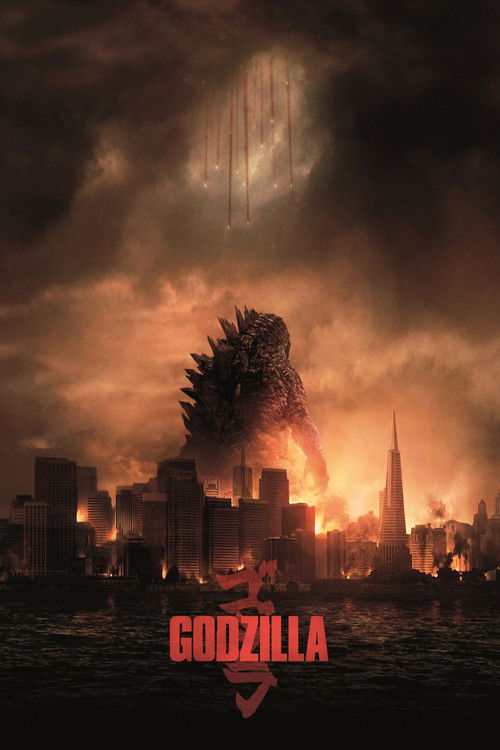
Godzilla
2014 · Gareth Edwards
When you want spectacle with patience — a disaster movie that treats its monster like a force of nature and makes you feel small in the best way. Great for a big-TV night when you want tension, not just noise.
What it's about
A Navy bomb-disposal officer is pulled from his family in San Francisco to Japan, where his obsessive father has spent years chasing the truth behind a disaster that shattered their lives. What they uncover is far bigger than either of them: ancient, colossal creatures rising from the deep, with humanity reduced to bystanders as forces of nature collide. The story tracks ordinary people at ground level while the world tilts around them.
The experience
This is a slow-burn monster movie built on dread and awe rather than nonstop mayhem — it keeps the creature half-glimpsed through smoke, doorways, and news footage until the reveals hit like thunderclaps. You spend most of it holding your breath, and the payoffs feel earned.
Performances
Bryan Cranston brings raw, grief-driven intensity to the father, grounding the early stretch of the film with an emotional urgency the genre rarely bothers with.
The craft
Gareth Edwards shoots the monsters from human eye level — from school buses, train cars, and falling aircraft — which makes the scale genuinely staggering. The famous halo-jump sequence, with its eerie choral score and red flares descending through storm clouds, is one of the great blockbuster images of its decade. Demands the biggest screen and best sound system available.
Why it matters
It relaunched Godzilla for American audiences with real seriousness, kicked off Legendary's MonsterVerse franchise, and became the go-to argument for restraint and withholding in an era of over-exposed CGI spectacle.
Snapshot
Gareth Edwards's Godzilla is a reverent, atmosphere-first reboot of Toho's monster franchise for an American studio, and the film that launched Legendary Pictures' "MonsterVerse." Conceived as a corrective both to Roland Emmerich's reviled 1998 Godzilla and to the disposable spectacle of the contemporary blockbuster, it treats the creature as an awe-inducing natural force glimpsed from human ground level rather than a video-game antagonist surveyed from on high. Its governing strategy is withholding: the monster is teased, obscured by smoke, dust, news chyrons and slamming doors for much of the running time, so that its eventual full reveal lands as catharsis. The film is notable for an unusually serious tone, a foregrounded ecological and nuclear subtext that nods to the 1954 original, and a marketing-defying narrative gambit that kills its apparent star—Bryan Cranston—in the first act. Critically it was received as a handsome, ambitious, atmospherically superb monster movie hobbled by thin human characters; commercially it was a substantial success that anchored a durable shared universe.
Industry & production
Godzilla was a co-production of Legendary Pictures and Warner Bros., released in May 2014, with Toho—the Japanese studio that has owned the character since 1954—licensing the property and retaining approval. The project had a protracted development: Legendary acquired the rights around 2010, and an early treatment by Frankenstein and Pacific Rim writer–director-adjacent talent circulated before the assignment settled. Max Borenstein wrote the screenplay, working from a story credited to Dave Callaham; Drew Pearce and Frank Darabont are widely reported to have contributed uncredited revisions, Darabont reportedly sharpening the military and tonal elements.
The defining industry story is the elevation of Gareth Edwards. Edwards had directed exactly one feature, the micro-budget Monsters (2010), a road movie set in a quarantined zone of giant creatures that he had largely visual-effected himself on a laptop. Legendary's gamble—handing a roughly $160-million tentpole (the figure is widely reported) to a near-novice—was a bet that an effects-literate independent sensibility could restore gravity to a franchise that American studios had handled clumsily. The bet paid off commercially: the film grossed in the region of half a billion dollars worldwide (again, the widely reported figure), enough to greenlight an expanding slate. Its success directly enabled Kong: Skull Island (2017), Godzilla: King of the Monsters (2019) and Godzilla vs. Kong (2021), making Godzilla (2014) the cornerstone of a multi-film, cross-studio franchise architecture modeled loosely on the Marvel template.
Technology
The film sits at the maturity point of photoreal digital creature work. The visual effects—anchored by Moving Picture Company (MPC), with Double Negative contributing—rendered Godzilla and the antagonist MUTOs (Massive Unidentified Terrestrial Organisms) as fully CG entities integrated into largely practical, often nocturnal environments. The production made a deliberate aesthetic of atmosphere as a rendering tool: dust, rain, smoke, ash and low light both sold scale and concealed the cost of sustained full-body monster shots, while echoing the obscuring fog of earlier suitmation cinema. Godzilla's design retained the silhouette and bearing of the Toho original—heavy, upright, almost mammalian in its weariness—rather than the sleeker, iguana-like 1998 redesign, a choice signaling fidelity to the source.
The picture was finished as a digital intermediate and released in 3D (a post-conversion) and large-format/IMAX presentations, formats its scale-driven imagery was built to exploit. Motion-reference and previsualization were central to staging the kaiju combat, but Edwards repeatedly framed that spectacle through human-scale apertures—a key device discussed below.
Technique
Cinematography
Shot by Seamus McGarvey (a two-time Oscar nominee for Atonement and Anna Karenina), the film favors a desaturated, often crepuscular palette and a relentlessly subjective, ground-level eyeline. McGarvey and Edwards repeatedly stage the monsters from the vantage of people: we see a tail through a window, a foot through smoke, the creature's scale registered against a freeway or a falling soldier rather than surveyed in clean wide masters. The most celebrated image—the HALO jump, in which paratroopers trailing red signal flares descend through cloud toward the ruined San Francisco skyline as Godzilla looms below—epitomizes the approach: spectacle filtered through a single falling human point of view. Compositions emphasize verticality and the crushing disproportion between people and creatures; the camera is often low, looking up, denied the establishing omniscience typical of the genre.
Editing
Cut by Bob Ducsay, the film is structured around deferral and interruption. Its signature editorial move is the repeated cut-away at the moment of monster action: a brawl is glimpsed on a child's hotel television, or a door slides shut just as the creatures clash, the payoff withheld for later. This is a disciplined, even teasing rhythm that builds anticipation but also drew the most common criticism—that the film over-rations its own spectacle. The third act finally relaxes the strategy, delivering sustained kaiju combat and the long-promised reveal of Godzilla's atomic breath.
Mise-en-scène / staging
Edwards stages destruction for scale and dread rather than kinetic thrill. Ruined cityscapes, a tsunami sequence in Honolulu, and the ash-choked San Francisco finale are composed as awe-and-aftermath tableaux—closer to disaster-sublime painting than to action choreography. The director's instinct, carried over from Monsters, is to keep the human figure in frame as a unit of measurement, so that environments do the work of conveying size.
Sound
Sound design is foundational to the film's effect. Godzilla's roar—an updated, bone-deep variant of the original's instrument-derived screech—is deployed as a withheld climax in its own right, built across the running time. The sound team modulates between overwhelming low-frequency assault and pointed silences (notably the near-wordless quiet of the HALO descent) to control the audience's nervous system. The MUTOs' echolocating clicks and the rumble of collapsing infrastructure round out a mix engineered for large-format subwoofer presentation.
Performance
The ensemble is deep but unevenly served by the script. Bryan Cranston, as obsessed nuclear engineer Joe Brody, gives the most charged performance and supplies the film's emotional engine—then exits early, a structural shock the marketing concealed. Aaron Taylor-Johnson, inheriting the protagonist role as Navy ordnance officer Ford Brody, is asked to be a stoic point-of-view conduit and is widely judged the film's blandest element, less a failure of acting than of writing. Ken Watanabe, as Dr. Ishiro Serizawa—his name a double homage to original director Ishirō Honda and the original film's Dr. Serizawa—functions as the picture's conscience and exposition, delivering the thematic thesis about restoring natural balance. Elizabeth Olsen, Sally Hawkins, David Strathairn and Juliette Binoche fill out the cast in roles of varying substance.
Narrative & dramatic mode
The film operates in a mode of escalating disaster realism crossed with the awe register of the alien-arrival picture. Its structure is deliberately anti-conventional: it spends a prologue and first act building a human melodrama of grief and obsession (the Brody family and the 1999 Janjira reactor disaster) before pivoting, via Cranston's death, into a globe-spanning monster crisis. The human thread thereafter becomes largely a vector for proximity to the creatures—Ford keeps improbably arriving at each new front—rather than a fully dramatized arc. The dramatic stakes are pitched at the civilizational scale of the disaster film while the emotional stakes stay nominally domestic, a tension the film never fully resolves and that critics identified as its central weakness.
Genre & cycle
Godzilla belongs simultaneously to the kaiju (giant-monster) tradition founded by Toho's 1954 Gojira and to the 2010s cycle of franchise-building "cinematic universe" blockbusters. Within kaiju conventions it restores the daikaiju-as-natural-force conception—Godzilla as an ancient apex predator and a kind of corrective immune response of the planet—over the man-in-suit wrestling spectacle of the Shōwa-era sequels, while still honoring the climactic monster-versus-monster brawl. As a cycle artifact it is a reboot/legacy entry: an attempt to reclaim a property from a discredited prior American adaptation and to seed a shared universe, placing it alongside the era's wave of reverent, tonally serious genre reboots.
Authorship & method
Edwards's authorship is legible in the consistency of method between Monsters and Godzilla: an effects-native director who treats the monster as a withheld, sublime presence experienced from human ground level, and who lets atmosphere and scale carry awe. His stated lineage is Spielbergian—the rationing of the shark in Jaws, the wonder-and-dread of Close Encounters and Jurassic Park—and the film's deferral strategy is a direct application of that grammar.
The key collaborators reinforce the seriousness of intent. Cinematographer Seamus McGarvey brings prestige-drama craft and the desaturated, subjective look. Composer Alexandre Desplat—an Oscar-winning, primarily art-house and prestige composer—supplies a brooding, percussive, brass-heavy score notable for its restraint and dread rather than triumphalism; his presence signals the film's reach for gravity over bombast. Editor Bob Ducsay executes the withholding rhythm. Screenwriter Max Borenstein, working from Dave Callaham's story, foregrounds the nuclear and ecological themes. A distinctive authorial-musical choice is the borrowing of György Ligeti's Requiem for the HALO jump—the same composition Kubrick used in 2001: A Space Odyssey—an explicit invocation of the cosmic sublime.
Movement / national cinema
The film is a hybrid object: an American studio blockbuster engineered around a Japanese cultural property, made under Toho's license and with conspicuous gestures of respect toward the Japanese original (the Janjira/Japan setting, the Honda and Serizawa homages, the retained classic silhouette). It thus sits at the transpacific intersection where Hollywood's globalized franchise economy meets the kaiju genre's specific national origins in postwar Japan. It is not part of any avant-garde or national-cinema movement so much as an instance of Hollywood's 2010s practice of importing and rehabilitating international IP for worldwide release, with the Chinese and global markets explicitly in view.
Era / period
The film is a product of the early-to-mid 2010s tentpole ecosystem: the post-Avatar large-format 3D landscape, the post-Avengers rush to build cinematic universes, and a digital-effects maturity that made sustained photoreal creatures routine. Its sober tone also reflects the lingering influence of Christopher Nolan-era "serious" blockbuster aesthetics on Warner Bros. genre filmmaking. Thematically it carries a contemporary ecological anxiety, and—released in 2011's shadow—has been read in relation to the Fukushima Daiichi nuclear disaster, whose imagery of reactor failure and evacuation the film's Janjira prologue evokes, even as its deeper nuclear lineage runs back to 1954.
Themes
The film's central theme is nature's restoration of balance: Watanabe's Serizawa articulates a conception of Godzilla not as villain but as an ancient equilibrating force that surfaces to cull the parasitic MUTOs and then returns to the sea, with humanity reduced to bystander. Bound up with this is a sustained meditation on human hubris and the nuclear age—Cold War atomic testing reimagined as failed attempts to kill the creature, radiation as both threat and the MUTOs' food source, and the 1954 original's status as a Lucky Dragon 5/Hiroshima-Nagasaki allegory consciously invoked. Secondary themes include grief and inheritance (the Brody father-son line, the literal and figurative legacies passed between generations) and the powerlessness of institutions and the military before forces of a wholly different scale.
Reception, canon & influence
Critical reception. The film was received as a serious, visually commanding monster movie with a notable flaw. Critics widely praised Edwards's atmosphere, the sense of scale, the sound design, and set pieces such as the HALO jump, while just as widely faulting the underwritten human characters—Taylor-Johnson's protagonist in particular—and debated whether the withholding of Godzilla was masterful restraint or frustrating tease. The early dispatch of Cranston's character became a recurring point of contention, seen as a bold subversion by some and a squandering of the cast's strongest player by others.
Influences on the film (backward). The most direct ancestor is Ishirō Honda's 1954 Gojira and its nuclear allegory, which the reboot honors in tone, design and naming. Equally formative is the Spielberg withholding tradition—Jaws, Close Encounters, Jurassic Park—and a Kubrickian reach for the sublime, made explicit by the 2001-derived use of Ligeti. Edwards's own Monsters (2010) is the immediate template for the ground-level, human-scale treatment of giant creatures. The film also defines itself against the negative example of Emmerich's 1998 Godzilla, deliberately reversing its choices.
Legacy (forward). Most consequentially, the film launched Legendary's MonsterVerse, the shared-universe franchise that produced Kong: Skull Island (2017), Godzilla: King of the Monsters (2019), Godzilla vs. Kong (2021) and subsequent entries and television spin-offs. It re-established Godzilla as a viable, prestige-adjacent Hollywood property and validated the strategy of restoring a kaiju to dignified, natural-force status—an approach that arguably influenced Toho's own celebrated Shin Godzilla (2016) climate and the broader 2010s revival of the character. Within Edwards's career it served as the calling card that led directly to Rogue One: A Star Wars Story (2016). Its reputation has remained that of an atmospheric, ambitious franchise-starter whose craft outran its screenplay—admired for what it withheld as much as for what it showed.
A Deleuzian reading
Start with the falling men.
The full Deleuzian reading of Godzilla →
Reception
Landed in 2014 to decent reviews but loud fan grumbling — mostly about how little of Godzilla you actually see. A decade of louder, goofier MonsterVerse sequels later, it's been steadily reappraised as the classiest entry in the franchise, with its slow-burn restraint now cited as a feature, not a bug.
How Godzilla was received, from release to now →
Influences: the films it descends from and the films it influenced
- Gojira (1954) — Establishes the kaiju-as-nuclear-allegory template and the somber, mournful tone — treating the monster as elegiac natural-force rather than spectacle — that Edwards's reboot deliberately restores and honors in naming and design.
- Monsters (2010) — Edwards's own VFX-native blueprint: shooting giant creatures from human ground-level eyeline with the monster mostly off-screen, letting atmosphere and scale generate awe — the exact method he scales up here.
- Jaws (1975) — The foundational withholding-deferral grammar — rationing the creature's full reveal and substituting suggestion (and a low-frequency motif) for sight — which Edwards applies directly as his structuring rhythm.
- Close Encounters of the Third Kind (1977) — Models the awe-and-dread register of slow disclosure and upward-gazing human-figure-as-scale staging, the wonder-tinged sublime Edwards reaches for in his reveal set pieces.
- Jurassic Park (1993) — Demonstrates photoreal CG creatures introduced through deferral and ground-level human reaction shots, the spectacle-economy of teasing before showing that Edwards inherits wholesale.
- 2001: A Space Odyssey (1968) — Source of the cosmic-sublime reach made literal through Ligeti's Requiem — the same composition Edwards borrows for the HALO jump to invoke awe over triumphalism.
- Godzilla (1998) — The negative template Edwards defines against — reversing its fully-exposed, frenetic creature and its disposable spectacle to recover dignity, scale and restraint.
- Psycho (1960) — Precedent for the anti-conventional structure of killing the apparent lead early (Cranston's first-act death) to destabilize audience expectation about who the story protects.
- Godzilla (1954) — Deliberately restores the withheld-monster discipline — reveals staged through TV feeds, dust and the HALO-jump obscurity — and keeps camera height at human eye level so that the creature is always framed by people looking up, reversing three decades of unmotivated aerial coverage.
- Kong: Skull Island (2017) — Second MonsterVerse entry built on Edwards's franchise architecture, extending the natural-force creature dignity and human-figure-as-scale staging into a shared universe.
- Godzilla: King of the Monsters (2019) — Direct sequel inheriting the desaturated-crepuscular palette and disaster-sublime tableaux, though it abandons Edwards's withholding for fuller monster exposure.
- Godzilla vs. Kong (2021) — Later MonsterVerse film continuing the photoreal-CG creature lineage and shared-universe reboot strategy that Edwards's 2014 film initiated.
- Rogue One: A Star Wars Story (2016) — Edwards carries forward his ground-level human-figure-as-scale staging and desaturated, atmosphere-heavy rendering of vast machines and battles into the Star Wars universe.
- Jurassic World Rebirth (2025) — Edwards's signature ground-level reveal that withholds the full creature and frames it through human-scale foreground — awe generated by restraint rather than saturation — is the directorial method he carries into Rebirth.
- War of the Worlds (2005) — Shares the disaster-sublime tableaux rendered strictly from a powerless human ground-level POV, with desaturated atmosphere and the figure dwarfed by catastrophe.
- Cloverfield (2008) — Parallel commitment to street-level, human-scale kaiju experience and withheld full-monster reveals, privileging on-the-ground terror over god's-eye spectacle.
- Pacific Rim (2013) — Contemporary kaiju revival using atmosphere-as-rendering — rain, fog and low light to lend photoreal giants weight and scale — though tonally maximalist against Edwards's restraint.
- Shin Godzilla (2016) — Toho's own revival restoring Godzilla to terrifying natural-force/nuclear-allegory status within the same 2010s reclamation Edwards validated, via withheld escalation and atmospheric dread.
- Jurassic World (2015) — Shares the withhold-the-monster discipline and human-scale-foreground lensing of a giant creature, plus seismic sub-bass roar design from the same low-frequency creature-vocabulary toolkit.
- Pacific Rim: Uprising (2018) — The contemporary kaiju revival that re-grounds Toho-scale monsters via human-eye-level scale cues; a parallel modernization of the same Godzilla lineage Uprising openly invokes.
Similar films
- Godzilla: King of the Monsters (2019) — influence & lineage
- Shin Godzilla (2016) — influence & lineage
- Pacific Rim (2013) — influence & lineage
- Godzilla (1998) — influence & lineage
- Cloverfield (2008) — influence & lineage
- War of the Worlds (2005) — influence & lineage
- Godzilla (1954) — shared sensibility
- Godzilla Minus One (2023) — shared sensibility